This qualitative study aims to expand the limited theoretical understanding of career regret by exploring its development and the key factors that contribute to it. Our theoretical model illustrates how career regret unfolds and highlights the interplay between these identified factors.
We conducted 27 semi-structured interviews followed by 16 retrospective narratives with professionals. The data were analyzed using the established procedures of grounded theory.
Our findings reveal that regret develops as a result of the behavioral response to a realized loss stemming from a career-related decision. Precisely, career regret develops when an individual responds to a realized loss with career inaction, which is shaped by two identified mechanisms: a feeling of low career agency and a feeling of being trapped. Based on these findings, we developed a theoretical model showing how a career decision becomes a career regret.
Despite its importance for research and practice, knowledge concerning career regret remains limited. While some studies aim to explore career regret as a phenomenon in a certain context or its relationship to other concepts, the career field lacks important theoretical insights into the nature of career regret, which we address with our study. We show how a career decision becomes a regret. In so doing, our research has important theoretical and practical implications.
Introduction
Almost every person knows the strong emotion of regret, the bitter rumination of what might have been. Among a myriad of decisions and choices [1] throughout the course of one’s life, career-related choices stand out as particularly consequential, shaping professional trajectories, financial stability and overall well-being (e.g. Gati and Tal, 2008). Indeed, research has shown that career and educational decisions evoke some of the strongest regrets individuals experience (Roese and Summerville, 2005), underscoring the profound emotional and psychological weight these choices carry. Importantly, career decisions extend beyond initial occupational selection to encompass a broad array of pivotal moments, including job transitions, promotions and salary negotiations (Gati and Kulcsár, 2021). Given their high stakes and long-term consequences, career decisions are inherently complex and prone to doubt (e.g. Argyropoulou et al., 2007; Gati and Tal, 2008; Verbruggen et al., 2015).
Despite the centrality of regret in decision-making processes (e.g. Connolly and Zeelenberg, 2002) and its extensive study in psychology and behavioral economics (e.g. Bell, 1982; Reynolds et al., 2006), career studies have yet to comprehensively examine the role of regret (e.g. Byington et al., 2019; Sullivan et al., 2007). Zeelenberg and Pieters (2007, p. 3) define regret as “the emotion that we experience when realizing or imagining that our current situation would have been better if only we had decided differently”. Consistent with this definition, we conceptualize career regret as a sustained feeling of distress regarding a past career-related decision.
While prior research has primarily focused on occupational choice regret (e.g. Budjanovcanin et al., 2019; Budjanovcanin and Woodrow, 2022), the broader landscape of career regret remains underexplored. Some studies have examined career regret among laid-off individuals (Sullivan et al., 2007), within entrepreneurial contexts (Ephrem and Murimbika, 2023), in relation to strategies for mitigating it (Schulze Schleithoff et al., 2025), and as a consequence of career inaction (e.g. D’Huyvetter et al., 2025; Verbruggen and De Vos, 2020). However, these contributions remain rather specific and fragmented, lacking a cohesive theoretical foundation that explains how career regret develops and what factors contribute to its persistence.
What is more, the absence of a robust theoretical foundation and conceptual clarity regarding career regret represents a significant problem in the literature, limiting our ability to fully understand its antecedents, mechanisms and consequences. Without such insights, career research risks overlooking a critical emotional dimension that influences both individual decision-making and long-term career trajectories. Thus, this study addresses a pressing knowledge shortage by systematically investigating the nature and development of career regret, contributing to a more comprehensive understanding of this phenomenon.
Hence, this study adopts a processual approach, drawing on qualitative data from 43 professionals to answer the following research question:
How does a career decision become a career regret?
Additionally, we answer the following three sub-questions:
How does career-related regret evolve?
What are the factors that contribute to career regret development?
What is the role of action and inaction for the experience of career-related regret?
Based on our findings, we develop a theoretical model illustrating the evolution of career regret and the factors that contribute to its emergence.
With our research, we make several important contributions to the literature on career regrets. We extend existing work on occupational choice regret (e.g. Budjanovcanin et al., 2019) and regret in specific career contexts (e.g. laid-off individuals, Sullivan et al., 2007). We highlight the necessity of a temporal and long-term perspective in studying career regret. By proposing a theoretical model of career regret development, we explain the mechanisms underlying its formation over time. Additionally, we contribute to the literature on career inaction by empirically demonstrating how career inaction leads to career regret, a relationship previously suggested by scholars (e.g. Verbruggen and De Vos, 2020).
Theoretical background
This section provides an overview of the literature on regret more broadly (e.g. George and Dane, 2016; Zeelenberg and Pieters, 2007) as well as the emerging research on career regret specifically (e.g. Sullivan et al., 2007). We also discuss factors that contribute to regret and the role of action versus inaction (e.g. Gilovich and Medvec, 1994; Schulze Schleithoff et al., 2025; Verbruggen and De Vos, 2020). In doing so, we aim to underscore the current limitations of this body of work and the need for further research. Importantly, this literature was consulted retrospectively and in line with our inductive study design, rather than serving as a priori guidance.
Regret in careers
Although regret has received considerable attention from researchers belonging to diverse fields, limited research exists on regret in terms of careers. A career can be defined as “the unfolding sequence of a person’s work experiences over time” (Arthur et al., 1989, p. 178). Given the multitude of opportunities and the long-term consequences of career decisions, careers offer various possibilities for regret. George and Dane (2016) inspected the role of regret in decision-making, reviewing the influence of emotions, moods and further moderators in the decision-making process of individuals. A variety of decisions made by individuals in the workplace and beyond is influenced by recollections of prior emotional experiences and influences of expected future emotions. Individuals may face tremendous difficulties when making career decisions (Gati and Kulcsár, 2021), and the stress and pressure that such decisions evoke may stem from the individual’s desire to avoid regret (Argyropoulou et al., 2007).
Yet, career decisions are often not directly considered causes for regret. This is because external factors and information that were not available at the time when the decision was made have an impact on the outcome and how the initial decision is viewed in hindsight (Katz, 1979; Pitz and Harren, 1980). Thus, time is a factor that may contribute to reevaluating career decisions and experiencing regret (e.g. Sanna et al., 2003). Although nascent, some prior research investigated regret in terms of careers. Sullivan et al. (2007) made important contributions to the literature on career regret. Specifically, the authors quantitatively assessed two categories of career regret from a sample of professionals who had been laid off. One category of regret concerned not engaging in political behavior within organizations, particularly neglecting networking that could have enhanced career advancement and related extrinsic outcomes, whereas another category of regret related to the non-pursuit of alternative career paths, such as prioritizing work-life balance and family.
Nevertheless, Sullivan et al. (2007) investigated a specific sample of individuals, which does not allow for drawing broader conclusions. In contrast, our study targets understanding the development of career regret of individuals who were, at the point of data collection, in an (objectively) successful career. In addition, a study by Budjanovcanin et al. (2019) discovered that social comparison and social influence are important antecedents of occupational choice regret. These determinants are associated with lower affective occupational commitment and higher intention to quit the profession – albeit cross-sectionally.
Although these prior studies make important theoretical contributions to the literature on occupational choice regret and regret of laid-off individuals, we still know little about career-related regret throughout the entire career path. Particularly, we lack important insights into the mechanisms that trigger career regret development and help to understand why certain career decisions develop into regret while others do not and are viewed from a positive perspective (e.g. Kutscher and Mayrhofer, 2023; Schulze Schleithoff et al., 2025).
Factors contributing to regret: the role of inaction and action
Time matters in shaping the efficacy of psychological processes that decrease the pain of regret after a considerable time lag (Gilovich and Medvec, 1995). Prior scholars argue that taking action causes more regret in the short term, whereas in the long run, omission (not acting) intensifies regret (Morrison and Roese, 2011). However, this pattern is likely to differ in the context of careers. Specifically, what prior research refers to as “short-term regret” following action may be more accurately understood as transitional career difficulty rather than regret per se (Schulze Schleithoff et al., 2025). While there are mechanisms that can ease the discomfort associated with taking action, these mechanisms are largely unavailable following inaction, as there is no concrete action on which individuals can ground their reflections. As a result, missed opportunities may remain salient and contribute to enduring regret (Gilovich and Medvec, 1994). Below, we review research and theories on inaction (e.g. Verbruggen and De Vos, 2020) and action (e.g. Schulze Schleithoff et al., 2025) in the context of careers, as well as broader regret literature (e.g. Gilovich and Medvec, 1994).
Career inaction is defined as “the failure to act sufficiently over some period of time on a desire to make a change in one’s career” (Verbruggen and De Vos, 2020, p. 378). The three characteristics of career inaction are (1) the wish to change the career, (2) acknowledging the ability to facilitate the desired change but not doing so sufficiently and (3) the situation continues over a period of time. Verbruggen and De Vos (2020) have emphasized the role of inaction for the process of regret development; however, precisely how this unfolds is still unknown and yet not empirically shown, since their work is conceptual.
Prior research suggests that because individuals experience greater regret following action in the short term, they are expected to engage in “psychological work” to reduce dissonance (Gilovich and Medvec, 1994, p. 362). Dissonance reduction functions to reinforce the attractiveness of a choice (Festinger, 1962). In other words, individuals aim to reduce inconsistency between their beliefs and actions. Thus, the overarching goal of reducing action-triggered regret leads individuals to engage in behaviors consistent with dissonance reduction, reinforcing the choice made. In contrast, inaction makes it harder to engage in this process in a timely manner, which may contribute to enduring regret (Gilovich and Medvec, 1994). Additionally, individuals have counterfactual thoughts about the life (and career) they could have had if they had made different choices in the past (Zeelenberg et al., 1998). Prompted by these counterfactual thoughts, individuals create a narrative of a different reality in which they imagine themselves in forgone professional identities (Obodaru, 2017) and compare their current selves to alternative and possible selves (Obodaru, 2012). Notably, alternative selves are identity counterfactuals that are integrated into the self-concept. These self-comparisons can be improved or worsened versions of reality (Obodaru, 2012). Although inaction may initially allow individuals to imagine idealized alternative selves unconstrained by factual experience, this lack of grounding may lead to unintended consequences. That is, over time, it enables increasingly favorable counterfactuals, which can intensify and prolong regret (Gilovich and Medvec, 1994). Verbruggen and De Vos (2020) suggest that when individuals fail to act on a desired career change, their initial pre-factual thoughts (e.g. imagining future possibilities) can evolve into counterfactual thoughts about what might have occurred had they acted. These upward counterfactuals (Roese, 1994) can intensify feelings of regret, as they focus attention on missed opportunities and unpursued career paths.
Overall, this suggests that action in careers, particularly when accompanied by repair (Schulze Schleithoff et al., 2025) or sensemaking (Kutscher and Mayrhofer, 2023), may prevent the development of lasting regret rather than cause it. Indeed, recent research on regret in careers found that repair, defined as “proactively fixing what was not working or was negatively impacting their career by using different strategies” (Schulze Schleithoff et al., 2025, p. 21), can help individuals to transform difficulties in careers into a sense of embracing instead of regretting. Thus, engaging in repair strategies can prevent regret from developing (Schulze Schleithoff et al., 2025). This is further supported by Kutscher and Mayrhofer (2023), who found that apprentices who engaged in enacted sensemaking by actively reflecting on and interpreting setbacks were more likely to develop growth-oriented aspirations and expectations. Lastly, in a qualitative study, Budjanovcanin and Woodrow (2022) identified strategies for dealing with occupational choice regret. They further developed a model suggesting that occupational choice regret is episodic and unfolds differently depending on the coping strategies individuals employ, leading to distinct regret profiles. These findings highlight variation in how individuals experience occupational choice regret and cope with it once it has occurred.
In sum, great endeavors toward studying regret in a broader sense are evident (e.g. Gilovich and Medvec, 1995; Zeelenberg and Pieters, 2007; Zeelenberg et al., 1998). However, these findings may not directly translate to career-related regret, given the extended time horizon inherent in careers (cf. Arthur et al., 1989). Moreover, despite some important contributions to occupational choice regret (e.g. Budjanovcanin et al., 2019; Budjanovcanin and Woodrow, 2022) as well as insights into how regret in careers can be mitigated (e.g. Schulze Schleithoff et al., 2025), still, little theoretical knowledge exists on how career regret develops in the first place, and which factors are responsible for its development.
Methodology
Procedure, sampling and data collection
This study aimed to contribute to the limited theoretical knowledge on career regret development. Therefore, a qualitative study design (Creswell, 2013) suits best the nascent state of the prior theory (Edmondson and McManus, 2007). To develop a model and guide future research, this study was designed with a grounded theory approach (Gioia et al., 2013; Strauss and Corbin, 1998). This approach helped us to explore the multifaceted process (Lee et al., 1999) of how a career decision becomes a career regret. Moreover, since our chosen definition of careers describes an accumulation of experiences that develop over time (Arthur et al., 1989) and our research question implies an unfolding over time, we took a processual approach in our research, because it aims to enhance understanding of how career regret as a phenomenon evolves (Cloutier and Langley, 2020; Langley, 1999). In so doing, we aligned with our grounded theory design as we compared small units of our gathered qualitative data to construct a framework of “categories” that described the phenomenon (Langley, 1999). However, our focus was not on capturing time itself, but rather on exploring the development of the phenomenon of career regret in relation to its contributing factors.
This qualitative research was conducted on two samples of working professionals who were pursuing further education at the time of data collection. Following purposive sampling (Patton, 1990), we approached managers who were enrolled in a part-time Ph.D. or an executive MBA (henceforth EMBA) program, each group drawn from a single, bounded program at separate European business schools, and participation based on voluntary self-selection following an invitation to take part in the study. These participants were selected because working professionals who pursue educational programs alongside their jobs are likely to have engaged in prior reflection and sensemaking regarding their career trajectories (De Déa Roglio and Light, 2009; Warhurst, 2011). Specifically, executive education often signals a deliberate assessment of past career decisions, actions and situations. Prior research on action and inaction suggests that individuals may seek further education to redirect their career paths, either as a response to occupational choice regret (e.g. Budjanovcanin and Woodrow, 2022) or to prevent potential regret (e.g. Schulze Schleithoff et al., 2025). Thus, we expected this sample to provide rich insights, enabling us to compare cases (regret vs. non-regret) and identify the underlying factors shaping these experiences. In addition, we assumed that working professionals who take deliberate steps, such as participating in executive education, may have constructed an imagination of their possible “better” selves (e.g. Markus and Nurius, 1986; Obodaru, 2012) in relation to their current selves. We considered this sample particularly insightful because it allowed us to explore participants’ expectations regarding their developmental programs and to examine how they compare their current situation with their desired future selves (e.g. Petriglieri et al., 2018). To conclude, we aimed to generate knowledge about potential regretful thoughts, the actions taken in response and the role these processes play in shaping career decisions. In total, we sampled 43 professionals (N = 43), representing a sample of 27 men and 16 women, with an average age of 43 years, and various years of work experience. An overview of their demographics, as well as the education they pursue, is presented in Table 1.
To understand how career regret develops and the factors contributing to it, we needed rich and in-depth narrative data about events, reflections and decisions over time. Accordingly, we collected qualitative data from 27 professionals pursuing a part-time Ph.D., utilizing semi-structured interviews and subsequent personal retrospective narratives of 16 professionals pursuing an EMBA. We purposefully chose this sequential approach as it allowed us to get an overall understanding of the phenomenon of career regret. Utilizing semi-structured interviews collected from 27 professionals pursuing a Ph.D. helped us to learn from our participants’ insights and compare their experiences. Building upon this by collecting retrospective narratives from 16 professionals pursuing an EMBA helped us to further understand these findings and capture the process of career regret development. We started our research by collecting qualitative data through semi-structured interviews. We used an interview protocol with open-ended questions about our topic of interest (Hermanowicz, 2002; Rapley, 2001), as well as elements of a narrative study approach (e.g. Riessman, 2008). More specifically, our questions covered the following themes. We began by asking participants to narrate their career stories, with a focus on past decisions, their current reflections on these decisions and how their careers had developed since then. In particular, we asked about difficult choices and the advice they would give to their younger selves. We also explored participants’ feelings and behaviors related to these career decisions. Additionally, we incorporated three time-orientation perspectives (past, present, future) to gain deeper insight into how participants reflect on prior career decisions and consider potential changes to their current circumstances. This technique allowed us to learn from our informants’ insights and to understand their lived experiences concerning certain episodes in their careers. Additionally, the process helped our informants to reflect on their career paths and their career decisions. In so doing, it enabled us to investigate career regret development in more depth and to capture it as a phenomenon that develops over time. The interview protocol is provided in Appendix.
As aforementioned, we built our conceptualization on the definition provided by Zeelenberg and Pieters (2007, p. 3), being “an unpleasant feeling, coupled with a clear sense of self-blame concerning its causes and strong wishes to undo the current situation”. Based on this, as well as the self-expressions of our participants (e.g. “having regret about …” or “regretting …”), out of 27 professionals pursuing a part-time Ph.D., 16 reported experiencing career regret. This allowed us to uncover the factors that led to these informants experiencing regret. The data were collected by the first author in spring 2021, fall 2022 and spring 2023, via the online platform Zoom. Interviews were conducted in English and German, with a time duration of 45–60 min. The participants signed a consent form beforehand. All interviews were recorded and transcribed, and the German interviews were translated by the first author. To ensure the data’s robustness, we asked the informants to confirm if our findings were consistent with their experiences.
Thereafter, to gain more insight into the factors contributing to regret development and to explore how career regret differs from other outcomes, we collected further data utilizing personal retrospective narratives. Retrospective studies have proven reliable for investigating processes over time (Langley, 1999), such as life regret (e.g. Hattiangadi et al., 1995), and have been recommended by prior scholars (Verbruggen and De Vos, 2020). This time, we asked our participants more explicitly to reflect on regrets about a career moment or decision to get a long-term perspective and an in-depth understanding. These narratives aimed to shed light on career regret development. As illustrated by the examples below, this data collection strategy effectively captures the development of regret over time: “In the course of time …”, “At the time, I did not regret it either. That came later”.
To ensure rigor and not “force” our informants to provide answers, we further gave them the opportunity to share their non-regret stories. Of 16 EMBA participants, 14 reported regret over their career decisions. The data were collected in fall 2022 by the fourth author. All participants signed a consent form. We informed the participants about our research beforehand and ensured that participation was entirely voluntary.
Overall, 69.8% of participants reported career-related regret. We subsequently analyzed these data, comparing those who experienced regret with those who did not.
Data analysis
We followed established grounded theory analysis techniques in the data analysis for both sets of qualitative data (Gioia et al., 2013; Strauss and Corbin, 1998). Data analysis was performed by the first author, with ongoing input from the other authors to enhance rigor and balance out preconceptions and misinterpretations inherent to the interpretative nature of the research. More specifically, co-authors contributed to the data analysis through continuous comparison of early interviews, cross-checking of emerging codes and iterative discussions about code interpretation and categorization throughout the axial coding process. These discussions served to challenge interpretations, refine coding decisions and ensure analytical rigor. In addition, the authors jointly agreed on clear criteria for identifying the presence or absence of career regret, based on our conceptual definition of career regret outlined earlier. Participants were categorized as experiencing career regret only when their narratives reflected key defining characteristics of regret as well as expressions of regret, allowing us to systematically distinguish between individuals with and without career regret. The software ATLAS.ti was used for data analysis.
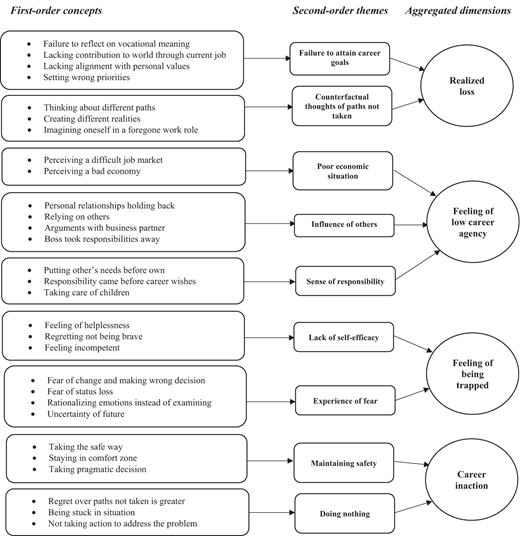
We started by open-coding our data with “in vivo” codes (Gioia et al., 2013), which helped us to stay as close as possible to our participants’ own words and terms. We remained very broad in this first step to ensure that we captured the phenomenon from all sides. This first round led to the creation of 835 first-order codes. We then continued, based on our conceptualization of career regret, which we outlined in the introduction, to distinguish between participants who explicitly stated having regret and those who stated not experiencing regret about their “mistakes” and “failures”. This was a starting point for us to further compare career regret with other experiences and get an initial notion of which factors (e.g. “scared”, “feeling responsible”, “helpless”) contribute to its development. We then searched for particular themes and categories concerning our research question and searched for differences and commonalities between the participants’ descriptions. For instance, we examined how informants who experienced regret narrated their feelings about their initial career decision. Similar codes were defined and categorized into first-order concepts, providing insights into our informants’ experiences and how they described factors leading to regrets, such as contextual factors (e.g. financial insecurity, feeling influenced). Those statements that did not fit the discovered categories were identified and sorted into the most fitting group or removed if they were not common across cases. This process yielded 333 codes.
Subsequently, we shifted the open coding to axial coding (Strauss and Corbin, 1998). This step aimed to find commonalities between the categories grounded in the participants’ words and statements with theoretical concepts to sort them into theoretical categories. The codes were analyzed once again and accumulated under topics. Specifically, common statements were accumulated into more theoretical categories, aiming to answer the research question. These statements were reviewed once again to ensure that they belonged in the right category. The data revealed that some individuals expressed frustration or disappointment with the outcomes of their career choices, for example due to a misalignment with their personal values, or by generating counterfactual thoughts about alternative career trajectories (Roese, 1994; Zeelenberg et al., 1998). We further decided to divide between emotions that shaped individuals’ reasoning (e.g. lack of confidence) and external factors (e.g. economy) shaping individuals’ experiences, as we realized that they are distinct from one another. We identified that a key difference between regretful informants and those with non-regret lies in how they view the irreversibility of their prior choices. Specifically, we saw that “regretters” felt unable to do something about the dissatisfying situation. Thus, we went back to our transcripts and coded once again paying attention to how informants described their passiveness and the factors which shaped this. In particular, participants who experienced regret highlighted that they felt “unable”, “stuck” or were “afraid” of changing something. During this analysis step, we moved back and forth between our emerging findings and existing literature to help us define the theoretical insights developing from the data (Gioia et al., 2013). After a brainstorming session with the research team, we decided to draw on the ideas of the career inaction literature (e.g. Verbruggen and De Vos, 2020) as we found it useful in understanding our informants’ behavior. Verbruggen and De Vos (2020) proposed in their conceptual work that career inaction is a key driver of regret. Yet this proposition has received only little empirical investigation to date. Furthermore, existing literature offers limited insight into the antecedents that lead individuals to remain inactive. By the end of this step, the first-order concepts were clustered into nine second-order themes that describe factors contributing to the development of career regret.
We accumulated these second-order categories into four overarching theoretical dimensions that served as a basis for the theory development. Our coding helped us to identify a set of commonalities and thereby explore factors that lead to the development of career regret. The outcome of the analytical process is depicted in the data structure (see Figure 1) (Gioia et al., 2013). The data’s recurring themes and concepts were selected and coded. The theoretical dimensions became the basis of our findings and helped us develop our theoretical model to answer the research question.
Findings
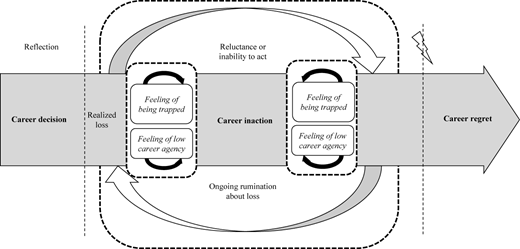
Our data analysis reveals that career regret is not determined by the characteristics of the initial career-related decision (i.e. freely chosen or externally influenced). Instead, we discovered that career regret develops when a person responds with career inaction to a realized loss resulting from a career decision. We further discovered that career inaction is shaped by two identified mechanisms, namely a feeling of low career agency as a cognitive mechanism and a feeling of being trapped as an affective mechanism. Based on our data analysis and inductive approach, we developed a model that shows how a career decision becomes a career regret (see Figure 2), which we present at this point to enhance understanding of this section, in which we discuss each of the identified factors and their interrelationships in detail.
On the left side, the model begins with the initial career choice. The arrow points from left to right, with career regret depicted on the right. The model illustrates how regret evolves: when there is a disparity between an individual’s expectations and the actual outcome, the decision results in a realized loss. Importantly, a realized loss does not automatically lead to career regret. What matters is whether the individual acts upon this realized loss. Career regret occurs when a person does not or fails to take action in response to a realized loss caused by their career decision, resulting in career inaction. The model emphasizes two mechanisms that contribute to career inaction: the feeling of low career agency and the feeling of being trapped. For example, an individual who recognizes that their chosen industry was not the right fit but remains in that field may experience regret over time, as illustrated in our informants’ narratives. This pattern is particularly pronounced among individuals with low career agency and a strong sense of feeling trapped. Individuals may become caught in a loop, repeatedly reflecting on the realized loss while remaining inactive, as depicted in the model. Over time, the initial career decision may solidify into a persistent negative emotion, which we label chronic career regret. We will now present and explain each of these factors individually, referring to respective informants. Additional quotes for each second-order theme are provided in Table 2.
Realized loss
Some participants reflected on their initial career decision and realized a loss. Specifically, they acknowledge having failed to attain their career goals and having counterfactual thoughts about paths not taken. Failure to attain career goals refers to the consequence of an individual’s unsuccessful search for purpose and fulfillment throughout their career, as well as a mismatch between their personal expectations and reality (e.g. realizing that a high salary does not ultimately lead to satisfaction). Counterfactual thoughts about paths not taken are the outcome of comparisons between reality and possible imagined alternatives. As these notions have no realistic basis, individuals tend to imagine their fictional world in a more pleasant way than the present reality. In the following section, we will elaborate in detail on both and emphasize in which way they lead to the experience of career regret.
Failure to attain career goals
Some individuals stated that they had not thought about what their career means to them. The realized loss resulted from a misalignment between their personal values and career or a lack of self-awareness which led to neglected identification of one’s vocational meaning: “It doesn’t fulfill me, there’s something larger in life that is waiting to be discovered” (I.18), or both. Another way that this factor was presented in the data was seen in individuals who recognized negative emotions associated with their missing contribution to society. For example, an informant noted that if he were given the chance to pursue a career with more impact, he would not hesitate to seize it.
I don’t know if, two years from now, I got an amazing opportunity to have a lot of impact on the world, would I remain loyal to my organization? Well, I think I would go for the high-impact role, to be honest, because at that point it would mean more impact for me as a person in the world. I can achieve a bigger contribution. So, why would I not want that?! (I.2)
Moreover, individuals experience a realized loss when they follow misaligned priorities during career decision-making. This misprioritization can be influenced by an individual’s social context, which may dictate certain expectations, but also by individuals themselves, for example prioritizing money and status over meaningfulness: “It makes me feel like a prostitute […] you sell yourself, just for a financial gain, but you’re not really being true and honest to yourself, it’s just purely selling yourself for something that is not meaningful (I.18)”. We saw various cases in which individuals described a mismatch between their career expectations and reality, caused by, for instance, entrepreneurial failure (e.g. I.3, I.25, I.29), a mischosen industry (e.g. I.7, who dreamed of the “sexier” automotive industry and I.39) or organizational transition (e.g. I.21 and I.37 faced problematic work cultures in their teams). The failure to attain one’s career goals subsequently leads to counterfactual thinking.
Counterfactual thoughts of paths not taken
Several informants described dissatisfaction concerning their current situation and that they dreamed of an alternative that was more attractive and desirable to them. These thoughts were not only tied to an occupational choice but also to the subsequent career path. Some interviewees referred to possible work roles they were not enacting at the time of the interview, such as being an architect, a journalist or an engineer: “Maybe I would have advised myself to try architecture school just very early on because that’s something that keeps popping up, like a regret” (I.10). Other alternative narratives centered on the respondents’ industry, organization, work culture and many other facets of their work lives.
In all these narratives, individuals create alternative selves in these different realities. Notably, the creation of these alternative selves is only related to a better version of the self (Obodaru, 2012). Consequently, individuals believe that their current situation would be better if they had made a different decision in the past. For example, Informant 1 regrets not having published more, a shortcoming she believes has hampered her entry into academia.
I think the thing that I am disappointed in is academia. Because it’s not very easy to get in. I think that universities are measured on publications rather than the value that people bring and what we’re supposed to share with the students, because I think there are not enough people […] And for me to get into that world […] if I want to do it I have to sacrifice too much, probably in order to be able to offer that. Or you know, I measured on publications as to whether I’m eligible to do that, I think that’s a problem. I’m disappointed with that, having known that I probably should have perhaps … published more. (I.1)
Informant 32 shared his career story in which he decided against a path in academia which he believes would have been more satisfying than his current career: “Now looking back at it, from time to time I regret that decision because I’d have been able to stay in a field I liked, highly growing, and where my profile of technical manager would have flourished greatly (I.32)”.
The feeling of low career agency and the feeling of being trapped
Realizing a loss in one’s career triggers sadness and disappointment, but not yet the prevailing emotion of regret with the wish to undo it. Specifically, we found that individuals remain inactive after realizing a loss depends on two mechanisms, namely the feeling of low career agency as a cognitive mechanism and the intensity of the feeling of being trapped as an affective mechanism. Specifically, career regret occurs when individuals remain inactive after experiencing a loss, a situation worsened by low personal career agency and a sense of being trapped. The feeling of low career agency is the result of external factors such as a poor economic situation, the influence of others and a sense of responsibility. The feeling of being trapped is triggered by an individual’s lack of self-efficacy and experience of fear. Both mechanisms interact and determine the way an individual responds to the realized loss. In the following section, we elaborate on them in detail.
Feeling of low career agency
The feeling of low agency over career-oriented behavioral responses affects career regret development. Specifically, when individuals feel unable to respond to their realized loss, they subsequently experience career regret. We discovered various reasons why one may experience low career agency. First, a poor economic situation with fewer opportunities compels the individual to stick to a career choice that is not entirely aligned with their values or desires. For example, a competitive job market leads the individual to stay in an easily attainable job rather than pursuing a job that provides them with meaningfulness, as, for instance, in the case of Informant 18 or 20. Informant 10 noted that the poor economy prevented her from correcting her career decision to not pursue her dream. In highly competitive and in-demand fields, individuals often experience reduced career agency, as highlighted by Informant 32. Second, the influence of others can lower one’s feeling of career agency. Specifically, individuals described the influence of family, supervisors, colleagues and partners as crucial factors shaping their feelings of career agency. As Informant 14 explains, she felt dependent on her colleagues: “I think I should have made my own decisions […] instead of depending on others” (I.14), which made her unable to act on her realized loss. Some individuals were not even able to actively make a career decision; others made the decision for them, as in the case of Informants 21 and 22, and these individuals later experienced regret because they remained inactive at the time. This further reinforces our initial finding that career regret differs from regret in other domains: it is not necessarily determined by whether the original decision was freely made or externally imposed. Instead, it is shaped by how individuals later respond to the realized loss. This is illustrated by the example of Informant 39, who continues to regret not having acted against this unfair treatment.
I was able to impress the interviewers with my technical expertise and was amongst the final five chosen for the HR interview. In the HR interview, I was denied the job [because of] my small physique (I would not be able to command the shopfloor workers as they wouldn’t take me seriously as their supervisor / line manager due to my small physique and statue) as a reason. I felt completely let down by the system and regretted […] [my] physique which was cited as a reason for me not getting the job in one of the biggest automotive companies in [country]. (I.36)
Third, an individual’s sense of responsibility, such as taking care of family or needing to earn money, influences their feeling of career agency. Many male informants explained experiencing low agency for their career as they had to take care for their families.
I think men are … I think they they feel more responsible for earning money […] I mean, every family is different, but I think in our family, he still thinks he’s more responsible and doesn’t dare to go as far as I do with leaving and really altering my career. It’s always about money, I think, the real career choices. I think they are always related to financial and status issues. (I.5)
Notably, also many women felt responsible for their families, as I.18, I.15 and I.10 underlined. We saw that individuals who end up with career regret believed that they were not able to escape the situation after they realized a loss and experienced low career agency.
Feeling of being trapped
The data also showed that the emotional experience of feeling trapped shaped participants’ inaction towards their realized loss and was crucial in the emergence of career regret. Specifically, when they experienced low self-efficacy or fear concerning their career situation, regret was likely to develop. When participants were asked about their feelings after they realized that a choice had led to a loss, those with regret described a feeling of helplessness and incompetence, which impacted them. Consequently, they regretted both their initial choice and their lack of courage to act. In many cases, the individual felt unable to escape the dissatisfying situation, as the following informant describes: “Looking back to the situation, I am convinced that I should have decided to shut down the company one year earlier. […] But I did not, I lacked self-efficacy, felt stuck and unable to make a tough decision” (I.29). In contrast, some individuals eventually managed to break free from the feeling of being trapped. In retrospect, they recognized that taking action earlier would have been beneficial, as it contributed to building their self-efficacy. This example further highlights that the identified mechanisms not only explain why individuals remain inactive but also show how acting upon a realized loss can foster self-efficacy over time.
What I have learned from finally stepping out of the organization is that I should have done this much earlier. It would have broadened my horizons, my skills, and my self-efficacy sooner in my career. I assumed self-efficacy would be needed to make a change. Instead, it’s change that builds self-efficacy. (I.33)
The feeling of being trapped could also be seen in the responses of individuals who experienced fear. This experience of fear arose from a variety of sources, for instance, not being ready for a particular position, being scared to lose a certain status or a fear of change in general in terms of daily life situations: “I didn’t have the guts to go and live and work abroad. So, there were a few opportunities at the beginning of my career to go to the US, and I said ‘no’ because I thought: maybe I’m gonna [going to] be lonely there (I.7)”.
Interestingly, although most individuals were aware of their realized loss early on, they were unable to change their situation as they were bound by fear. This emotion held them back and made them unable to implement change. We saw that the feeling of low career agency and the feeling of being trapped are mechanisms that shape a person’s career inaction. Those individuals who did not feel in control and felt trapped failed to act upon their dissatisfying situation. Eventually, the career regret became a loop that reinforced the reflection of the realized loss, leading to a constant feeling of remorse: “Even though I made career progress within the law firm, I regret not leaving my first organization sooner, just out of fear and of lack of self-efficacy (I.30)”.
Below, we will outline how career inaction eventually led to the experience of career regret.
Career inaction
The data revealed that career inaction supported the development of a realized loss into a career regret, which has already been proposed by prior scholars (c.f., Verbruggen and De Vos, 2020). We saw in the data that career inaction is composed of maintaining safety and doing nothing. Maintaining safety instead of pursuing a new opportunity results from an individual’s preference to stay in their comfort zone. For instance, individuals may reflect on a decision not to become an expatriate in the USA and, despite recognizing it as a loss, refrain from taking action to change the situation (e.g. I.7, I. 15). Informant 9 shared a story in which he stayed for too long in a role that did not challenge him anymore: “I did that for too long. I was stuck in this world [referring to his role] for too long. I think about it now, the thing that I regret is maybe that I worked there the first five years of my career (I.9)”. Although he had changed positions at the time of the interview, his regret remained as he was stuck in the loop of realizing his loss and staying inactive for too long. Since this behavior cannot be corrected, individuals regret their omission. Similarly, Informant 29 described being paralyzed by ongoing disagreements on a project and an overall fear of failure. He eventually regretted this decision.
Because of that lack of action, I wasted more than one year on a project that was clearly doomed, instead of changing the chapter in my career and opening a new one. This is probably the situation in my career that I regretted the most, not having done things differently. (I.29)
Career inaction can give rise to career regret, as the absence of action highlights the importance of missed opportunities: “So, what I realized is that I have more regret about the roads not taken than about roads I did take” (I.10). Informant 30 describes his career regrets as the following: “I only regret the things I didn’t do” (I.30). In fact, individuals feel a lack of control and passively endure the dissatisfying situation. The emotional burden increases the regret. Since inactive individuals never tried and, consequently, have no possibility to justify their behavior, they again start to wonder about other possible realities leading to the prior realized loss. Eventually, individuals find themselves in a loop of rumination about their loss and remorse about their inability to change and inaction over time:
The decision I took was not in line with my goals, or views in which direction I wanted to take my career. I regret not being able to analyze my emotions better at that time. I stayed at the [name of form] for many years after this decision. The described event above repeated itself with other job offers. The bar I set myself to leave became higher and higher in my head. (I.30)
Discussion
To answer how a career decision becomes a career regret, we assimilated qualitative data from two samples of professionals. We found that career regret develops when individuals respond to a realized loss with career inaction. This response is shaped by two mechanisms: a cognitive mechanism, feeling of low career agency, and an affective mechanism, feeling of being trapped. Our findings make important contributions to the literature on career regret (e.g. Budjanovcanin et al., 2019) and related research fields, such as career inaction (e.g. Verbruggen and De Vos, 2020).
First, this study extends prior research on career regret in several ways (e.g. Budjanovcanin et al., 2019; Sullivan et al., 2007). We expanded the range of areas examined in the career domain that are subject to regret. Specifically, most of the research on career regret so far has been focused on occupational choice regret (e.g. Budjanovcanin and Woodrow, 2022) or on specific samples (e.g. laid-off individuals, Sullivan et al., 2007; or entrepreneurs, e.g. Ephrem and Murimbika, 2023). However, individuals not only experience occupational choice regret or regret once their career ends or shifts, as in the cases of this prior research. Instead, career regret can also occur during a career path. Although previous research highlights that regret concerning one’s occupation is expected to have more far-reaching consequences due to the considerable obstacles to undoing these choices (Budjanovcanin et al., 2019), our data suggest that there are many different choices throughout a career that can lead to regret.
Our data analysis reveals that career regret is not determined by the characteristics of the initial career-related decision (i.e. freely chosen or externally influenced) (Zeelenberg et al., 2000) in contrast to insights from previous research in other fields of regret (e.g. Gilovich and Medvec, 1994; Zeelenberg, 1999). As we found, regret development in the context of careers is determined by the way individuals respond to their career choices and the realized losses, whether occupational or career-related, which indicates that the behavioral response is a shaping factor (e.g. Schulze Schleithoff et al., 2025). This finding underlines the complex nature of regret in careers, because careers have a long-term development subject to fluctuations, uncertainties and changes, highlighting the need for more longitudinal and process research on regret to capture its dynamic nature. Moreover, further research is needed to identify the different categories of regret that individuals may experience across their careers. While Sullivan et al. (2007) found two categories of career regret among laid-off individuals, broader samples are required to enhance the generalizability of these findings.
Second, we contribute to the literature on career regret by proposing a theoretical model that explains how career regret develops. While research on this topic remains in its early stages, some scholars have begun to explore it, for instance, by identifying the antecedents of occupational choice regret (Budjanovcanin et al., 2019), categorizing different types of career regret (Sullivan et al., 2007) or examining factors that may mitigate regret in career contexts (Schulze Schleithoff et al., 2025). However, our understanding of the nature and development of career regret remained limited. This has led to a critical knowledge shortage, as the absence of a clear definition and shared theoretical framework makes it difficult to foster a common scholarly conversation. Our proposed model addresses this by shedding light on the key factors that lead to the experience of regret in careers.
Specifically, the model illustrates that career regret development is determined by the ways individuals respond to a realized loss, whether occupational or career-related. We identified career inaction (Verbruggen and De Vos, 2020) as a key factor for whether a decision becomes a career regret or not, and in line with prior scholars (e.g. Gilovich and Medvec, 1994), emphasized the role of action and inaction for (career) regret development. Furthermore, our identified mechanisms affect the degree to which a person remains inactive. While one of the mechanisms (i.e. the feeling of low career agency) draws on the environment of the person and is the reflection of the external pressures they experience, the second mechanism (i.e. the feeling of being trapped) reflects on the emotions that a person experiences in relation to their realized loss. These findings are novel as they suggest that one’s accountability for a career decision, which has been found to be important for regret development (Roese and Summerville, 2005; Zeelenberg, 1999; Zeelenberg et al., 2000), is not a key factor for career regret development. Thereby, our research theoretically contributes to the scarce knowledge on career regret (e.g. Byington et al., 2019) and particularly its development (e.g. Sullivan et al., 2007). Future research should further examine the different manifestations of career regret and additional potential influencing factors. We further invite scholars to link the literature on career regret with career orientations in the contemporary context, as we believe these topics are interrelated.
Our findings further empirically complement the literature on career inaction (e.g. Verbruggen and De Vos, 2020). Our proposed model reveals the implications of career inaction on the development of career regret as we identified career inaction as an imperative for career regret development. In their conceptual work, Verbruggen and De Vos (2020) propose that career inaction may contribute to feelings of regret, as individuals’ pre-factual thoughts about desired changes (Rothausen et al., 2017) can evolve into counterfactual reflections on missed opportunities (McCloy and Byrne, 2000; Roese, 1994). However, the mechanisms through which career inaction may lead to regret, as well as the contributing factors and processes, had remained underexplored (D’Huyvetter et al., 2025).
Budjanovcanin and Woodrow (2022) investigated different profiles of individuals experiencing occupational choice regret. They found that, for example, “early responders” act quickly to change or adjust their career path, “explorers” gather more information or experiment with alternatives, whereas “stagnaters” delay or avoid engaging in such strategies. By contrast, Schulze Schleithoff et al. (2025) identify triggering factors that prompt individuals to engage in repair strategies, thereby helping them to avoid the development of career regret in the first place and suggesting that career regret evolves over time rather than emerging suddenly. Our study contributes to this conversation by suggesting that the two identified mechanisms, namely a feeling of low career agency and a feeling of being trapped, shape how individuals respond to a realized loss and make career inaction more likely. Specifically, these mechanisms are associated with individuals remaining inactive in their careers, which may contribute to feelings of regret. Nevertheless, the nature of our research design does not allow us to draw any conclusions about the interplay of these factors. Therefore, we call for more quantitative research that captures these relationships. Moreover, in line with Verbruggen and De Vos (2020), we call for future research to further empirically explore if career inaction differs due to context, personality and time.
Practical implications
Our study provides valuable practical implications for individuals seeking to avoid career regret. This study emphasizes that careers offer numerous possibilities for regrets, from initial career choices to decisions throughout one’s entire working life. Individuals can reduce the likelihood of career regret by maintaining a reflective mindset, pursuing coaching or training and aligning their careers with personal values. Awareness of potential losses and the development of proactive strategies can help prevent career inaction, particularly when individuals experience low career agency or feel trapped.
Notably, our findings extend prior research (e.g. Kutscher and Mayrhofer, 2023; Schulze Schleithoff et al., 2025), highlighting that career regret can often be avoided through proactive action and is more likely to develop through inaction (Verbruggen and De Vos, 2020). Deliberate and courageous choices, together with opportunities to repair difficulties arising from realized losses, enable individuals to recover and continue developing their careers in a positive direction (Schulze Schleithoff et al., 2025). Accordingly, educators, career coaches and organizations can encourage a view of difficulties as missteps rather than failures, while providing mentoring, training and tools that help individuals clarify career priorities and make adaptive decisions. In particular, organizations can provide resources to help individuals avoid the negative emotions associated with career regret, which are expected to affect both overall well-being and performance. Similarly, career counselors can apply theoretical insights on career regret to help clients avoid inaction and counterbalance the impact of the identified mechanisms.
Limitations and implications for future research
This study is not without limitations, which provide essential opportunities for future research. First, although our data are appropriate for capturing a process and developing a theoretical model, implications, especially on decisions and regret, should be studied for a longer period (preferably an entire career path) to discover whether informants’ perceptions and insights changed over time. Given that this may not always be visible, one could explore a specific group (young professionals, graduates, expats or recent career changers) and observe them or utilize monthly regret diaries to capture the development of individuals’ emotions and investigate potential fluctuations therewith. An alternative approach, often used in regret research in other domains (e.g. Gilovich and Medvec, 1994), would be to employ a vignette-based experimental design to prompt participants to think about certain events and which emotions they may trigger.
Second, since this study is based on the perceptions of a specific group of informants, the outcomes are not generalizable to every working individual. While we tried to explore a wider sample as a response to previous research on career regret, which was focused on certain contexts, our sample also has limitations. In fact, all our participants were at the time of data collection in the process of further education, which may lead to a different way of perceiving career regret, as they already engage in at least some way in behavioral repair work. Hence, future research must explore the perceptions of other cohorts (e.g. single parents, blue-collar workers or gig workers) to achieve a broader understanding of career regrets. Data from several different participants referring to the same phenomenon are likely to provide more thorough information and a more holistic perspective.
Author contributions
Claire Schulze Schleithoff: writing-original draft, writing-review, data collection, data curation, formal analysis, project administration, conceptualization, methodology. Evgenia Lysova: supervision, discussion on data analysis, conceptualization. Svetlana Khapova: supervision, conceptualization. Konstantin Korotov: data collection, resources, writing-review, conceptualization.
Ethical statement
Our research is in accordance with the ethical standards and integrity policies.
We thank the professionals for sharing their experiences and insights with us. We would like to thank Alexandra Budjanovcanin for giving us a friendly review and Gina Dokko for providing us with feedback that helped us further develop this paper.
Appendix 1
Interview protocol
Interview questions:
Stage 1: Outline Career Path and Identify Possible Regrets:
First of all, I would like to know what is your current role/position?
Please tell me the story of your career with particular attention on any key events and milestones.
Now I want you to think about decisions or situations that you have liked to be different that influenced your career path. Please tell me also about these events.
(Can you give a more detailed description of what happened?)
Stage 2: Time Traveling and Time Perceptions:
Imagine you would have the chance to make decisions differently in your career, what would you do differently? Which advice would you give your “old self”, based on your current knowledge and your current situation?
(How would you make it different and why would you decide to do it this way?)
Time orientation: On a scale from 1 to 5, 1 = not at all similar to you, 3 = neutral, and 5 = being very much similar to you, how similar are the descriptions of people in the following paragraphs to you? Why did you choose this rating?
[Past oriented]. Category A – individuals are focused on how things were earlier in life. They often think and talk about past experiences. Their behavior seems to be more influenced by past experiences than future goals.
[Present Oriented]. Category B – individuals are more focused on what is going on right now than on what may happen in the future. They try to live 1 day at a time. They like to be spontaneous and make decisions on the spur of the moment.
[Future oriented]. Category C – individuals are focused on what will happen to them tomorrow. They lay out their plans well. They think about the future consequences of their actions and are also more likely to be adaptable related to their careers.
Stage 3: Reveal Feelings About Regret:
How did you come up to realize that you should have made the aforementioned decision differently (e.g. you talked with someone about it)?
Did you try to fix the impacts of the event/situation? If so, what exactly did you do (career repair)?
How did you feel in that moment when you realized that you should have made a different decision?
How do you feel about it now?
Thinking again about this time, what are the events or experiences that stand out in your memory as of particular importance?
Will you describe an event or episode that happened during this time that stands out as significant in some way?
Stage 4: Consequences of Regrets on Future Career Decisions:
Can you tell me how your career was developing after this event/situation? What happened after this event/situation? For example, what were other important events/situations that followed?
How do you see that this event/situation shaped the development of your career?
How do you think your life would be like if you had not had this event/situation?
Stage 5: Personal Demographics:
Thank you once again for your participation in this interview. In order to analyze the data, we need some information regarding your personal characteristics:
What is your date of birth?
What is your highest level of education?
How many years did you worked already regarding your professional career, excluding internships and part-time jobs (working experience)?
What is your nationality?
What gender do you identify with?
Appendix 2
Supplementary Materials – Additional Information on Interview Protocol
In line with our inductive, qualitative research design, we aimed to retrieve insights from our participants that allow us to understand how a career decision evolves into regret and why. Below we provide more detailed insights into our reasoning for each stage in the interview protocol.
Interview questions
Stage 1: Outline Career Path and Identify Possible Regrets:
After asking about their current role or position as warm-up question, we began our interviews with a broader question, inviting participants to narrate their career paths with attention to any key events and milestones. Often, even in response to this initial question, participants spontaneously revealed difficult situations and experiences of regret. Importantly, we avoided using the term “regret” ourselves unless participants mentioned the emotion, in order to prevent biasing their responses. We then asked about choices or situations, acknowledging that, as our informants highlighted, deciding not to act on a situation can also be considered a decision, one they later wished had been different. This allowed us to identify moments of counterfactual thinking, specifically upwards counterfactuals, in which participants imagined that an alternative scenario would have been better than their current situation.
Stage 2: Time Traveling and Time Perceptions:
As noted above, we adopted an inductive, exploratory study design. Prior research on regret in other domains has indicated that time plays an important role in shaping regret. Accordingly, we aimed to gain a deeper understanding of our participants’ time orientations (i.e. whether they focus more on the past, present or future) and how these orientations influence their perceptions and emotions.
Stage 3: Reveal Feelings About Regret:
Here, we aimed to gain insights into the nature of career regret. Specifically, we sought to understand participants’ emotions both at the time the choice was made or situation occurred and how they feel about it today. Because participants reflected on past events, and in line with process-oriented research approaches, our study design allowed us to trace developments over time based on participants’ accounts. To explore differences between past and present perceptions, as well as whether participants experienced regret and any actions they took, we asked whether they had attempted to address or resolve the situation. This question became a key determinant in our research, helping us distinguish between participants who experienced regret and those who did not.
Stage 4: Consequences of Regrets on Future Career Decisions:
In this phase, we sought to understand the (potential) consequences of the choices participants had made and how they perceive the role of these choices in shaping their subsequent careers. In particular, we focused on the future dimension, given that careers evolve over time and our participants were still actively engaged in their career paths. This contrasts with some prior research on career regret who were unable to talk about future career paths (Sullivan et al., 2007) and allowed us to explore participants’ perceptions of how their experiences might shape their future career trajectories. In hindsight, also this stage was insightful, given that it revealed that those informants who did not act were more likely to envision a more desirable future.
Stage 5: Personal Demographics:
In the last phase, we aimed to get insights into the demographics of our participants. We provide this information in Table 1.
Note
In the following, the terms decision and choice will be used interchangeably.