The article investigates the process of a slowing globalization, also referred to as slowbalization or deglobalization. It aims to present changes in international supply chains in the context of deglobalization.
There are several factors that have particularly contested the sense and significance of globalization. They include the COVID-19 pandemic (characterized by lockdowns, closing borders and disrupting supply chains) and civilization challenges (aggravated after 2020), the most significant of which is the US–China trade war. Russia's invasion of Ukraine, combined with the imposition of economic sanctions on Russia, has changed the assumptions of the trade policy of Western countries, mostly the US tariffs, all of which have brought in the process of decoupling.
The article presents the fragmentation of supply chains and the relocation of industrial resources, along with a discussion of the accompanying causes, especially in relation to the Chinese economy.
The article designates the geopolitical, geographical and cultural dimensions of selective deglobalization.
Noticeably, deglobalization trends have been uneven over time, in various countries worldwide, and in relation to products/industries.
Deglobalization: the background of the process
Globalization is a process by which businesses and other organizations develop international influence or start operating on a global scale. From an economic perspective, globalization is a special case of internationalization. It encompasses the growth and development of global connections as well as integration and interdependence between enterprises, institutions and states. It results in the increased flow of goods, services, capital and information between countries. Recognizing the significance of globalization, there have been numerous publications discussing “what is globalization” even in recent times (e.g. Robertson & White, 2007; Smith & Iyall, 2013).
Globalization has strengthened international cooperation and integration by consolidating trade agreements. An important yet often overlooked and improperly assessed feature is the expansion of international economic linkages, reflected not only in the rising share of global trade and investment in world output but also in the growing number of markets and enterprises participating in cross-border cooperation (Perraton, 2019). Developing trade and investment ties has contributed to the reduction of global poverty, simultaneously benefiting consumers with lower incomes in developed economies through lower prices. The second inseparable attribute of globalization is the standardization (at least partial) of activities in a vast international space, which constitutes the basis for achieving significant economies of scale (Cox, 2018). This is particularly important as we are dealing with compression in the individual phases of the product life cycle, including the phase of benefiting from the funds invested in research and development aimed at creating new products. In other words, the two inalienable characteristics of globalization that distinguish it from all stages of international cooperation are universality and standardization of production and trade activities.
Since the early twenty-first century, public debates have increasingly emphasized the disadvantages of globalization and the tendency of states to withdraw from global and regional initiatives in favor of unilateral action (Stefanowski, 2018, pp. 5–21). For example, one of the topics of the presidential campaign in the USA in 2016 was the position of the candidates (Donald Trump versus Hilary Clinton) on globalization, and especially questioning it and undermining its meaning (which resulted in new protectionism in trade between the USA and China). In turn, in the same year, supporters of international integration in Great Britain lost the referendum that decided that country would leave the European Union (Brexit took place at 23:00 hours GMT on January 31, 2020, which was 00:00 on February 1, 2020 CET).
The process of slowbalization has been evidently noticeable since the financial crisis in 2007 (Linsi, 2021). “Slowbalization” is a term first used in 2015 by Dutch trend analyst Adjiedj Bakas. As reported in an issue of The Economist devoted to this phenomenon, signs of a slowdown in global integration were visible after the global financial crisis. Since then, trade has been growing at a slower pace than GDP (Antràs, 2021), and its share in global GDP has fallen from 61 to 58%; Indirect imports have begun to lose importance, and corporations are deriving a decreasing percentage of their profits from operations abroad. Baldwin (2022) and Goldberg and Reed (2023) suggest that we may see such a slowdown as a natural phenomenon in world trade after its earlier rapid growth. However, since the tariff war between the United States and China, there has been a sharp increase in trade restrictions (Fajgelbaum & Khandelwal, 2022).The meaning and significance of globalization have become particularly contested in the context of the COVID-19 pandemic (2019–2023), which closed borders, disrupted supply chains and posed other civilization challenges that emerged after 2020. These include, primarily,
Trade war between the United States and China; noteworthy, average tariffs on goods traded between China and the United States have increased by three to six times since 2017 (Bown, 2023). More broadly, the number of new global trade restrictions each year has been steadily increasing, from about 650 new restrictions in 2017 to more than 3,000 in 2023.
Russia's invasion of Ukraine (24/02/2022) and the resulting termination of trade contracts;
Imposition of economic sanctions on Russia and withdrawal from or restriction of operations in Russia by the vast majority of European, Japanese and North American companies;
A change in the trade policies and consumptions of Western countries, referred to as decoupling, and understood as a process of systematically reducing economic dependencies between these countries and China. Notably, in the European Union, the milder but more encompassing term derisking, proposed by the President of the European Commission, U. von der Leyen, has gained greater popularity.
Rodrik (2022) notes emphatically:
It is now widely accepted that the post-1990s era of hyperglobalization is over. In fact, hyperglobalization has been in retreat since the global financial crisis of 2007–2008. Trade as a share of global GDP began to decline after 2007, when China's export-to-GDP ratio fell by as much as 16 percentage points. Global value chains stopped spreading. International capital flows have never returned to their pre-2007 levels, and populist politicians openly hostile to globalization became much more influential in developed economies. In the second decade of the twenty-first century, there were numerous publications indicating the end of globalization (e.g. King, 2017). The COVID-19 pandemic and Russia's war with Ukraine have relegated global markets to a secondary and, at best, supportive role in relation to national goals, particularly public health and national security. But all this talk of deglobalization should not obscure the possibility that the current crisis may actually lead to better globalization.
Kołodko (2022) has a somewhat different opinion, stating that politicians, media and economists were too hasty in predicting the end of globalization. In reality, economic globalization has only temporarily lost its momentum. Despite its shortcomings, globalization still supports economic growth, especially through cross-border trade, which allows producers to reap economies of scale. The recent shocks have strained, rather than doomed, global supply chains. A major test of the functionality of globalization from a global perspective was the global financial crisis of 2007–2008, which exposed its weaknesses. However, it seems that it did not undermine the rationale behind it. The second major test was the COVID-19 pandemic, and another was the Russian–Ukrainian war. In the above context, the concerns expressed by the International Monetary Fund that “the collapse of trade links would most negatively affect low-income countries and less affluent consumers in developed economies” are not without reason (Maciejewski, 2023). The cited study emphasizes:
The deeper the fragmentation, the higher the costs, and technological decoupling significantly increases the losses resulting from trade restrictions. Major deglobalization of the world economy after decades of increasing integration could reduce global economic output by as much as 7%, but losses would reach 8–12% in those countries where technology is also decoupled, International Monetary Fund analysts estimated in a new report.
The above diverging assessments on globalization indicate that if we consider the possible future of this process, it is justified to use the scenario method, the advantage of which lies in considering a number of the most probable variants of globalization development in the future. There are at least several possible scenarios of changes in the globalization process. Gorynia, Nowak, Trąpczyński, and Wolniak (2022), and Gorynia (2023), pp. 10–11) indicate three of them. The first is disrupted globalization, which consists of.
More or less severe globalization disruptions in all its component processes, predicting a temporary turmoil in national economies, companies and institutions;
Strengthening of existing anti-globalization trends already present in the world before COVID-19 and the war in Ukraine;
The occurrence of indirect effects (acting as a catalyst for other changes) and direct effects like lockdown, other regulatory measures, consumer and employee health and economic conditions, and attitudes;
Different recovery paths (return to normality): faster for developed countries and the retail sector, but a medium-term return to pre-pandemic conditions may last from one to three years.
The second scenario is based on globalization rebalanced, defined as a state between back to normal and withdrawal from globalization. It manifests in the restoration of balance in such areas as the role of the state and market in shaping the globalization process and its outcomes, (re)shaping the configuration of the global value chains (Barbieri, Boffelli, Elia, Fratocchi, & Kalchschmidt, 2000), control over foreign direct investment (FDI) and behaviors of international corporations, modus operandi and leadership in international institutions (e.g. UN agencies). Therefore, the aim in this case is to maintain the positive effects of globalization using the existing impulses for change.
The third possible scenario of globalization is deglobalization, which emphasizes the understanding of globalization as an amplifier of shocks, such as those caused by the COVID-19 pandemic (Marinov & Marinova, 2000; Abdal & Ferreira, 2021). Based on the likely political, economic, medical and social conditions, it may not be possible to restore pre-pandemic levels of global interconnectedness, and the disruption of value chains due to the demand-supply shock may result in the relocation of multinational production to closer locations (nearshoring). New or renovated business models may emerge (Marinova & Marinov, 2023), emphasizing regional concentration and horizontal rather than vertical growth. Consequently, actors may shift to lean physical infrastructure to reduce the resource commitment to physical infrastructure and display a preference for digital operations, driven by calls for “domestic supply chains.”
The selective nature of deglobalization and its causes
International economic cooperation (trade, investments) is selective by definition. International business is a sequence of decisions regarding the choice of market, product and service, and the method of their delivery to a foreign recipient or, conversely, purchasing something from a foreign supplier. For example, to a first approximation, one can refer to the basic classification of goods from the point of view of trade: tradables and nontradables. The structure of tradables is undergoing certain changes, some nontradables are becoming tradables. Similar processes occur in the scope of foreign direct investment. Thus, just as globalization is selective by definition, deglobalization is equally selective.
The prefix “de-” in the term deglobalization means either the opposite of globalization or its reduction (Belo, 2004). There is a tendency to simplify this process in discussions on deglobalization, although in reality its nature is more complex. In the simplest sense, we may understand globalization as, on the one hand, an increase in the share of international trade and investment in the world/global Gross Product and, on the other hand, an increase in the number of markets and enterprises involved in international cooperation. Considering only these two variables, the situation seems clear when “everything is growing.” Meanwhile, when “everything is falling,” there are grounds to talk about deglobalization. However, to make such a statement, the observation must be related to a certain period, not just to one moment in time. Theoretically, two alternative scenarios are also theoretically possible: trade and investment may increase even as the number of cooperating firms and markets declines. The outlined reasoning can also be further complicated, for example, by separating changes in trade from changes in investment, which do not have to go hand in hand. Thus, estimating the globalization progress can be complicated depending on the considered attributes of this process.
After the COVID-19 pandemic subsided, there were indicators of a “retreat from globalization” or at least a slowdown in the phenomenon. We may find evidence of these trends in the results of research by Reuters and Maersk in 2022 (MAERSK, 2024), according to which the surveyed entrepreneurs expressed the following opinions.
67% stated that disruptions in global supply chains led to a change in the sources of raw materials and semi-finished products;
37% admitted that they considered the necessity to change the location of their factories.
Numerous corporate analyses and macroeconomic reports document the fragmentation of supply chains and the relocation of industrial capacity, particularly in relation to China's economy. The Agility Emerging Market Logistics Index (2023) report is worth citing. The authors based it on an analysis of economic, trade, social, digital and transport indicators and classified emerging economies in terms of their potential and competitiveness as logistics markets. The conclusions drawn on this basis indicate that although China maintains its position as the world leader in the logistics market, its position is at risk, and starting from 2023, this country is to be more often omitted in the production chain (this concerns the removal of production and supply sources, as well as the limitation of investment). China's position as a leader is supported by attributes such as the scale of China's economy and population and growth prospects, as well as the level and dynamics of the country's urbanization, income distribution and the size of the contract logistics and parcel delivery sectors.
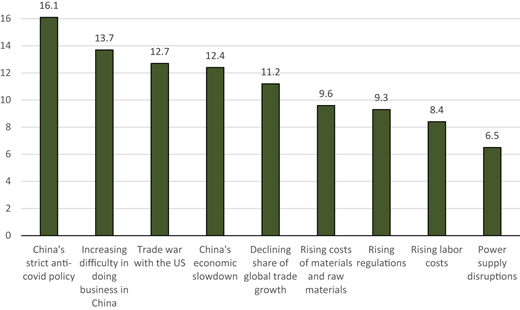
The reasons for the relocation and investment restrictions in China are interesting. Among the most important, 750 senior managers in global logistics indicated primarily (Agility Emerging Market Logistics Index, 2023): strict anti-COVID policies and the resulting large-scale lockdowns, which had catastrophic consequences for international logistics, including high freight rates, delays and limited container availability. Other important reasons include increasing difficulties in handling business, the trade war with the US, the economic slowdown in China and the decline in China's share in global trade growth. Moreover, rising labor costs are becoming increasingly important, which reduces China's competitiveness and investment attractiveness. Since 2010, around 60% of greenfield investment has flowed to “developing” economies, with the largest increases in 2021–2023 in Africa and India, while investment in China and Russia has fallen by around 70% and 98%, respectively (compared to pre-pandemic averages) (Bush, 2024). Increased investment in many developing economies suggests a reconfiguration of trade in the coming years. Figure 1 presents a detailed summary of the nine most important reasons for the decline in China's attractiveness.
Due to the above reasons, China stopped being the first choice for relocation after 2024 (Agility Emerging Market Logistics Index, 2023, 2024). The most frequently indicated relocation destinations have become Southeast Asia (13.6%), followed by India (13.4%) and Europe (13.1%). Notably, the surveyed logistics managers indicated that, on the one hand, India is gaining importance as a producer and market; but on the other hand, they mentioned inadequate infrastructure and corruption as the biggest barriers there. Next on the list of priorities is North America (12.9%), and only then China (12.6%), Latin America and the rest of Asia (both 10.2%). Furthermore, the industry is preparing to increase investment in Africa, especially sub-Saharan area. Noteworthy, 2/3 of managers claim that climate change has already become a factor influencing investment decisions in their companies. The situation before 2023 was completely different. Back then, companies relocated operations most often to China (17.1%), followed by India (13.8%) and Europe (13.6%).
Consequently, we may generalize that the declarations of company relocation run on the desire to reduce the risk of global supply chain disruptions caused by the phenomena indicated above (pandemic, war, politics, etc.). We may consider these motivations as an example of derisking, which, according to Podsiad, Piłat, and Walewski (2023, p. 7), includes at least two processes that differ in dynamics and consequences. First, it may mean deglobalization understood as moving factories and suppliers closer to final sales markets, i.e., the previously mentioned nearshoring. In the longer term, other trends may emerge, e.g. to relocate production not only to new, closer locations but also in line with the change in the supply chain strategy of some companies transferring their operations back to the home country (backshoring) or locating their new production investment there (onshoring). In parallel to this process, production diversification may increase, because an entrepreneur who operates in many markets may replace one factory with several smaller ones located closer to the final sales markets. Second, derisking may also mean replacing current sources of supply with sources located closer to the target market or closer to the factories of the final product (nearsourcing).
Podsiad et al. (2023) further note that deglobalization, understood as moving production closer to target markets and intensifying cooperation with close sub-suppliers, may mean not only a geographical dimension but also a cultural one. In other words, deglobalization does not necessarily reduce transportation distances. One can also implement it by moving supply chains to countries that are closer in terms of culture and civilization (although geographically similar to the previous contractors), but above all, politically friendly, meaning lower economic risk. This trend has recently been referred to as friendshoring, a term introduced by Janet Yellen in April 2022 (Kollewe, 2022). This means that economic deglobalization may take on a selective nature and apply to different markets, industries and enterprises, as well as to specific goods and services in varying degrees.
However, this selective deglobalization may not be visible, for example, in the level of the total volume of trade. This suggests that global trade may remain largely unchanged, stabilizing at a state of dynamic equilibrium. In the language of modern economic geography, we refer to such a condition as a steady state, which relates directly to the cosmological steady state theory of Bondi and Gold (1948) and Hoyle (1948). However, analyses of selected parameters in global trade and investment flows may reveal changes over time, which will be particularly visible in.
A general decrease in the distance (in geographical terms) between recipients and suppliers of exchanged goods,
Moving the links of the production chain closer to target markets, to safe countries (in terms of geography and geopolitics) and closer in terms of culture,
Progressive deglobalization observed at the level of individual products (commodity groups).
Geopolitical, geographical and cultural dimensions of selective deglobalization
Trade restraints observed since the start of the US–China tariff war, the events related to the COVID-19 pandemic, and Russia's aggression against Ukraine have triggered a discussion on the need for new protectionism, decoupling, nearshoring, friendshoring and the consequences of trade division between countries as a result of geopolitical tensions (Góes & Bekkers, 2022; Aiyar, Gourinchas, Presbitero, & Ruta, 2023; Attinasi, Boeckelmann, & Meunier, 2023; Campos, Estefania-Flores, Furceri, & Timini, 2023; Puślecki, 2023). However, the results of the analyses conducted thus far do not clearly reveal the above-mentioned tendencies to retreat from globalization or accelerated deglobalization. Although deglobalization pressures exist, they vary significantly across time, countries and industries.
Historically, value chains have been changing gradually, and the recent years have been no exception. Since 1995, no economy has gained or lost more than two percentage points of its annual share in global exports in any value chain. This has not changed despite increasing customs tariffs and restrictions in recent years. However, since 2017, the geography of linkages between economies has been changing (Bush, 2024, p. 4). Bosone, Dautovic, Fidora, and Stamato (2024) reached a similar conclusion, stating that geopolitics, understood as geopolitical distance, began to significantly affect global trade after 2018. We may understand geopolitical distance as a new measure, i.e., a kind of equivalent of geographic distance. It is a quantitative (although imperfect) definition of the agreement in global issues of states (proximity or distance on a scale of 0–10) constructed on the basis of the records of 201 votes in the UN General Assembly in the years 2005–2022. The authors of Geopolitics and the geometry of global trade used such a quantitative measure (Bush, 2024). The influence on global trade coincides temporally with the US–China tariff war, the COVID-19 pandemic, and further, the Russian invasion of Ukraine. Moreover, the analysis by Bosone et al. (2024) sheds light on the diversity of the geopolitical impact on different groups of countries.
Four country pairs, the United States–China, the United States–France, Germany–China and Germany–France, illustrate how geopolitical distance has evolved. The analysis results indicate an increasing distance to China for both United States and Germany, as well as its further growth in the following years. In other words, geopolitical distance, which uses a gravity model that considers unobservable factors influencing trade, as well as national border effects and bilateral (time-varying) trade costs, including customs duties, became a significant factor in shaping trade flows after 2018, and its impact has been growing even more over time. The authors emphasize that since 2018, trade between geopolitically close countries has increased by 6% compared to the period of 2012–2017. Meanwhile, trade between rivals has decreased by 4%. The increase in the geopolitical distance results mainly from the deteriorating geopolitical relations, in particular between the United States and China (generally, between the West and the East), which results in a mutual decrease in trade.
Remarkably, Bosone et al. (2024) found a significant increase in the trade between pairs of countries located far apart. Podsiad et al. (2023) had similar observations. They found that the geographical distance for imported goods has been growing in recent years in the case of Poland, China and the European Union. Distinctively, we can include only the USA in the rhetoric of deglobalization, which has been gaining momentum in recent years. In detail, according to Bush (2024, p. 3), since 2017, the United States has reduced the geographical trade distance and diversified the trade sources. Thus, the average import distance indicator does not confirm the thesis of a broad retreat from globalization. We have observed a more pronounced decline in the average export distance in recent years in Poland, the European Union and the USA. Since 2020, the Western countries analyzed by Podsiad et al. (2023) have been importing goods from increasingly distant regions, but they are sending goods closer and closer. In turn, ASEAN countries, Brazil and India trade more both across the entire geopolitical spectrum and over longer distances (Bush, 2024).
Overall, actors have shown little movement toward geographically close partners, but they have clearly shifted toward geopolitically aligned partners. Simultaneously, research by Bayoumi, Barkema, and Cerdeiro (2019) indicates that geopolitical factors do not have a significant impact on the total imports of the European Union. This result may reflect the high degree of integration of the global supply chains within the European Union. This results from the fact that production structures are not very flexible (at least in the short term) and that the degree of this rigidity rises with the increase of integration with global supply chains.
The analysis of average trade distances for groups of countries with different capitalism types shows that each economy's trade approach depends on its structure and position. Generally speaking, liberal market economies (e.g. Australia, Canada, New Zealand and the United Kingdom) tend to systematically increase the average import and export distances. Coordinated market economies (e.g. Japan, Germany, Switzerland and the Netherlands) display the greatest reserve toward the idea of globalization. The average import distance in this group has oscillated around the value from 2001, and in the case of exports, it has even decreased (Podsiad et al., 2023, p. 31). However, the behaviors of individual countries vary quite often.
Bosone et al. (2024) also studied the impact of the Russian invasion on Eurozone exports. The war reduced these exports to Russia by more than half, which is not surprising given the imposed EU sanctions. Notably, the vast majority of companies from Europe, as well as from Japan and the United States, have withdrawn or limited their operations in Russia. Simultaneously, trade flows to Russia's neighboring countries increased, probably due to the restructuring of the supply chain. Bosone et al. (2024) estimate that the Eurozone exports to geopolitically close countries were about 13% higher after the war began compared to a counterfactual scenario if the war had not broken out. Interestingly, Bosone et al. (2024) did not find in the Eurozone trade orientation any signs of diverting from China. This certainly reflects China's interest and market power in strategic sectors. Moreover, Podsiad et al. (2023, p. 4) emphasize that developed countries have noticeably reduced the distances of their exported goods, whereas China shows a different pattern. In recent years, China has exported goods over increasing distances, contradicting the general trend of shorter trade distances and the relocation of production closer to target markets in safer, nearby countries. On the other hand, the growing importance of geopolitical distance as a barrier to the flow of investments and trade is becoming clearly noticeable.
When measuring trading–partner distance by cultural differences, deglobalization largely reflects friendshoring, achieved mainly through cultural convergence among states rather than changes in trade's spatial structure. The approach used to measure the cultural distance between countries is based on the assumption that we should consider cultural differences between countries along two dimensions: (1) support for traditional vs. secular rational authority; (2) support for survival vs. self-expression values. We may assign each country two values corresponding to its position in the two dimensions. This allows us to place them in a two-dimensional space and calculate the Euclidean distance between each pair of countries, X and Y. According to research by Podsiad et al. (2023), the cultural distance separating Poland, China, and the USA from export and import partners has shortened. In other words, trade takes place between culturally similar countries. However, trade in the European Union as an entity deviates from this logic, most probably because scholars have not observed similar convergence with import and export partners in this area (although in terms of export, some stabilization has been visible in recent years). Therefore, it is difficult to draw unambiguous conclusions regarding the impact of cultural distance on deglobalization processes.
Selective deglobalization of product groups
Regardless of overall trends, analysts should examine selective deglobalization at the product level. Podsiad et al. (2023, pp. 20–24) provide an in-depth analysis of individual product groups, yielding several notable observations (see Table 1). From it, we may conclude the following.
China is the only one of the considered entities that experiences “accelerating deglobalization” in group (7), mainly in the subgroup “other electronic equipment,” which covered 22% of Chinese imports in 2021. This subgroup contains mainly electronic integrated circuits. All other countries included in the analysis experience globalization in group (7).
China's imports also stood out in groups 0 (food and live animals) and 2 (inedible raw materials). In both cases, China experiences globalization, while the rest of the world is mostly deglobalizing.
Considering the current geopolitical situation, it is worth paying attention to the group of energy carriers (3). The USA is dealing with “accelerating deglobalization” [6], and the European Union as a whole, China and Poland with a “retreat from globalization” [3]. Interestingly, in Poland, the European Union and China, “accelerating deglobalization” or “retreat from globalization” relates to coal and fuels, but not natural gas.
In the case of the European Union, “accelerating deglobalization” [6] concerns primarily the import of food products. In the case of exports from the European Union, Poland and the USA, deglobalization or “retreat from globalization” [3] concerns 62%, 60% and 41% of products, respectively.
Chinese exports clearly display a strong predominance of processes that fit into the logic of globalization, which is progressing much faster than in the case of Chinese imports and much faster than in the exports of the other analyzed countries. The distance over which China sends its goods has been growing in recent years, concerning the groups that constitute 87% of Chinese exports. In other words, globalization trends prevail in China in relation to the export of most product groups, and “deglobalization” [3] or “retreat from globalization” [4] concerns only 13% of China's exports.
These observations indicate that the US–China trade war has increased Chinese tariffs, producing certain effects. Although the economy feels these negative impacts, they have not caused serious damage, keeping China on a path of “slower globalization” [2].
Conclusions
Our considerations lead to the following conclusions.
Globalization is a logical consequence of the current development of the market economy. It is undergoing distinguishing changes. Globalization evolves with changing conditions, mainly political, economic, technological and environmental. Their effects are disruptions and restrictions on the flow of global supply chains, which trigger the processes of economic deglobalization. Consequently, new relocalization trends appear: nearshoring, nearsourcing, backshoring, reshoring, onshoring and friendshoring.
Deglobalization does not manifest itself unambiguously and uniformly and is not a homogeneous process. It unfolds differently across countries and over time, varying by geographic, geopolitical and cultural dimensions, as well as by product groups, industries, sectors, firms and individual goods or services. Therefore, no universal generalization applies.
The impact of geopolitics on different groups of countries is not uniform. The geopolitical dimension, associated with a low risk level, has become a significant factor in shaping trade flows and foreign direct investment, and its importance is growing.
The geographical dimension (proximity) does not confirm the thesis of an unequivocal retreat from globalization. Reducing distance to trading partners or moving the production chain links closer to target markets (nearshoring) is not very clear. Highly developed countries have noticeably shortened export distances, whereas China has increased them, and geographic deglobalization in imports remains minimal.
Cultural similarity promotes business contacts and is largely consistent with friendshoring.
Generalizing globalization or deglobalization by product groups and exports or imports is difficult to indicate and grasp. The existing trends vary across countries. They change quite dynamically depending on the economic policy conducted in various countries. China presents a clearer picture: accelerated globalization affects most Chinese products, which are exported over increasing distances.
Simultaneously, it seems that one should not ignore the views signaled by the International Monetary Fund warning against the possible negative effects of deglobalization. Fragmentation of the global economy is tantamount to a tendency towards “separatization” or “autarkization” of economic processes in individual countries and regions. Restrictions on cross-border migration and limited direct trade and capital flows would pose a significant threat to the development opportunities of catching-up economies and would also constitute a barrier to the provision of global public goods. One cannot ignore the results of research showing that deeper fragmentation causes higher costs and that technological separation significantly increases losses due to trade restrictions. This situation causes threats that mostly concern emerging and low-income economies. The cited IMF report even notes: “With less international risk sharing, global economic fragmentation could lead to greater macroeconomic volatility, more serious crises and greater pressure on national buffers” (Maciejewski, 2023).
Therefore, it is difficult to predict the future of the ongoing processes. However, we can confidently predict that trade and FDI flows will benefit most from increased security via geopolitical and cultural proximity, which will not always align with geographic closeness. In turn, this will deepen selective deglobalization, which will reduce economic risk on the one hand, increase resistance to shocks, and create opportunities for many partners. On the other hand, transferring investments (relocation) is associated with high costs.
In the analyses conducted so far, we implicitly assumed that both globalization and deglobalization have a uniform and averaged impact across product groups and country groups. In reality, both processes vary significantly across products and differ in geographic areas. We recommend that further research identify, document, and analyze these specificities, address the resulting consequences and consider economic policy in the international business context.