Skip to article sections
Purpose

We aimed to explore the factors influencing the intention to use service robots as a touchpoint in customer service settings, with special research attention devoted to perceived media richness.

Design/methodology/approach

We employed a quantitative methodology to collect data from Polish consumers. We recruited a total of 439 respondents using a convenience sampling method and administered a survey in 2023. We conducted structural equation modelling using IBM SPSS AMOS.

Findings

Our findings provide crucial insights into the impact of service robots’ perceived media richness and expected anthropomorphic features. Specifically, perceived media richness has both direct and indirect positive effects on behavioural intentions.

Research limitations/implications

This article’s limitations primarily concern the research sample and the sampling technique. A key managerial implication of the study is the significance of media richness as a crucial characteristic of touchpoints. One should consider this aspect when planning multi-touchpoint strategies during the customer service phase.

Originality/value

This study applies the concept of perceived media richness to the context of service robots, highlighting both direct and indirect effects. It introduces a novel shift in the understanding of anthropomorphism – from a focus on perception to one on expectation.

The integration of artificial intelligence (AI) into the service economy is accelerating (Tojib, Sujan, Ma, & Tsarenko, 2023). In today’s rapidly evolving world, where technology is booming, managers increasingly utilize AI in service settings to engage with customers (Yin, Li, & Qiu, 2023). In particular, the use of robots in the service sector is on the rise (Lu, 2024; Tian, Yan, & Li, 2025). Service robots have emerged as a revolutionary innovation (Agarwal et al., 2024) signalling a major shift in the service industry (Rana, Begum, Faisal, & Mishra, 2024) as well as a transformation in the retail sector (Vinoi, Shankar, Agarwal, & Alghafes, 2025). We are witnessing a shift from people supervising technology to people being replaced by technology (Wang, Matook, & Dennis, 2024). In this context, service robots are becoming crucial touchpoints in the customer journey in omnichannel retail environments (Arce-Urriza, Chocarro, Cortinas, & Marcos, 2025). However, as the service industry becomes more intelligent and automated, concerns emerge about how technological advancements are reshaping the user experience and how service outcomes are evaluated (Bai et al., 2024). Fostering consumer acceptance of social robots in retail and service contexts remains a complex challenge (Begum, Faisal, Sobh, Nunkoo, & Rana, 2025) and a growing topic in marketing research (Gao, Chang, Yang, & Yu, 2025). To enhance customer interaction with AI-driven solutions, producers often design these technologies to resemble human characteristics (Zhang, Wang, Lu, Liu, & Feng, 2024). Thanks to these innovations, robots have become more cognitively and visually human-like, highly perceptive, and responsive to their surroundings (Song & Kim, 2022). They can also eliminate or mitigate typical interpersonal problems like direct perceived discrimination (Seyitoğlu & Ivanov, 2023).

Social robots can serve tactically to focus on repetitive and often monotonous activities currently performed by humans (de Kervenoael, Hasan, Schwob, & Goh, 2020). Lee (2021) notes the multiplicity of definitions of service robots due to the research momentum in this area. Some researchers indicate the difficulty of agreeing on a universal definition of a service robot (Van Wynsberghe, 2016).

Research estimates that the service robot market is growing rapidly, from USD 37 billion in 2020 to a projected USD 102.5 billion by the end of 2025, with a compound annual growth rate of 22.6% (Lu, Zhang, & Zhang, 2021). The International Federation of Robotics predicts that the expansion of service robot usage in this decade will surpass the annual rates of 30% observed in the previous decade (Belanche, Casaló, Flavián, & Schepers, 2020). Humanoid robots have moved beyond the realm of fantasy and science fiction, becoming part of everyday life and emerging as a leading frontier of service innovation (Paluch, Wirtz, & Kunz, 2020; Mende, Scott, van Doorn, Grewal, & Shanks, 2019). Experts foresee that some sectors, such as financial services, will be completely automated by 2030 and that the economic impact of AI on national GDP could be around 20% in countries like China and the United States (Flavián, Belk, Belanche, & Casaló, 2024).

This article is an attempt to better understand customer interactions with service robots through the concept of perceived media richness due to researchers’ opinion that this issue is vital yet still not fully recognized (Pitardi, Wirtz, Paluch, & Kunz, 2022). The quality of information exchange between buyer and seller is an integral part of a long-term customer relationship (Carlson, 2018). One quality component of communications is perceived media richness. The article refers mainly to media richness theory (MRT) and marketing channel/touchpoint preferences. Focusing on the service process, we pay attention to the multiplicity of touchpoints and approach service robots as a new optional touchpoint.

To explore the factors influencing the intention to use service robots as a touchpoint in customer service settings, we developed a research model. We expected that implementing it would confirm the effect of consumer innovativeness, trust in service robots, and performance expectancy on service robot use. Thus, this study contributes to the existing knowledge by applying perceived media richness to the service robot context. To the best of our knowledge, perceptions of the media richness of service robots have not been fully recognized and have only received preliminary analysis. The second novel aspect of our research is its innovative conceptualization of service robot anthropomorphism, focusing on expected rather than perceived anthropomorphism.

This article is structured as follows. First, we briefly outline the theoretical background for our research model. Second, we present the model development and hypotheses. We then describe the research methodology in terms of sampling design, measurement, and data collection. Next, we combine the analysis and results before discussing the theoretical and practical implications of the study. Finally, we conclude by exploring the limitations of our research and future research suggestions.

Due to the progress of information and communication technology in retailing, the list of touchpoints in the purchasing process seems to be constantly growing. Cutting-edge technologies drive the ongoing development of self-service technologies (SSTs), enabling customers to access services without direct employee involvement (Chun, Hung, Wang, & Wang, 2019). Recent developments in SST include the use of AI, information systems, and mobile technology to enhance competitive advantages (Feng, Tu, Lu, & Zhou, 2019). Innovation is essential for companies to develop in a highly competitive market (Candraningrum, 2018). One example of such innovation is the service robot powered by AI and its vital impact on customer experience (Zhang, Huang, Li, & Ren, 2022). The use of service robots is rapidly increasing in customers’ daily lives, in both the private and public sectors (Kraus et al., 2024). However, research indicates that human-support robots critically differ from traditional self-service technologies in that they can more meaningfully engage with consumers on a social level (Van Doorn et al., 2017).

We argue that perceived media richness should be one of the characteristics used to assess new touchpoints. Daft and Lengel introduced MRT (1984, 1986) as an extension of information processing theory. Before the electronic age, scholars defined media richness as the “ability of information to change understanding within a time frame” (Daft & Lengel, 1986, p. 560). More recently, researchers conceptualized it as a set of four dimensions: the opportunity for two-way communication, the ability to communicate a variety of cues (e.g. verbal, symbolic and nonverbal), the capacity to convey a sense of personal presence, and language variety (Badger, Kaminsky, & Behrend, 2014). According to MRT, every communication medium has its information richness (Daft & Lengel, 1984), and the richer a medium is, the more components of media richness it incorporates. Traditionally, we have seen face-to-face communication as the richest medium, whereas impersonal written documents as the leanest because they typically communicate objective information with limited richness features (Frasca & Edwards, 2017). In this context, researchers distinguish between a rich environment (with audio and video components and large user interfaces) and a lean environment (pure text, small user interfaces; Maity, Dass, & Kumar, 2018). Brunelle (2009) notes that inconsistent empirical findings have resulted from the introduction of new media such as electronic mail and voice mail, and MRT must integrate these new media. In this study, we aimed to analyse robots’ perceived media richness and to develop the media richness continuum proposed by Suh (1999). Many fields have employed media richness theory, with studies seeking to expand its achievements. In the context of a rapid increase in the possibilities of modern technology use, scholars study the issue of media richness in areas such as virtual worlds (Tan, Tan, & Teo, 2012), mobile shopping (Li, Dong, & Chen, 2012; Tseng, Cheng, Li, & Teng, 2017), internet recruitment systems (Badger et al., 2014; Frasca & Edwards, 2017), social media engagement (Cao, Meadows, Wong, & Xia, 2021; Hasim, Shahrin, Wahid, & Shamsudin, 2020), and online learning platforms (Wang, 2022). Service robots are another area requiring analysis focused on perceived media richness because the latter influences the intention to use a particular touchpoint. According to the literature, perceived media richness has a positive impact on the intention to use a particular media channel/touchpoint (Lipowski & Bondos, 2018; Brunelle, 2009). Therefore, we put forward the following hypotheses:

H1a.

Perceived media richness is positively associated with intention to use service robots.

H1b.

Perceived media richness has a positive indirect association with intention to use service robots via performance expectancy.

H2.

Perceived media richness is positively associated with performance expectancy.

Performance expectancy refers to the extent to which users believe that a system would enhance their performance (Sethibe & Naidoo, 2022). The term is essentially similar to the perceived usefulness of technology (Ain, Kaur, & Waheed, 2016; Raza, Qazi, Khan, & Salam, 2021). Performance expectancy emphasizes the service robot’s ability and skill in performing challenging tasks driven by users’ desires and beliefs (Song et al., 2024). More precisely, the performance expectancy of AI service robots refers to the degree to which individuals believe that the services provided by these robots can meet or exceed their expectations (Lei, Hossain, & Wong, 2023). Performance expectancy is rooted in the Unified Theory of Acceptance and Use of Technology (UTAUT) model proposed by Venkatesh, Morris, Davis, and Davis (2003). Since its introduction, numerous studies have found a positive relationship between performance expectancy and behavioural intention in different technology contexts. For example, studies have examined the intention to use robotics automation technology (Sethibe & Naidoo, 2022), ChatGPT (Camilleri, 2024), mobile apps (Tam, Santos, & Oliveira, 2020; Alalwan, 2020), mobile payments (Al-Saedi, Al-Emran, Ramayah, & Abusham, 2020), and mobile health (Alam, Hoque, Hu, & Barua, 2020). Despite these findings, some research does not support the hypothesis that performance expectancy positively influences behavioural intention (e.g. Chaudhry et al., 2023; Zwain, 2019). However, most researchers posit that consumers would adopt a technology if they understood that it would boost their efficiency (Raza et al., 2021).

In this light, we hypothesized:

H3.

Performance expectancy is positively associated with intention to use service robots.

Further, anthropomorphism has become vital in the fast-developing technological environment and has drawn the attention of researchers in multiple areas (Liu, Jiang, Li, & Mou, 2024). Scholars consider anthropomorphism a key factor in determining consumer attitudes and behaviours in various fields of digital agents (Kim, Lee, & Kang, 2025). We may define anthropomorphism as the attribution of human-like characteristics to nonhuman entities (Złotowski et al., 2018). Human-like characteristics in service robots can be critical to consumers accepting robotic service (Murphy, Gretzel, & Pesonen, 2019) and beneficial for human–robot interaction (Roesler, Onnasch, & Majer, 2020; Lv, Liu, Luo, Liu, & Li, 2021). Pelau, Dabija, and Ene (2021) link anthropomorphism to the personification of a non-human entity. Researchers have found that service robots may elicit either negative or positive reactions from consumers, depending on their level of similarity to humans (Zhang, Gursoy, Zhu, & Shi, 2021; Yang, Li, Feng, Chen, & Tseng, 2024a; Plotkina, Orkut, & Karageyim, 2024). A negative response can be a refusal to use the service robot (Gursoy, Chi, Lu, & Nunkoo, 2019) or a lack of genuine interactions (Shin & Jeong, 2020). In contrast, positive effects include higher service-quality prediction (Zhu & Chang, 2020) and positive attribution of responsibility (Belanche, Casalo, Flavian, & Schepers, 2020). Belanche, Casalo, Schepers, and Flavian (2021) found that a robot’s physical human likeness increases customers’ expectations of service value. However, some researchers still note that the link between service robot anthropomorphism and customers’ service evaluations remains unclear (Lu et al., 2021; Castelo, Boegershausen, Hildebrand, & Henkel, 2023; Xu, Hsiao, Sacha Reid, & Ma, 2023; Yanxia, Shijia, & Yuyang, 2024). In this regard, Tojib et al. (2023) discussed the potential double-edged effect of anthropomorphism in service robots. Accordingly, we believe that examining how consumers’ expectations of anthropomorphic features in service robots influence their performance expectancy and trust in robots is essential. As the anthropomorphization of service robots continues to grow, researchers recognize the necessity of exploring the characteristics of anthropomorphism and its impact on human–machine interactions and trust further (Plotkina et al., 2024; Liu et al., 2024; Yang, Chi, Bi, & Xu, 2024b). Our research model integrates this conceptualization of a robot anthropomorphism, drawing on the “computers are social actors” assumption (Nass & Moon, 2000), according to which humans apply social norms and expectations to technical devices (Leichtmann & Nitsch, 2021). Consequently, we hypothesized:

H4.

Expected anthropomorphism is positively associated with performance expectancy.

H5.

Expected anthropomorphism is positively associated with trust in service robots.

H5a.

Expected anthropomorphism has positive indirect associations with intention to use service robots through (a) performance expectancy and (b) trust in service robots.

As a fundamental antecedent of social interaction, trust refers to the willingness to rely on another despite potential uncertainty and loss (Chi, Jia, Li, & Gursoy, 2021). Trust is essential to technology acceptance and takes on even greater importance as technologies become increasingly complex (Kuen, Westmattelmann, Bruckes, & Schewe, 2023; Nguyen, Nguyen, Cai, Yuen, & Wang, 2025). Early researchers doubted the authenticity of the concept of trust in technology (e.g. Friedman, Kahn, & Howe, 2000; Solomon & Flores, 2003), arguing that trust exists only when the trustee has volition and moral agency, which technology lacks (McKnight, Carter, & Clay, 2009). However, other researchers noted that technology with human-like characteristics might create human-like trust (Choung et al., 2023). Along these lines, Chi et al. (2021) found that trust in interactions with AI social robots is a combination of “human trust in information technology” and “human trust in humans.” Trust is a mental mechanism based on incomplete information that helps reduce complexity to allow decision-making under uncertainty (Kahneman, Slovic, & Tversky, 1982). Accordingly, trust reduces customer concerns and is essential for customers to adopt new technology (Aggarwal & Gour, 2020). Recent analyses have focused on the positive impact of consumers’ trust in a company on their intentions to adopt AI services from said company (Frank, Jacobsen, Søndergaard, & Otterbring, 2023), the positive impact of trust in a chatbot on customers’ reliance on it (Cheng, Bao, Zarifis, Gong, & Mou, 2022) and the influence of trust in service robots in general on the willingness to use a specific robot (Kraus et al., 2024). These studies point to a new trajectory for research on consumer trust. In the literature, trust is a multidimensional concept with different components (Wang et al., 2023). Researchers will continue to show interest in understanding the role of trust in technology acceptance and how trust can be built (Kuen et al., 2023). We propose to investigate the dimension of trust in robots and its influence on the intention to use robots during customer service. In a service context, trust relies on a customer’s perception of an agent’s ability to understand their needs and provide helpful responses (Oliveira, Lizarelli, Teixeira, & Mendes, 2023). Specifically, consumer trust in service robots has its roots in trust in automation (Li, Zhou, Jiang, Fan, & Song, 2024). One of the main reasons for the constant interest in consumer trust in technology is the proliferation of technologies and the fundamental changes associated with it (Distel, Engelke, & Querfurth, 2021). As AI-enhanced technologies grow, so does the need to define and examine users’ trust in them (Choung et al., 2023). Therefore, hypothesized:

H6.

Trust in service robots is positively associated with intention to use service robots.

Consumer innovativeness is a well-researched and defined concept (Ozturk et al., 2023), understood as the tendency to purchase and use new products more quickly and more often than other people (Kim, Choe, & Hwang, 2021). It refers to consumers’ predisposition to try new or different products/services rather than stick to current and previous choices (Steenkamp, Ter Hofstede, & Wedel, 1999). Innovation diffusion research recognizes that highly innovative individuals actively seek information about new ideas, which results in stronger intentions to use innovative solutions (Wu, Qi Lin, & Yuen, 2024). Numerous empirical studies have shown a positive link between consumer innovativeness and behavioural intentions (Li, Wang, Li, & Liao, 2021). Some of this research has also focused on its impact on trust (Huang, Kim, & Lennon, 2024; Della Corte, Sepe, Gursoy, & Prisco, 2023).

On this basis, we hypothesized:

H7a.

Consumer innovativeness is positively associated with trust in service robots.

H7b.

Consumer innovativeness has a positive indirect association with intention to use service robots via trust in service robots.

H8.

Consumer innovativeness is positively associated with intention to use service robots.

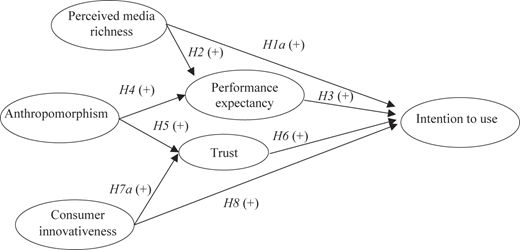
Figure 1 presents our research model. We aimed to identify the factors influencing the intention to use service robots as a touchpoint in customer service settings. As Wong and Wong note (2024), despite the growing prevalence of service robots, a comprehensive and empirically validated framework for understanding consumer acceptance of service robots is still missing. Researchers have advanced several approaches to build a theoretical foundation for this issue, with multiple technology acceptance models offering valuable frameworks (Cabrilo, Leung, Tsai, & Dahms, 2024). Some argue that the extension of the technology acceptance model (Davis, 1989) is adequate (Kao and Huang, 2023), while others suggest that one must consider a wider range of factors and incorporate them into the service robot acceptance model (sRAM). According to the technology acceptance model, a customer’s intention to use a new technology is based on their cognitive assessment of its perceived usefulness and ease of use. Meanwhile, the sRAM provides a comprehensive framework that integrates functional, social, and relational dimensions (Wirtz et al., 2018). Researchers have used this theoretical base (Arce-Urriza et al., 2025), with some studies incorporating additional variables into the modified sRAM (Song et al., 2024). Our model is built on the core aspects of the three dimensions of sRAM. Trust represents the relational aspect, performance expectations – the functional aspect, and anthropomorphism – the social aspect. Moreover, we included perceived media richness as well as personal innovativeness to enhance our model. Let us also note the emergence of an alternate research stream centring on the humanness of service robot acceptance (Arikan, Altinigne, Kuzgun, & Okan, 2023). Additional justification for including anthropomorphism as a variable in the model is the “computers are social actors” theory (Nass & Moon, 2000) used by research on human–computer/robot interactions (de Kervenoael, Schwob, Hasan, & Psylla, 2024; Xie, Li, & Li, 2025; Piercy, Montgomery-Vestecka, & Lee, 2025; Cai, Heo, & Yan, 2025; Yücel & Rızvanoğlu, 2025).

The measurement items utilized for each variable are based on validated items from previous research, with modifications. Table 1 presents these items in detail.

We used multi-item measures with a seven-point Likert scale (1 = strongly disagree, 7 = strongly agree). Behavioural intention in our research model concerns service robot use intention, which indicates that customers are willing to use service robots during the service.

We conducted structural equation modelling (SEM) using IBM SPSS AMOS (version 29), which is well-suited for estimating reflective measurement models with continuous data. Given the adequate sample size (N = 439), we employed maximum likelihood estimation (MLE), as it provides robust and efficient parameter estimates under conditions of multivariate normality. We specified all constructs in the model as reflective, consistent with theoretical expectations and measurement assumptions. We used the bootstrapping method with 2,000 sub-samples as a nonparametric method to verify the direct effect and mediation effect at a 0.05 significance level.

Data collection procedure

We used an online questionnaire survey method to collect the data. We surveyed in 2023 among 439 students pursuing economic studies (both first and second-cycle studies) and their family members and friends who might have experience using service robots. Student samples are often more homogeneous than non-student samples (Agadullina & Lovakov, 2018). The questionnaire provided a clear set of instructions for participants. All respondents completed the self-administered questionnaire based on their experiences with service robots. The research procedure ensured the anonymity of all participants.

To assess the potential risk of common method variance (CMV), we conducted Harman’s single-factor test by performing an exploratory factor analysis (EFA) on all measurement items without rotation. The results show that the first factor accounted for 35.1% of the total variance, which was well below the commonly accepted threshold of 50.0%. This suggests that CMV was unlikely to be a serious concern in this study and that the observed relationships among the constructs were not predominantly driven by method bias. This approach is consistent with recommendations in business research methodology (Fuller, Simmering, Atinc, Atinc, & Babin, 2016), where Harman’s test remains a commonly used initial diagnostic for CMV.

Most respondents had some experience with service robots. When asked about the last time they had interacted with a robot during customer service, their answers were as follows: 58.8% had contact within the previous quarter, 29.4% within the last year, 9% more than a year ago, and 2.8% had never had any contact at all. Since we identified the respondents’ experience with service robots after the survey was completed, we described the sampling as pure convenience-based with an ex-post eligibility filter. We did not use a probability mechanism. The sample consisted of university students recruited via convenience sampling, which may introduce a bias toward tech-savvy individuals.

The survey focused on the expected anthropomorphism of service robots rather than perceived anthropomorphism. Accordingly, the questions concerned a general context and did not refer to a specific situation.

Research sample characteristics

Table 2 presents the demographic information of the 439 respondents. We performed post hoc power analysis using an online SEM power calculator (Soper, 2024). The analysis assumed the presence of six latent variables and 26 observed variables, with an anticipated effect size of 0.30, a power level of 0.80, and a significance level of 0.05. We determined the minimum recommended sample size to be 161. Since the actual sample size was 439, the study had adequate power to identify medium-sized effects within the model.

In terms of gender identity, 60.5% of respondents were women, and 39.5% were men. Approximately 80% of respondents were below the age of 35. The age range of the participants was consistent with the research setting because young people nowadays are willing to interact with service robots in the customer service process more frequently than older customers. Furthermore, the vast majority of the participants had interacted with service robots in the customer service process before. Young people, women, and individuals with higher education dominated the sample. Compared to national data, the sample was strongly skewed toward young, technically literate respondents. Given the sampling method (non-probability sampling) and the sample structure, we may generalize the results only to this specific group, and not to the entire population of the country under study.

We first performed several statistical tests to ensure the reliability and validity of all the measures. As shown in Table 3, we employed Cronbach’s α values to test internal consistency reliability, and the Cronbach’s α of all the measures exceeded the recommended threshold. We assessed internal consistency and reliability using Cronbach’s α and composite reliability, with a minimum threshold of 0.7, as recommended by Hair, Hult, Ringle, and Sarstedt (2017). Cronbach’s α for all constructs ranged from 0.792 to 0.874, and the CR values ranged from 0.850 to 0.914, confirming high internal reliability. Following Henseler, Ringle, and Sarstedt (2015), the variables in the measurement model exhibited satisfactory levels of reliability and internal consistency, as evidenced by Cronbach’s α and composite reliability values exceeding 0.7. Moreover, each construct’s average variance extracted was above 0.5, suggesting satisfactory convergent validity. We assessed multicollinearity by examining the correlations among latent constructs in the structural model (Table 4). All inter-construct correlations were below the recommended threshold of 0.85 (Kline, 2016), indicating that multicollinearity was not a concern in the model.

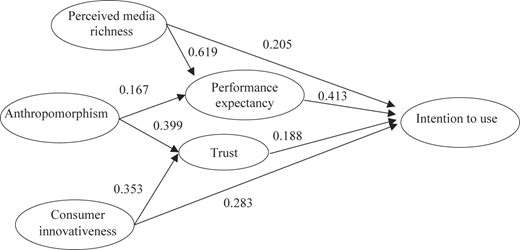
We assessed model fit using criteria such as root mean square error of approximation (RMSEA), comparative fit index (CFI), Tucker-Lewis index (TLI), and the chi-square to degrees of freedom ratio (χ2/df). For an acceptable model, RMSEA should be ≤ 0.08, CFI ≥0.90, and χ2/df < 3.00 (Huang, Chen, & Weng, 2017; Juhari, Arifin, Aiyub, & Ismail, 2024). We applied a significance level of p < 0.05 to determine statistical significance. Figure 2 gives the goodness of fit values obtained as a result of testing SEM (χ2/df = 2.268, PCLOSE = 0.130, CFI = 0.946, IFI = 0.946, TLI = 0.935, and RMSEA = 0.054). According to the analysis findings, the goodness-of-fit values of the model were within acceptable limits, and the model was valid (p < 0.05).

We measured discriminant validity with the Fornell–Larcker criterion. As the results of the former index in Table 5 show, all the values on the diagonal were higher than those below. Hence, we could accept discriminant validity for this measurement model as it supported the discriminant validity between the constructs (Ab Hamid, Sami, & Mohmad Sidek, 2017).

The analysis results (Figure 2, Table 7) indicate that perceived media richness (β = 0.167, p-value <0.001), performance expectancy (β = 0.413, p-value <0.001), trust in robots (β = 0.188, p-value <0.001), and consumer innovativeness (β = 0.283, p-value <0.001) have a positive and significant influence on intention to use service robots (R2 = 0.75). Apart from these results, based on the coefficient results, we could also observe that both perceived media richness (β = 0.619, p-value <0.001) and expected anthropomorphism (β = 0.167, p-value <0.001) had a positive significant influence on performance expectancy (R2 = 0.48). Similarly, expected anthropomorphism (β = 0.399, p-value <0.001) and consumer innovativeness (β = 0.353, p-value <0.001) had a positive and significant influence on trust in robots (R2 = 0.34). Thus, we confirmed all hypotheses (H1H8) (Table 7). We used R2 values to measure the proportion of variance explained in each construct.

We estimated the significance of the mediation effects using bias-corrected bootstrap confidence intervals (CIs) (Table 6). Perceived media richness, the anthropomorphism of service robots, and customer innovativeness all demonstrated significant indirect effects on the intention to use a service robot, thereby supporting hypotheses H1b, H5a, and H7b, respectively (Table 7).

Table 6 presents three types of effects. As we can see, all three indirect effects were statistically significant, as their 95% confidence intervals did not include zero, and all p-values were below 0.01. This indicates that at least one intervening variable mediated the relationships between three variables and the outcome variable: the indirect effect of perceived media richness on intention to use a service robot (β = 0.256) was the strongest among the three, representing a moderate to large effect size according to the interpretative guidelines proposed by Preacher and Kelley (2011). The indirect effect of expected anthropomorphism on intention to use a service robot (β = 0.134) was moderate, and the indirect effect of consumer innovativeness on intention to use a service robot (β = 0.078) was small but statistically significant. The results indicate that there were significant mediation pathways within the model. The results presented in Tables 6 and 7 indicate both the indirect and direct impact of the perceived informational richness of service robots on the intention to use them during the post-purchase service stage. This directly corresponds to the article’s title, which highlights precisely this dual influence.

All effects included in the analysis were statistically significant. Given the aim of the study and the focus on the perceived informational richness of service robots, we gave particular attention to this variable. The indirect effect of perceived media richness on the intention to use a service robot was significant, indicating that perceived media richness can influence usage intention, not only directly but also through a mediating variable. The total effect of perceived media richness on the intention to use a service robot was also significant, further reinforcing the idea that this perception positively impacts usage intention through both direct and indirect pathways. In our model, the mediating variable between perceived media richness and the intention to use the robot was performance expectancy, which also served as a significant direct predictor of the outcome variable.

We aimed to explore the factors influencing the intention to use service robots during customer service, with particular emphasis on the role of perceived media richness. Based on prior empirical evidence, we tested a theoretical model on a sample of 439 Polish consumers. We chose the AMOS approach for the analysis. Pursuant to the student-based, non-probability nature of the sample, the generalizability of the findings was limited. Future research should explore scenario-based or stimulus-based designs to replicate findings in contexts involving actual or simulated robot interactions.

Our findings provide crucial insights into the impact of service robots’ perceived media richness and expected anthropomorphic features on consumers’ intention to use service robots during customer service. The new knowledge gained from this study stems from the application of perceived media richness to the service robot context. Our goal was to introduce the service robot as a new touchpoint in the service process, with its level of perceived media richness. Despite the influential work of Brengman, Willems, De Gauquier, and Vanderborght (2024), the current understanding of perceived media richness in service robots remains underdeveloped. As hypothesized, the perceived media richness of service robots had a direct positive impact on behavioural intentions and performance expectations. The analysis also showed that perceived media richness indirectly affects behavioural intention through performance expectations. Therefore, the high perceived media richness of service robots is significant not only for its direct impact on customers’ willingness to use this touchpoint during the post-purchase service stage but also for its positive indirect effect by enhancing performance expectations. Given the high R2 value of the dependent variable in the model, the performance expectancy of service robots during post-purchase service warrants further scholarly exploration.

In the context of robot anthropomorphism, we identified its indirect effects on the intention to use service robots. In our model, this indirect influence occurred through trust in service robots and performance expectations. Notably, expected anthropomorphism was the only variable in the model that did not have a direct link to the outcome variable. However, despite the absence of a direct effect, it still plays a significant role in shaping customers’ willingness to engage with service robots.

Concerning the other novel aspect of our research, namely, the conceptualization of service robot anthropomorphism, our results are consistent with studies conducted by other researchers (Belanche et al., 2021; Zhang et al., 2021, 2024; Yuan, Peng, Liu, & Wang, 2025) showing that service robot anthropomorphism has a significant influence on performance expectancy and trust in service robots. Thus, expected anthropomorphism constitutes an important heuristic attribute of service robots, and scholars have reported that it significantly influences consumers’ trust. However, the concerns raised by some researchers (Watson, 2019; Hari, Sharma, Verma, & Chaturvedi, 2025) about the ethics of anthropomorphism in AI devices with social features will be important in future research.

This article makes a threefold theoretical contribution. First, it extends the media richness continuum presented by Suh (1999). This model ranks media on a continuum describing their relative richness, from richest to leanest, along several dimensions, with face-to-face being considered the richest medium (Brunelle, 2009). However, as the development and application of social robots in real-life settings increase rapidly, we must extend the continuum beyond the traditional set of media. If we consider robots to lack certain human characteristics in their communication (Hoorn, 2020), research is warranted on this touchpoint. Accordingly, we included the service robot as another touchpoint on the media richness continuum. In the multichannel/multi-touchpoint shopping environment, it may be useful to rename this continuum the “touchpoint media richness continuum.” We believe that it is possible to create a distinct continuum of media richness (2.0) specifically focused on the broad category of service robots. However, this is a conceptual proposition that requires empirical validation in future research. Perceived media richness will differ for a humanoid robot standing next to a customer, a phone call with a robot, and communication via chat. Therefore, in the new media richness continuum, a service robot will take the place of a human, with different communication variants such as face-to-face, verbal indirect, written, and other forms of interactions. Thus far, scholars have conducted very little empirical work (e.g. Brengman et al., 2024) on the perceived media richness of service robots during customer service, and important insights into their role are yet to be uncovered. Consequently, like Brengman et al. (2024), we set out to expand the media richness continuum because we believe that this concept must be updated to keep up with rapid technological progress. In doing so, our research contributes to the broader literature on media richness. According to channel expansion theory, past experiences influence how an individual develops a perception of the richness of a given media channel (Carlson & Zmud, 1999). Lipowski and Bondos (2018) indicated that the perceived richness of a specific purchase channel is not static and instead depends on the experience acquired by individuals, which allows them to develop knowledge bases that may be used to encode and decode rich messages on a channel more effectively. Given that research suggests a strong impact of (even limited) personal experiences with service robots on people’s behaviours and intention to use them, perceived media richness is likely to become even more influential when consumers become more familiar with this technology. Contributing to the theoretical development of media richness theory, we validate perceived media richness as a significant driver of both performance expectancy and behavioural intention, thereby extending the theory into the domain of human-robot interaction (HRI), particularly in service recovery and customer support contexts. This demonstrates that media richness is not limited to human-human communication but is also a relevant predictor of trust and usability in AI-based service channels. The second theoretical contribution is a novel definition of anthropomorphism. Human-robot collaboration is crucial in the era of Industry 5.0. Thus, research on this is also crucial (Xu et al., 2023). To the best of our knowledge, the vast majority of research articles devoted to the anthropomorphism of social robots focus on perceived anthropomorphism. However, even then, there is no consensus as to whether this type of anthropomorphism in service robots enhances customers’ experiences (Blut, Wang, Wunderlich, & Brock, 2021). In our research approach, we included expected anthropomorphism due to respondents’ rather low level of familiarity with service robots. Moreover, the importance of expected anthropomorphism may vary depending on the task complexity. A high level may be more important when the task to be performed is more complex. As Tojib et al. (2023) highlight, it is essential for companies to clearly define the intended role of service robots. A high degree of anthropomorphism in service robots is not always necessary. Instead, it depends on whether the robot is designed as a complement to or a targeted replacement for humans. Consumers do not always expect high levels of anthropomorphism, just like they do not always expect high media richness. Therefore, the validity of the expected anthropomorphism variable may vary in different studies, and perceived anthropomorphism may be more relevant in some contexts. Nonetheless, we believe that this differentiation in the conceptualization of service robots’ anthropomorphism can be useful for better understanding the phenomenon. Our research focuses on the theoretical aspect of anthropomorphism, which scholars recognize as crucial for grasping how people respond to robots (Tojib et al., 2023). We aimed to enhance the understanding of the relationship between service robot anthropomorphism and service recipients. To the best of our knowledge, this is the first study to examine the effect of expected anthropomorphism on customers’ behavioural intentions in a service context. While we acknowledge that this construct may not yet be fully developed within our model, we are confident that it provides a justified and promising foundation for further investigation. We offer theoretical support for the idea that expected anthropomorphism plays a significant role in building trust and performance expectations. This perspective expands existing models, such as the UTAUT and TAM, by introducing expected anthropomorphism, defined as a pre-use cognitive evaluation, as a new factor that affects trust, performance expectancy, and ultimately, behavioural intention. By doing this, we move beyond traditional views that consider anthropomorphism merely as a design attribute or a post-use perception. Instead, we emphasize its proactive role in shaping user expectations and decision-making before any interaction takes place.

Finally, this study contributes to the growing body of literature on service robots by examining the post-purchase phase of the customer journey, an area that remains relatively underexplored. While prior research has primarily focused on initial interactions with robots (e.g. during purchase or information search), our findings demonstrate that both anthropomorphic cues and rich communication capabilities continue to influence user perceptions and decision-making even after the transaction is complete.

Moreover, this study has implications for managers. First, given the findings on the direct and indirect effects of perceived information richness (HB1-HB2), companies using service robots in after-sales support should focus on enhancing the quality and style of communication provided by the robot. This is crucial because it directly shapes the intention to use the robot and also indirectly influences it by fostering positive expectations of its performance. Steps such as improving the conversational interface, personalizing messages, and clearly presenting the robot’s functions can significantly boost customer acceptance of this mode of interaction. Companies that provide service robots for after-sales support should focus on the media richness of their interactions. This refers to how effectively the robots communicate information and respond to customer needs. Key elements that enhance media richness include the language’s naturalness, voice communication, facial expressions, response speed, and the ability to ask open-ended questions. These factors significantly influence customers’ willingness to engage with this contact channel. Perceived media richness influences how customers assess the robot’s usability and effectiveness. High-quality communication raises expectations about the interaction’s effectiveness, leading to a more positive evaluation of the brand contact. Therefore, it is important to ensure that the robot appears to be a “competent interlocutor.” It should provide specific and useful information while being able to adapt flexibly to the context of the customer’s situation, such as handling complaints, responding to enquiries about order status, or addressing changes in delivery dates. The indirect effect of perceived information abundance on the intention to use a service robot indicates that companies should design the robot experience to clearly communicate its efficiency and benefits. Emphasizing features like “responses in under 5 seconds” and “instant contact updates” can be effective. Furthermore, it is important to highlight the modern technology and the solution’s professionalism, and encourage initial interactions through tutorials or demonstrations. Perceived media richness constitutes a fundamental touchpoint characteristic, and one should consider it when planning multi-touchpoint strategies in the customer service stage. These results are consistent with those of Maity and Daas (2014), who analysed consumer decision-making in a multichannel shopping environment.

Second, the results highlight the vital importance of anthropomorphic design in service robots used for post-purchase interactions. By incorporating human-like features, such as natural language communication, empathetic responses, and a friendly appearance, companies can foster customer trust and enhance performance expectations. This sequential effect ultimately increases customers’ willingness to engage with service robots. Therefore, organizations should view anthropomorphism not merely as an aesthetic choice but as a strategic component that improves both the perceived reliability and acceptance of service robots. This approach leads to more effective and satisfying customer interactions. Moreover, managers should note that service robots are not the same as SSTs, with which consumers are more familiar. This reasoning is in line with the study by Brengman et al. (2024), which showed that a humanoid service robot achieves more favourable interactions and responses than an SST. However, some authors reported no such differences in touchpoint evaluations (Leichtmann & Nitsch, 2021). A compelling reason to distinguish between STTs and humanoid service robots lies in the role of anthropomorphism. People can expect more human-like features from service robots than from tablet kiosks. Anthropomorphism can satisfy the need for social connection and control of the environment by creating humans out of nonhumans (Blut et al., 2021). Humans are more willing to interact with robots if they are human-like rather than machine-like (Kim, 2024). According to our research, expected anthropomorphism positively impacts both trust in robots and performance expectations. Both of these findings are consistent with the literature on perceived anthropomorphism (Qin, Li, Zhu, & Qiu, 2025; So, Kim, Liu, Fang, & Wirtz, 2024; Della Corte et al., 2023). We believe that expected anthropomorphism (i.e. human-like features) constitutes an important heuristic attribute of service robots and influences consumers’ trust in such robots and performance expectancy significantly. Consequently, our findings shed light on service robot anthropomorphism in general. It seems vital because of the crucial difference between humanoid service robots and traditional SST (Wirtz, Kunz, Paluch, & Pitardi, 2024). Confirming our hypotheses that expected anthropomorphism positively affects variables shaping the intention to use a service robot raises important questions about anthropomorphism’s role in human–robot interaction. In this context, there is still potential for further development in studies on the anthropomorphism of service robots (Yang et al., 2024a).

The confirmation of research hypotheses regarding consumer innovativeness provides valuable insights for service providers implementing robotic solutions. Specifically, identifying and targeting consumer segments with higher levels of innovativeness can accelerate adoption, as these individuals are more likely to trust robots and intend to use them. Building trust is a crucial mediating factor, which indicates that strategies aimed at enhancing the perceived reliability and competence of robots may be particularly effective among innovation-oriented customers. Therefore, communication strategies should be tailored to emphasize novelty, technological advancement, and trustworthiness to engage early adopters and foster broader acceptance.

Despite its limitations, this article opens up avenues for future research. The first limitation concerns the research sample, specifically its size and exclusive focus on one country (Poland), which prevents the study’s conclusions from being generalized to other regions and societies with more advanced AI technology. The other important aspect affecting the generalizability of our findings is the sampling technique (pure convenience-based with an ex-post eligibility filter), which provides some of the vital limitations associated with it. Convenience sampling is a method of non-probabilistic sampling that involves collecting samples from easily accessible locations or sources (Edgar & Manz, 2017). We selected respondents primarily based on their availability and willingness to participate; they were not necessarily knowledgeable about or experienced with the phenomenon of interest, which aligns more closely with convenience sampling than purposive sampling (Creswell & Plano Clark, 2011). Due to the sampling technique used, the obtained results have limited potential for generalization to the entire population. Considering the population structure of the studied country and the research sample, the sample is biased towards a younger, more educated demographic and skewed regarding technology exposure. The research sample demonstrates a higher representation of women compared to the general Polish population, along with a significant distinction between rural and urban respondents. However, the most significant overrepresentation concerns age: over 80% of respondents were under 34, while this age group constitutes approximately 20% of the overall population. This predominance of young people in the sample likely influenced their experiences with service robots, since the general population may not share the same level of technological awareness. Due to the sample’s nature, the results are most representative of young adults with high technological awareness (e.g. students), and one cannot directly generalize them to the entire population.

Second, we focused on the application of AI technology in the form of service robots during customer service, which we can associate with different levels of perceived risk (low vs. high). In future research, it would be useful to explore the high-risk stage in the buying process or more complex tasks (defined in the scenario-based survey) that customers may encounter during customer service. Task complexity seems to be particularly important in media richness contexts (Yoo, 2023; Otondo, Van Scotter, Allen, & Palvia, 2008).

Third, consumer trust is a dynamic concept that varies depending on the stage of technology, and the existing literature emphasizes its conditional nature (Mari, Mandelli, & Algesheimer, 2024). We may also define trust differently, as a latent variable (Leschanowsky, Rech, Popp, & Bäckström, 2024). For example, Choung et al. (2023) identified two stages in the trust life cycle (initial trust and ongoing trust), which depend on one’s initial experience and may play different roles in shaping behavioural intentions. Manser Payne and O’Brien (2024) differentiated between levels of advanced virtual agent models and underlined the varying significance of user trust in each case. The notion of stages in the trust life cycle may explain the rather weak but still significant impact of trust in service robots on behavioural intentions in our model.

Fourth, the anthropomorphism conceptualization proposed in the research model deserves greater scholarly attention to ensure that related research efforts are reasonable. We believe that they are, as long as we see anthropomorphism as a multi-layered phenomenon that encompasses different levels of categorization and cognitive attribution (Kühne & Peter, 2023). Future studies could offer a different perspective on the issue of anthropomorphism. In this regard, Bhatti and Robert (2023) presented an interesting scale of anthropomorphism (high, medium, low). Moreover, our study did not account for the moderating effect of some factors, such as task complexity (Ltifi, 2023), technology self-efficacy (Merdin-Uygur & Ozturkcan, 2024), and consumer innovativeness (Alotaibi, Shafieizadeh, & Alsumait, 2022). Future research could explore the causal links between these factors. Moreover, some demographic characteristics of customers, such as gender, may influence their acceptance or perception of service robots during customer service (Kislev, 2023). Therefore, future research should address specific customer attributes.

Lastly, we agree with Brengman et al. (2024) that longitudinal studies are necessary to investigate the lasting novelty effect of service robots. The fading of the novelty effect is connected with customers’ tendency to develop more realistic assessments of a robot’s capabilities as their experience with it increases (Hoorn, 2020) and the fact that “relationships develop through reciprocal self-disclosure” (Fox & Gambino, 2021, p. 297).
Ab Hamid
,
M. R.
,
Sami
,
W.
, &
Mohmad Sidek
,
M. H.
(
2017
).
Discriminant validity assessment: Use of Fornell & Larcker criterion versus HTMT criterion
.
Journal of Physics: Conference Series
,
890
(
1
), 012163.
Agadullina
,
E. R.
, &
Lovakov
,
A. V.
(
2018
).
Are people more prejudiced towards groups that are perceived as coherent? A meta-analysis of the relationship between out-group entitativity and prejudice
.
British Journal of Social Psychology
,
57
(
4
),
703
731
, doi: .
Agarwal
,
R.
,
Mehrotra
,
A.
,
Mishra
,
A.
,
Rana
,
N. P.
,
Nunkoo
,
R.
, &
Cho
,
M.
(
2024
).
Four decades of sustainable tourism research: Trends and future research directions
.
International Journal of Tourism Research
,
26
(
2
), e2643. doi: .
Aggarwal
,
S.
, &
Gour
,
A.
(
2020
).
Peeking inside the minds of tourists using a novel web analytics approach
.
Journal of Hospitality and Tourism Management
,
45
,
580
591
. doi: .
Ain
,
N.
,
Kaur
,
K.
, &
Waheed
,
M.
(
2016
).
The influence of learning value on learning management system use: An extension of UTAUT2
.
Information Development
,
32
(
5
),
1306
1321
. doi: .
Alalwan
,
A. A.
(
2020
).
Mobile food ordering apps: An empirical study of the factors affecting customer e-satisfaction and continued intention to reuse
.
International Journal of Information Management
,
50
,
28
44
. doi: .
Alam
,
M. Z.
,
Hoque
,
M. R.
,
Hu
,
W.
, &
Barua
,
Z.
(
2020
).
Factors influencing the adoption of mHealth services in a developing country: A patient-centric study
.
International Journal of Information Management
,
50
,
128
143
. doi: .
Alotaibi
,
S.
,
Shafieizadeh
,
K.
, &
Alsumait
,
K.
(
2022
).
Customers’ perceptions toward service robots at restaurants: The moderating role of consumer innovativeness and the mediating role of perceived hedonic benefits
.
Journal of Quality Assurance in Hospitality and Tourism
,
25
(
5
),
1
23
. doi: .
Al-Saedi
,
K.
,
Al-Emran
,
M.
,
Ramayah
,
T.
, &
Abusham
,
E.
(
2020
).
Developing a general extended UTAUT model for M-payment adoption
.
Technology in Society
,
62
, 101293. doi: .
Arce-Urriza
,
M.
,
Chocarro
,
R.
,
Cortinas
,
M.
, &
Marcos
,
G.
(
2025
).
From familiarity to acceptance: The impact of Generative Artificial Intelligence on consumer adoption of retail chatbots
.
Journal of Retailing and Consumer Services
,
84
, 104234. doi: .
Arikan
,
E.
,
Altinigne
,
N.
,
Kuzgun
,
E.
, &
Okan
,
M.
(
2023)
).
Robots be held responsible for service failure and recovery? The role of robot service provider agents’ humanlikeness
.
Journal of Retailing and Consumer Services
,
70
, 103175. doi: .
Badger
,
J. M.
,
Kaminsky
,
S. E.
, &
Behrend
,
T. S.
(
2014
).
Media richness and information acquisition in internet recruitment
.
Journal of Managerial Psychology
,
29
(
7
),
866
88
. doi: .
Bai
,
S.
,
Yu
,
D.
,
Han
,
Ch.
,
Yang
,
M.
,
Gupta
,
B. B.
,
Arya
,
V.
, …
Zhao
,
J.
(
2024
).
Warmth trumps competence? Uncovering the influence of multimodal AI anthropomorphic interaction experience on intelligent service evaluation: Insights from the high-evoked automated social presence
.
Technological Forecasting and Social Change
,
204
(
C
), 123395. doi: .
Begum
,
N.
,
Faisal
,
M. N.
,
Sobh
,
S.
,
Nunkoo
,
R.
, &
Rana
,
N. P.
(
2025
).
Consumers acceptance of service robots in hotels: A meta-analytic review
.
International Journal of Hospitality Management
,
126
, 104052. doi: .
Belanche
,
D.
,
Casalo
,
L. V.
,
Flavian
,
C.
, &
Schepers
,
J.
(
2020
).
Robots or frontline employees? Exploring customers’ attributions of responsibility and stability after service failure or success
.
Journal of Service Management
,
31
(
2
),
267
289
. doi: .
Belanche
,
D.
,
Casaló
,
L. V.
,
Flavián
,
C.
, &
Schepers
,
J.
(
2020
).
Service robot implementation: A theoretical framework and research agenda
.
The Service Industries Journal
,
40
(
3-4
),
203
225
. doi: .
Belanche
,
D.
,
Casalo
,
L. V.
,
Schepers
,
J.
, &
Flavian
,
C.
(
2021
).
Examining the effects of robots’ physical appearance, warmth, and competence in frontline services: The humanness-value-loyalty model
.
Psychology and Marketing
,
38
(
12
),
2357
2376
. doi: .
Bhatti
,
S.
, &
Robert
,
L. P.
(
2023
).
Human, machine, or hybrid? Using anthropomorphism to conceptualize trust in robots
.
Proceedings of the 26th Americas Conference on Information Systems, (AMCIS 2023), August 10–12
,
Panama City, Panama
.
Blut
,
M.
,
Wang
,
C.
,
Wunderlich
,
N. V.
, &
Brock
,
C.
(
2021
).
Understanding anthropomorphism in service provision: A meta-analysis of physical robots, chatbots, and other AI
.
Journal of the Academy of Marketing Science
,
49
(
4
),
632
658
. doi: .
Brengman
,
M.
,
Willems
,
K.
,
De Gauquier
,
L.
, &
Vanderborght
,
B.
(
2024
).
Media richness effectiveness: Humanoid robots with or without voice, or just a tablet kiosk?
.
Psychology and Marketing
,
41
(
4
),
734
753
. doi: .
Brunelle
,
E.
(
2009
).
Introducing media richness into an integrated model of consumers’ intentions to use online stores in their purchase process
.
Journal of Internet Commerce
,
8
(
3
),
222
245
. doi: .
Cabrilo
,
S.
,
Leung
,
R.
,
Tsai
,
F.-S.
, &
Dahms
,
S.
(
2024
).
‘I am served by a robot!’: Internal antecedents of customer acceptance of robotic hotel-service agents
.
Journal of Organizational Change Management
,
37
(
7
),
1427
1445
. doi: .
Cai
,
N.
,
Heo
,
J.
, &
Yan
,
J.
(
2025
).
Understanding consumer reactions to chatbot service failures: Evidence from a Wizard-of-Oz experiment
.
Acta Psychologica
,
253
, 104707. doi: .
Camilleri
,
M. A.
(
2024
).
Factors affecting performance expectancy and intentions to use ChatGPT: Using SmartPLS to advance an information technology acceptance framework
.
Technological Forecasting and Social Change
,
201
, 123247. doi: .
Candraningrum
,
D. A.
(
2018–2019
).
The development of interpersonal and impersonal communication to support relationship marketing at the holding state-owned company
.
IFIM’s Focus: International Journal of Management
,
14
,
14
23
.
Cao
,
D.
,
Meadows
,
M.
,
Wong
,
D.
, &
Xia
,
S.
(
2021
).
Understanding consumers’ social media engagement behaviour: An examination of the moderation effect of social media context
.
Journal of Business Research
,
122
,
835
846
. doi: .
Carlson
,
J. R.
, &
Zmud
,
R. W.
(
1999
).
Channel expansion theory and the experiential nature of media richness perceptions
.
The Academy of Management Journal
,
42
(
2
),
153
170
. doi: .
Carlson
,
C. S.
(
2018
).
Buyer-seller communications: Trusted advisor constructs and measurement
.
Atlantic Marketing Journal
,
7
(
1
),
33
48
.
Castelo
,
N.
,
Boegershausen
,
J.
,
Hildebrand
,
C.
, &
Henkel
,
A. P.
(
2023
).
Understanding and improving consumer reactions to service bots
.
Journal of Consumer Research
,
50
(
4
),
848
863
. doi: .
Chandra
,
S.
,
Srivastava
,
S. C.
, &
Theng
,
Y. L.
(
2010
).
Evaluating the role of trust in consumer adoption of mobile payment systems: An empirical analysis
.
Communications of the Association for Information Systems
,
27
(
1
),
561
588
. doi: .
Chaudhry
,
N. I.
,
Rehman
,
S. U.
,
Elrehail
,
H.
,
Masaeid
,
T. F. A.
,
Adaileh
,
R.
, &
Alzoubi
,
H. M.
(
2023
).
Analyzing effect of fear and uncertainty avoidance on use behavior of learning management system: Post COVID-19 era
.
International Journal of Information Management Data Insights
,
3
(
2
), 100197. doi: .
Cheng
,
X.
,
Bao
,
Y.
,
Zarifis
,
A.
,
Gong
,
W.
, &
Mou
,
J.
(
2022
).
Exploring consumers’ response to text-based chatbots in e-commerce: The moderating role of task complexity and chatbot disclosure
.
Internet Research
,
32
(
2
),
496
517
. doi: .
Chi
,
O. H.
,
Jia
,
S.
,
Li
,
Y.
, &
Gursoy
,
D.
(
2021
).
Developing a formative scale to measure consumers’ trust toward interaction with artificially intelligent (AI) social robots in service delivery
.
Computers in Human Behavior
,
118
, 106700. doi: .
Choung
,
H.
,
David
,
P.
, &
Ross
,
A.
(
2023
).
Trust in AI and its role in the acceptance of AI technologies
.
International Journal of Human–Computer Interaction
,
39
(
9
),
1727
1739
. doi: .
Chun
,
L.
,
Hung
,
K.
,
Wang
,
D.
, &
Wang
,
S.
(
2019
).
Determinants of self-service technology adoption and implementation in hotels: The case of China
.
Journal of Hospitality Marketing and Management
,
29
(
6
),
636
661
. doi: .
Creswell
,
J. W.
, &
Plano Clark
,
V. L.
(
2011
).
Designing and conducting mixed method research
.
Thousand Oaks, CA
:
2nd Sage
.
Daft
,
R. L.
, &
Lengel
,
R. H.
(
1984
).
Information richness: A new approach to managerial behavior and organization design
.
Research in Organizational Behavior
,
6
,
191
233
.
Daft
,
R. L.
, &
Lengel
,
R. H.
(
1986
).
Organizational information requirements, media richness and structural design
.
Management Science
,
32
(
5
),
554
571
. doi: .
Davis
,
F.
(
1989
).
Perceived usefulness, perceived ease of use, and user acceptance of information technology
.
MIS Quarterly
,
13
(
3
),
319
340
. doi: .
de Kervenoael
,
R.
,
Hasan
,
R.
,
Schwob
,
A.
, &
Goh
,
E.
(
2020
).
Leveraging human-robot interaction in hospitality services: Incorporating the role of perceived value, empathy, and information sharing into visitors’ intentions to use social robots
.
Tourism Management
,
78
, 104042. doi: .
de Kervenoael
,
R.
,
Schwob
,
A.
,
Hasan
,
R.
, &
Psylla
,
E.
(
2024
).
SIoT robots and consumer experiences in retail: Unpacking repeat purchase intention drivers leveraging computers are social actors (CASA) paradigm
.
Journal of Retailing and Consumer Services
,
76
, 103589. doi: .
Della Corte
,
V.
,
Sepe
,
F.
,
Gursoy
,
D.
, &
Prisco
,
A.
(
2023
).
Role of trust in customer attitude and behaviour formation towards social service robots
.
International Journal of Hospitality Management
,
114
, 103587. doi: .
Distel
,
B.
,
Engelke
,
K. M.
, &
Querfurth
,
S.
(
2021
).
Trusting me, trusting you – trusting technology? A multidisciplinary analysis to uncover the status quo of research on trust in technology. Working Paper No. 35, European Research Center for Information Systems
.
Edgar
,
T. W.
, &
Manz
,
D. O.
(
2017
).
Research methods for cyber security
.
Rockland, MA
:
Elsevier
.
Feng
,
W.
,
Tu
,
R.
,
Lu
,
T.
, &
Zhou
,
Z.
(
2019
).
Understanding forced adoption of self-service technology: The impacts of users’ psychological reactance
.
Behaviour and Information Technology
,
38
(
8
),
820
832
. doi: .
Flavián
,
C.
,
Belk
,
R. W.
,
Belanche
,
D.
, &
Casaló
,
L. V.
(
2024
).
Automated social presence in AI: Avoiding consumer psychological tensions to improve service value
.
Journal of Business Research
,
175
(
C
), 114545. doi: .
Fornell
,
C.
, &
Larcker
,
D. F.
(
1981
).
Evaluating structural equation models with unobservable variables and measurement error
.
Journal of Marketing Research
,
18
(
1
),
39
50
. doi: .
Fox
,
J.
, &
Gambino
,
A.
(
2021
).
Relationship development with humanoid social robots: Applying interpersonal theories to human-robot interaction
.
Cyberpsychology, Behavior, and Social Networking
,
24
(
5
),
294
299
. doi: .
Frank
,
D.-A.
,
Jacobsen
,
L. F.
,
Søndergaard
,
H. A.
, &
Otterbring
,
T.
(
2023
).
In companies we trust: Consumer adoption of artificial intelligence services and the role of trust in companies and AI autonomy
.
Information Technology and People
,
36
(
8
),
155
173
. doi: .
Frasca
,
K. J.
, &
Edwards
,
M. R.
(
2017
).
Web-based corporate, social and video recruitment media: Effects of media richness and source credibility on organizational attraction
.
International Journal of Selection and Assessment
,
25
(
2
),
125
137
. doi: .
Friedman
,
B.
,
Kahn
,
P. H.
 Jr.
, &
Howe
,
D. C.
(
2000
).
Trust online
.
Communications of the ACM
,
43
(
12
),
34
40
. doi: .
Fuller
,
C. M.
,
Simmering
,
M. J.
,
Atinc
,
G.
,
Atinc
,
Y.
, &
Babin
,
B. J.
(
2016
).
Common methods variance detection in business research
.
Journal of Business Research
,
69
(
8
),
3192
3198
. doi: .
Gao
,
Y.
,
Chang
,
Y.
,
Yang
,
T.
, &
Yu
,
Z.
(
2025
).
Consumer acceptance of social robots in domestic settings: A human-robot interaction perspective
.
Journal of Retailing and Consumer Services
,
82
, 104075. doi: .
Gursoy
,
D.
,
Chi
,
O. H.
,
Lu
,
L.
, &
Nunkoo
,
R.
(
2019
).
Consumers acceptance of artificially intelligent (AI) device use in service delivery
.
International Journal of Information Management
,
49
,
157
169
. doi: .
Hair
,
J. F.
,
Hult
,
G. T. M.
,
Ringle
,
C. M.
, &
Sarstedt
,
M.
(
2017
).
A primer on partial least squares structural equation modelling
( (2nd ed.) ).
Los Angeles
:
Sage
.
Hari
,
H.
,
Sharma
,
A.
,
Verma
,
S.
, &
Chaturvedi
,
R.
(
2025
).
Exploring ethical frontiers of artificial intelligence in marketing
.
Journal of Responsible Technology
,
21
, 100103. doi: .
Hasim
,
M. A.
,
Shahrin
,
M.
,
Wahid
,
R. A.
, &
Shamsudin
,
M. F.
(
2020
).
A review on media richness affecting purchase intention on Instagram: The mediating role of brand loyalty
.
International Journal of Psychosocial Rehabilitation
,
24
(
7
),
3894
3902
.
Henseler
,
J.
,
Ringle
,
C. M.
, &
Sarstedt
,
M.
(
2015
).
A new criterion for assessing discriminant validity in variance-based structural equation modelling
.
Journal of the Academy of Marketing Science
,
43
(
1
),
115
135
. doi: .
Hoorn
,
J. F.
(
2020
).
Theory of robot communication: I. The medium is the communication partner
.
International Journal of Humanoid Robotics
,
17
(
6
), 2050026. doi: .
Huang
,
P.-H.
,
Chen
,
H.
, &
Weng
,
L.-J.
(
2017
).
A penalized likelihood method for structural equation modeling
.
Psychometrika
,
82
(
2
),
329
354
. doi: .
Huang
,
R.
,
Kim
,
M.
, &
Lennon
,
S.
(
2024
).
Voice-based personal assistant (VPA) trust: Investigating competence and integrity
.
Telematics and Informatics Reports
,
14
, 100140. doi: .
Juhari
,
M. L.
,
Arifin
,
K.
,
Aiyub
,
K.
, &
Ismail
,
Z. S.
(
2024
).
Developing a safety and health practices in building model of physical environment, facility management, and worker perception: Structural equation modeling approach
.
Heliyon
,
10
(
22
), e40396. doi: .
Jung
,
I.
,
Quan
,
W.
,
Yu
,
J.
, &
Han
,
H.
(
2023
).
Are you ready for robot services? Exploring robot-service adoption behaviors of hotel-goers
.
International Journal of Hospitality Management
,
109
, 103404. doi: .
Kahneman
,
D.
,
Slovic
,
P.
, &
Tversky
,
A.
(
1982
).
Judgments under uncertainty
.
New York
:
Cambridge University Press
.
Kao
,
W.-K.
, &
Huang
,
Y.-S.
(
2023
).
Service robots in full- and limited-service restaurants: Extending technology acceptance model
.
Journal of Hospitality and Tourism Management
,
54
,
10
21
. doi: .
Kim
,
J. J.
,
Choe
,
J. Y.
, &
Hwang
,
J.
(
2021
).
Application of consumer innovativeness to the context of robotic restaurants
.
International Journal of Contemporary Hospitality Management
,
33
(
1
),
224
242
. doi: .
Kim
,
T.
,
Lee
,
O.-K. D.
, &
Kang
,
J.
(
2025
).
Why people trust AI software robots: A mediated moderation perspective on the interaction between their intelligence and appearance
.
Industrial Management & Data Systems
,
125
(
8
),
2426
2456
. doi: .
Kim
,
R. Y.
(
2024
).
Anthropomorphism and human-robot interaction
.
Communications of the ACM
,
67
(
2
),
80
85
. doi: .
Kislev
,
E.
(
2023
).
The robot-gender divide: How and why men and women differ in their attitudes toward social robots
.
Social Science Computer Review
,
41
(
6
),
2230
2248
. doi: .
Kline
,
R. B.
(
2016
).
Principles and practice of structural equation modeling
( (4th ed.) ).
New York
:
Guilford Press
.
Kraus
,
J.
,
Miller
,
L.
,
Klumpp
,
M.
,
Babel
,
F.
,
Scholz
,
D.
,
Merger
,
J.
, &
Baumann
,
M.
(
2024
).
On the role of beliefs and trust for the intention to use service robots: An integrated trustworthiness beliefs model for robot acceptance
.
International Journal of Social Robotics
,
16
(
6
),
1223
1246
. doi: .
Kuen
,
L.
,
Westmattelmann
,
D.
,
Bruckes
,
M.
, &
Schewe
,
G.
(
2023
).
Who earns trust in online environments? A meta-analysis of trust in technology and trust in provider for technology acceptance
.
Electron Markets
,
33
(
61
),
61
. doi: .
Kühne
,
R.
, &
Peter
,
J.
(
2023
).
Anthropomorphism in human–robot interactions: A multidimensional conceptualization
.
Communication Theory
,
33
(
1
),
42
52
. doi: .
Lee
,
M. K. O.
,
Cheung
,
Ch. M. K.
, &
Chen
,
Z.
(
2007
).
Understanding user acceptance of multimedia messaging services: An empirical study
.
Journal of the American Society for Information Science and Technology
,
58
(
13
),
2066
2077
. doi: .
Lee
,
I.
(
2021
).
Service robots: A systematic literature review
.
Electronics
,
10
(
21
),
2658
. doi: .
Lei
,
Ch.
,
Hossain
,
M. S.
, &
Wong
,
E.
(
2023
).
Determinants of repurchase intentions of hospitality services delivered by artificially intelligent (AI) service robots
.
Sustainability
,
15
(
6
),
4914
. doi: .
Leichtmann
,
B.
, &
Nitsch
,
V.
(
2021
).
Is the social desirability effect in human–robot interaction overestimated? A conceptual replication study indicates less robust effects
.
International Journal of Social Robotics
,
13
(
5
),
1013
1031
. doi: .
Leschanowsky
,
A.
,
Rech
,
S.
,
Popp
,
B.
, &
Bäckström
,
T.
(
2024
).
Evaluating privacy, security, and trust perceptions in conversational AI: A systematic review
.
Computers in Human Behavior
,
159
, 108344. doi: .
Li
,
M.
,
Dong
,
Z. Y.
, &
Chen
,
X.
(
2012
).
Factors influencing consumption experience of mobile commerce: A study from experiential view
.
Internet Research
,
22
(
2
),
120
141
. doi: .
Li
,
L.
,
Wang
,
Z.
,
Li
,
Y.
, &
Liao
,
A.
(
2021
).
Impacts of consumer innovativeness on the intention to purchase sustainable products
.
Sustainable Production and Consumption
,
27
,
774
786
. doi: .
Li
,
Y.
,
Zhou
,
X.
,
Jiang
,
X.
,
Fan
,
F.
, &
Song
,
B.
(
2024
).
How service robots’ human-like appearance impacts consumer trust: A study across diverse cultures and service settings
.
International Journal of Contemporary Hospitality Management
,
36
(
9
),
3151
3167
. doi: .
Lipowski
,
M.
, &
Bondos
,
I.
(
2018
).
The influence of perceived media richness of marketing channels on online channel usage: Intergenerational differences
.
Baltic Journal of Management
,
13
(
2
),
169
190
. doi: .
Liu
,
W.
,
Jiang
,
M.
,
Li
,
W.
, &
Mou
,
J.
(
2024
).
How does the anthropomorphism of AI chatbots facilitate users' reuse intention in online health consultation services? The moderating role of disease severity
.
Technological Forecasting and Social Change
,
203
, 23407. doi: .
Ltifi
,
M.
(
2023
).
Trust in the chatbot: A semi-human relationship
.
Future Business Journal
,
9
(
1
), 109. doi: .
Lu
,
L.
,
Zhang
,
P.
, &
Zhang
,
T. C.
(
2021
).
Leveraging “human-likeness” of robotic service at restaurants
.
International Journal of Hospitality Management
,
94
, 102823. doi: .
Lu
,
H.
(
2024
).
Exploring the predictors of public acceptance of artificial intelligence-based resurrection technologies
.
Technology in Society
,
78
, 102657. doi: .
Lv
,
X. Y.
,
Liu
,
Y.
,
Luo
,
J.
,
Liu
,
Y.
, &
Li
,
C.
(
2021
).
Does a cute artificial intelligence assistant soften the blow? The impact of cuteness on customer tolerance of assistant service failure
.
Annals of Tourism Research
,
87
, 103114. doi: .
Maity
,
M.
, &
Daas
,
M.
(
2014
).
Consumer decision-making across modern and traditional channels: E-commerce, m-commerce, in-store
.
Decision Support Systems
,
61
,
34
46
. doi: .
Maity
,
M.
,
Dass
,
M.
, &
Kumar
,
P.
(
2018
).
The impact of media richness on consumer information search and choice
.
Journal of Business Research
,
87
,
36
45
. doi: .
Manser Payne
,
E. H.
, &
O'Brien
,
C. A.
(
2024
).
The search for AI value: The role of complexity in human-AI engagement in the financial industry
.
Computers in Human Behavior: Artificial Humans
,
2
(
1
), 100050. doi: .
Mari
,
A.
,
Mandelli
,
A.
, &
Algesheimer
,
R.
(
2024
).
Empathic voice assistants: Enhancing consumer responses in voice commerce
.
Journal of Business Research
,
175
, 114566. doi: .
McKnight
,
H.
,
Carter
,
M.
, &
Clay
,
P.
(
2009
).
Trust in technology: Development of a set of constructs and measures
.
DIGIT 2009 Proceedings
,
10
.
Available from:
 https://aisel.aisnet.org/digit2009/10
Mende
,
M.
,
Scott
,
M. L.
,
van Doorn
,
J.
,
Grewal
,
D.
, &
Shanks
,
I.
(
2019
).
Service robots rising: How humanoid robots influence service experiences and elicit compensatory consumer responses
.
Journal of Marketing Research
,
56
(
4
),
535
556
. doi: .
Merdin-Uygur
,
E.
, &
Ozturkcan
,
S.
(
2024
).
The robot saw it coming: Physical human interference, deservingness, and self-efficacy in service robot failures
.
Behavior and Information Technology
,
44
(
7
),
1
20
. doi: .
Murphy
,
J.
,
Gretzel
,
U.
, &
Pesonen
,
J.
(
2019
).
Marketing robot services in hospitality and tourism: The role of anthropomorphism
.
Journal of Travel and Tourism Marketing
,
36
(
7
),
784
795
. doi: .
Nass
,
C.
, &
Moon
,
Y.
(
2000
).
Machines and mindlessness: Social responses to computers
.
Journal of Social Issues
,
56
(
1
),
81
103
. doi: .
Nguyen
,
C. T.
,
Nguyen
,
T. T.
,
Cai
,
L.
,
Yuen
,
K. F.
, &
Wang
,
X.
(
2025
).
A perception-based investigation on logistics robot adoption: From an integrated perspective of trust formation and technology acceptance
.
The International Journal of Logistics Management
,
36
(
4
),
1094
1118
. doi: .
Oliveira
,
G. G. D.
,
Lizarelli
,
F. L.
,
Teixeira
,
J. G.
, &
Mendes
,
G. H. D. S.
(
2023
).
Curb your enthusiasm: Examining the customer experience with alexa and its marketing outcomes
.
Journal of Retailing and Consumer Services
,
71
, 103220. doi: .
Otondo
,
R. F.
,
Van Scotter
,
J. R.
,
Allen
,
D. G.
, &
Palvia
,
P.
(
2008
).
The complexity of richness: Media, message, and communication outcomes
.
Information and Management
,
45
(
1
),
21
30
. doi: .
Ozturk
,
A. B.
,
Pizam
,
A.
,
Hacikara
,
A.
,
An
,
Q.
,
Chaulagain
,
S.
,
Balderas-Cejudo
,
A.
, …
State
,
O.
(
2023
).
Hotel customers’ behavioral intentions toward service robots: The role of utilitarian and hedonic values
.
Journal of Hospitality and Tourism Technology
,
14
(
5
),
780
801
. doi: .
Paluch
,
S.
,
Wirtz
,
J.
, &
Kunz
,
W. H.
(
2020
). Service robots and the future of service. In
M.
 
Bruhn
,
M.
 
Kirchgeorg
, &
C.
 
Burmann
(Eds),
Marketing Weiterdenken – Zukunftspfade für eine marktorientierte Unternehmensführung
( (2nd ed.) ).
Springer Gabler-Verlag
.
Pelau
,
C.
,
Dabija
,
D.-C.
, &
Ene
,
I.
(
2021
).
What makes an AI device human-like? The role of interaction quality, empathy and perceived psychological anthropomorphic characteristics in the acceptance of artificial intelligence in the service industry
.
Computers in Human Behavior
,
122
, 106855. doi: .
Piercy
,
C. W.
,
Montgomery-Vestecka
,
G.
, &
Lee
,
S. K.
(
2025
).
Gender and accent stereotypes in communication with an intelligent virtual assistant
.
International Journal of Human-Computer Studies
,
195
, 103407. doi: .
Pitardi
,
V.
,
Wirtz
,
J.
,
Paluch
,
S.
, &
Kunz
,
W. H.
(
2022
).
Service robots, agency and embarrassing service encounter
.
Journal of Service Management
,
33
(
2
),
389
414
. doi: .
Plotkina
,
D.
,
Orkut
,
H.
, &
Karageyim
,
M. A.
(
2024
).
Give me a human! How anthropomorphism and robot gender affect trust in financial robo-advisory services
.
Asia Pacific Journal of Marketing and Logistics
,
36
(
10
),
2689
2705
. doi: .
Preacher
,
K. J.
, &
Kelley
,
K.
(
2011
).
Effect size measures for mediation models: Quantitative strategies for communicating indirect effects
.
Psychological Methods
,
16
(
2
),
93
115
. doi: .
Qin
,
M.
,
Li
,
S.
,
Zhu
,
W.
, &
Qiu
,
S.
(
2025
).
Trust in service robot: The role of appearance anthropomorphism
.
Current Issues in Tourism
,
28
(
1
),
36
54
. doi: .
Rana
,
N. P.
,
Begum
,
N.
,
Faisal
,
M., N.
, &
Mishra
,
A.
(
2024
).
Customer experiences with service robots in hotels: A review and research agenda
.
Journal of Hospitality Marketing and Management
,
34
(
2
),
145
174
. doi: .
Raza
,
S. A.
,
Qazi
,
W.
,
Khan
,
K. A.
, &
Salam
,
J.
(
2021
).
Social isolation and acceptance of the learning management system (LMS) in the time of COVID-19 pandemic: An expansion of the UTAUT model
.
Journal of Educational Computing Research
,
59
(
2
),
183
208
. doi: .
Roesler
,
E.
,
Onnasch
,
L.
, &
Majer
,
J. I.
(
2020
).
The effect of anthropomorphism and failure comprehensibility on human-robot trust
.
Proceedings of the Human Factors and Ergonomics Society Annual Meeting
,
64
(
1
),
107
111
. doi: .
Sethibe
,
T.
, &
Naidoo
,
E.
(
2022
).
The adoption of robotics in the auditing profession
.
South African Journal of Information Management
,
24
(
1
). doi: .
Seyitoğlu
,
F.
, &
Ivanov
,
S.
(
2023
).
Service robots and perceived discrimination in tourism and hospitality
.
Tourism Management
,
96
, 104710. doi: .
Shin
,
H. H.
, &
Jeong
,
M.
(
2020
).
Guests’ perceptions of robot concierge and their adoption intentions
.
International Journal of Contemporary Hospitality Management
,
32
(
8
),
2613
2633
. doi: .
So
,
K. K. F.
,
Kim
,
H.
,
Liu
,
S. Q.
,
Fang
,
X.
, &
Wirtz
,
J.
(
2024
).
Service robots: The dynamic effects of anthropomorphism and functional perceptions on consumers’ responses
.
European Journal of Marketing
,
58
(
1
),
1
32
. doi: .
Solomon
,
R. C.
, &
Flores
,
F.
(
2003
). Building trust. In
Business, Politics, Relationships, and Life
.
Oxford University Press
.
Song
,
S. Y.
, &
Kim
,
Y. K.
(
2022
).
Factors influencing consumers’ intention to adopt fashion robot advisors: Psychological network analysis
.
Clothing and Textiles Research Journal
,
40
(
1
),
3
18
. doi: .
Song
,
X.
,
Gu
,
H.
,
Ling
,
X.
,
Ye
,
W.
,
Li
,
X.
, &
Zhu
,
Z.
(
2024
).
Understanding trust and rapport in hotel service encounters: Extending the service robot acceptance model
.
Journal of Hospitality and Tourism Technology
,
15
(
5
),
842
861
. doi: .
Soper
,
D. S.
(
2024
).
A-priori sample size calculator for structural equation model
.
Available from:
 https://www.danielsoper.com/statcalc
Steenkamp
,
J. B. E.
,
Ter Hofstede
,
F.
, &
Wedel
,
M.
(
1999
).
A cross-national investigation into the individual and national cultural antecedents of consumer innovativeness
.
Journal of Marketing
,
63
(
2
),
55
69
. doi: .
Suh
,
K. S.
(
1999
).
Impact of communication medium on task performance and satisfaction: An examination of media-richness theory
.
Information and Management
,
35
(
5
),
295
312
. doi: .
Tam
,
C.
,
Santos
,
D.
, &
Oliveira
,
T.
(
2020
).
Exploring the influential factors of continuance intention to use mobile apps: Extending the expectation confirmation model
.
Information Systems Frontiers
,
22
(
1
),
243
257
. doi: .
Tan
,
W.-K.
,
Tan
,
Ch.-H.
, &
Teo
,
H.-H.
(
2012
).
Conveying information effectively in a virtual world: Insights from synthesized task closure and media richness
.
Journal of the American Society for Information Science and Technology
,
63
(
6
),
1198
1212
. doi: .
Tian
,
M.
,
Yan
,
J.
, &
Li
,
X.
(
2025
).
Anthropomorphism of service-oriented AI and customers’ propensity for value co-creation
.
Marketing Intelligence and Planning
,
43
(
1
),
50
72
. doi: .
Tojib
,
D.
,
Sujan
,
R.
,
Ma
,
J.
, &
Tsarenko
,
Y.
(
2023
).
How does service robot anthropomorphism affect human co-workers?
.
Journal of Service Management
,
34
(
4
),
750
769
. doi: .
Tseng
,
F. C.
,
Cheng
,
T. C. E.
,
Li
,
K.
, &
Teng
,
C. I.
(
2017
).
How does media richness contribute to customer loyalty to mobile instant messaging?
.
Internet Research
,
27
(
3
),
520
537
. doi: .
Van Doorn
,
J.
,
Mende
,
M.
,
Noble
,
S. M.
,
Hulland
,
J.
,
Ostrom
,
A. L.
,
Grewal
,
D.
, &
Petersen
,
J. A.
(
2017
).
Domo Arigato Mr. Roboto: Emergence of automated social presence in organizational frontlines and customers’ service experiences
.
Journal of Service Research
,
20
(
1
),
43
58
. doi: .
van Pinxteren
,
M. M. E.
,
Wetzels
,
R. W. H.
,
Rüger
,
J.
,
Pluymaekers
,
M.
, &
Wetzels
,
M.
(
2019
).
Trust in humanoid robots: Implications for services marketing
.
Journal of Services Marketing
,
33
(
4
),
507
518
. doi: .
Van Wynsberghe
,
A.
(
2016
).
Service robots, care ethics, and design
.
Ethics and Information Technology
,
18
(
4
),
311
321
. doi: .
Venkatesh
,
V.
,
Morris
,
M. G.
,
Davis
,
G. B.
, &
Davis
,
F. D.
(
2003
).
User acceptance of information technology: Toward a unified view
.
MIS Quarterly
,
27
(
3
),
425
478
. doi: .
Venkatesh
,
V.
,
Thong
,
J. Y.
, &
Xu
,
X.
(
2012
).
Consumer acceptance and use of information technology: Extending the unified theory of acceptance and use of technology
.
MIS Quarterly
,
36
(
1
),
157
178
. doi: .
Vinoi
,
N.
,
Shankar
,
A.
,
Agarwal
,
R.
, &
Alghafes
,
R.
(
2025
).
Revolutionizing retail: The transformative power of service robots on shopping dynamics
.
Journal of Retailing and Consumer Services
,
82
, 104085. doi: .
Wang
,
Ch.
,
Liu
,
T.
,
Zhu
,
Y.
,
Wang
,
H.
,
Wang
,
X.
, &
Zhao
,
S.
(
2023
).
The influence of consumer perception on purchase intention: Evidence from cross-border E-commerce platforms
.
Heliyon
,
9
(
11
), e21617. doi: .
Wang
,
J. M.
,
Matook
,
S.
, &
Dennis
,
A. R.
(
2024
).
Unintended consequences of humanoid service robots: A case study of public service organizations
.
Journal of Business Research
,
174
, 114509. doi: .
Wang
,
Z.
(
2022
).
Media richness and continuance intention to online learning platforms: The mediating role of social presence and the moderating role of need for cognition
.
Frontiers in Psychology
,
13
, 950501. doi: .
Watson
,
D.
(
2019
).
The rhetoric and reality of anthropomorphism in artificial intelligence
.
Minds and Machines
,
29
(
3
),
417
440
. doi: .
Wirtz
,
J.
,
Patterson
,
P. G.
,
Kunz
,
W. H.
,
Gruber
,
T.
,
Lu
,
V. N.
,
Paluch
,
S.
, &
Martins
,
A.
(
2018
).
Brave new world: Service robots in the frontline
.
Journal of Service Management
,
29
(
5
),
907
931
. doi: .
Wirtz
,
J.
,
Kunz
,
W. H.
,
Paluch
,
S.
, &
Pitardi
,
W.
(
2024
). Service robots and their implications for service delivery. In
O.
 
Furrer
,
M.
 
Landry
,
Ch.
 
Baillod
, &
J. Y.
 
Kerguignas
(Eds),
A research agenda for service marketing
,
Elgar Research Agendas
. doi: .
Wong
,
A.
, &
Wong
,
J.
(
2024
).
Service robot acceptance in museums: An empirical study using the service robot acceptance model (sRAM)
.
Journal of Services Marketing
,
38
(
5
),
619
635
. doi: .
Wu
,
M.
,
Qi Lin
,
A. S.
, &
Yuen
,
K. F.
(
2024
).
The effects of motivated consumer innovativeness on consumer acceptance of autonomous delivery robots
.
Journal of Retailing and Consumer Services
,
81
, 104030. doi: .
Xie
,
Z.
,
Li
,
S.
, &
Li
,
W.
(
2025
).
Do discussions in human-computer communities trigger group polarization? Insights from the media evocation paradigm
.
Computers in Human Behavior
,
165
, 108561. doi: .
Xu
,
J.
,
Hsiao
,
A.
,
Sacha Reid
,
S.
, &
Ma
,
E.
(
2023
).
Working with service robots? A systematic literature review of hospitality employees’ perspectives
.
International Journal of Hospitality Management
,
113
, 103523. doi: .
Yang
,
M.
,
Li
,
J.
,
Feng
,
L.
,
Chen
,
S.-C.
, &
Tseng
,
M.-L.
(
2024a
).
Service robot anthropomorphism on consumer usage intention: Curvilinear and linear effect
.
Industrial Management and Data Systems
,
124
(
2
),
612
639
. doi: .
Yang
,
Y.
,
Chi
,
M.
,
Bi
,
X.
, &
Xu
,
Y.
(
2024b
).
How does the anthropomorphism of service robots impact employees’ role service behavior in the workplace?
.
International Journal of Hospitality Management
,
122
, 103857. doi: .
Yanxia
,
C.
,
Shijia
,
Z.
, &
Yuyang
,
X.
(
2024
).
A meta-analysis of the effect of chatbot anthropomorphism on the customer journey
.
Marketing Intelligence and Planning
,
42
(
1
),
1
22
. doi: .
Yin
,
D.
,
Li
,
M.
, &
Qiu
,
H.
(
2023
).
Do customers exhibit engagement behaviors in AI environments? The role of psychological benefits and technology readiness
.
Tourism Management
,
97
, 104745. doi: .
Yoo
,
J.
(
2023
).
The effects of augmented reality on consumer responses in mobile shopping: The moderating role of task complexity
.
Heliyon
,
9
(
3
), e13775. doi: .
Yuan
,
J.
,
Peng
,
X.
,
Liu
,
Y.
, &
Wang
,
Q.
(
2025
).
Don’t look at me!: The role of avatars’ presentation style and gaze direction in social chatbot design
.
Computers in Human Behavior
,
164
, 108501. doi: .
Yücel
,
Y.
, &
Rızvanoğlu
,
K.
(
2025
).
Breaking down barriers: A new approach to virtual museum navigation for people with visual impairments through voice assistants
.
International Journal of Human-Computer Studies
,
194
, 103403. doi: .
Zhang
,
F.
,
Sun
,
S.
,
Lu
,
C.
, &
Chang
,
V.
(
2020
).
Consumer innovativeness, product innovation and smart toys
.
Electronic Commerce Research and Applications
,
41
, 100974. doi: .
Zhang
,
M.
,
Gursoy
,
D.
,
Zhu
,
Z.
, &
Shi
,
S.
(
2021
).
Impact of anthropomorphic features of artificially intelligent service robots on consumer acceptance: Moderating role of sense of humor
.
International Journal of Contemporary Hospitality Management
,
33
(
11
),
3883
3905
. doi: .
Zhang
,
S.
,
Huang
,
C.
,
Li
,
X.
, &
Ren
,
A.
(
2022
).
Understanding impacts of service robots with the revised gap model
.
Sustainability
,
14
(
5
),
2692
. doi: .
Zhang
,
J.
,
Wang
,
X.
,
Lu
,
J.
,
Liu
,
L.
, &
Feng
,
Y.
(
2024
).
The impact of emotional expression by artificial intelligence recommendation chatbots on perceived humanness and social interactivity
.
Decision Support Systems
,
187
, 114347. doi: .
Zhu
,
D. H.
, &
Chang
,
Y. P.
(
2020
).
Robot with humanoid hands cooks food better? Effect of robotic chef anthropomorphism on food quality prediction
.
International Journal of Contemporary Hospitality Management
,
32
(
3
),
1367
1383
. doi: .
Złotowski
,
J.
,
Sumioka
,
H.
,
Eyssel
,
F.
,
Nishio
,
S.
,
Bartneck
,
C.
, &
Ishiguro
,
H.
(
2018
).
Model of dual anthropomorphism: The relationship between the media equation effect and implicit anthropomorphism
.
International Journal of Social Robotics
,
10
(
5
),
701
714
. doi: .
Zwain
,
A. A. A.
(
2019
).
Technological innovativeness and information quality as neoteric predictors of users’ acceptance of learning management system: An expansion of UTAUT2
.
Interactive Technology and Smart Education
,
16
(
3
),
239
254
. doi: .
Published in Central European Management Journal. Published by Emerald Publishing Limited. This article is published under the Creative Commons Attribution (CC BY 4.0) license. Anyone may reproduce, distribute, translate and create derivative works of this article (for both commercial and non-commercial purposes), subject to full attribution to the original publication and authors. The full terms of this license may be seen at Link to the terms of the CC BY 4.0 licence.

Data & Figures

Figure 1
A diagram with six ovals showing factors like media richness, trust, and expectancy leading to intention to use.The diagram starts on the left side with three ovals labeled “Perceived media richness”, “Anthropomorphism”, and “Consumer innovativeness”. In the middle, two ovals are arranged vertically, labeled “Performance expectancy” and “Trust”. On the right, an oval is labeled “Intention to use”. “Perceived media richness” on the left has two arrows emerging from it: one arrow labeled “H 2 (plus)” pointing downward to “Performance expectancy”, in the middle, and another arrow labeled “H 1 a (plus)” pointing rightward to “Intention to use” on the right. Below it, “Anthropomorphism” sends an arrow labeled “H 4 (plus)” upward to “Performance expectancy” and another arrow labeled “H 5 (plus)” downward to “Trust”. The bottom oval on the left, “Consumer innovativeness”, sends an arrow labeled “H 7 a (plus)” upward to “Trust” and an arrow labeled “H 8 (plus)”, diagonally upward to “Intention to use”. In the center, the oval “Performance expectancy” sends an arrow labeled “H 3 (plus)” rightward to “Intention to use”. The oval “Trust” sends its own arrow labeled “H 6 (plus)” rightward to “Intention to use”. On the far right, the oval labeled “Intention to use” receives all rightward arrows.

Conceptual research model. Note. (+) denotes a positive impact. Source: Own elaboration

Figure 1
A diagram with six ovals showing factors like media richness, trust, and expectancy leading to intention to use.The diagram starts on the left side with three ovals labeled “Perceived media richness”, “Anthropomorphism”, and “Consumer innovativeness”. In the middle, two ovals are arranged vertically, labeled “Performance expectancy” and “Trust”. On the right, an oval is labeled “Intention to use”. “Perceived media richness” on the left has two arrows emerging from it: one arrow labeled “H 2 (plus)” pointing downward to “Performance expectancy”, in the middle, and another arrow labeled “H 1 a (plus)” pointing rightward to “Intention to use” on the right. Below it, “Anthropomorphism” sends an arrow labeled “H 4 (plus)” upward to “Performance expectancy” and another arrow labeled “H 5 (plus)” downward to “Trust”. The bottom oval on the left, “Consumer innovativeness”, sends an arrow labeled “H 7 a (plus)” upward to “Trust” and an arrow labeled “H 8 (plus)”, diagonally upward to “Intention to use”. In the center, the oval “Performance expectancy” sends an arrow labeled “H 3 (plus)” rightward to “Intention to use”. The oval “Trust” sends its own arrow labeled “H 6 (plus)” rightward to “Intention to use”. On the far right, the oval labeled “Intention to use” receives all rightward arrows.

Conceptual research model. Note. (+) denotes a positive impact. Source: Own elaboration

Close Figure 1
Figure 2
A diagram with six ovals linked by arrows with path loadings showing predictors leading to intention to use.The diagram starts on the left side with three ovals labeled “Perceived media richness”, “Anthropomorphism”, and “Consumer innovativeness”. In the middle, two ovals are arranged vertically, labeled “Performance expectancy” and “Trust”. On the right, an oval is labeled “Intention to use”. “Perceived media richness” on the left has two arrows emerging from it: one arrow labeled “0.619” pointing downward to “Performance expectancy” in the middle, and another arrow labeled “0.205” pointing rightward to “Intention to use” on the right. Below it, “Anthropomorphism” sends an arrow labeled “0.167” upward to “Performance expectancy” and another arrow labeled “0.399” downward to “Trust”. The bottom oval on the left, “Consumer innovativeness”, sends an arrow labeled “0.353” upward to “Trust” and an arrow labeled “0.283” diagonally upward to “Intention to use”. In the center, the oval “Performance expectancy” sends an arrow labeled “0.413” rightward to “Intention to use”. The oval “Trust” sends its own arrow labeled “0.188” rightward to “Intention to use”. On the far right, the oval labeled “Intention to use” receives all rightward arrows.

Theoretical model with results. Note. Model fit: CMIN/df (χ2/df) = 2.268, RMSEA = 0.054; PCLOSE = 0.130, CFI = 0.946; IFI = 0.946; TLI = 0.935; all coefficients significant at p < 0.001. Source: Own elaboration

Figure 2
A diagram with six ovals linked by arrows with path loadings showing predictors leading to intention to use.The diagram starts on the left side with three ovals labeled “Perceived media richness”, “Anthropomorphism”, and “Consumer innovativeness”. In the middle, two ovals are arranged vertically, labeled “Performance expectancy” and “Trust”. On the right, an oval is labeled “Intention to use”. “Perceived media richness” on the left has two arrows emerging from it: one arrow labeled “0.619” pointing downward to “Performance expectancy” in the middle, and another arrow labeled “0.205” pointing rightward to “Intention to use” on the right. Below it, “Anthropomorphism” sends an arrow labeled “0.167” upward to “Performance expectancy” and another arrow labeled “0.399” downward to “Trust”. The bottom oval on the left, “Consumer innovativeness”, sends an arrow labeled “0.353” upward to “Trust” and an arrow labeled “0.283” diagonally upward to “Intention to use”. In the center, the oval “Performance expectancy” sends an arrow labeled “0.413” rightward to “Intention to use”. The oval “Trust” sends its own arrow labeled “0.188” rightward to “Intention to use”. On the far right, the oval labeled “Intention to use” receives all rightward arrows.

Theoretical model with results. Note. Model fit: CMIN/df (χ2/df) = 2.268, RMSEA = 0.054; PCLOSE = 0.130, CFI = 0.946; IFI = 0.946; TLI = 0.935; all coefficients significant at p < 0.001. Source: Own elaboration

Close Figure 2
Table 1

Survey items

VariablesItemContentReference
Behavioural intention (BI)BI1Having the opportunity, I will use service robots in the futureAdapted from Venkatesh et al. (2003), van Pinxteren, Wetzels, Rüger, Pluymaekers, and Wetzels (2019) 
BI2Having the opportunity, I intend to interact with a service robot
BI3I intend to use service robots during customer service
BI4Using service robots in customer service is a good idea
Perceived media richness (MR)MR1I can get immediate feedback through the service robot contactAdapted from Lee, Cheung, and Chen (2007) 
MR2Service robot contact is appropriate for customer service
MR3By contacting the service robot, I can get a variety of information
MR4By contacting the robot, I can get additional guidance
Performance expectancy (PE)PE1I find service robots useful in customer serviceAdapted from Venkatesh, Thong, and Xu (2012) 
PE2Using service robots makes me more efficient in my operations
PE3Using service robots helps me accomplish tasks faster
PE4Using service robots allows me to achieve the goal
Expected anthropomorphism (A)A1The robot should look like a human
The robot should talk like a human
The robot should move like a human
The robot should think like a human
The robot should be empathetic like a human
Adapted from van Pinxteren et al. (2019) 
A2
A3
A4
A5
Trust (T)T1I have confidence that using service robots is safeAdapted from Chandra, Srivastava, and Theng (2010) 
T2I trust that service robots are trustworthy
T3I have no concerns about giving personal information to service robots
T4I know that service robots are reliable
Consumer innovativeness (CI)CI1If I heard about new technology for using service robots, I would look for a way to gain experience with itAdapted from Jung, Quan, Yu, and Han (2023) and Zhang, Sun, Lu, and Chang (2020) 
CI2Among my friends, I am usually the first one to try new technology
CI3I like to experiment with new technologies
CI4I know more about new technologies for using service robots than people around me
CI5I am interested in new technologies in customer service
Source(s): Own elaboration
Table 2

Research sample characteristics

CharacteristicsNumber of respondentsPercentage of sample
GenderFemale26660.5
Male17339.5
Age (years)18–2426560.4
25–349822.3
35–44276.2
45–54358.0
55 or more143.2
Phase of the family life cycleSingle-person household24856.6
Marriage/Partnership without children8920.2
Marriage/Partnership with dependent children8419.1
Marriage/Partnership with children not living with their parents184.1
Role in the householdA person dependent on other family members19444.2
One of the breadwinners of the family21649.2
The sole breadwinner of the family296.6
Place of permanent residenceVillage20747.2
Smaller city – up to 100,000 inhabitants12027.3
Large city – over 100,000 inhabitants11225.5
Self-assessment of the financial situationBad71.6
Rather bad112.5
Neither bad nor good11927.1
Rather good21448.8
Good8820.0
Source(s): Own elaboration
Table 3

Reliability and validity of the research variables

Cronbach’s alpha (>0.7)Composite reliability (CR)Average variance extracted (AVE) (>0.5)
Perceived media richness0.8200.8810.649
Performance expectancy0.8690.9100.718
Expected anthropomorphism0.7920.8500.653
Trust in robots0.8410.9070.764
Consumer innovativeness0.8580.8970.636
Intention to use a robot0.8740.9140.727
Source(s): Own elaboration
Table 4

Correlation matrix of latent constructs

VariableCIPMRATPEINT
CI1.000     
PMR0.4131.000    
A0.2410.3561.000   
T0.4650.2920.4801.000  
PE0.3140.7300.3780.2641.000 
INT0.5970.7240.4070.5150.7211.000

Note(s): CI – Consumer innovativeness; PMR – Perceived media richness; A – Expected anthropomorphism; T – Trust in robots; PE – Performance expectancy; INT – Intention to use a robot

All correlations are Pearson’s r. Values above 0.85 may indicate potential multicollinearity. All variables are reflective latent constructs

Source(s): Own elaboration
Table 5

Fornell-Larcker criterion

Fornell-Larcker criterion
ConstructsExpected anthropomorphismIntention to use a robotConsumer innovativenessPerceived media richnessPerformance expectancyTrust in robots
Expected anthropomorphism0.808     
Intention to use a robot0.3070.853    
Consumer innovativeness0.1970.5680.797   
Perceived media richness0.2900.6390.3580.805  
Performance expectancy0.3070.7220.4300.6440.847 
Trust in robots0.3510.5970.4390.4900.5750.874

Note(s): The results supported discriminant validity, as the square root of each construct’s AVE (on the diagonal) was higher than any of its correlations with other constructs (off-diagonal), in line with the Fornell-Larcker criterion (Fornell & Larcker, 1981)

Source(s): Own elaboration
Table 6

Standardized direct, indirect, and total effects of the hypothesized model

PathsTotal effectDirect effectIndirect effect95% BC confidence intervalp-value
Perceived media richness → Intention to use a robot0.256[0.170, 0.345]0.001
Expected anthropomorphism → Intention to use a robot0.144[0.077, 0.224]0.001
Consumer innovativeness → Intention to use a robot0.066[0.028, 0.123]0.001
Perceived media richness → Intention to use a robot0.205[0.083, 0.324]0.002
Perceived media richness → Intention to use a robot0.461[0.347, 0.568]0.001
Consumer innovativeness → Intention to use a robot0.283[0.191, 0.381]0.001
Consumer innovativeness → Intention to use a robot0.350[0.268, 0.440]0.001
Consumer innovativeness → Trust0.3530.353[0.233, 0.457]0.001
Perceived media richness → Performance expectancy0.6190.619[0.518, 0.706]0.001
Expected anthropomorphism → Trust0.3990.391[0.271, 0.519]0.001
Expected anthropomorphism → Performance expectancy0.1670.167[0.053, 0.274]0.003
Trust → Intention to use the robot0.1880.211[0.072, 0.305]0.002
Performance expectancy → Intention to use the robot0.4130.413[0.274, 0.533]0.002
Source(s): Own elaboration
Table 7

Verification of the research hypotheses

Hypothesis symbolHypothesized path coefficient relationshipsVerification
H1Perceived media richness → Intention to use a robotAcceptance
H1bPerceived media richness → Intention to use a robot via Performance expectancyAcceptance
H2Perceived media richness → Performance expectancyAcceptance
H3Performance expectancy → Intention to use a robotAcceptance
H4Expected anthropomorphism → Performance expectancyAcceptance
H5Expected anthropomorphism → Trust in robotsAcceptance
H5aThe anthropomorphism of service robots → Intention to use service robots via Performance expectancy and TrustAcceptance
H6Trust in robots → Intention to use a robotAcceptance
H7aConsumer innovativeness → Trust in robotsAcceptance
H7bCustomer innovativeness → intention to use service robots via TrustAcceptance
H8Consumer innovativeness → Intention to use a robotAcceptance
Source(s): Own elaboration

Supplements

References

Ab Hamid
,
M. R.
,
Sami
,
W.
, &
Mohmad Sidek
,
M. H.
(
2017
).
Discriminant validity assessment: Use of Fornell & Larcker criterion versus HTMT criterion
.
Journal of Physics: Conference Series
,
890
(
1
), 012163.
Agadullina
,
E. R.
, &
Lovakov
,
A. V.
(
2018
).
Are people more prejudiced towards groups that are perceived as coherent? A meta-analysis of the relationship between out-group entitativity and prejudice
.
British Journal of Social Psychology
,
57
(
4
),
703
731
, doi: .
Agarwal
,
R.
,
Mehrotra
,
A.
,
Mishra
,
A.
,
Rana
,
N. P.
,
Nunkoo
,
R.
, &
Cho
,
M.
(
2024
).
Four decades of sustainable tourism research: Trends and future research directions
.
International Journal of Tourism Research
,
26
(
2
), e2643. doi: .
Aggarwal
,
S.
, &
Gour
,
A.
(
2020
).
Peeking inside the minds of tourists using a novel web analytics approach
.
Journal of Hospitality and Tourism Management
,
45
,
580
591
. doi: .
Ain
,
N.
,
Kaur
,
K.
, &
Waheed
,
M.
(
2016
).
The influence of learning value on learning management system use: An extension of UTAUT2
.
Information Development
,
32
(
5
),
1306
1321
. doi: .
Alalwan
,
A. A.
(
2020
).
Mobile food ordering apps: An empirical study of the factors affecting customer e-satisfaction and continued intention to reuse
.
International Journal of Information Management
,
50
,
28
44
. doi: .
Alam
,
M. Z.
,
Hoque
,
M. R.
,
Hu
,
W.
, &
Barua
,
Z.
(
2020
).
Factors influencing the adoption of mHealth services in a developing country: A patient-centric study
.
International Journal of Information Management
,
50
,
128
143
. doi: .
Alotaibi
,
S.
,
Shafieizadeh
,
K.
, &
Alsumait
,
K.
(
2022
).
Customers’ perceptions toward service robots at restaurants: The moderating role of consumer innovativeness and the mediating role of perceived hedonic benefits
.
Journal of Quality Assurance in Hospitality and Tourism
,
25
(
5
),
1
23
. doi: .
Al-Saedi
,
K.
,
Al-Emran
,
M.
,
Ramayah
,
T.
, &
Abusham
,
E.
(
2020
).
Developing a general extended UTAUT model for M-payment adoption
.
Technology in Society
,
62
, 101293. doi: .
Arce-Urriza
,
M.
,
Chocarro
,
R.
,
Cortinas
,
M.
, &
Marcos
,
G.
(
2025
).
From familiarity to acceptance: The impact of Generative Artificial Intelligence on consumer adoption of retail chatbots
.
Journal of Retailing and Consumer Services
,
84
, 104234. doi: .
Arikan
,
E.
,
Altinigne
,
N.
,
Kuzgun
,
E.
, &
Okan
,
M.
(
2023)
).
Robots be held responsible for service failure and recovery? The role of robot service provider agents’ humanlikeness
.
Journal of Retailing and Consumer Services
,
70
, 103175. doi: .
Badger
,
J. M.
,
Kaminsky
,
S. E.
, &
Behrend
,
T. S.
(
2014
).
Media richness and information acquisition in internet recruitment
.
Journal of Managerial Psychology
,
29
(
7
),
866
88
. doi: .
Bai
,
S.
,
Yu
,
D.
,
Han
,
Ch.
,
Yang
,
M.
,
Gupta
,
B. B.
,
Arya
,
V.
, …
Zhao
,
J.
(
2024
).
Warmth trumps competence? Uncovering the influence of multimodal AI anthropomorphic interaction experience on intelligent service evaluation: Insights from the high-evoked automated social presence
.
Technological Forecasting and Social Change
,
204
(
C
), 123395. doi: .
Begum
,
N.
,
Faisal
,
M. N.
,
Sobh
,
S.
,
Nunkoo
,
R.
, &
Rana
,
N. P.
(
2025
).
Consumers acceptance of service robots in hotels: A meta-analytic review
.
International Journal of Hospitality Management
,
126
, 104052. doi: .
Belanche
,
D.
,
Casalo
,
L. V.
,
Flavian
,
C.
, &
Schepers
,
J.
(
2020
).
Robots or frontline employees? Exploring customers’ attributions of responsibility and stability after service failure or success
.
Journal of Service Management
,
31
(
2
),
267
289
. doi: .
Belanche
,
D.
,
Casaló
,
L. V.
,
Flavián
,
C.
, &
Schepers
,
J.
(
2020
).
Service robot implementation: A theoretical framework and research agenda
.
The Service Industries Journal
,
40
(
3-4
),
203
225
. doi: .
Belanche
,
D.
,
Casalo
,
L. V.
,
Schepers
,
J.
, &
Flavian
,
C.
(
2021
).
Examining the effects of robots’ physical appearance, warmth, and competence in frontline services: The humanness-value-loyalty model
.
Psychology and Marketing
,
38
(
12
),
2357
2376
. doi: .
Bhatti
,
S.
, &
Robert
,
L. P.
(
2023
).
Human, machine, or hybrid? Using anthropomorphism to conceptualize trust in robots
.
Proceedings of the 26th Americas Conference on Information Systems, (AMCIS 2023), August 10–12
,
Panama City, Panama
.
Blut
,
M.
,
Wang
,
C.
,
Wunderlich
,
N. V.
, &
Brock
,
C.
(
2021
).
Understanding anthropomorphism in service provision: A meta-analysis of physical robots, chatbots, and other AI
.
Journal of the Academy of Marketing Science
,
49
(
4
),
632
658
. doi: .
Brengman
,
M.
,
Willems
,
K.
,
De Gauquier
,
L.
, &
Vanderborght
,
B.
(
2024
).
Media richness effectiveness: Humanoid robots with or without voice, or just a tablet kiosk?
.
Psychology and Marketing
,
41
(
4
),
734
753
. doi: .
Brunelle
,
E.
(
2009
).
Introducing media richness into an integrated model of consumers’ intentions to use online stores in their purchase process
.
Journal of Internet Commerce
,
8
(
3
),
222
245
. doi: .
Cabrilo
,
S.
,
Leung
,
R.
,
Tsai
,
F.-S.
, &
Dahms
,
S.
(
2024
).
‘I am served by a robot!’: Internal antecedents of customer acceptance of robotic hotel-service agents
.
Journal of Organizational Change Management
,
37
(
7
),
1427
1445
. doi: .
Cai
,
N.
,
Heo
,
J.
, &
Yan
,
J.
(
2025
).
Understanding consumer reactions to chatbot service failures: Evidence from a Wizard-of-Oz experiment
.
Acta Psychologica
,
253
, 104707. doi: .
Camilleri
,
M. A.
(
2024
).
Factors affecting performance expectancy and intentions to use ChatGPT: Using SmartPLS to advance an information technology acceptance framework
.
Technological Forecasting and Social Change
,
201
, 123247. doi: .
Candraningrum
,
D. A.
(
2018–2019
).
The development of interpersonal and impersonal communication to support relationship marketing at the holding state-owned company
.
IFIM’s Focus: International Journal of Management
,
14
,
14
23
.
Cao
,
D.
,
Meadows
,
M.
,
Wong
,
D.
, &
Xia
,
S.
(
2021
).
Understanding consumers’ social media engagement behaviour: An examination of the moderation effect of social media context
.
Journal of Business Research
,
122
,
835
846
. doi: .
Carlson
,
J. R.
, &
Zmud
,
R. W.
(
1999
).
Channel expansion theory and the experiential nature of media richness perceptions
.
The Academy of Management Journal
,
42
(
2
),
153
170
. doi: .
Carlson
,
C. S.
(
2018
).
Buyer-seller communications: Trusted advisor constructs and measurement
.
Atlantic Marketing Journal
,
7
(
1
),
33
48
.
Castelo
,
N.
,
Boegershausen
,
J.
,
Hildebrand
,
C.
, &
Henkel
,
A. P.
(
2023
).
Understanding and improving consumer reactions to service bots
.
Journal of Consumer Research
,
50
(
4
),
848
863
. doi: .
Chandra
,
S.
,
Srivastava
,
S. C.
, &
Theng
,
Y. L.
(
2010
).
Evaluating the role of trust in consumer adoption of mobile payment systems: An empirical analysis
.
Communications of the Association for Information Systems
,
27
(
1
),
561
588
. doi: .
Chaudhry
,
N. I.
,
Rehman
,
S. U.
,
Elrehail
,
H.
,
Masaeid
,
T. F. A.
,
Adaileh
,
R.
, &
Alzoubi
,
H. M.
(
2023
).
Analyzing effect of fear and uncertainty avoidance on use behavior of learning management system: Post COVID-19 era
.
International Journal of Information Management Data Insights
,
3
(
2
), 100197. doi: .
Cheng
,
X.
,
Bao
,
Y.
,
Zarifis
,
A.
,
Gong
,
W.
, &
Mou
,
J.
(
2022
).
Exploring consumers’ response to text-based chatbots in e-commerce: The moderating role of task complexity and chatbot disclosure
.
Internet Research
,
32
(
2
),
496
517
. doi: .
Chi
,
O. H.
,
Jia
,
S.
,
Li
,
Y.
, &
Gursoy
,
D.
(
2021
).
Developing a formative scale to measure consumers’ trust toward interaction with artificially intelligent (AI) social robots in service delivery
.
Computers in Human Behavior
,
118
, 106700. doi: .
Choung
,
H.
,
David
,
P.
, &
Ross
,
A.
(
2023
).
Trust in AI and its role in the acceptance of AI technologies
.
International Journal of Human–Computer Interaction
,
39
(
9
),
1727
1739
. doi: .
Chun
,
L.
,
Hung
,
K.
,
Wang
,
D.
, &
Wang
,
S.
(
2019
).
Determinants of self-service technology adoption and implementation in hotels: The case of China
.
Journal of Hospitality Marketing and Management
,
29
(
6
),
636
661
. doi: .
Creswell
,
J. W.
, &
Plano Clark
,
V. L.
(
2011
).
Designing and conducting mixed method research
.
Thousand Oaks, CA
:
2nd Sage
.
Daft
,
R. L.
, &
Lengel
,
R. H.
(
1984
).
Information richness: A new approach to managerial behavior and organization design
.
Research in Organizational Behavior
,
6
,
191
233
.
Daft
,
R. L.
, &
Lengel
,
R. H.
(
1986
).
Organizational information requirements, media richness and structural design
.
Management Science
,
32
(
5
),
554
571
. doi: .
Davis
,
F.
(
1989
).
Perceived usefulness, perceived ease of use, and user acceptance of information technology
.
MIS Quarterly
,
13
(
3
),
319
340
. doi: .
de Kervenoael
,
R.
,
Hasan
,
R.
,
Schwob
,
A.
, &
Goh
,
E.
(
2020
).
Leveraging human-robot interaction in hospitality services: Incorporating the role of perceived value, empathy, and information sharing into visitors’ intentions to use social robots
.
Tourism Management
,
78
, 104042. doi: .
de Kervenoael
,
R.
,
Schwob
,
A.
,
Hasan
,
R.
, &
Psylla
,
E.
(
2024
).
SIoT robots and consumer experiences in retail: Unpacking repeat purchase intention drivers leveraging computers are social actors (CASA) paradigm
.
Journal of Retailing and Consumer Services
,
76
, 103589. doi: .
Della Corte
,
V.
,
Sepe
,
F.
,
Gursoy
,
D.
, &
Prisco
,
A.
(
2023
).
Role of trust in customer attitude and behaviour formation towards social service robots
.
International Journal of Hospitality Management
,
114
, 103587. doi: .
Distel
,
B.
,
Engelke
,
K. M.
, &
Querfurth
,
S.
(
2021
).
Trusting me, trusting you – trusting technology? A multidisciplinary analysis to uncover the status quo of research on trust in technology. Working Paper No. 35, European Research Center for Information Systems
.
Edgar
,
T. W.
, &
Manz
,
D. O.
(
2017
).
Research methods for cyber security
.
Rockland, MA
:
Elsevier
.
Feng
,
W.
,
Tu
,
R.
,
Lu
,
T.
, &
Zhou
,
Z.
(
2019
).
Understanding forced adoption of self-service technology: The impacts of users’ psychological reactance
.
Behaviour and Information Technology
,
38
(
8
),
820
832
. doi: .
Flavián
,
C.
,
Belk
,
R. W.
,
Belanche
,
D.
, &
Casaló
,
L. V.
(
2024
).
Automated social presence in AI: Avoiding consumer psychological tensions to improve service value
.
Journal of Business Research
,
175
(
C
), 114545. doi: .
Fornell
,
C.
, &
Larcker
,
D. F.
(
1981
).
Evaluating structural equation models with unobservable variables and measurement error
.
Journal of Marketing Research
,
18
(
1
),
39
50
. doi: .
Fox
,
J.
, &
Gambino
,
A.
(
2021
).
Relationship development with humanoid social robots: Applying interpersonal theories to human-robot interaction
.
Cyberpsychology, Behavior, and Social Networking
,
24
(
5
),
294
299
. doi: .
Frank
,
D.-A.
,
Jacobsen
,
L. F.
,
Søndergaard
,
H. A.
, &
Otterbring
,
T.
(
2023
).
In companies we trust: Consumer adoption of artificial intelligence services and the role of trust in companies and AI autonomy
.
Information Technology and People
,
36
(
8
),
155
173
. doi: .
Frasca
,
K. J.
, &
Edwards
,
M. R.
(
2017
).
Web-based corporate, social and video recruitment media: Effects of media richness and source credibility on organizational attraction
.
International Journal of Selection and Assessment
,
25
(
2
),
125
137
. doi: .
Friedman
,
B.
,
Kahn
,
P. H.
 Jr.
, &
Howe
,
D. C.
(
2000
).
Trust online
.
Communications of the ACM
,
43
(
12
),
34
40
. doi: .
Fuller
,
C. M.
,
Simmering
,
M. J.
,
Atinc
,
G.
,
Atinc
,
Y.
, &
Babin
,
B. J.
(
2016
).
Common methods variance detection in business research
.
Journal of Business Research
,
69
(
8
),
3192
3198
. doi: .
Gao
,
Y.
,
Chang
,
Y.
,
Yang
,
T.
, &
Yu
,
Z.
(
2025
).
Consumer acceptance of social robots in domestic settings: A human-robot interaction perspective
.
Journal of Retailing and Consumer Services
,
82
, 104075. doi: .
Gursoy
,
D.
,
Chi
,
O. H.
,
Lu
,
L.
, &
Nunkoo
,
R.
(
2019
).
Consumers acceptance of artificially intelligent (AI) device use in service delivery
.
International Journal of Information Management
,
49
,
157
169
. doi: .
Hair
,
J. F.
,
Hult
,
G. T. M.
,
Ringle
,
C. M.
, &
Sarstedt
,
M.
(
2017
).
A primer on partial least squares structural equation modelling
( (2nd ed.) ).
Los Angeles
:
Sage
.
Hari
,
H.
,
Sharma
,
A.
,
Verma
,
S.
, &
Chaturvedi
,
R.
(
2025
).
Exploring ethical frontiers of artificial intelligence in marketing
.
Journal of Responsible Technology
,
21
, 100103. doi: .
Hasim
,
M. A.
,
Shahrin
,
M.
,
Wahid
,
R. A.
, &
Shamsudin
,
M. F.
(
2020
).
A review on media richness affecting purchase intention on Instagram: The mediating role of brand loyalty
.
International Journal of Psychosocial Rehabilitation
,
24
(
7
),
3894
3902
.
Henseler
,
J.
,
Ringle
,
C. M.
, &
Sarstedt
,
M.
(
2015
).
A new criterion for assessing discriminant validity in variance-based structural equation modelling
.
Journal of the Academy of Marketing Science
,
43
(
1
),
115
135
. doi: .
Hoorn
,
J. F.
(
2020
).
Theory of robot communication: I. The medium is the communication partner
.
International Journal of Humanoid Robotics
,
17
(
6
), 2050026. doi: .
Huang
,
P.-H.
,
Chen
,
H.
, &
Weng
,
L.-J.
(
2017
).
A penalized likelihood method for structural equation modeling
.
Psychometrika
,
82
(
2
),
329
354
. doi: .
Huang
,
R.
,
Kim
,
M.
, &
Lennon
,
S.
(
2024
).
Voice-based personal assistant (VPA) trust: Investigating competence and integrity
.
Telematics and Informatics Reports
,
14
, 100140. doi: .
Juhari
,
M. L.
,
Arifin
,
K.
,
Aiyub
,
K.
, &
Ismail
,
Z. S.
(
2024
).
Developing a safety and health practices in building model of physical environment, facility management, and worker perception: Structural equation modeling approach
.
Heliyon
,
10
(
22
), e40396. doi: .
Jung
,
I.
,
Quan
,
W.
,
Yu
,
J.
, &
Han
,
H.
(
2023
).
Are you ready for robot services? Exploring robot-service adoption behaviors of hotel-goers
.
International Journal of Hospitality Management
,
109
, 103404. doi: .
Kahneman
,
D.
,
Slovic
,
P.
, &
Tversky
,
A.
(
1982
).
Judgments under uncertainty
.
New York
:
Cambridge University Press
.
Kao
,
W.-K.
, &
Huang
,
Y.-S.
(
2023
).
Service robots in full- and limited-service restaurants: Extending technology acceptance model
.
Journal of Hospitality and Tourism Management
,
54
,
10
21
. doi: .
Kim
,
J. J.
,
Choe
,
J. Y.
, &
Hwang
,
J.
(
2021
).
Application of consumer innovativeness to the context of robotic restaurants
.
International Journal of Contemporary Hospitality Management
,
33
(
1
),
224
242
. doi: .
Kim
,
T.
,
Lee
,
O.-K. D.
, &
Kang
,
J.
(
2025
).
Why people trust AI software robots: A mediated moderation perspective on the interaction between their intelligence and appearance
.
Industrial Management & Data Systems
,
125
(
8
),
2426
2456
. doi: .
Kim
,
R. Y.
(
2024
).
Anthropomorphism and human-robot interaction
.
Communications of the ACM
,
67
(
2
),
80
85
. doi: .
Kislev
,
E.
(
2023
).
The robot-gender divide: How and why men and women differ in their attitudes toward social robots
.
Social Science Computer Review
,
41
(
6
),
2230
2248
. doi: .
Kline
,
R. B.
(
2016
).
Principles and practice of structural equation modeling
( (4th ed.) ).
New York
:
Guilford Press
.
Kraus
,
J.
,
Miller
,
L.
,
Klumpp
,
M.
,
Babel
,
F.
,
Scholz
,
D.
,
Merger
,
J.
, &
Baumann
,
M.
(
2024
).
On the role of beliefs and trust for the intention to use service robots: An integrated trustworthiness beliefs model for robot acceptance
.
International Journal of Social Robotics
,
16
(
6
),
1223
1246
. doi: .
Kuen
,
L.
,
Westmattelmann
,
D.
,
Bruckes
,
M.
, &
Schewe
,
G.
(
2023
).
Who earns trust in online environments? A meta-analysis of trust in technology and trust in provider for technology acceptance
.
Electron Markets
,
33
(
61
),
61
. doi: .
Kühne
,
R.
, &
Peter
,
J.
(
2023
).
Anthropomorphism in human–robot interactions: A multidimensional conceptualization
.
Communication Theory
,
33
(
1
),
42
52
. doi: .
Lee
,
M. K. O.
,
Cheung
,
Ch. M. K.
, &
Chen
,
Z.
(
2007
).
Understanding user acceptance of multimedia messaging services: An empirical study
.
Journal of the American Society for Information Science and Technology
,
58
(
13
),
2066
2077
. doi: .
Lee
,
I.
(
2021
).
Service robots: A systematic literature review
.
Electronics
,
10
(
21
),
2658
. doi: .
Lei
,
Ch.
,
Hossain
,
M. S.
, &
Wong
,
E.
(
2023
).
Determinants of repurchase intentions of hospitality services delivered by artificially intelligent (AI) service robots
.
Sustainability
,
15
(
6
),
4914
. doi: .
Leichtmann
,
B.
, &
Nitsch
,
V.
(
2021
).
Is the social desirability effect in human–robot interaction overestimated? A conceptual replication study indicates less robust effects
.
International Journal of Social Robotics
,
13
(
5
),
1013
1031
. doi: .
Leschanowsky
,
A.
,
Rech
,
S.
,
Popp
,
B.
, &
Bäckström
,
T.
(
2024
).
Evaluating privacy, security, and trust perceptions in conversational AI: A systematic review
.
Computers in Human Behavior
,
159
, 108344. doi: .
Li
,
M.
,
Dong
,
Z. Y.
, &
Chen
,
X.
(
2012
).
Factors influencing consumption experience of mobile commerce: A study from experiential view
.
Internet Research
,
22
(
2
),
120
141
. doi: .
Li
,
L.
,
Wang
,
Z.
,
Li
,
Y.
, &
Liao
,
A.
(
2021
).
Impacts of consumer innovativeness on the intention to purchase sustainable products
.
Sustainable Production and Consumption
,
27
,
774
786
. doi: .
Li
,
Y.
,
Zhou
,
X.
,
Jiang
,
X.
,
Fan
,
F.
, &
Song
,
B.
(
2024
).
How service robots’ human-like appearance impacts consumer trust: A study across diverse cultures and service settings
.
International Journal of Contemporary Hospitality Management
,
36
(
9
),
3151
3167
. doi: .
Lipowski
,
M.
, &
Bondos
,
I.
(
2018
).
The influence of perceived media richness of marketing channels on online channel usage: Intergenerational differences
.
Baltic Journal of Management
,
13
(
2
),
169
190
. doi: .
Liu
,
W.
,
Jiang
,
M.
,
Li
,
W.
, &
Mou
,
J.
(
2024
).
How does the anthropomorphism of AI chatbots facilitate users' reuse intention in online health consultation services? The moderating role of disease severity
.
Technological Forecasting and Social Change
,
203
, 23407. doi: .
Ltifi
,
M.
(
2023
).
Trust in the chatbot: A semi-human relationship
.
Future Business Journal
,
9
(
1
), 109. doi: .
Lu
,
L.
,
Zhang
,
P.
, &
Zhang
,
T. C.
(
2021
).
Leveraging “human-likeness” of robotic service at restaurants
.
International Journal of Hospitality Management
,
94
, 102823. doi: .
Lu
,
H.
(
2024
).
Exploring the predictors of public acceptance of artificial intelligence-based resurrection technologies
.
Technology in Society
,
78
, 102657. doi: .
Lv
,
X. Y.
,
Liu
,
Y.
,
Luo
,
J.
,
Liu
,
Y.
, &
Li
,
C.
(
2021
).
Does a cute artificial intelligence assistant soften the blow? The impact of cuteness on customer tolerance of assistant service failure
.
Annals of Tourism Research
,
87
, 103114. doi: .
Maity
,
M.
, &
Daas
,
M.
(
2014
).
Consumer decision-making across modern and traditional channels: E-commerce, m-commerce, in-store
.
Decision Support Systems
,
61
,
34
46
. doi: .
Maity
,
M.
,
Dass
,
M.
, &
Kumar
,
P.
(
2018
).
The impact of media richness on consumer information search and choice
.
Journal of Business Research
,
87
,
36
45
. doi: .
Manser Payne
,
E. H.
, &
O'Brien
,
C. A.
(
2024
).
The search for AI value: The role of complexity in human-AI engagement in the financial industry
.
Computers in Human Behavior: Artificial Humans
,
2
(
1
), 100050. doi: .
Mari
,
A.
,
Mandelli
,
A.
, &
Algesheimer
,
R.
(
2024
).
Empathic voice assistants: Enhancing consumer responses in voice commerce
.
Journal of Business Research
,
175
, 114566. doi: .
McKnight
,
H.
,
Carter
,
M.
, &
Clay
,
P.
(
2009
).
Trust in technology: Development of a set of constructs and measures
.
DIGIT 2009 Proceedings
,
10
.
Available from:
 https://aisel.aisnet.org/digit2009/10
Mende
,
M.
,
Scott
,
M. L.
,
van Doorn
,
J.
,
Grewal
,
D.
, &
Shanks
,
I.
(
2019
).
Service robots rising: How humanoid robots influence service experiences and elicit compensatory consumer responses
.
Journal of Marketing Research
,
56
(
4
),
535
556
. doi: .
Merdin-Uygur
,
E.
, &
Ozturkcan
,
S.
(
2024
).
The robot saw it coming: Physical human interference, deservingness, and self-efficacy in service robot failures
.
Behavior and Information Technology
,
44
(
7
),
1
20
. doi: .
Murphy
,
J.
,
Gretzel
,
U.
, &
Pesonen
,
J.
(
2019
).
Marketing robot services in hospitality and tourism: The role of anthropomorphism
.
Journal of Travel and Tourism Marketing
,
36
(
7
),
784
795
. doi: .
Nass
,
C.
, &
Moon
,
Y.
(
2000
).
Machines and mindlessness: Social responses to computers
.
Journal of Social Issues
,
56
(
1
),
81
103
. doi: .
Nguyen
,
C. T.
,
Nguyen
,
T. T.
,
Cai
,
L.
,
Yuen
,
K. F.
, &
Wang
,
X.
(
2025
).
A perception-based investigation on logistics robot adoption: From an integrated perspective of trust formation and technology acceptance
.
The International Journal of Logistics Management
,
36
(
4
),
1094
1118
. doi: .
Oliveira
,
G. G. D.
,
Lizarelli
,
F. L.
,
Teixeira
,
J. G.
, &
Mendes
,
G. H. D. S.
(
2023
).
Curb your enthusiasm: Examining the customer experience with alexa and its marketing outcomes
.
Journal of Retailing and Consumer Services
,
71
, 103220. doi: .
Otondo
,
R. F.
,
Van Scotter
,
J. R.
,
Allen
,
D. G.
, &
Palvia
,
P.
(
2008
).
The complexity of richness: Media, message, and communication outcomes
.
Information and Management
,
45
(
1
),
21
30
. doi: .
Ozturk
,
A. B.
,
Pizam
,
A.
,
Hacikara
,
A.
,
An
,
Q.
,
Chaulagain
,
S.
,
Balderas-Cejudo
,
A.
, …
State
,
O.
(
2023
).
Hotel customers’ behavioral intentions toward service robots: The role of utilitarian and hedonic values
.
Journal of Hospitality and Tourism Technology
,
14
(
5
),
780
801
. doi: .
Paluch
,
S.
,
Wirtz
,
J.
, &
Kunz
,
W. H.
(
2020
). Service robots and the future of service. In
M.
 
Bruhn
,
M.
 
Kirchgeorg
, &
C.
 
Burmann
(Eds),
Marketing Weiterdenken – Zukunftspfade für eine marktorientierte Unternehmensführung
( (2nd ed.) ).
Springer Gabler-Verlag
.
Pelau
,
C.
,
Dabija
,
D.-C.
, &
Ene
,
I.
(
2021
).
What makes an AI device human-like? The role of interaction quality, empathy and perceived psychological anthropomorphic characteristics in the acceptance of artificial intelligence in the service industry
.
Computers in Human Behavior
,
122
, 106855. doi: .
Piercy
,
C. W.
,
Montgomery-Vestecka
,
G.
, &
Lee
,
S. K.
(
2025
).
Gender and accent stereotypes in communication with an intelligent virtual assistant
.
International Journal of Human-Computer Studies
,
195
, 103407. doi: .
Pitardi
,
V.
,
Wirtz
,
J.
,
Paluch
,
S.
, &
Kunz
,
W. H.
(
2022
).
Service robots, agency and embarrassing service encounter
.
Journal of Service Management
,
33
(
2
),
389
414
. doi: .
Plotkina
,
D.
,
Orkut
,
H.
, &
Karageyim
,
M. A.
(
2024
).
Give me a human! How anthropomorphism and robot gender affect trust in financial robo-advisory services
.
Asia Pacific Journal of Marketing and Logistics
,
36
(
10
),
2689
2705
. doi: .
Preacher
,
K. J.
, &
Kelley
,
K.
(
2011
).
Effect size measures for mediation models: Quantitative strategies for communicating indirect effects
.
Psychological Methods
,
16
(
2
),
93
115
. doi: .
Qin
,
M.
,
Li
,
S.
,
Zhu
,
W.
, &
Qiu
,
S.
(
2025
).
Trust in service robot: The role of appearance anthropomorphism
.
Current Issues in Tourism
,
28
(
1
),
36
54
. doi: .
Rana
,
N. P.
,
Begum
,
N.
,
Faisal
,
M., N.
, &
Mishra
,
A.
(
2024
).
Customer experiences with service robots in hotels: A review and research agenda
.
Journal of Hospitality Marketing and Management
,
34
(
2
),
145
174
. doi: .
Raza
,
S. A.
,
Qazi
,
W.
,
Khan
,
K. A.
, &
Salam
,
J.
(
2021
).
Social isolation and acceptance of the learning management system (LMS) in the time of COVID-19 pandemic: An expansion of the UTAUT model
.
Journal of Educational Computing Research
,
59
(
2
),
183
208
. doi: .
Roesler
,
E.
,
Onnasch
,
L.
, &
Majer
,
J. I.
(
2020
).
The effect of anthropomorphism and failure comprehensibility on human-robot trust
.
Proceedings of the Human Factors and Ergonomics Society Annual Meeting
,
64
(
1
),
107
111
. doi: .
Sethibe
,
T.
, &
Naidoo
,
E.
(
2022
).
The adoption of robotics in the auditing profession
.
South African Journal of Information Management
,
24
(
1
). doi: .
Seyitoğlu
,
F.
, &
Ivanov
,
S.
(
2023
).
Service robots and perceived discrimination in tourism and hospitality
.
Tourism Management
,
96
, 104710. doi: .
Shin
,
H. H.
, &
Jeong
,
M.
(
2020
).
Guests’ perceptions of robot concierge and their adoption intentions
.
International Journal of Contemporary Hospitality Management
,
32
(
8
),
2613
2633
. doi: .
So
,
K. K. F.
,
Kim
,
H.
,
Liu
,
S. Q.
,
Fang
,
X.
, &
Wirtz
,
J.
(
2024
).
Service robots: The dynamic effects of anthropomorphism and functional perceptions on consumers’ responses
.
European Journal of Marketing
,
58
(
1
),
1
32
. doi: .
Solomon
,
R. C.
, &
Flores
,
F.
(
2003
). Building trust. In
Business, Politics, Relationships, and Life
.
Oxford University Press
.
Song
,
S. Y.
, &
Kim
,
Y. K.
(
2022
).
Factors influencing consumers’ intention to adopt fashion robot advisors: Psychological network analysis
.
Clothing and Textiles Research Journal
,
40
(
1
),
3
18
. doi: .
Song
,
X.
,
Gu
,
H.
,
Ling
,
X.
,
Ye
,
W.
,
Li
,
X.
, &
Zhu
,
Z.
(
2024
).
Understanding trust and rapport in hotel service encounters: Extending the service robot acceptance model
.
Journal of Hospitality and Tourism Technology
,
15
(
5
),
842
861
. doi: .
Soper
,
D. S.
(
2024
).
A-priori sample size calculator for structural equation model
.
Available from:
 https://www.danielsoper.com/statcalc
Steenkamp
,
J. B. E.
,
Ter Hofstede
,
F.
, &
Wedel
,
M.
(
1999
).
A cross-national investigation into the individual and national cultural antecedents of consumer innovativeness
.
Journal of Marketing
,
63
(
2
),
55
69
. doi: .
Suh
,
K. S.
(
1999
).
Impact of communication medium on task performance and satisfaction: An examination of media-richness theory
.
Information and Management
,
35
(
5
),
295
312
. doi: .
Tam
,
C.
,
Santos
,
D.
, &
Oliveira
,
T.
(
2020
).
Exploring the influential factors of continuance intention to use mobile apps: Extending the expectation confirmation model
.
Information Systems Frontiers
,
22
(
1
),
243
257
. doi: .
Tan
,
W.-K.
,
Tan
,
Ch.-H.
, &
Teo
,
H.-H.
(
2012
).
Conveying information effectively in a virtual world: Insights from synthesized task closure and media richness
.
Journal of the American Society for Information Science and Technology
,
63
(
6
),
1198
1212
. doi: .
Tian
,
M.
,
Yan
,
J.
, &
Li
,
X.
(
2025
).
Anthropomorphism of service-oriented AI and customers’ propensity for value co-creation
.
Marketing Intelligence and Planning
,
43
(
1
),
50
72
. doi: .
Tojib
,
D.
,
Sujan
,
R.
,
Ma
,
J.
, &
Tsarenko
,
Y.
(
2023
).
How does service robot anthropomorphism affect human co-workers?
.
Journal of Service Management
,
34
(
4
),
750
769
. doi: .
Tseng
,
F. C.
,
Cheng
,
T. C. E.
,
Li
,
K.
, &
Teng
,
C. I.
(
2017
).
How does media richness contribute to customer loyalty to mobile instant messaging?
.
Internet Research
,
27
(
3
),
520
537
. doi: .
Van Doorn
,
J.
,
Mende
,
M.
,
Noble
,
S. M.
,
Hulland
,
J.
,
Ostrom
,
A. L.
,
Grewal
,
D.
, &
Petersen
,
J. A.
(
2017
).
Domo Arigato Mr. Roboto: Emergence of automated social presence in organizational frontlines and customers’ service experiences
.
Journal of Service Research
,
20
(
1
),
43
58
. doi: .
van Pinxteren
,
M. M. E.
,
Wetzels
,
R. W. H.
,
Rüger
,
J.
,
Pluymaekers
,
M.
, &
Wetzels
,
M.
(
2019
).
Trust in humanoid robots: Implications for services marketing
.
Journal of Services Marketing
,
33
(
4
),
507
518
. doi: .
Van Wynsberghe
,
A.
(
2016
).
Service robots, care ethics, and design
.
Ethics and Information Technology
,
18
(
4
),
311
321
. doi: .
Venkatesh
,
V.
,
Morris
,
M. G.
,
Davis
,
G. B.
, &
Davis
,
F. D.
(
2003
).
User acceptance of information technology: Toward a unified view
.
MIS Quarterly
,
27
(
3
),
425
478
. doi: .
Venkatesh
,
V.
,
Thong
,
J. Y.
, &
Xu
,
X.
(
2012
).
Consumer acceptance and use of information technology: Extending the unified theory of acceptance and use of technology
.
MIS Quarterly
,
36
(
1
),
157
178
. doi: .
Vinoi
,
N.
,
Shankar
,
A.
,
Agarwal
,
R.
, &
Alghafes
,
R.
(
2025
).
Revolutionizing retail: The transformative power of service robots on shopping dynamics
.
Journal of Retailing and Consumer Services
,
82
, 104085. doi: .
Wang
,
Ch.
,
Liu
,
T.
,
Zhu
,
Y.
,
Wang
,
H.
,
Wang
,
X.
, &
Zhao
,
S.
(
2023
).
The influence of consumer perception on purchase intention: Evidence from cross-border E-commerce platforms
.
Heliyon
,
9
(
11
), e21617. doi: .
Wang
,
J. M.
,
Matook
,
S.
, &
Dennis
,
A. R.
(
2024
).
Unintended consequences of humanoid service robots: A case study of public service organizations
.
Journal of Business Research
,
174
, 114509. doi: .
Wang
,
Z.
(
2022
).
Media richness and continuance intention to online learning platforms: The mediating role of social presence and the moderating role of need for cognition
.
Frontiers in Psychology
,
13
, 950501. doi: .
Watson
,
D.
(
2019
).
The rhetoric and reality of anthropomorphism in artificial intelligence
.
Minds and Machines
,
29
(
3
),
417
440
. doi: .
Wirtz
,
J.
,
Patterson
,
P. G.
,
Kunz
,
W. H.
,
Gruber
,
T.
,
Lu
,
V. N.
,
Paluch
,
S.
, &
Martins
,
A.
(
2018
).
Brave new world: Service robots in the frontline
.
Journal of Service Management
,
29
(
5
),
907
931
. doi: .
Wirtz
,
J.
,
Kunz
,
W. H.
,
Paluch
,
S.
, &
Pitardi
,
W.
(
2024
). Service robots and their implications for service delivery. In
O.
 
Furrer
,
M.
 
Landry
,
Ch.
 
Baillod
, &
J. Y.
 
Kerguignas
(Eds),
A research agenda for service marketing
,
Elgar Research Agendas
. doi: .
Wong
,
A.
, &
Wong
,
J.
(
2024
).
Service robot acceptance in museums: An empirical study using the service robot acceptance model (sRAM)
.
Journal of Services Marketing
,
38
(
5
),
619
635
. doi: .
Wu
,
M.
,
Qi Lin
,
A. S.
, &
Yuen
,
K. F.
(
2024
).
The effects of motivated consumer innovativeness on consumer acceptance of autonomous delivery robots
.
Journal of Retailing and Consumer Services
,
81
, 104030. doi: .
Xie
,
Z.
,
Li
,
S.
, &
Li
,
W.
(
2025
).
Do discussions in human-computer communities trigger group polarization? Insights from the media evocation paradigm
.
Computers in Human Behavior
,
165
, 108561. doi: .
Xu
,
J.
,
Hsiao
,
A.
,
Sacha Reid
,
S.
, &
Ma
,
E.
(
2023
).
Working with service robots? A systematic literature review of hospitality employees’ perspectives
.
International Journal of Hospitality Management
,
113
, 103523. doi: .
Yang
,
M.
,
Li
,
J.
,
Feng
,
L.
,
Chen
,
S.-C.
, &
Tseng
,
M.-L.
(
2024a
).
Service robot anthropomorphism on consumer usage intention: Curvilinear and linear effect
.
Industrial Management and Data Systems
,
124
(
2
),
612
639
. doi: .
Yang
,
Y.
,
Chi
,
M.
,
Bi
,
X.
, &
Xu
,
Y.
(
2024b
).
How does the anthropomorphism of service robots impact employees’ role service behavior in the workplace?
.
International Journal of Hospitality Management
,
122
, 103857. doi: .
Yanxia
,
C.
,
Shijia
,
Z.
, &
Yuyang
,
X.
(
2024
).
A meta-analysis of the effect of chatbot anthropomorphism on the customer journey
.
Marketing Intelligence and Planning
,
42
(
1
),
1
22
. doi: .
Yin
,
D.
,
Li
,
M.
, &
Qiu
,
H.
(
2023
).
Do customers exhibit engagement behaviors in AI environments? The role of psychological benefits and technology readiness
.
Tourism Management
,
97
, 104745. doi: .
Yoo
,
J.
(
2023
).
The effects of augmented reality on consumer responses in mobile shopping: The moderating role of task complexity
.
Heliyon
,
9
(
3
), e13775. doi: .
Yuan
,
J.
,
Peng
,
X.
,
Liu
,
Y.
, &
Wang
,
Q.
(
2025
).
Don’t look at me!: The role of avatars’ presentation style and gaze direction in social chatbot design
.
Computers in Human Behavior
,
164
, 108501. doi: .
Yücel
,
Y.
, &
Rızvanoğlu
,
K.
(
2025
).
Breaking down barriers: A new approach to virtual museum navigation for people with visual impairments through voice assistants
.
International Journal of Human-Computer Studies
,
194
, 103403. doi: .
Zhang
,
F.
,
Sun
,
S.
,
Lu
,
C.
, &
Chang
,
V.
(
2020
).
Consumer innovativeness, product innovation and smart toys
.
Electronic Commerce Research and Applications
,
41
, 100974. doi: .
Zhang
,
M.
,
Gursoy
,
D.
,
Zhu
,
Z.
, &
Shi
,
S.
(
2021
).
Impact of anthropomorphic features of artificially intelligent service robots on consumer acceptance: Moderating role of sense of humor
.
International Journal of Contemporary Hospitality Management
,
33
(
11
),
3883
3905
. doi: .
Zhang
,
S.
,
Huang
,
C.
,
Li
,
X.
, &
Ren
,
A.
(
2022
).
Understanding impacts of service robots with the revised gap model
.
Sustainability
,
14
(
5
),
2692
. doi: .
Zhang
,
J.
,
Wang
,
X.
,
Lu
,
J.
,
Liu
,
L.
, &
Feng
,
Y.
(
2024
).
The impact of emotional expression by artificial intelligence recommendation chatbots on perceived humanness and social interactivity
.
Decision Support Systems
,
187
, 114347. doi: .
Zhu
,
D. H.
, &
Chang
,
Y. P.
(
2020
).
Robot with humanoid hands cooks food better? Effect of robotic chef anthropomorphism on food quality prediction
.
International Journal of Contemporary Hospitality Management
,
32
(
3
),
1367
1383
. doi: .
Złotowski
,
J.
,
Sumioka
,
H.
,
Eyssel
,
F.
,
Nishio
,
S.
,
Bartneck
,
C.
, &
Ishiguro
,
H.
(
2018
).
Model of dual anthropomorphism: The relationship between the media equation effect and implicit anthropomorphism
.
International Journal of Social Robotics
,
10
(
5
),
701
714
. doi: .
Zwain
,
A. A. A.
(
2019
).
Technological innovativeness and information quality as neoteric predictors of users’ acceptance of learning management system: An expansion of UTAUT2
.
Interactive Technology and Smart Education
,
16
(
3
),
239
254
. doi: .

Languages

or Create an Account

Close subscription notice
Close access options