The aim of the article is to present the impact of business model changes on work satisfaction, with particular emphasis on the mediating role of personnel policies. The literature highlights the vital importance of studying job satisfaction in the context of employee well-being and work efficiency. In examining the impact of changes in the business model on employee satisfaction in the pharmaceutical industry, it is assumed that personnel policies serve as a key mediating variable between the business model and employee satisfaction.
The study assumed the hypothesis that a change in the business model leads to changes in the personnel policies implemented in the organization, which determines total employee satisfaction and its components. In order to verify the hypothesis, statistical data collected through surveys conducted on a sample of 793 pharmacists working in Poland were used. Two structural equation models (SEM) were used to analyze the collected empirical data. In the first model, the dependent variable is the level of job satisfaction, while the independent variable is the change in the business model of running a pharmacy, which affects the change in personnel policies, which in turn affects the level of total job satisfaction. The second model describes the impact of changing the business model on personnel policies, which affects satisfaction with job content, work organization, working conditions, personnel development, interpersonal relations and remuneration.
The results of the SEM model estimations indicate a significant impact of business model changes on changes in human resource policies in pharmacies. The model in which the dependent variable is total job satisfaction demonstrates a significant and positive impact of personnel policies on work satisfaction, confirming their mediating role. The second model estimated shows a significant and positive impact of changes in personnel policies on the various components of work satisfaction. The conducted empirical research highlights the significant role of personnel policies as a mediator between changes in the business model and work satisfaction in the pharmaceutical industry. The study also emphasizes the significance of personnel policies as an adaptive tool for employees in response to organizational changes.
This article discusses the impact of changes in business activity in a specific market – pharmaceutical retailing – on pharmacists' work satisfaction. This adds value, as does the demonstration of the mediating role of personnel policies in the process of the impact of business model changes on overall job satisfaction and its components.
Introduction
Today's companies, operating in a rapidly changing market environment, face the need to constantly adapt their business models. These changes are in response to increasing competition, digitization of the economy, demographic transformations and changing customer expectations. A special role in the adaptability of organizations is played by people, whose importance as carriers of intellectual and cultural capital is becoming crucial to building competitive advantage (Barney & Wright, 2001). Under conditions of increasing innovative and organizational pressure, employee satisfaction – understood as a subjective, cognitive and emotional assessment of the quality of professional experiences – gains strategic importance. It includes both a rational assessment of working conditions, development opportunities and consistency of organizational values with individual preferences, as well as emotional reactions related to the feeling of appreciation, security and the meaning of performed tasks. Its level influences not only the engagement, loyalty and effectiveness of an individual but also the stability and long-term effectiveness of the entire enterprise (Gaertner & Nollen, 1989; Juchnowicz, 2014). It takes on particular significance in industries based on direct client relationships, such as the pharmaceutical industry, where the attitudes and behavior of personnel have a direct impact on the experience and perception of value by customers (Berry, 1998). Thus, employees are more likely to perceive the working environment positively, because an organization will help them grow (Allen, Ericksen, & Collins, 2013), give support (Rhoades & Eisenberger, 2002) and satisfy their affiliation need. Research by Barakat and Sallam (2025) indicates that the key factors influencing pharmacists' satisfaction and retention in the profession are opportunities for professional development, work–life balance and organizational support.
Changes in the business model, although necessary from a competitive perspective, may affect the perception of job stability, responsibilities and interpersonal relationships in the organization – and therefore employee satisfaction. However, these factors do not operate in a linear manner; the mediating role of personnel policies becomes a critical element. The way changes are implemented, internal communication, organizational culture and incentive systems determine whether the transformation of the business model will promote job satisfaction or become a source of tension and frustration. Previous research on the relationship between changes in business models and job satisfaction focused mainly on industrial and general service sectors, largely omitting areas of high public trust, such as the pharmaceutical sector. The research gap therefore concerns the limited knowledge of how business model transformations – including the transition from independent pharmacies to chain or franchise pharmacies – affect pharmacists' perception of work, well-being and job satisfaction. There is also a lack of in-depth empirical analyses showing mediating mechanisms between strategic change and employee reactions, especially the role of personnel policies as a moderating factor. This article attempts to fill this gap by examining the relationship between business model changes, personnel policies and job satisfaction in the context of the Polish pharmaceutical market. The purpose of the article is to explore the impact of business model changes on employee's satisfaction, considering the mediating role of personnel policies. In the following part of the article presents theoretical background on the relationship between changes in business models, personnel policies and work satisfaction. The next part describes the methodological approach. Then empirical evidence of SEM model estimations is described. Finally, discussion of the results, conclusions and directions for further research are presented.
Theoretical background
Work satisfaction
Work satisfaction is a focus of management science, organizational psychology and HRM practice. It is most often defined as a positive emotional and cognitive attitude toward work and its conditions, which is the result of a subjective evaluation of the work environment (Juchnowicz, 2014). The terms “job satisfaction,” “work satisfaction” and “professional satisfaction” are often used interchangeably and are treated as synonyms in this article, considering their close semantic relationship. From a semantic perspective, work satisfaction comprises three components: an employee's awareness of the work environment, the emotions experienced within that environment and specific behaviors related to work (Juchnowicz, 2014). The concept defined in this way allows for the analysis of attitudes toward employment from both a cognitive-affective and behavioral perspective. As previously indicated, job satisfaction is most often defined as a positive emotional state resulting from the subjective evaluation of work and the conditions in which it is performed (Judge, Thoresen, Bono, & Patton, 2001). Spector (2012) emphasizes that it also reflects an emotional attitude toward various aspects of work, such as salary, supervisors, colleagues and professional development. From an individual perspective, job satisfaction affects various aspects of psychological well-being: sense of professional identity, meaning of work, levels of stress and burnout and overall quality of life. Individuals experiencing high levels of satisfaction are more resilient to stress, less likely to change jobs and more willing to invest in professional development (Hodgetts, 1991; Luthans, 1995). Robak (2013) emphasizes that job satisfaction significantly influences employee behavior, including their commitment, loyalty and willingness to take pro-organizational actions. Research also suggests that job satisfaction acts as a psychological buffer – satisfied individuals are less susceptible to the effects of organizational restructuring, time pressure or workplace conflicts (Schultz & Schultz, 2002). Contemporary approaches, such as the concepts of work–life balance, job creation and job embeddedness, emphasize the integrative role of work in an individual's life (Mitchell, Holtom, Lee, Sablynski, & Erez, 2001; Wrześniewski & Dutton, 2001).
From an organizational perspective, job satisfaction translates into increased employee engagement (Harter, Schmidt, & Hayes, 2002), lower turnover rates (Mobley, 1977), higher productivity and work quality (Hackman & Oldham, 1980), better customer service (Heskett, Jones, Loveman, Sasser, & Schlesinger, 1994), enhanced innovation and organizational flexibility (Borowska-Pietrzak, 2023). From a strategic perspective, organizations aware of the importance of satisfaction seek to increase it through measures in the areas of motivation, leadership style, internal communication, employee development and participation in decision-making (Ulrich & Brockbank, 2005; Pocztowski, 2018).
Research shows that a well-designed work environment – one that provides autonomy, supports relationships and enables the achievement of goals – results in higher levels of satisfaction (Juchnowicz, 2014; Wyród-Wróbel, 2016). This approach views job satisfaction as the outcome of complex relationships between expectations and experiences, incorporating both objective factors and the subjective interpretation of the professional situation. This kind of theoretical construct allows not only to measure the level of satisfaction but also to understand its variability in the context of organizational change. Śliwicki (2025) indicates that among people aged 50–60+, the key factors influencing job satisfaction are job stability, good relationships in the workplace and the opportunity to use professional experience.
Job satisfaction among pharmacists has been a subject of interest to researchers for many years, but its importance has significantly increased in the context of dynamic changes in the healthcare sector and the evolution of pharmacy business models. Recent studies indicate that job satisfaction is not only a key factor influencing the effectiveness and quality of pharmaceutical care but also patient loyalty and the level of trust in pharmacists. Alshahrani, Ishaqui, and Alavudeen (2025) emphasize that a high level of job satisfaction among pharmacists significantly correlates with better work performance and stronger patient relationships, while its low-level leads to increased staff turnover and a decrease in the quality of services provided. In a comprehensive literature review, Barakat and Sallam (2025) identified five key groups of factors determining pharmacists' job satisfaction: remuneration and benefits, workload and stress levels, professional development opportunities, support from management and colleagues and the level of autonomy in decision-making.
A particularly important issue is the relationship between professional burnout and job satisfaction. Zhang et al. (2025) demonstrated that failure to fulfil a psychological contract – i.e. an employee's expectations of their employer – leads to a decline in motivation, an increase in burnout symptoms and, consequently, a decrease in job satisfaction.
Cherecheş, Finta, Prisada, and Rusu (2024) highlighted the significance of non-material factors such as social recognition, autonomy and development opportunities. In their netnographic analysis, the authors showed that although financial issues remain important, interpersonal relationships within the team, workload, legal regulations and the general operating conditions of the pharmacy equally strongly influence satisfaction levels. Similar conclusions stem from regional studies conducted by Gavazova, Bashev, Atliev, and Grekova (2025), who showed that the most important determinants of satisfaction are stress, working conditions and workload.
In summary, the literature confirms that pharmacists' work satisfaction is a key factor influencing employment stability, service quality and the effective functioning of pharmacies. At the same time, there is a visible research gap concerning analyses that comprehensively address the impact of changes in pharmacy business models on employee satisfaction. Most previous studies focused on selected determinants of satisfaction, overlooking the broader context of strategic transformations in the pharmaceutical sector.
Business models
Changing the business model is one of the most important reorganization drivers in modern organizations, shaping not only the company's structure and strategy but also the subjective professional experiences of employees. A business model, as defined by Osterwalder and Pigneur (2010), describes how value is created, delivered and captured. Thus, its transformation involves redefining the core assumptions of an organization's operations: customer relationships, revenue generation, cost structure, employee roles and processes.
Betz (2002) emphasizes that a business model is a key strategic management tool, enabling the translation of an organization's vision into specific operational activities and competitive advantage. Osterwalder and Pigneur (2010) presented a comprehensive framework for creating and analyzing business models that enable the design of innovative strategies tailored to a dynamically changing market environment.
The business model transformation is often associated with digitization, automation, consolidation or the implementation of innovative models based on platformization or subscription services (Teece, 2010). Such changes impact:
Redefinition of professional roles,
Redefinition of responsibilities,
New competency requirements,
Changes in collaboration formats (e.g. from full-time employment to B2B contracts),
Different mechanisms of supervision and control.
From an employee's perspective, this means having to adapt quickly to new conditions, which is often accompanied by lack of stability, increased uncertainty and pressure to perform.
Business model changes directly influence the emotional and cognitive perception of work. As Borowska-Pietrzak's research (2023) shows, an important role here is played not only by the content of the change but also by the way it is implemented – transparency, procedural justice, employee participation in decision-making.
According to Lazarus and Folkman's (1984) stress theory, employees perceive change as either a challenge or a threat depending on their available adaptive resources. When change is perceived as unpredictable and uncontrollable, it can lead to reduced sense of security, loss of autonomy, sense of meaninglessness of work and reduced job satisfaction (Andreini, Bettinelli, Pedeliento, & Salo, 2022). In turn, change supported by an organizational culture based on dialogue and participation can lead to increased engagement and a sense of influence, which enhances job satisfaction (Wrześniewski & Dutton, 2001; Juchnowicz, 2014).
Chesbrough (2007) emphasizes that business model innovation goes beyond technology itself, encompassing the creation of new ways of delivering value to customers and generating revenue within an organization. The transformation of a business model, although often unavoidable, frequently triggers a range of emotional and behavioral responses from employees. Changing strategic goals, organizational structures, scope of responsibilities or remuneration systems may lead to increased uncertainty, loss of influence on the work environment and a decreased sense of security, which in consequence reduces employee's satisfaction (Pocztowski, 2018). As Borowska-Pietrzak (2023) notes, organizational changes, including those related to business models, are perceived by employees not only through the prism of their content but also through the way they are implemented. The perception of procedural justice, the quality of communication and employee participation in the decision-making process become key here.
Therefore, it is essential to discuss changes in business models within pharmaceutical retail businesses. This issue, particularly over the last decade, has gained significant popularity among both practitioners and business theorists (Osterwalder, Pigneur, & Tucci, 2005). As already mentioned, contemporary concepts of the business model particularly emphasize the issue of value creation. According to Chesbrough and Rosenbloom (2002), a business model performs the following functions:
Articulates the value proposal (i.e. the value created for customers through a specific product/service offering),
Defines the target market segment and specifies the revenue generation mechanism (i.e. identifies the recipients of the offering and the reason why they will be interested in it),
Defines the value chain structure required for creating and distributing the offering, and the complementary resources necessary to support its position in the value network.
Despite various approaches to creating and modifying business models in the pharmaceutical industry, common elements can be identified. Firstly, a business model is interpreted as a kind of action plan or way of thinking about a company's activities. Secondly, it contains elements of operationalization – mechanisms for translating business concepts into specific actions. Thirdly, it defines how value is created for the customer.
The analysis of changes in a pharmacy's business model should focus on the key elements defining the model. This model describes and emphasizes the importance of an effective and efficient state that should exist between the entrepreneur, the pharmacy and the market niche in which it operates. Only in such an arrangement can one speak of success and stable development of the pharmacy.
The maturity of pharmacy enterprises to operate in a highly competitive environment, influenced by both local and international factors, should be reflected in the adopted development strategies and modifications of business models. Strategically important are decisions regarding changes in the form of business conducted (traditional or chain pharmacy), the type and structure of resources and competencies, as well as the impact of internal and external factors on the enterprise's operations.
Changes in the business models of pharmacies are increasingly associated with the introduction of various innovations. The pursuit of increasing enterprise value is based on modifying the business concept and management system, which includes resource acquisition and a focus on the needs of internal and external stakeholders. These models are embedded in a specific market environment that determines their key assumptions, significance and utility.
The context of pharmacy business model change
In Poland, there are almost 12,000 pharmacies and pharmacy outlets, and their number has been continuously growing since the beginning of the transformation process to the market economy. (IQVIA raport, 2024). The Polish pharmacy market is a dynamically changing environment. The closed facilities are being replaced by pharmacies that are better adapted to the needs of customers. These changes are a result, among other things, of evolving consumer attitudes and expectations, demographic shifts, as well as the evolution of business models in pharmacy businesses. Traditional pharmacies operating in the market are most often family businesses, often owned by pharmacists, developed over years thanks to their effort and ingenuity. Their competitive advantage is based on professional advice and pharmaceutical care, with the pharmacist's mission playing a significant role. In contrast, pharmacy chains operate aggressively, leveraging economies of scale. They offer competitive prices, occupy the most attractive locations and spread fixed costs across many sales points, which gives them a significant market advantage.
The contemporary pharmaceutical industry, both in Poland and other EU countries, is undergoing dynamic transformational processes that concern not only regulations and technology but primarily the evolution of business models. The traditional pharmacy model was based on the independent operation of an individual pharmacist, whose primary value proposition was the sale of prescription drugs (Rx) and over-the-counter products (OTC), while simultaneously providing professional pharmaceutical advice (Wiśniewski, Religioni, & Merks, 2020). In recent years, however, there has been significant pressure to change this logic. The main factors driving the evolution of the pharmacy business model include:
increasing competition from pharmacy chains, which, thanks to economies of scale, uniform IT systems, central purchasing negotiations and integrated marketing, achieve higher operational efficiency and a stronger market position,
structural regulations, such as the “Pharmacy for Pharmacist” (AdA) Act introduced in Poland in 2017, which limited the development of new chain pharmacies through ownership and demographic restrictions (Wiśniewski et al., 2020). This regulation aimed to strengthen individual pharmacists, but in practice, it led to a diversification of adaptive strategies among market players,
advancing digitalization, including mandatory e-prescriptions, the development of e-health platforms and the growing importance of telepharmacy and online services, which are changing patient expectations and the way pharmaceutical services are provided,
Changes in patient preferences, who expect not only the sale of medicines but also extended healthcare, including preventive services, vaccinations, diagnostic tests or counselling on chronic pharmacotherapy (Peletidi, Doundoulakis, Vavoulioti, Petrou, & Petrides, 2025).
To effectively compete with pharmacy chains, a growing number of individual pharmacies are opting for soft integration structures such as franchises, purchasing groups or partnership programs. These are intermediate models that allow pharmacies to benefit from some of the advantages of chains while maintaining formal legal and organizational independence. Soft franchises in the pharmacy sector differ from classic full franchises in that the franchisee retains full ownership and some decision-making freedom, while the franchisor provides a support package that may include:
Joint purchasing negotiations and central commercial terms,
Access to integrated IT systems (ERP, CRM, sales analytics),
A unified marketing strategy and brand visualization,
Staff training and standardization of patient service processes,
The opportunity to participate in nationwide loyalty and service programs (Merks et al., 2024; Peletidi et al., 2025).
This type of integration allows individual pharmacies to increase their negotiating power with wholesalers and manufacturers, reduce operational costs and offer patients a consistent service experience comparable to what large chains provide. In international literature, this phenomenon is referred to as “co-opetition” – the cooperation of competitors to increase customer value and improve their market position (Brandenburger & Nalebuff, 2021). Merks et al. (2024) emphasize that the development of pharmaceutical care in Polish pharmacies requires further integration of clinical services and systemic support for pharmacists in their daily practice.
In Poland, regulations shape both entry barriers and the way pharmacies can integrate. The “Pharmacy for Pharmacist” Act introduced the principle that only pharmacists can own new pharmacies, and it also restricted their location based on the number of inhabitants and distance from other establishments (Wiśniewski et al., 2020). While these regulations slowed down the expansion of large capital chains, they did not halt the processes of soft consolidation; in fact, they accelerated them. Individual pharmacies, seeking to survive under margin pressure and increasing technological demands, began to form network structures based on cooperation, which formally remain dispersed but in practice function as integrated organisms (Apteka dla aptekarza – bezpieczeństwo lekowe dla pacjenta, 2025).
The change in the business model also concerns the value proposition offered to the patient. A pharmacy ceases to be merely a point of sale for medicines and becomes a health services center where, in addition to dispensing prescriptions, the following are possible: protective vaccinations, rapid diagnostic tests, pharmaceutical advice and health education, monitoring adherence and patient management in chronic therapies (Merks et al., 2024). In Poland, this process is supported by legal regulations, including the Act on the Profession of Pharmacist and subsequent executive acts, which enabled the launch of publicly funded pilot programs, such as reproductive health services implemented since 2024 (Komunikat, 2024). As a result, the revenue model of pharmacies is becoming hybrid, combining retail sales margins with funding for service provisions and elements of subscription fees. The transformation of business models in the pharmaceutical industry is occurring simultaneously on several levels:
Change in value proposition – from “product sales” to “solving patient health problems.”
Integration through soft structures – franchises, partnership programs and purchasing groups are becoming a key tool for the survival of individual pharmacies.
Digitization and omnichannel – pharmacies are combining stationary channels with digital services and telepharmacy.
New revenue streams – development of clinical services and pharmaceutical care programs funded by public and private sources.
Role of regulations – regulations shape not only the market structure but also the boundaries of possible innovations in business models.
This change is process-oriented and adaptive – it requires pharmacies to be flexible, build new competencies, invest in technology and develop a culture of cooperation, with chains through shared resources and service standardization. The process of shaping employee satisfaction highlights the importance of both the organization and work environment, as well as individual characteristics that differentiate the level of perceived satisfaction.
Changes in the business model of pharmacies are often associated with adapting HR practices to new market and organizational conditions. It means modifications in motivational systems, recruitment and competence development, as well as remuneration systems. Pharmacies implementing network or franchise solutions typically standardize work procedures and introduce greater control over staff performance, which requires training in customer service, consultative selling and product category management. Simultaneously, there is a tendency toward the professionalization of managerial roles and a greater emphasis on key performance indicators (KPIs) in employee evaluation. The role of pharmacists also changes – from a strictly dispensing function to a more advisory and service-oriented one, which entails the need to develop soft skills and adapt career paths to the new service model. The systematic review analyzed various studies exploring the connection between job satisfaction, pharmacist performance and patient trust in diverse healthcare environments. The included studies employed a range of methodologies, such as cross-sectional surveys, longitudinal analyses and qualitative assessments. This variety offers a detailed perspective on the factors influencing job satisfaction and how these factors affect pharmacists' professional outcomes (Alshahrani et al., 2025).
Personnel/HR policies
The transition from an individual to a chain model involves a change in the scope of pharmacists' responsibilities, limiting decision-making autonomy and introducing standardized procedures. In this context, job satisfaction depends on the organization's ability to maintain elements of decision-making, dialogue and recognition of the expert role (Borowska-Pietrzak, 2023). Clark (2001) argues that employees' decisions to leave their jobs are a reliable indicator of job satisfaction, enabling more accurate measurements of factors affecting well-being in the workplace. De Witte (2005) points out that job insecurity negatively affects job satisfaction, organizational commitment and mental health of employees. Research by Barakat and Sallam (2025) indicates that the key factors influencing pharmacists' satisfaction and retention in the profession are opportunities for professional development, work–life balance and organizational support.
The role of personnel/HR policies as an intermediary mechanism becomes particularly important here. Personnel policies, understood as a set of deliberate and consistent principles and objectives aimed at attracting, developing, motivating and retaining employees, serve as a critical buffer between organizational changes and their impact on personnel. Research by Ulrich and Brockbank (2005) shows that the HR function can cease to be a purely service function and become a true strategic partner of the organization – if it focuses on creating value not only for the organization but also for employees and other stakeholders. Personnel policies can act as a mediating factor between business model changes and the level of job satisfaction – affecting both the perception of the change itself and employees' emotional responses. Its effectiveness depends on three key elements: transparent communication – enabling employees to understand the goals and direction of changes while reducing uncertainty, a sense of procedural fairness – achieved by involving employees in the decision-making process and ensuring equal treatment, and developmental support – providing opportunities to acquire new skills, adapt to evolving requirements and build a sense of empowerment.
The literature emphasizes the evolving role of HR architecture, shifting from an administrative function to a strategic partner responsible not only for personnel processes but also for shaping organizational culture and influencing employee experience (Ulrich, 1997; Pocztowski, 2018). This implies that personnel policies can not only “respond” to change but actively co-create it – supporting the transformation of the business model through developmental, educational and integrative initiatives.
Conway and Briner (2005) emphasize that the psychological contract between an employee and an organization forms the basis for mutual expectations and influences the level of commitment and job satisfaction. Juchnowicz (2014) indicates that the level of job satisfaction in the service sector in Poland depends mainly on the quality of interpersonal relations and opportunities for professional development. Zalewska (2011) demonstrated that overall job satisfaction consists of cognitive and emotional components, which influence the employee's well-being and functioning within the organization to varying degrees. In turn, Stor (2024) presents the relationships between shaping employee work engagement and job satisfaction and company performance. Wnuk (2021) emphasizes that personnel policies influence the level of job satisfaction in organizations undergoing strategic changes by supporting adaptation and strengthening relational social capital. Rudawska (2023) demonstrated that engagement-based HR practices enhance job satisfaction and encourage proactive knowledge seeking, particularly in organizations where employees identify strongly with the company. Cropanzano and Wright (2001) confirm that there is a strong correlation between employee well-being and productivity, pointing out that happy employees are more likely to achieve better professional results. In conditions of uncertainty and transformation, organizations that treat employees as key stakeholders and provide them with systemic support can maintain high levels of job satisfaction (Bednarska, 2016). Otherwise, the lack of clear and coherent personnel policies may lead to increased tensions, resistance to change and the outflow of key employees.
The mediating model has also been confirmed in empirical research (Wnuk, 2021), where personnel policies turned out to be a mediating factor between organizational changes and job satisfaction, influencing components such as: identification with work, interpersonal relations, sense of influence and trust. This indicates that the impact of strategic changes is not automatic – it can be either amplified or mitigated by personnel policies. This supports the thesis that personnel policies not only facilitate the achievement of organizational goals but also foster lasting relationships with employees in the face of inevitable change.
In the context of changes in pharmacy business models – such as transitioning from an independent to a chain model – the importance of a well-thought-out and supportive personnel policies becomes critical. These changes may include changing the extent of pharmacists' autonomy, transforming the compensation structure and introducing standardized procedures that affect feelings of job satisfaction to varying degrees. In summary, the literature highlights significant relationships between organizational changes, personnel policies and employee's satisfaction. Understanding the role of personnel policies as a mediating factor is key to effectively implementing changes and maintaining employee engagement in a dynamically evolving organizational environment. Taking this into account, the main hypothesis assumes that changes in the business model influence job satisfaction both directly and indirectly, with the moderating role of personnel policies.
Empirical material and research methods
The aim of the empirical research was to determine the impact of changes in the business model on job satisfaction, with particular emphasis on the mediating role of personnel policies. The starting point for developing the research methodology was the assumption that changes in business operations lead to internal organizational changes, including adjustments in personnel policies. The analysis used data collected in the period February – August 2022 on a sample of people employed in pharmacies located in Poland. The research tool was a survey questionnaire distributed both online and during in-person interactions with pharmacy employees.
The reliability of the research tool used was assessed using Cronbach's alpha coefficient. For the entire construct, a value of α = 0.84 (95% CI: 0.81–0.87) was obtained, which indicates good internal consistency of the scale. Next, an analysis of the impact of individual questionnaire items on the coefficient value was performed by sequentially removing individual questions. The removal of any item did not lead to a significant increase in Cronbach's alpha, which confirms the validity of leaving all items in the final version of the tool.
Before commencing the actual study, a pilot questionnaire was conducted. The survey was given to five pharmacists to assess the comprehensibility of the questions, the clarity of the wording and the adequacy of the response scales. Based on the comments received, minor editorial corrections were made, after which the main study was commenced.
A total of 793 responses were collected. In the structure of the surveyed group of pharmacy employees, women dominate – accounting for over 90% of the sample. More than 81% of all respondents are aged between 26 and 41. The majority of those working in retail pharmacies have a master's degree - 78.8%. Over 47% of respondents have a work tenure of 5 to 10 years. The majority work in county-level cities (54.6%) and cities with a population of 20,000 to 50,000. Their earnings most commonly fall within the range of 5,000 to 7,000 PLN gross (42.7%) or between 3,500 and 5,000 PLN gross (approximately 38.7%).
To achieve the research objective and to verify the hypothesis, structural equations modeling (SEM) was applied, using only observable variables. SEM belongs to the class of multivariate parametric statistical models and can be used to test research hypotheses involving highly complex causal relationships (Cole & Preacher, 2014). The construction of the model is based on linear regression, incorporating multiple dependent variables, independent variables, mediators and moderators. The advantages of SEM modeling include the ability to integrate knowledge from numerous studies into a single model, the ability to analyze relationships between latent variables and observable variables, the ability to infer causality, and applicability to both cross-sectional and longitudinal data (McNeish, 2025).The SEM model is frequently used to examine factors influencing job satisfaction and the interactions between them (Song, Li, & Zhao, 2020; Wildan, 2022).
Two conceptual models were adopted in the study. The first model aims to investigate the impact of changes in the business model on overall job satisfaction. In this model:
The independent variable was the change in the way the pharmacy operates (business model change), which was associated with the occurrence of events such as: a pharmacy joining a chain, joining a virtual network, entering a franchise, entering a partnership program, entering a purchasing group; this variable takes “yes/no” values,
The mediating variable was the change in personnel policies, understood as modifications in HR actions in response to strategic changes, manifested by changes in the rules of recruitment, promotion, training and remuneration; this variable takes “yes/no” values,
The dependent variable was the change in overall job satisfaction reported by employees on a Likert scale, in response to the question: Are you satisfied with your current job? (definitely no, rather no, neither yes nor no, rather yes, definitely yes).
This model allowed for the identification of both the direct impact of business model changes on employee satisfaction and the indirect impact through implemented HR actions. The study also evaluated the existence and strength of the mediation effect.
The second model is more in-depth and focuses on analyzing the components of job satisfaction. It was assumed that changes in personnel policies do not have a uniform impact on overall job satisfaction but rather differentiate the impact on its individual components. In this model, the dependent variables were collected from employees on a Likert scale in response to the question: How has the change in the way business is conducted (business model) affected satisfaction with the following aspects of your work? (clearly decreased, somewhat decreased, remained unchanged, somewhat increased, clearly increased):
Job content (scope, variety, autonomy),
Work organization (process transparency, workload),
Working conditions (physical and psychosocial work environment),
Personnel development (career, promotion, training),
Interpersonal relations (team climate, collaboration),
Remuneration (pay equity, transparency of reward systems).
The change in personnel policies was treated as an intermediary variable, while the change in the business model was considered as an independent variable. The model allowed to assess which dimensions of job satisfaction are most susceptible to the influence of personnel policies and which remain more resistant to such changes.
Both models were estimated using the maximum likelihood (ML) estimation method. The analysis was conducted using IBM SPSS AMOS 28.0 software. To assess the fit of the models, standard indicators were considered: chi2/df, CFI (Comparative Fit Index), TLI (Tucker–Lewis Index) and RMSEA (root mean square error of approximation). The interpretation scope included both direct and indirect effects (mediations), for which significance tests were also conducted, including the Sobel Test. The choice of SEM methodology, even when limited exclusively to observable variables, enabled the simultaneous analysis of many relationships while maintaining theoretical coherence and control of complex causal relationships.
Research results
Tables 1 and 2 present respondents' opinions on their level of job satisfaction and the impact of changes in the business model on overall job satisfaction as well as its individual components. During the study, respondents were asked whether they were satisfied with their current job. The possible answers to this question were as follows: definitely not, rather not, neither yes nor no, rather yes, definitely yes. For further analysis, these responses were assigned numerical labels ranging from 1 to 5. The structure of responses to this question is shown in Table 1.
Respondents most frequently answered the job satisfaction question with “definitely yes” – accounting for over 59.5% of responses. This resulted in a relatively high average score of 4.42 based on the numerical labels assigned to the responses.
Given that the study's objective was to evaluate the impact of changes in the business model in pharmacies, which also brought about personnel policies changes, additional questions were asked about the occurrence of these changes and their impact on total job satisfaction as well as satisfaction in the following areas: job content, work organization, working conditions, personnel development, interpersonal relations and remuneration. The structure of responses to questions about business model changes and changes in personnel policies is presented in Table 2.
Over 90.5% of respondents indicated that over the last five years the pharmacies where they work have changed their business model. In nearly 70% of cases, these changes have also led to adjustments in personnel policies. Table 3 presents the distribution of responses regarding the impact of changes in the business model on total job satisfaction, as well as on the individual factors contributing to job satisfaction.
For overall satisfaction with job content and work organization, the dominant impact rating is “clearly increased,” and for working conditions, personnel development, interpersonal relations and remuneration, “somewhat increased.” Responses “clearly decreased” make up a marginal share in the structure of the collected data.
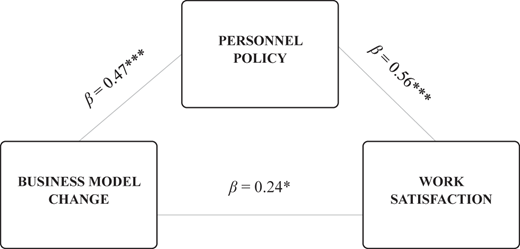
In the context of the growing dynamics of business model transformations and their impact on employees' subjective well-being, SEM offers a robust method to verify the mechanisms through which reorganization influences job satisfaction. This includes both direct effects and those mediated by the adjustment of personnel policies. The following are the results of SEM modeling, which illustrate the mechanisms by which business model transformation affects job satisfaction – both directly and through the mediating role of personnel policies. The diagram below presents the results of path estimation for the first model, in which personnel policies serve as a mediating factor in the relationship between business model changes and total job satisfaction. Both indirect and direct effects are visible, along with the estimated regression coefficients (β).
The model was of a general nature and served to verify the hypothesis about the direct and indirect impact of organizational changes on the level of job satisfaction, with the mediating role of personnel policies. The estimation results revealed the following:
The change in the business model has a statistically significant impact on the direction and intensity of changes in personnel policies (β = 0.47, p < 0.001).
Personnel policies significantly influence total job satisfaction (β = 0.56, p < 0.001).
The change in the business model also directly affects job satisfaction (β = 0.24, p = 0.037); however, this direct effect is weaker than the indirect one.
Mediation analysis, conducted using the bootstrapping method (n = 5,000), confirmed a significant indirect effect: β = 0.265, 95% CI [0.18, 0.36], p < 0.001. This indicates partial mediation – personnel policies mediate the relationship between business model changes and job satisfaction but do not fully explain it. The total effect of organizational changes on job satisfaction amounted to β = 0.50.
The model was estimated using the maximum likelihood (ML) method. The model fit indices were deemed satisfactory: χ2 (48) = 96.4, p < 0.001, CFI = 0.93, TLI = 0.91, RMSEA = 0.045, SRMR = 0.042. These results confirm the validity of the model's theoretical structure and its alignment with the data.
The above analysis shows that changes in the business model have a significant impact on changes in personnel policies and job satisfaction levels. There is a clear mediating effect of personnel policies, which reinforces the positive perception of the reorganization. All effects are positive. The results highlight the importance of personnel policies as a buffer in the transformation process – well-designed HR initiatives, such as effective communication, employee participation and development systems, can significantly boost employee satisfaction and reduce resistance to change.
The above model indicates that changes in the business model have a significant impact on adjustments in personnel policies and job satisfaction. A mediating effect of changes in personnel policies is clearly observed, with all effects being positive.
In research on organizational behavior, increasing emphasis is being placed on the analysis of multidimensional job satisfaction and the structural factors that determine it. Particularly in the context of organizational changes, SEM is increasingly used. SEM allows for the identification of whether and how personnel policies act as a buffering mechanism in the relationship between business model changes and various aspects of employee satisfaction. The results of the estimation of the in-depth SEM model covering six job satisfaction components are presented below.
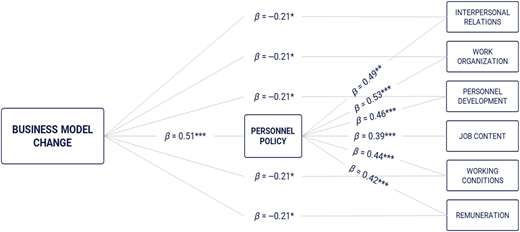
Figure 2 presents the in-depth structural model, where changes in the business model affect the components of job satisfaction exclusively through the mediating role of personnel policies. Six dimensions of satisfaction were considered: interpersonal relations, work organization, personnel development, job content, working conditions and remuneration.
The model reflects full mediation – changes in the business model directly and negatively impact each component of job satisfaction; however, these effects are mitigated or neutralized by interventions in personnel policies.
The estimation results demonstrated the following:
Business model changes positively influence personnel policies (β = 0.51, p < 0.001).
Personnel policies significantly and positively affect all components of job satisfaction:
Interpersonal relations (β = 0.49, p < 0.001)
Work organization (β = 0.53, p < 0.001)
Personnel development (β = 0.46, p < 0.001)
Job content (β = 0.39, p < 0.001)
Working conditions (β = 0.44, p < 0.001)
Remuneration (β = 0.42, p < 0.001)
Business model changes directly and negatively affect job satisfaction components, with an average impact of β = −0.21, p < 0.05.
The Sobel Test and the analysis of indirect regression paths confirmed the presence of full mediation – the impact of business model changes on the components of job satisfaction occurs exclusively through changes in personnel policies. The model was estimated using the maximum likelihood (ML) method. The model fit indices are at an acceptable level: χ2 (102) = 185.6, p < 0.001; CFI = 0.95; TLI = 0.92; RMSEA = 0.041; SRMR = 0.046.
The second model indicates that business model changes, when not accompanied by appropriate HR interventions, may lead to a decline in the evaluation of various aspects of job satisfaction. Personnel policies, therefore, act as a buffer for change, enabling employees to positively interpret organizational transformations. A well-managed change process – rooted in effective communication, employee participation and investment in employee development – can significantly enhance satisfaction and reduce resistance to change.
Overall, both models demonstrated that organizational change is not inherently positive or negative from employees' perspective – its perception depends on whether it is accompanied by coherent and supportive personnel policies. A well-managed change process (e.g., through communication, employee participation and development systems) can significantly enhance employee satisfaction and reduce the risk of resistance to change.
Discussion
The conducted research confirmed the existence of significant relationships between organizational changes – particularly business model transformations – and work satisfaction levels (Borowska-Pietrzak, 2023). Importantly, the results underscored that personnel policies play a key mediating role, significantly modifying both the strength and direction of the impact of these changes on employees. This is in line with another research (Wnuk, 2021; Rudawska, 2023). According to the first model (Figure 1), business model changes have a positive effect on both the development direction of personnel policies and overall job satisfaction. This may indicate that in many organizations, changes in the business model are used as an opportunity to redefine the personnel policies – to increase transparency, modernize motivational systems or improve working conditions. Under such conditions, with appropriate support from management and HR teams, employees perceive changes not as a threat but as an opportunity for growth. This perception is reflected in increased satisfaction levels.
The second model (Figure 2), which offers a more detailed approach, reveals that the direct impact of organizational changes on components of job satisfaction can be negative. This indicates that, initially, changes such as restructuring, new processes, automation or shifting objectives may be perceived by employees as destabilizing, increasing uncertainty and reducing their sense of control over their work. Changes in working conditions, if not properly communicated or implemented with employee involvement, can lead to violations of mutual expectations and commitments, ultimately resulting in lower morale.
This is where the strength of personnel policies as a mediating factor becomes evident. The results indicate that its indirect impact on partial satisfaction components – such as interpersonal relations, opportunities for development, work organization, remuneration and working conditions – is not only positive but also significantly stronger than the direct impact of organizational changes alone. This outcome can be interpreted considering Herzberg's motivation theory, in which motivators and hygiene factors interact differently on job satisfaction. Personnel policies can address both aspects – by eliminating sources of dissatisfaction (e.g. poor working conditions, inadequate pay, lack of communication) and by enhancing motivators (e.g. opportunities for advancement, recognition and professional development).
These findings align with empirical research, such as studies conducted by Hay Group (Royal & Yoon, 2009), which demonstrated that employee engagement levels in organizations with high-quality personal/HR policy were on average 2.5 times higher, and customer satisfaction levels were 22% greater compared to organizations where HR practices were primarily reactive and operational. In this context, the role of the HR department evolves from a service-oriented function to that of a strategic partner in driving change.
The results of this study align with the current trends in the literature emphasizing the integration of organizational strategy and HR strategy. Pocztowski (2018) points out that building value for stakeholders – including employees – should be the primary goal of personnel policies. Research confirms that this approach is not only valid but also practically effective.
From a practical standpoint, the results indicate that organizations cannot focus exclusively on the economic or market aspects of business model transformation. Each change should be carried out in parallel in the social dimension, through well-thought-out, coherent and engaging actions in the field of people management. Communication, participation, investment in development and responsible leadership are becoming integral elements of an effective change process. The results confirm previous findings (Ulrich & Brockbank, 2005), indicating the role of HR department as a strategic mediator between the intention of change and its social reception. In the studied organizational context, personnel policies acted as a mechanism transforming change into a source of positive professional experience, while neutralizing naturally occurring tensions and fear of losing control.
Practical implications
The results of the research have direct practical application in pharmacy management, which in recent years has been operating in conditions of intense business model change, including market consolidation, process standardization, digitization of patient service and the expansion of the role of pharmacies to include pharmaceutical care services. The analyses indicate that the effectiveness of these changes – from the perspective of pharmacist satisfaction – depends largely on the quality and consistency of personnel policy. In practice, this means that change must be managed at the level of individual pharmacies, not just at the level of the chain's headquarters. Pharmacy managers should be equipped with specific communication tools to explain the rationale behind the changes being introduced, such as new patient service standards, modifications to job responsibilities or the implementation of sales and inventory systems. Clearly linking organizational changes to the daily professional practice of pharmacists reduces the sense of chaos and work overload, which, as the results show, negatively affect the assessment of the organization and working conditions.
Another key implication is the need to strengthen the participation of pharmacy staff. A practical solution may be to involve pharmacists in the process of adapting procedures, e.g. in the area of pharmaceutical care, vaccinations or additional services. Consulting work schedules, responsibilities and how new tasks are carried out increases the sense of professional autonomy, which directly translates into greater satisfaction with the content of work and team relations.
Another important area of application for the results is professional development planning in the context of the changing role of pharmacists. Pharmacy organizations should link the transformation of their business model to realistic development paths, such as participation in pharmaceutical care programs, training in patient communication or the use of new technologies. Without such a link, changes are perceived as an increase in workload rather than an opportunity for competence development.
The results of the study also emphasize the need to adapt remuneration systems to new expectations and tasks. In the pharmacy industry, this means inter alia, greater transparency of bonus rules, taking into account the quality of work with patients, and not only sales results, and the introduction of non-financial incentives (e.g. flexible working hours, support for work-life balance). Such solutions reinforce the positive impact of personnel policy on job satisfaction, especially in conditions of regulatory and staffing pressure.
In summary, the results of the study indicate that in the pharmacy industry, changes to the business model should always be supported by consistent HR activities at the pharmacy and chain level. A properly designed personnel policy not only reduces the negative effects of change but also transforms it into a factor that strengthens the professional identity of pharmacists, the stability of teams and the long-term effectiveness of pharmacies.
Conclusions
The aim of this study was to present the relationship between the change of the business model and the level of job satisfaction, considering the mediating role of personnel policies. The conducted analyses, based on SEM, clearly demonstrate that well-designed and strategically integrated personnel policies can effectively mitigate consequences of business model transformations. Although changing the business model often causes anxiety, a sense of threat or a decrease in the sense of security among employees, research has shown that properly implemented HR activities – such as dialogue, participation, development support and adjustment of motivation systems – can not only neutralize this negative impact but also promote increased engagement and maintaining a high level of job satisfaction.
The obtained results confirm the assumptions of the contemporary paradigm of strategic human resources management, which emphasizes the need to treat personnel policies as active tools for managing change. In the surveyed organizations, personnel policies played the role of a mechanism integrating employee interests with the new logic of action resulting from the change in the business model.
At this point, it is necessary to note certain limitations when formulating conclusions resulting from the above study. Firstly, the correlational nature of the study does not allow for unambiguous conclusions about cause-and-effect relationships. Secondly, the study was conducted in a specific sectoral context, which limits the possibility of generalizing the results to other industries. Furthermore, it is recommended to include moderating and control variables in future research, such as gender, age, industry or job tenure, as these factors may influence perceptions of change and the effectiveness of HR interventions.
Regardless of the aforementioned limitations, the presented analyses provide practical premises for HR managers and specialists. They indicate the need for early and strategic planning of HR activities as part of organizational transformations and the importance of shaping a culture of dialogue, trust, and development. Integration of the personnel/HR function with the logic of change management seems today not so much an option as a necessity – both from the perspective of organizational effectiveness and employee well-being.
The results obtained are consistent with the accepted theoretical framework, according to which changes in an organization's business model affect employee satisfaction by modifying internal management mechanisms, in particular personnel policy. The identified empirical relationships confirm the assumptions of the literature indicating that reformulating the way value is created and delivered leads to changes in the organization of work, the scope of employee autonomy and expectations regarding their competences, which directly translates into the level of perceived job satisfaction.
The results of the empirical study thus provide an empirical illustration of the concept of a business model as a structure that determines not only an organization's market relations but also its internal functioning. In the context of publicly accessible pharmacies, these changes manifest themselves, among other things, in the intensification of sales activities, the redefinition of the professional roles of pharmacists and the increased importance of performance measures, which is reflected in the job satisfaction ratings obtained in the study.
At the same time, the use of personnel policy as an intermediate variable allows for better embedding of the results in the current research on the relationship between organizational change and employee well-being. The results confirm that it is not the change in the business model itself, but the manner of its implementation – in particular, personnel, communication and motivational solutions – that determines its consequences for job satisfaction. This approach ensures consistency between the theoretical part, the construction of the research model and the interpretation of empirical results, strengthening the internal coherence of the entire article.
Glossary of Acronyms and Specialized Terms
AdA (Pharmacy for Pharmacist Act) – Polish legal regulation introduced in 2017, limiting pharmacy ownership to pharmacists and imposing demographic and geographic restrictions on new pharmacy openings.
Business Model Change – A transformation in the way an organization operates, including changes in value creation, organizational structure, market approach or revenue logic.
HR/Personnel Policies – A coherent set of principles, practices and instruments aimed at managing employees, including recruitment, training, remuneration, performance appraisal and career development.
Job Satisfaction/Work Satisfaction – A cognitive and emotional evaluation of one's work and working conditions, reflecting the degree to which professional expectations are fulfilled.
SEM (Structural Equation Modeling) – A multivariate statistical technique used to analyze complex causal relationships between observed and latent variables, including mediation effects.
Mediation Effect – A statistical relationship in which the effect of an independent variable on a dependent variable is transmitted through a third variable (mediator).
Personnel Policy as a Mediator – The role of HR practices in transmitting and shaping the impact of business model changes on employee job satisfaction.
Pharmaceutical Retail Sector – A segment of the healthcare system focused on community pharmacies providing medicinal products and pharmaceutical care services.