


The presented article concerns managerial competencies in the medical device industry. The research aimed to identify and assess certain managerial competencies and diagnose the gap between the declared and desired competencies of the interviewed managers. We asked the following question: How does the model competence profile of a manager in the medical device industry look, and is there a gap between the desired and declared competencies of the relevant managers?
We conducted the research between 2018 and 2020 using diagnostic and survey methods. The study covered 130 managers representing various companies in the medical device industry. The companies were based in Germany, Great Britain, France and Poland.
Research results analysis showed a competency gap in most of the assessed competencies. Moreover, we found statistically significant differences in the self-assessments of managers concerning their nationality. Managers from Poland rated their competencies higher than respondents from other countries.
The study has several limitations. First, we collected the data between 2018 and 2020, before and during the early stages of the COVID-19 pandemic. Second, the research focuses on four selected countries, thereby limiting the findings’ broader applicability. Finally, we used an inherently subjective self-assessment method. This could potentially lead to discrepancies between perceived and actual competency levels.
The research results could potentially provide practical recommendations for medical device companies to eliminate the competence gap and create effective management development programs.
This research contributes to our understanding of the desired competence profile of managers working in the medical devices industry and to the diagnosis and assessment of the competency gap, i.e. the difference between the competencies desired for a given position and those that respondents possessed. Furthermore, this research identifies the differences between managers from Poland who represent the medical devices industry and those from other European countries.
Introduction
Currently, organizations operate in environments characterized by rapid and unpredictable changes. The drivers behind these changes are factors such as globalization, demographic shifts, rapid technological advancements, and unexpected events like the COVID-19 pandemic (Aldrich, 2008; Pieters, 2017; Brammer & Clark, 2020; Hanelt, Bohnsack, Marz, & Antunes, 2020; Cavus, Mohammed, & Yakubu, 2021; Centobelli, Cerchione, Esposito, Passaro, & Shashi, 2021). Such conditions require organizations to be flexible, adaptive, and innovative to thrive in a competitive global market. In this context, managerial competencies become a critical determinant of organizational success, as effective management is essential for navigating uncertainty and leveraging opportunities (Shet & Pereira, 2021; Korica, Nicolini, & Johnson, 2015).
The medical device industry, known for its rapid innovation and stringent regulatory demands, presents unique challenges that require specific managerial skills.
This study aims to explore the competencies required for managers in the medical device industry by identifying strengths and areas for potential development. We conducted the research between 2018 and 2020 with 130 managers from Germany, the United Kingdom, France, and Poland. We chose these countries due to their significant role in the medical device industry and diverse cultural backgrounds.
Behind effective leadership in any industry is competency models that define the core skills and attributes necessary for success in specific sectors. The medical device industry involves rapid innovation and complex regulatory requirements. Therefore, establishing a clear competence profile for managers is essential to ensure that they meet industry-specific demands (Hogan & Warrenfeltz, 2003; Asumeng, 2014; Griffin, Phillips, & Gully, 2019). This study seeks to answer the following question:
How does the model competence profile of a manager in the medical devices industry look?
Competency theory emphasizes the value of self-assessment as a tool for understanding a managerial cohort’s existing skill level. This approach provides insight into managers’ perceived strengths and highlights areas in need of improvement, thereby helping to highlight any misalignments between self-perception and organizational expectations (Chereau & Meschi, 2017). To explore these concepts, we asked a second research question:
What is the declared competence level of surveyed managers?
Gap analysis is a strategic tool used to identify the discrepancies between the current managers’ competencies and the ideal competencies required to meet organizational goals. This analysis is crucial for tailoring both training and development programs that address specific needs within an industry (Kaur & Kumar, 2013; Asumeng, 2014). Thus, we also investigated the following research question:
How does the competency gap manifest between managers' desired and declared competencies?
Cross-cultural management theories suggest that cultural and economic factors influence managerial behavior and skills significantly. Comparing managers from different national contexts, we can uncover how these influences shape the competencies required for effective leadership in a globalized industry (Bloom, Sadun, Lemos, & Reenen, 2019; Rašković, Colakoglu, Gonzalez-Perez, & Minbaeva, 2022). Consequently, the study poses the following question:
What are the differences in the declared level of competencies between managers from Poland and the other analyzed countries?
Theoretical framework
The article’s subject matter revolves around managerial competencies. This concept lacks a single, universally accepted definition in the academic literature. Instead, various perspectives exist, and they all propose different ways to define, categorize, and measure competencies. Frequently, scholars use terms like skills, abilities, and qualifications interchangeably with competencies, and thereby add to the concept’s complexity (Rakowska, 2007; Massing & Schneider, 2017). This diversity has led to numerous typologies in the literature. In this study, we focused on the widely recognized divisions between behavioral competencies, these pertain to the behaviors required for effective workplace performance and functional competencies. In turn, these behaviors come about due to specific knowledge and skill sets required for a particular role (Armstrong & Taylor, 2020).
According to the behavioral approach, competencies encompass knowledge, skills, and attitudes that enable individuals to perform effectively in specific situations. This broader perspective considers both internal factors (like knowledge and skills) and external factors (such as the organizational environment), which together influence employee behavior (Boyatzis, 2011).
Competencies go beyond skills as they involve knowledge, personal attributes, and motivation. They allow individuals to translate their skills into effective action (Antonacopoulou & Fitzgerald, 1996). From a human resource management perspective, competency potential, which is the aggregate of an individual’s traits and abilities, is critical in determining the current and future capacity of an individual to fulfill organizational tasks (Staškeviča, 2019). Competency potential includes theoretical knowledge, practical skills, motivation, and other personal characteristics that influence an individual’s capacity to meet their job requirements.
The literature has extensively discussed managerial competencies within the context of rapid economic and market changes. Scholars often divided them into technical, interpersonal, and conceptual skills, according to Katz’s proposition (Rakowska & Sitko-Lutek, 2000). Researchers have since expanded this framework and added diagnostic, communication, and decision-making skills to address the growing complexity of managerial roles and their ambiguity (Peterson & Van Fleet, 2008; Griffin et al., 2019). Notable frameworks, such as Whetten and Cameron’s model, emphasize the distinction between personal and interpersonal skills, while highlighting the importance of emotional intelligence and social adaptability in leadership (Whetten & Cameron, 2011).
Another popular perspective among scholars is the iceberg model of competencies, which suggests that only a fraction of competencies, such as technical skills, are visible and easily measurable. By contrast, more profound attributes like interpersonal skills and attitudes lie below the surface (Viitala, 2005). Although more complex to measure, these deeper competencies are often more critical for effective managerial performance.
The competency gap is a central concept to understanding how well managers meet organizational expectations. A competency gap exists when there is a discrepancy between the competencies required for a role and those that a manager currently possesses. Identifying this gap allows for targeted development and training programs to align current competencies with the ideal skill set that the organization requires (Kaur & Kumar, 2013).
Modern competency models have evolved to reflect the complexity of managerial roles. For example, Hogan and Warrenfeltz’s model categorizes competencies into intrapersonal, interpersonal, business/technical, and leadership skills, thereby highlighting the multi-faceted nature of managerial effectiveness (Hogan & Warrenfeltz, 2003). Similarly, Asumeng’s Holistic Domain Model further integrates competencies across domains, thus providing a comprehensive framework that includes leadership, technical abilities, mentoring skills, and interpersonal abilities to capture the full spectrum of managerial expertise (Asumeng, 2014).
In the VUCA context (volatility, uncertainty, complexity, and ambiguity), the medical device industry faces an increasingly unpredictable and turbulent environment that requires managers to possess agile, flexible, and innovative competencies (Raja, 2021). In these conditions, human capital has become the most critical asset for organizations, which often serves as a key source of competitive advantage (Liu, 2024). Organizational teams are more diverse than ever. Rapid internationalization, corporate expansions, mergers, and demographic shifts influence this trend. Furthermore, the drivers behind diversity are also aging populations and the coexistence of multiple generations within the workforce, each with unique expectations and skills (Rašković et al., 2022).
Technological advancements and internationalization have also heightened the demand for highly skilled professionals. In response to labor shortages, organizations increasingly recruit from diverse groups, including national minorities, immigrants, and older workers, who have historically occupied the periphery of the labor market (Chereau & Meschi, 2017). Simultaneously, the rising levels of public awareness regarding human rights and employment equality have led to stricter enforcement of anti-discrimination laws. These economic and social transformations have underscored the necessity for effective diversity management, which has become a strategic imperative in VUCA conditions (Rašković et al., 2022).
Consequently, organizations expect contemporary managers to develop competencies that will enable them to navigate complex and uncertain environments while leading diverse and multicultural teams effectively. This trend reflects the need for skills beyond traditional leadership, emphasizing adaptability, cultural awareness, and the ability to foster innovation amidst uncertainty (Rakowska, 2018).
This article focuses on the competencies of managers in the medical device industry, a sector of the economy characterized by its high innovation levels, significant growth potential, and global reach. The medical device and pharmaceutical industries are crucial components of the healthcare system. They contribute directly to the protection and improvement of public health by providing essential products for accurate patient diagnosis and effective treatment (Feliczek, 2016). Commonly, we refer to them as the medical technology or “medtech” industry. This sector includes companies that design, manufacture, and distribute various medical devices (Cheng, 2003). These devices range from simple consumer health products to highly advanced innovations, such as diagnostic tools, imaging technology, and complex surgical implants and monitoring systems (MedTech Europe, 2015). The complexity and diversity of this sector and its critical role in healthcare highlight the need for the targeted analysis of managerial competencies that are vital for driving success in this dynamic and internationally oriented industry.
Scholars frequently characterize the medical device industry as diverse and innovative. Moreover, scholars expect its further growth and increased significance in the future (Ramakrishna, Tian, Wang, Liao, & Teo, 2015). Key drivers of the sector’s development include advancements in medical science, the rising prevalence of chronic diseases, aging populations, and emerging new infections. Along with increasing organizational wealth, these factors fuel greater demand for healthcare services and lead to higher healthcare expenditures (The European Medical Technology, 2015). To address these rising costs, healthcare providers and organizations must form novel strategies to enhance clinical value by improving patient diagnosis, treatment, and rehabilitation processes through the efficient use of advanced technologies while achieving economic optimization.
Positioned alongside the defense and computer industries (Chatterji, 2009), scholars acknowledge the medical device sector as one of the world’s fastest-growing parts of the overall economy. We may see its expansion in the heightened sales of existing products and the development and launch of new, innovative offerings (Feliczek, 2016). Hence, the industry is often labeled high-tech, especially in highly industrialized countries with creative economies and substantial per capita national income (Gacek et al., 2013). Beyond manufacturing and commercial endeavors, the sector’s innovativeness and technological progress stem from extensive research and development activities that frequently result from collaborations with the scientific and academic communities. This scientific foundation necessitates the creation of specialized, high-paying jobs within the medical device sector and related sectors.
The medical device industry displays rapid innovation, dynamic growth (Feliczek, 2016; Gacek et al., 2013), and stringent market demands. It requires management teams to operate within a framework of complex regulatory environments, particularly given the sector’s reliance on advanced scientific research for developing new high-tech products (Chatterji, 2009; Addressing the Regulatory Divergences in the Medical Devices Sector, 2016). The industry’s global operational scale, which necessitates the effective management of culturally diverse teams, compounds this complexity. Thus, effective diversity management has become critical for leveraging varied perspectives, skills, and expertise sets in response to rapidly changing market dynamics.
A comparative analysis of managerial competencies across different countries in the medical device sector revealed significant variations stemming from local cultural, economic, and educational contexts. For instance, managers tend to demonstrate high technical and problem-solving competencies in countries with a strong engineering and technical education tradition, such as Germany and South Korea. This aligns with a culture prioritizing precision, technological expertise, and innovation. By contrast, countries with a more service-oriented economic structure, like the United States and the United Kingdom, often emphasize managerial competencies related to strategic thinking, communication, and leadership, which reflects educational systems that prioritize management and business skills (Qurashi & Zahoor, 2017; Bloom et al., 2019; Hampel, 2021).
Various economic factors also play a pivotal role in shaping managerial competencies. In developing economies, resource constraints may limit access to advanced training programs and development opportunities for managers in the medical device industry. This often results in a competency gap, particularly in terms of strategic decision-making and innovation management, where managers from developed economies frequently excel (Ricardianto et al., 2022). By contrast, managers from emerging markets might possess more practical, hands-on skills due to the necessity of operating with limited resources, these circumstances may foster creativity and adaptability (Ginter, Duncan, & Swayne, 2018; Krówczyński, 2019).
Furthermore, cultural differences also influence managerial competencies, particularly with regard to the typical approach to diversity management. Collectivist cultures, such as Japanese and Chinese cultures, display a stronger emphasis on group harmony and consensus-building, which may foster teamwork and conflict resolution competencies but at the same time hinder risk-taking and innovation (Bloom et al., 2019). Conversely, individualistic cultures, like that of the United States, promote leadership styles that encourage autonomy and entrepreneurial thinking. This approach can lead to a higher propensity for innovation but may challenge team cohesion (Hampel, 2021).
The present study concerns managerial competencies within the medical device industry in Poland, Germany, the United Kingdom, and France. The literature analysis concerning the subject revealed distinct national profiles shaped by unique cultural, economic, and educational contexts. In Germany, a country known for its strong engineering tradition and highly developed vocational education system, managerial competencies relate to a deep level of technical expertise and a structured approach to problem-solving. This aligns with the country’s focus on precision and efficiency, particularly within the field of medical technology, where regulatory rigor and technical excellence are paramount (Lawrence, 2017; Bird & Osland, 2017). By contrast, the United Kingdom emphasizes leadership and strategic competencies, thereby reflecting a business environment that values innovation, flexibility, and management skills fostered by a well-established higher education system and also strong ties between academia and the medical industry (The European Medical Technology, 2015).
As an emerging player in the medical device market, Poland exhibits a different competency profile. Managers often display practical skills in the fields of adaptability and resourcefulness, this reflects the recent economic growth of the country and increasing investment in high-tech industries. However, limited access to advanced managerial training remains a challenge, which highlights the competency gap in strategic decision-making and international market navigation as compared to their Western European counterparts (Lewandowska, 2016). With its long history of centralized regulation and an emphasis on healthcare quality, France prefers regulatory compliance, risk management, and patient safety competencies. French managers often prioritize competencies tied to navigating complex regulatory frameworks and maintaining high standards of medical safety and ethics (Bird & Osland, 2017).
The literature analysis revealed a research gap concerning the specific competencies that managers require in the medical device sector, particularly in light of these cultural, economic, and educational factors. This study addresses the gap by exploring how these diverse influences shape the skills, knowledge, and attributes that managers require in this globalized and innovation-driven industry.
The proposed research model conceptualizes managerial competencies such as integrating knowledge, skills, and dispositions from various sources. These include education, professional experience, and various demographic backgrounds. The proposed model examines four critical dimensions of competencies, i.e. knowledge, personal skills, interpersonal skills, and competencies related to diversity management. Given the global orientation of the industry and the significance of managing diverse teams, we integrated an additional category (not previously analyzed in depth by researchers in the context of the medical device industry) related to diversity management. This inclusion was essential, as successful management in the medical device sector increasingly requires the navigation of multicultural environments and fostering innovation within heterogeneous teams (Qurashi & Zahoor, 2017; Ginter et al., 2018).
Research methodology
We based the presented article on a quantitative approach, which aims to identify and assess the competencies of managers representing the analyzed enterprises. The presented study is part of a broader research project investigating the competencies of managers in the medical device industry and diversity management within their companies.
The study aimed to answer the following research questions:
RQ1: How does the model competence profile of a manager in the medical device industry look?
RQ2: What is the declared competence level of the surveyed managers?
RQ3: How does the competency gap manifest between managers' desired and declared competencies?
RQ4: What are the differences in the declared level of competencies between managers from Poland and the other countries analyzed?
We conducted an empirical study based on a literature review and reports from organizations in the medical device industry. The research involved two distinct stages. In the first stage, we conducted in-depth individual interviews with six managers from Poland, all of whom had over five years of managerial experience in the medical devices industry within multinational corporations. The research team conducted these interviews in person between March and May 2018. The qualitative research aimed to refine the survey questionnaire, specifically the proposed competency model for medical device industry managers. Initially, we developed this process through a comprehensive literature review. During these interviews, we asked participants to identify critical competencies relevant to their industry, assess their significance within the context of the role of a medical device manager, and provide feedback concerning the survey content. The sample selection was purposeful. We targeted experienced managers to ensure their relevant expertise. We systematically coded and analyzed the collected qualitative data to identify patterns and insights, which informed the final structure and content of the survey tool used in the second research stage.
The next step of the empirical study was quantitative research that used a diagnostic survey method and survey technique. The survey assessed managerial competencies, and its design ensured that respondents evaluated each of the analyzed competencies from two points of view: (1) the importance of a given competency with regard to their current professional work and (2) the perceived level of a given competency. We asked respondents to rate competencies on a scale of 1–7, where one was the lowest, and seven was the highest.
The questionnaire included four areas of competencies, i.e.:
Knowledge (15 items);
Personal skills (9 items);
Interpersonal skills (25 items);
Competencies and attitudes related to diversity management (12 items).
We conducted the quantitative research in English and through direct contact. We presented only the study of Polish managers in their native language. We translated the questionnaire from Polish to English and vice versa to ensure conceptual equivalence and clarity.
We conducted the empirical research from 2018 to 2020, employing a diagnostic survey using a particular survey technique. The study covered the management staff of companies in the medical device industry. They were mainly senior and middle-level managers in small and medium-sized enterprises due to the structure of the industry in which approximately 95% of employees work. We also assumed that the structure of the surveyed sample reflected the structure of the sector in terms of gender, age, and nationality.
We conducted the research in selected European countries, i.e. Germany, France, Great Britain, and Poland. Apart from Poland, we selected countries with a high degree of activity in the medical device industry. Germany, France, and the UK are among the six countries in Europe with the highest number of registered business entities dealing with medical devices and the highest percentage of people employed in this industry.
The sample selection was purposeful. Approximately twenty-six thousand companies operate in Europe. One hundred and thirty managers participated in the study, thereby constituting approximately 0.5% of the total population.
We surveyed 130 managers from 130 different organizations. Among the respondents, 21% work in micro-enterprises, 46% in small enterprises, 25% in medium-sized enterprises, and 8% in large enterprises. At the same time, 71% of these companies operate globally, 18% in different European countries, and 11% only operate nationally. The structure of origin of the surveyed organizations is as follows: 32% are registered in Germany, 19% in Great Britain, 26% in France, 18% in Poland, and 5% in other countries.
Among the surveyed managers, 11% worked at a low management level, 67% at a medium or high management level, 18% on a management contract, and 5% did not respond. In total, 38 women and 91 men participated in the study. Among them, 19% represent the baby boomer generation, 43% represent Generation X, and 38% represent Generation Y.
The conducted research provided empirical material that we subjected to statistical analysis. We entered the obtained data into a database created on an Excel spreadsheet. The subjects of measurement and analysis were qualitative (metric) and quantitative (7-point ordinal scale and average) variables. We assessed the relationships between the qualitative variables using the Chi-square test of independence. We used Cronbach’s alpha coefficients to assess the reliability of the scales and analyzed the relationship between the quantitative variables studied using the Pearson correlation coefficient.
Findings
We asked respondents to assess the analyzed competencies in two ways, i.e.:
Determining the importance of a given competence in the work of a manager in the medical device industry;
By assessing their level of a given competence.
The results of the first part of the analysis, i.e. the importance of a given competence in the workplace, became the foundation for building a model; the desired competence profile of the manager of the analyzed industry. By contrast, we used the second part (concerning the level of a given competence assigned by the respondents) to construct a profile of the competencies declared by the respondents. Combining these two approaches allowed us to diagnose the competence gap, which is the difference between the competencies desired in a given position and those possessed by the respondents.
We selected the most important managerial competencies using R. Kolman’s quality assessment method, in which the tolerance for the value of the examined feature is set at <0.7; 1> (Kolman, 2009).
The importance of certain competencies in the work of managers
Among the 15 assessed knowledge areas, respondents indicated found the following as most important for managers in the medical industry: English knowledge (94% of respondents gave this a rating of 5, 6, or 7), strategic management (89%), marketing knowledge (88%), industry knowledge (87%), understanding the relevant legal regulations (80%), and general medical knowledge (75%).
Less than 70% of respondents rated the remaining competencies as necessary. The least important factors in the work of an industry manager were medical pharmaceutical knowledge (which only 26% of respondents considered significant), knowledge of foreign languages other than English, and the use of IT applications designed for the industry (in each case 45% of respondents thought of them as important in the workplace).
In the next step, we asked respondents to assess the importance of personal skills in their professional work. Respondents rated the following five out of nine possible competencies as the highest: resistance to stress and self-control (92% of respondents rated them as important at work), proficiency in thinking and creating solutions other than those that already exist, consistency in action and entrepreneurship (91% each). Only one of the competencies analyzed in this group was rated as necessary by less than 70% of respondents. This was the ability to create and use new media forms (films, presentations, portals, etc.) and the ability to critically assess such content (rated as necessary by 68% of respondents).
The largest group of assessed competencies were interpersonal skills. All but one of the 25 competencies from this group were part of the set of the highest-rated competencies according to R. Kolman’s methodology. Respondents gave the highest scores to negotiation skills (which 97% of respondents considered necessary at work), teamwork (94%), prioritizing goals (93%), effective communication, and ethical behavior (92% each). In this group of competencies, the lowest-rated skill was the ability to work effectively in virtual teams, which respondents rated at 67%.
The last group of analyzed competencies involved the competencies and attitudes related to diversity management. In this group, respondents rated all 12 competencies very high (over 78% of respondents considered each of them necessary in their work). The most significant percentage of respondents considered learning at work to be essential (93%). Moreover, respondents rated the following as necessary: understanding, tolerance, and respect for cultural differences (85%), open and flexible attitude, curiosity about diversity (83%), and fair and impartial treatment of diversity (81%). The lowest, but still very high, was knowledge orientation (78%).
The research results allowed us to identify a model competence profile of medical device managers. The ten highest-rated competencies included the following competencies: knowledge of English (average score 6.4 on a 7-point scale), negotiation skills (6.3), building and using one’s network of contacts, effective communication, active listening, and teamwork (each with an average of 6.2), and finally: establishing new contacts, prioritizing goals, ethical behavior, and learning at work (average 6.1).
Competency gap
In the next stage, we asked respondents to self-assess their competencies. Notably, respondents rated the level of competencies held as lower than the need for the same competencies in their workplace. A comparative analysis showed statistically significant differences in 46 out of 62 competencies. This means that a gap occurred in 74% of the assessed competencies. We calculated the significance level using the student’s t-test. The limit value was 0.05.
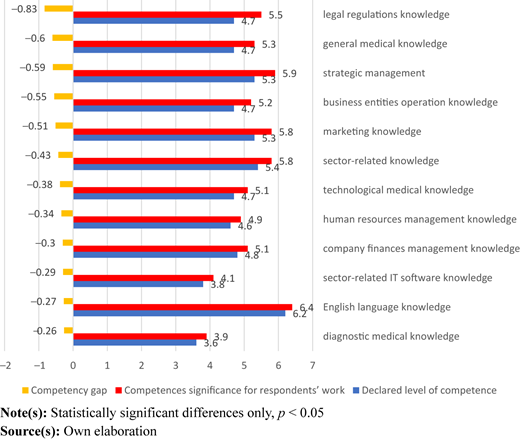
In the case of the first of the analyzed competence areas, i.e. knowledge, only three items showed no significant statistical differences. This applies to general IT skills, medical and pharmaceutical knowledge, and knowledge of foreign languages other than English. In the case of the remaining competencies assessed by this group, we diagnosed a competency gap. The most significant number concerns knowledge of legal regulations (0.83, with the average for importance at work being 5.5 and the average declared by respondents being 4.7). The following areas regarding the gap were knowledge areas such as general medical knowledge (gap of 0.60, average 5.3 vs 4.7) and strategic management (0.59; 5.9 vs 5.3). Figure 1 graphically presents the knowledge-related competency gap.
The next area of assessed competence was respondents’ personal skills. The statistical analysis of the collected material showed no statistically significant differences in two of the nine assessed competencies, i.e. awareness of one’s strengths and weaknesses and the tendency to take risks. In other cases, we noted a competency gap between the demand for competencies and the level declared by the respondents. In the case of the remaining seven competencies, we identified a competency gap was identified (Figure 2), with the most significant differences between the demand for competencies at work and the level declared by the respondents regarding stress resistance (gap of 0.50; with averages of 6.0 vs 5.5), creating and handling new forms of communication (0.43; 5.1 vs 4.7), and proficiency in thinking and creating solutions other than the existing ones (0.38; 5.0 vs 5.6).
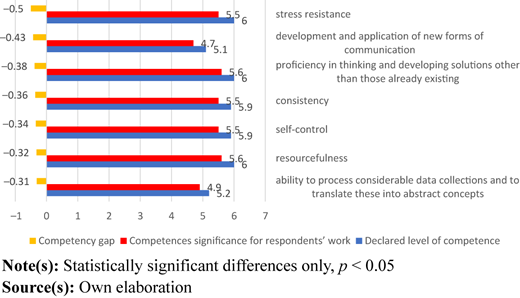
Competency gap in the competencies related to the personal skills of the respondents
Competency gap in the competencies related to the personal skills of the respondents
The next area of competencies assessed concerned the largest group, i.e. interpersonal skills (Figure 3). As many as 92% of the 25 competencies surveyed showed significant statistical differences. We found an enormous gap regarding the ability to build and use one’s network of contacts (0.97, with averages of 6.2 vs 5.2). Other competencies in which we diagnosed a high competency gap was the creation of a vision and the ability to transfer it (0.76; 5.8 vs 5.1) and negotiating skills (0.75; 6.3 vs 5.5). We diagnosed no competence gaps only for ethical behavior and building trust. Respondents indicated these competencies as very important for managers in the medical device industry and declared that they possessed a high level of these skills.
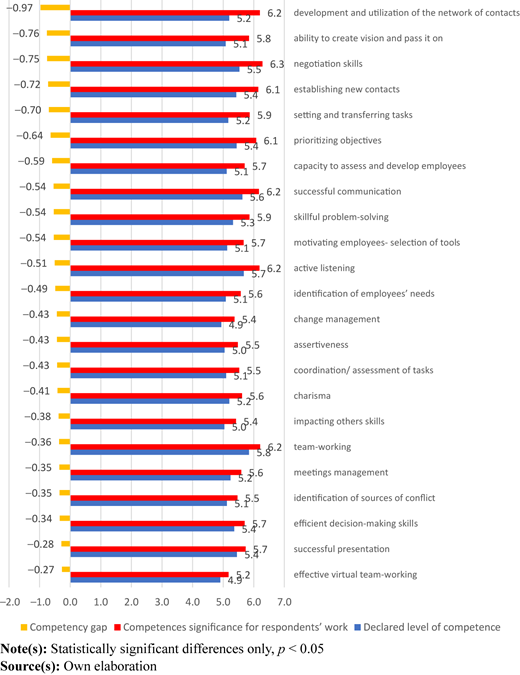
Competency gap in the competencies related to the interpersonal skills of respondents
Competency gap in the competencies related to the interpersonal skills of respondents
The last competency area was the competency related to diversity management. We observed a competency gap only in 2 out of 12 of the assessed competencies. Interestingly, in the case of understanding, tolerance, and respect for gender differences, the level declared (average rating of 5.9) by managers significantly exceeded the desired level (average rating of 5.6). For the remaining nine competencies, managers claimed to possess a level of each competency close to the average importance that respondents assessed to be necessary in the workplace. We diagnosed a competency gap only in the case of two items (Figure 4). These were learning at work (0.26; 6.1 vs 5.8) and the ability to manage differences resulting from diversity (0.25; 5.5 vs 5.3).
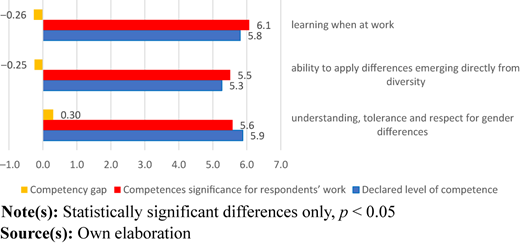
Competencies and nationality
We found it interesting to learn about the differences in competencies declared by managers from different countries. For this purpose, we conducted a statistical analysis of the collected empirical material. We compared the competencies declared by managers from Poland and the managers from other countries. Table 1 presents the results in this area but only for competencies that displayed statistically significant differences. Interestingly, in the case of all the competencies assessed, Polish managers declared that they possessed a higher level of a given competency than their foreign counterparts.
Self-assessment of competencies: poles vs other respondents
| Competencies | Poles | Germans, French, British | Difference in the declared competence level | p |
|---|---|---|---|---|
| K: human resources management | 5.33 | 4.4 | −0.94 | 0.01 |
| K: sector-related knowledge | 6.17 | 5.21 | −0.97 | 0 |
| K: sector-related IT software knowledge | 4.63 | 3.61 | −1.02 | 0.01 |
| PS: awareness of own strengths and weaknesses | 6.04 | 5.51 | −0.53 | 0.04 |
| IS: identification of sources of conflict | 5.54 | 4.98 | −0.56 | 0.04 |
| IS: change management | 5.48 | 4.84 | −0.64 | 0.04 |
| IS: motivating employees- selection of tools | 5.63 | 4.97 | −0.66 | 0.04 |
| IS: ability to create a vision and pass it on | 5.58 | 4.94 | −0.64 | 0.03 |
| IS: effective virtual team-working | 5.48 | 4.76 | −0.72 | 0.02 |
| IS: efficient decision-making skills | 5.96 | 5.22 | −0.74 | 0.01 |
| DM: open and flexible attitude | 6.33 | 5.75 | −0.58 | 0.04 |
| DM: learning when at work | 6.30 | 5.64 | −0.66 | 0.03 |
| DM: ability to apply differences (…) | 5.87 | 5.11 | −0.76 | 0.02 |
Note(s): Statistically significant differences only, p < 0.05
Source(s): Own elaboration
In the case of competencies in the area of knowledge, statistically significant differences occurred in 20% of the analyzed competencies. They concerned IT applications, HRM knowledge, and industry knowledge.
Regarding competencies in the area of personal skills, we found statistically significant differences only in one. It concerned an awareness of one’s strengths and weaknesses.
The next area we examined was interpersonal competencies. Of the 25 items, we diagnosed differences due to nationality for six items, i.e. 28% of the total. Polish managers rated themselves significantly higher than the other respondents in terms of their ability to create a vision and communicate it, identify sources of conflicts, manage change, motivate employees, the ability to make efficient decisions, and the ability to work effectively in virtual teams that involve building commitment, being a leader, motivating.
The last analyzed competence area concerned competencies and attitudes related to diversity management. We diagnosed statistically significant differences in three of the 12 analyzed competence areas, i.e. the ability to use differences resulting from diversity, learning at work, and an open and flexible attitude.
Discussion
We evaluated the competencies of managers in the medical device industry, with data collected from 130 managers across four European countries. We identified a set of competencies crucial for effective management within the industry. Notably, 70% of respondents considered 82% of the evaluated competencies (50 out of 61) either necessary or very important, with a rating of 5 or higher on a 7-point scale. These findings facilitated the development of a model competency profile specific to the medical device sector.
The top-rated competencies, such as English language proficiency (6.4 average rating), negotiation skills (6.3), communication skills, networking, and teamwork, emphasize technical and interpersonal skills. We may attribute the prominence of English language proficiency to the international operations of medical device companies, where English serves as the primary business language. This result is consistent with the findings of the Konigova team (2012), which underscored the importance of foreign language skills and specialized industry knowledge for managerial roles, thereby reflecting the medical device industry’s international and highly regulated nature. Similarly, Rakowska (2008) and Szczepańska-Woszczyna and Dacko-Pikiewicz (2014) also identified industry-specific expertise as a crucial competency, thereby underscoring the alignment between this study’s results and the existing literature.
Respondents also rated highly interpersonal skills such as negotiation, networking, effective communication, and teamwork, thereby confirming the significance of these competencies in the literature. Scholars like Chong (2013), Nikitina and Lapiņa (2019), and Shet and Pereira (2021) have consistently emphasized that interpersonal skills are vital for contemporary managers, especially in sectors where collaborative problem-solving and stakeholder management are critical.
The study identified a competency gap in two-thirds of the evaluated competencies, thereby indicating statistically significant discrepancies between the current skill levels of managers and the competencies deemed necessary for effective performance. This suggests a need for targeted development in areas such as industry-specific knowledge and legal expertise, particularly given the complex regulatory environment of the medical device sector. These results are consistent with the findings of Wong (2020) and Sitko-Lutek and Jakubiak (2020), who argue that managers in innovative and cross-sectoral industries must engage in continuous, strategic competency development to remain competitive.
A comparative analysis revealed notable differences in self-assessment among managers from Poland as compared to those from other countries included in the study. Polish managers tended to rate their competencies higher in 23% of the evaluated competencies. This may indicate a stronger self-perception or reflect some specific context of the industry as it operates in Poland. In Poland, society considers the medical device sector to be prestigious. Therefore, it potentially attracts more qualified individuals as compared to Western Europe where the industry is just one of several attractive sectors. This disparity aligns with the concept of cultural differences in terms of self-assessment and the perception of professional competency, thereby highlighting the need for future research to explore these distinctions in greater depth.
Conclusions
Human resources are among the most critical assets that leaders manage. In managerial practice, there is a continuous effort to implement innovative strategies that maximize the workforce potential and foster productivity, engagement, and job satisfaction. However, to effectively support the professional development of their teams, managers must continuously enhance their competencies. This study specifically focused on identifying the competencies necessary for managers in the medical device industry and diagnosing the competency gap between the required and existing skill sets. Recognizing this gap is essential for prioritizing areas critical to improving managerial competencies. The analysis of the research results provided answers to the following research questions:
RQ1: What does the model competence profile of a manager in the medical devices industry look like?
The research identified a model competence profile for managers. It emphasized a combination of technical and interpersonal skills. Key competencies included English language proficiency, negotiation skills, communication, networking, and teamwork. These competencies reflect the international scope and complexity of the medical device sector.
RQ2: What is the declared competence level of the surveyed managers?
The study assessed the current levels of these competencies. In total, 70% of respondents found 82% of the evaluated competencies as necessary or very important. This assessment provides a clear view of the strengths managers perceive in themselves and highlights the further development potential.
RQ3: How does the competency gap manifest between managers' desired and declared competencies?
We observed a significant competency in two-thirds of the assessed competencies, indicating a mismatch between the current skill levels of managers and the competencies they view as crucial. This highlights the specific areas where targeted professional development must align with industry demands.
RQ4: What are the differences in the declared competencies level between managers from Poland and the other countries analyzed?
The comparative analysis showed that Polish managers rated their competencies higher than their counterparts in other countries in 23% of the evaluated areas. This may reflect a stronger self-perception or industry dynamics specific to Poland, the society considers the medical device sector as particularly prestigious.
We conducted the research within the medical device industry, which supports national healthcare systems and remains competitive in a dynamic economic environment. An analysis of the existing literature highlighted a notable research gap concerning the specific competencies required by managers in this field and the presence of a competency gap within organizations producing medical devices. We aimed to contribute to closing this gap, but we also recognize that the study does not exhaust the topic but rather serves as a valuable contribution to the ongoing discussion concerning managerial competencies in the medical device industry.
A research results analysis allowed us to indicate future research directions. Importantly, the self-assessment method we used in this study was inherently subjective, which might potentially lead to discrepancies between perceived and actual competency levels. Future research should aim to employ more objective assessment tools to validate these findings and explore how these competencies evolve in response to external factors such as global disruptions, the COVID-19 pandemic being a prime example. Furthermore, scholars could also expand the research range to include a broader, more representative sample across different regions and company sizes. This would enhance the results’ generalizability and provide a more comprehensive understanding of managerial competencies in the medical device industry.
This study has several limitations. First, we conducted the research between 2018 and 2020, just before and during the early stages of the COVID-19 pandemic. The pandemic had a notable impact on the medical device industry, as it required managers to develop new skills such as crisis management, rapid decision-making, and digital transformation. Although the study provides valuable insights into managerial competencies as they existed during this period, the fast-changing landscape highlights the need for future research to examine how global disruptions like the pandemic have influenced the necessary skill set for managers in this field. Such studies could offer a clearer picture of how competencies have evolved before, during, and after the pandemic, thereby aiding in better preparation to meet future challenges. Moreover, the study focused on four selected countries, thereby limiting the generalizability of the relevant findings. The sample used in this study does not represent the entire medical device industry. This factor restricts our ability to apply the results more broadly. However, we identified specific managerial competencies and highlighted critical gaps, thus providing a foundation for more extensive and diverse future research.

