


The study aims to investigate the perceived institutional barriers of migrant entrepreneurship faced in a new destination host country and the abilities of local authorities to support migrant entrepreneurship.
We applied the qualitative research method based on the focus group discussions. Migrants from two sub-groups (Ukrainian, n = 19 and other, n = 15) participated in four focus groups conducted between February 2023 and July 2024 in one of the cities in Poland, which constitutes a new immigrant destination country.
We found some perceived formal barriers in migrant entrepreneurship in the new destination country, similar to those of migrants regardless of their country of origin, such as language barriers, lack of comprehensive information on running a business, lack of legal and advisory support and bureaucracy. Migrants’ origin (Ukrainian vs non-Ukrainian) also influences differences in their perceived access to funding, and their stability and legal aspects of residence affect their entrepreneurial activities.
Our results contribute to the discussion on migrant entrepreneurship from the perspective of the new destination host country. We recognize similarities and differences in migrants’ barriers to entrepreneurship depending on their origin. We discovered nuances in the perception of institutional barriers in the context of migrant diversity and how non-Ukrainian migrants feel treated as “worse” migrants.
Introduction
With the rising migration scale in recent times (King & Okólski, 2019; Dao, Docquier, Maurel, & Schaus, 2021; Trehan, Hu, & Kevill, 2021), the economic integration of migrants into host societies is a significant aspect of the political debate (Häkkilä & Toikko, 2021; Michele, Luisa, Martina, & Simone, 2023). Scholars often perceive entrepreneurship, understood as establishing and running one’s own business (De Luca & Ambrosini, 2019; Audretsch, Belitski, Caiazza, & Desai, 2022; Brieger & Gielnik, 2021; Gaweł & Toikko, 2024) as a viable option for migrant integration, as it overcomes obstacles that migrants face in the labor market (Vandor, 2021; Farashah & Blomquist, 2022). Migrant entrepreneurship is a phenomenon gaining research attention (Nazareno, Zhou, & You, 2019; Dabić et al., 2020; Desai, Naudé, & Stel, 2021; Morales, Brieger, De Clercq, & Martin, 2022). However, the existing literature about migrant entrepreneurship suffers from a limited number of analyzed host countries (Wellalage, Fernandez, & Bui, 2023). In particular, research on immigrant entrepreneurship in new destinations is limited despite the immigration’s increasing geographic diversity (Liu, Liang, & Chunyu, 2023).
The distinctiveness of new immigrant destination countries is linked to the novelty of the migration situation, which impacts both residents and migrants (Winders, 2014). Compared to traditional destinations, where migration policies have evolved with years of experience in receiving migrants (Backman, Lopez, & Rowe, 2021; Nijhoff, 2021; Salmon & Singleton, 2023; Solano, 2023), countries that are new destinations need to create a new political framework for migrant integration (Dobbs, 2024; Winders, 2014). To formulate the policy supporting migrant entrepreneurship in new destination countries, it is first crucial to understand the institutional barriers that migrants perceive, which justifies the first research question.
What are the perceived institutional barriers that migrants encounter in the new destination country when engaging in entrepreneurship?
Local aspects of migrants’ settlement also impact their entrepreneurship due to the importance of spatial differentiation, geographical distance, size of the place or mobility infrastructure, or accessibility to local resources (Kalantaridis & Bika, 2006; Riaño, Webster, Sandoz, Solano, & Yamamura, 2024; Yetkin & Tunçalp, 2023). Local institutions often mediate between the national regulatory system and migrants (Ozasir-Kacar & Essers, 2023) and manage the migration flow (Malatinec, Urbančíková, & Hudec, 2020), which allows us to formulate the research question about the role of local authorities of new destination countries in supporting migrant entrepreneurship.
How can local authorities in the new destination country support migrants in overcoming these barriers?
The article is structured as follows. In the theoretical section, we will discuss the mixed embeddedness of migrant entrepreneurship and the specifics of new immigrant destination countries. Then, we will follow by presenting the research context of Poland as an example of a new destination country that is part of Central and Eastern Europe. We will describe the research method based on focus group interviews with Ukrainians and other migrants settled in Poland and planning a business. We will present and discuss the research results, together with their implications.
Theoretical development
Migrant entrepreneurship and its mixed embeddedness
Migration is one of the key recent phenomena (King & Okólski, 2019; Dao et al., 2021; Trehan et al., 2021) discussed in the context of economic integration, meaning the achievement of the professional status of a migrant compatible with their skills and qualifications (Michele et al., 2023). Effectively handling the movement of migrants stands as a primary challenge for European nations in the twenty-first century (Dao et al., 2021; Coletti & Pasini, 2023). Entrepreneurship is considered both as one way of economic integration for migrants into receiving countries and as a way of opportunity-driven way of development (Wiers and Chabaud, 2022; Coletti & Pasini, 2023), also for refugees (Almohammad, Durrah, & Ahmed, 2021; Backman et al., 2021). Scholars see migrant entrepreneurship as necessity-driven, undertaken because of limited possibilities for employment due to discrimination, language or qualification barriers, and as opportunity-driven, aiming to exploit the business potential of host countries (Nazareno et al., 2019; Wellalage et al., 2023; Yasin & Hafeez, 2023). Differences in individual access to human, social, and financial capital, as well as in the structural environment of the country of origin and the host country, affect the diversity of migrant entrepreneurship (Nazareno et al., 2019). The specific spatial and social contexts of running a business, related to the cross-border movement, and knowledge of the language and cultural norms of the host countries, are the main features of the migrant entrepreneurial environment (Salmon & Singleton, 2023; Zhang, Wei, & Mao, 2024). Moreover, migrant entrepreneurs already established in the host country also play a crucial role in assisting newcomers with their integration (Coletti & Pasini, 2023).
Scholars often use the theory of mixed embeddedness to explore the obstacles to migrant entrepreneurship (Kloosterman, Van Der Leun, & Rath, 1999; Salmon & Singleton, 2023; Wellalage et al., 2023; Yamamura, 2023). Despite opinions that it has lost its applicability (Wiers & Chabaud, 2022), the mixed embeddedness theory has become a kind of benchmark in the discussion on migrant entrepreneurship (Solano, 2023; Wellalage et al., 2023; Yetkin & Tunçalp, 2023).
The theory of mixed embeddedness assumes that entrepreneurs operate being embedded both in their social networks and the economic and political framework (Kloosterman et al., 1999). This theory combines the agency of migrants and the opportunity structure (Solano, 2023), as the agency of migrant entrepreneurs is embedded in their social networks and available resources (Nijhoff, 2021; Yasin & Hafeez, 2023). It assumes the dual embeddedness in both social networks and institutional contexts (Yamamura, 2023). At the macro level, the institutional regime of the host country affects migrant entrepreneurs; at the meso level, local and regional settings influence them; and at the micro level, their resources shape their experiences (Bagwell, 2018).
In the case of migrant entrepreneurs, scholars often discuss the institutional and socio-economic environment of the host country (Bagwell, 2018). The institutional context of the host country relates to the macro-economic structures of business rules, regulation, and legislation as well as business culture (Kloosterman et al., 1999; Solano, 2023; Solano, Ram, & Rath, 2023). Typically, scholars discuss the institution’s impact on entrepreneurship from the perspective of regulatory, normative, and cognitive pillars (Haini et al., 2023) or formal and informal institutions (Ratten & Tajeddini, 2018). In the context of migrants, the host country’s institutional embeddedness varies most among host countries (Bagwell, 2018), and the national regulatory framework affects variations in migrant entrepreneurship across different countries (Yasin & Hafeez, 2023).
According to Bagwell (2018), authorities should incorporate local embeddedness into the concept of mixed embeddedness. The inclusion of spatiality is needed to acknowledge the significance of spatial differentiation, geographical distance, and the size of the place or mobility infrastructure in shaping migrant entrepreneurship (Yetkin & Tunçalp, 2023; Gaweł & Marcinkowski, 2024; Riaño et al., 2024), especially as the research recognizes reliability on local resources in the entrepreneurial processes (Kalantaridis & Bika, 2006). Moreover, local institutions often act as an intermediary between the regulatory system and migrants (Ozasir-Kacar & Essers, 2023) and are responsible for migration flow management (Malatinec et al., 2023).
The literature widely discusses barriers to migrant entrepreneurship, including forcibly displaced refugees (Salmon & Singleton, 2023). Among them, scholars perceive multidimensional barriers in relation to language support, business and legal advice, or access to seed funds (Salmon & Singleton, 2023). Other barriers investigated in the literature are status and residence permits, access to different institutions of the host country, and understanding the complex bureaucracy (Nijhoff, 2021; Yamamura, 2023). Moreover, literature recognizes legal status showing rights to full access to the labor market of the host country as an individual characteristic of migrants impacting their ability to engage in entrepreneurship (Solano, 2023). The institutional framework also determines the legal capacity of certain migrant groups to become self-employed, often based on the legal status of their residence (Solano, 2023). Scholars also consider cultural determinants to be an important factor affecting migrant entrepreneurship. A range of studies found a significant negative effect of cultural distance on migrants’ self-employment both for external (Mrożewski & Hering, 2023) and internal migrants (Zhu, Lee, Hong, & Shi, 2023).
Migrant integration in the new destination host countries
Europe has attracted a significant number of international migrants in the last few decades, experiencing several waves of migration after the Second World War (King & Okólski, 2019). European countries differ across dimensions, including their migration strategies pertaining to third-country nationals (Michele et al., 2023; Solano, 2023). Political history after 1945 constitutes the primary explanation of Europe’s division. The Iron Curtain split Europe into the Western and Eastern Blocs; within the Western Bloc, northwestern regions attracted immigration, while southern regions experienced emigration (King & Okólski, 2019; Dobbs, 2024). The collapse of communism and the enlargement of the European Union are the key trends that significantly shaped the migration map of Europe after the 1990s (King & Okólski, 2019). In consequence, there are European countries, such as the United Kingdom, which have attracted regular migration and refugees for many years (Trehan et al., 2021; Salmon & Singleton, 2023), while for others, the net immigration situation is a relatively new phenomenon.
As new countries and new regions become attractive destinations for migration, scholars have developed the concept of new immigrant destinations (Winders, 2014). The common features of the new migration directions are a short-term acceleration of the immigration flow and a change in the long-term tradition of emigration (Pędziwiatr & Magdziarz, 2023). Although the concept of new immigrant destinations relates not only to new destination countries but also to regions, for example, rural or mountain regions (Kalantaridis & Bika, 2006; Fromentin, 2023; Michele et al., 2023), in the article, we focus on the country level.
In the context of countries and regions, new immigration destinations create some challenges in migrant integration (Liu, Liang, & Chunyu, 2023). All aspects of migration integration are new for both residents and institutions (Winders, 2014). In traditional destinations, years of experience in hosting migration allow them to formulate policies towards migration and practices in their integration (Backman et al., 2021; Nijhoff, 2021; Salmon & Singleton, 2023; Solano, 2023), while the situation of receiving countries of new destinations is diverse as they need to create a new political framework and their migration policies (Winders, 2014; Dobbs, 2024). The institutional and economic contexts of new immigration destinations include the absence of ethnic communities or the inexperience of receiving immigrants from locals (Liu et al., 2023). The specific situation of the new destination countries implies the need to understand the perceived barriers to entrepreneurship of settled migrants in new destination countries to develop the institutional framework, and the capacity of local authorities to support migrant entrepreneurship.
Research method
Poland as an example of a new immigrant destination: the research context
Poland is a new immigrant destination country similar to some other countries in Central and Eastern Europe (Dobbs, 2024). Czechia, as one of the first former Eastern Bloc countries, started to attract migrants soon after the fall of the Iron Curtain (Křížková & Ouředníček, 2020). Later, other Visegrad countries, such as Poland, Slovakia, and Hungary, also experienced net immigration (Pędziwiatr & Magdziarz, 2023).
In the first decade after the European Union enlargement in 2004, Polish citizens massively emigrated to the EU countries due to economic reasons and became a significant group of foreigners (Okólski, 2021; Salamońska, Lesińska, & Kloc-Nowak, 2021; Grabowska & Jastrzebowska, 2023), often engaged in entrepreneurship (Lassalle, Johanson, Nicholson, & Ratajczak-Mrozek, 2020). This resulted in the decades of negative migration balance (Brzozowski, Chwat, & Sikorska, 2023). Then, we observed their returns (Grabowska & Jastrzebowska, 2023). Estimates show that around two million Polish citizens emigrated during the peak between 2004 and 2017 and were still abroad in 2018, accounting for approximately 5% of the population (Okólski & Wach, 2020).
Before the fall of the Iron Curtain in 1989, immigration to Poland was unattractive and in fact inaccessible (Okólski & Wach, 2020). After the accession to the European Union, Poland not only experienced intensive emigration, but also started to attract significant numbers of immigrants, with increasing diversity in terms of nationality, ethnicity, gender, age, education, and employment (Okólski & Wach, 2020; Okólski, 2021; White, 2022; Kałuża-Kopias, 2023).
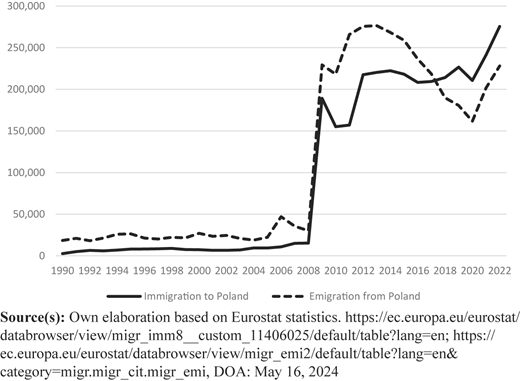
Figure 1 presents detailed statistics based on data from Eurostat, the European Statistical Office of the European Union. The data shows a significant increase in both immigration and emigration after Poland’s accession to the European Union, with net immigration observed in Poland since 2018. The migration dynamics allow Poland to be classified as a new immigrant destination (Pędziwiatr & Magdziarz, 2023). Poland’s immigration policy is assessed as ad-hoc rather than long-term, with examples of good practices at the local authorities level (Okólski & Wach, 2020).
Research assumptions
As an example of a new immigrant destination country (Pędziwiatr & Magdziarz, 2023) with a rather ad-hoc immigration policy and good practices at the local government level (Okólski & Wach, 2020), Poland justifies its choice as a country to be investigated while answering the research questions (RQ1–RQ3) based on the qualitative research.
We designed the focus group study to explore the challenges of setting up a business by migrants residing in Poland aiming to answer research question RQ1 related to perceived institutional barriers to migrant entrepreneurship in new destination countries. We conducted research on two migrant groups: Ukrainian migrants and migrants coming from countries other than Ukraine. We selected these two groups of migrants motivated by the specific situation of Ukrainians compared to other nationalities in the context of mixed embeddedness.
According to the data from Statistics Poland [1] and research (Duszczyk et al., 2023), Ukrainians constitute the majority of migrants settled in Poland, as they constitute 80% of all migrants, including children. In 2023, Ukrainians accounted for 70% of foreigners performing work, followed by Belarusians (11.2%), Georgians (2.8%), Indians (1.7%), Moldavians (1.5%), Russians (1.0%), and others (11.8%) [2]. As the agency of migrant entrepreneurs is embedded in their social networks and available resources (Nijhoff, 2021; Yasin & Hafeez, 2023) and the institutional context (Kloosterman et al., 1999; Yamamura, 2023), the high share of Ukrainian migrants constitutes an important aspect of mixed embeddedness in the context of their growing diaspora and social networks.
The relatively liberal access to the Polish labor market for citizens of Ukraine (and some other countries) and the implementation of the EU Temporary Protection Directive in March 2022 after the escalation of the armed conflict (Duszczyk et al., 2023) resulted in different legal statuses of Ukrainians settled in Poland (Łysienia, 2023; Pędziwiatr & Magdziarz, 2023; Pozniak, 2023). Compared to migrants from other countries, Ukrainians can benefit from a relatively simplified process of legalizing their stay and work in Poland. Moreover, despite Poland’s mainly ad-hoc migration policy (Okólski & Wach, 2020) and limited institutional support for migrants (Duszczyk et al., 2023), Ukrainian immigrants can experience relative social and institutional support in their integration.
The high share of Ukrainians among migrants in Poland and the policy of their integration justify the comparison of their perception of entrepreneurial barriers with the opinions of migrants from other countries to identify similarities and significant differences in their needs when setting up and running a business. By comparing these two groups, the study aimed to capture the universal challenges that entrepreneurial migrants encounter in Poland and understand the specific needs and problems that may be specific to each group in the context of migrant diversity. By adopting this approach, we could understand more fully the socio-cultural and legal-economic context in which migrants function in Poland.
In this way, the study also aimed to understand the differences between migrant groups, which can shape more effective support and integration strategies for migrants at the local level in Poland (RQ2). Thus, the study can provide valuable lessons for both public institutions and NGOs involved in helping migrants and promoting entrepreneurship among this social group. It could also be of value to other countries that are becoming a new destination for migrants.
Research sample and data collection
We used a focus group method that consisted of four group discussions with migrants living in Poland to gain an in-depth understanding of their opinions. We discussed issues related to entrepreneurship in the migrant group, focusing particularly on the barriers that make it difficult, if not impossible, to start and run a business. Participants had the opportunity to share their experiences, thoughts, and suggestions on starting and running a business in Poland from the perspective of a foreigner. We then conducted a comparative analysis to identify significant similarities and differences between various migrant groups.
A total of 34 people participated in five focus groups. Two of the groups consisted of migrants of Ukrainian origin (10 and 9 people accordingly) and three of migrants from countries other than Ukraine (eight, five, and two people accordingly). We conducted the focus groups between February 2023 and July 2024 in cooperation with a local municipality that provides training for migrants interested in running a business. The training sessions provided by the local government aimed at explaining the formal possibilities for foreigners living in Poland to register their business. After the training sessions, we held focus group discussions with the participants, lasting about 1.5 hours each. We invited all training participants to participate in the focus group discussions. This strategy of attracting participants allowed us to include in the discussion those migrants who had developed entrepreneurial intentions enough to register their businesses to participate in the community training. We conducted the discussion in the group of Ukrainian migrants in Ukrainian with the help of an interpreter and with the group of migrants from other countries in English. We informed all participants about the research purpose of the focus groups and about anonymity and voluntariness.
Only adults participated in the survey, and their ages varied. The majority of respondents with Ukrainian background were women (78.9%) with higher education (84.2%). The dominant age group was 36–45 (42.1%). More than half of migrants from Ukraine have stayed in Poland for less than a year (52.6%). Most respondents had no experience in running their own business (57.9%).
The majority of respondents among migrants from outside Ukraine were women (60.0%) with higher education (100%). The dominant age group was 18–25 years old (38.5%). The largest part of the respondents stayed in Poland from one to five years (64.3%). Most respondents had no experience in running their own business (60.0%). Table 1 presents the sample’s detailed characteristics. The participants came from a variety of countries, including Canada, Denmark, Hungary, Hong Kong, Indonesia, Japan, Nigeria, Pakistan, the Philippines, Tanzania, and Turkiye.
Characteristics of the focus groups’ participants
| Characteristics | Ukrainian migrants | Non-Ukrainian migrants |
|---|---|---|
| Age | ||
| 18–25 years | 10.5% | 38.5% |
| 26–35 years | 31.6% | 30.8% |
| 36–45 years | 42.1% | 15.4% |
| over 45 years | 15.8% | 15.4% |
| Gender | ||
| woman | 78.9% | 60.0% |
| man | 21.1% | 40.0% |
| Education | ||
| secondary | 15.8% | 0.0% |
| higher | 84.2% | 100.0% |
| Period of stay in Poland | ||
| less than 1 year | 52.6% | 7.1% |
| 1–5 years | 10.5% | 64.3% |
| more than 5 years | 36.8% | 28.6% |
| Experience in running own business | ||
| no | 57.9% | 60.0% |
| yes | 42.1% | 40.0% |
Note(s): N of Ukrainian migrants = 19, N of non-Ukrainian migrants = 15
Source(s): Own elaboration
After all focus groups, we followed the analytical procedure similar to that employed in other qualitative research in the field of migrant entrepreneurship (Glinka, Glińska-Neweś, & Zakrzewska-Bielawska, 2023). We went through the respondents’ opinions to identify and group the main themes they had expressed. While grouping, we looked for similarities and differences in opinions of Ukrainian and non-Ukrainian migrants with regard to entrepreneurship barriers.
Results
Similarities in perceptions of barriers to entrepreneurship observed by migrant groups
When analyzing the barriers to entrepreneurship of Ukrainian and non-Ukrainian migrants, we discovered some similarities and differences (see Figure 2). Among the similarities, both migrant groups named language barriers, lack of access to comprehensive information, the need for legal and advisory support, and paperwork and bureaucracy as factors limiting entrepreneurship.
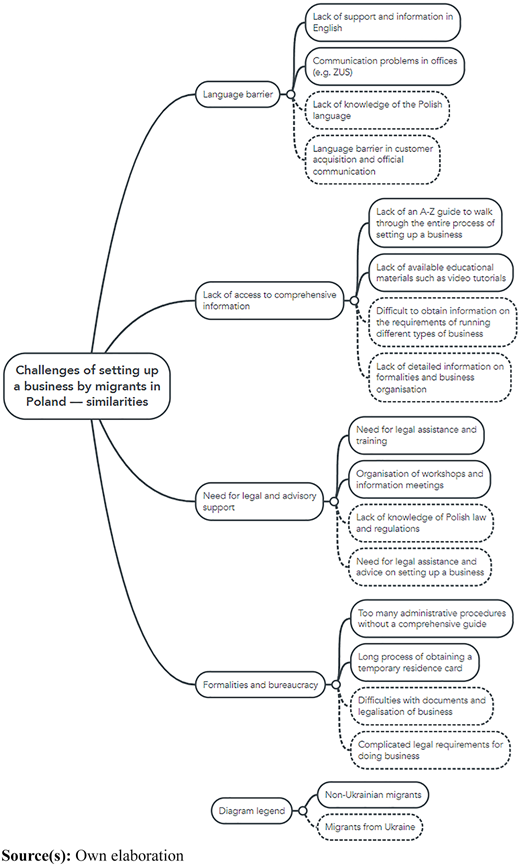
Challenges of setting up a business by migrants in Poland: Similarities in Ukrainian and non-Ukrainian migrant groups
Challenges of setting up a business by migrants in Poland: Similarities in Ukrainian and non-Ukrainian migrant groups
Language barrier
Both non-Ukrainian and Ukrainian migrants experience communication-related difficulties in the context of setting up a business in Poland. However, there are significant differences in the nature of these difficulties. Non-Ukrainian migrants often lack support and information related to entrepreneurship in English, which can be an additional barrier given the prevalence of English as an international language. On the other hand, migrants from Ukraine have access to some forms of public support in Ukrainian, so they do not need to use English. However, Ukrainians comment on language barriers in the context of their insufficient knowledge of the Polish language, which makes it difficult not only to communicate in offices but also to obtain clients and conduct formal official matters. Due to the similarity of the Polish and Ukrainian languages, Ukrainian migrants may have easier access to learning Polish, while migrants from other countries may require support in English.
English-speaking folks are a big plus. [Non-Ukrainian migrant 3]
Official website is not in English. [Non-Ukrainian migrant 5]
The English language will be a big plus if it is added, it is so needed. [Non-Ukrainian migrant 6]
Polish people at official places prefer to communicate in Polish and do not understand you or English. [Non-Ukrainian migrant 15]
Lack of language skills makes it difficult to attract clients. [Ukrainian migrant 2]
Lack of language skills, but this is currently improving. [Ukrainian migrant 7]
Lack of access to comprehensive information
A key barrier to migrant entrepreneurship identified in focus groups involves limited access to information about the formal requirements for starting and managing a business in Poland. When analyzing the lack of access to comprehensive information, we identified several similarities and some differences between migrant groups. Both non-Ukrainian and Ukrainian migrants experienced difficulties in obtaining complete information on setting up a business in Poland. Both groups indicated a lack of A-Z guides and available educational materials, such as video tutorials, which hindered their business start-up processes. However, migrants from Ukraine were more likely to seek more specific information on regulations for specific types of business activities. In the focus groups, they expressed a need for detailed information on the requirements for running different types of business activities. On the other hand, non-Ukrainian migrants focused mainly on seeking information on the legalization of residence and basic issues related to setting up a business. These differences suggest the need to provide tailored information sources to meet the diverse needs of migrants regarding entrepreneurship in Poland.
There is no A-Z complex support or advice in one place. [Non-Ukrainian migrant 10]
Too many administrative actions in separate places are required when setting up a business, with no A-Z guide on a real case. [Non-Ukrainian migrant 12]
Difficult to obtain information on the requirements for running different types of activities (e.g. nursery school). [Ukrainian migrant 18]
Lack of market knowledge, difficulty in finding companies to work with. [Ukrainian migrant 13]
It seems easier to do business in Poland than in Ukraine, but you need to know Polish law and regulations. [Ukrainian migrant 5]
The need for legal and advisory support
In both groups, migrants expressed the need for legal assistance and access to training that would enable them to better understand Polish law and business regulations. Moreover, both groups emphasized the importance of organizing workshops and information meetings that could provide them with the necessary tools and guidance in the process of setting up a business. These similarities suggest that both non-Ukrainian and Ukrainian migrants need legal and counseling support to successfully cope with the formal and legal requirements and other difficulties related to entrepreneurship in Poland.
I believe that local communities organizing events like this will have a positive impact on migrants who aspire to start their own businesses. [Non-Ukrainian migrant 7]
I find it intriguing to consider hosting monthly meetings for international individuals, perhaps featuring examples of businesses already established here. [Non-Ukrainian migrant 2]
Difficulty in accessing information. In particular, the lack of information on what the tax system is like. The tax burden in Ukraine is lower than in Poland. Ukrainians need more information on running their own business, especially on formal, legal, and tax aspects. [Ukrainian migrant 18]
Formalities and bureaucracy
Both respondents groups indicated an excess of administrative procedures and a lack of comprehensive guides, which made it difficult for them to do business in Poland. Furthermore, both non-Ukrainian and Ukrainian migrants experienced difficulties related to documents and the legalization of their stay, which affected their life stability and ability to start their businesses. Both groups also faced complex legal requirements for doing business, which was an additional barrier to the business start-up process. These similarities highlight the need to simplify administrative procedures and provide migrants with personalized support sources to facilitate their start-up in Poland.
I need help with residence permit. [Non-Ukrainian migrant 8]
Took over a year to receive a second student card despite having a previous card. Local authorities should address these issues to support immigrant entrepreneurs. [Non-Ukrainian migrant 1]
No idea about taxes and payments each month, no language skills, limited professional staff. [Ukrainian migrant 17]
Difficulties with documents (more so before the war) as we wait for residency, various problems with legalizing residency. [Ukrainian migrant 13]
Observed differences
When analyzing the barriers to migrant entrepreneurship in Poland as a new destination country, we identified some differences between migrant groups (see Figure 3), such as those related to support for specific groups, access to funding, and issues concerning legal residence and stability.
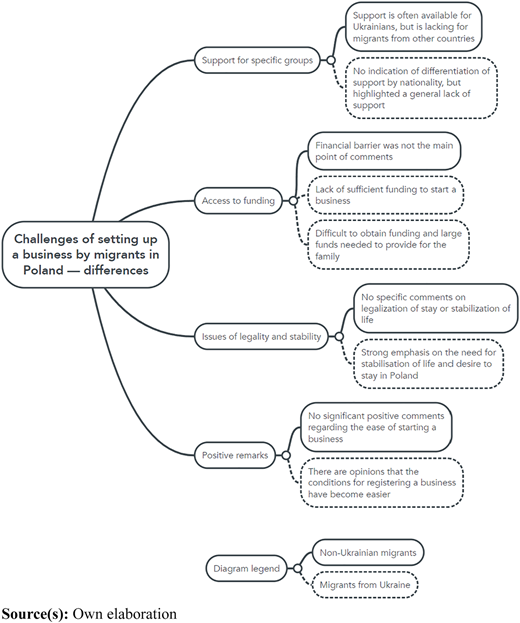
Challenges of setting up a business by migrants in Poland: Differences in Ukrainian and non-Ukrainian migrant groups
Challenges of setting up a business by migrants in Poland: Differences in Ukrainian and non-Ukrainian migrant groups
Support for specific groups
Non-Ukrainian participants noted that there was available support for Ukrainians, but it was absent for migrants from other countries. This observation suggests the existence of certain preferences or orientations among institutions or organizations when it comes to providing support to migrants in Poland. On the other hand, migrants from Ukraine did not indicate a differentiation of support by the nationality of migrants but highlighted a general lack of support for migrants as a whole. Migrants from Ukraine still experience difficulties in accessing support, indicating the need for more even distribution and provision of support for migrants across all groups.
I also have problems with the ZUS (Social Insurance Institution) office. I know there are many Ukrainians living in your country. Ukrainian language support is provided for them. However, Poland is an EU country. There are foreigners from many countries living in your country. Therefore, they should be able to provide services in English. We cannot communicate in English. Something can be done about this. [Non-Ukrainian migrant 4]
Access to funding
Non-Ukrainian migrants were less likely to highlight the financial barrier as the main point of comment, suggesting that this is not the most important issue for this group of migrants in terms of setting up a business in Poland. In contrast, migrants from Ukraine were more likely to report the lack of sufficient financial resources to start a business as the main obstacle for them. Moreover, Ukrainian migrants experienced difficulties in obtaining funding and needed large amounts of money to support their families. This situation arises largely because many Ukrainians living in Poland fled their country after Russia’s 2022 aggression. These differences point to the need to provide more targeted financial solutions and support to Ukrainian migrants to help them get started and ensure financial stability in their new environment.
I do not have enough money to open a business, because renting an apartment is so expensive. [Ukrainian migrant 15]
Issues of legality and stability
Non-Ukrainian migrants were less likely to comment on legalizing their stay or stabilizing their lives in Poland. In contrast, migrants from Ukraine emphasized the need to legalize their stay, stabilize their lives, and expressed a desire to stay in Poland for a longer period of time. Based on their statements, we may conclude that they treated entrepreneurship as a form of establishing a life in a new reality. On the other hand, non-Ukrainian migrants may be less interested in these issues, which may be due to differences in the legal situation and individual migration plans of this group. These differences highlight the need to adapt support and integration strategies to the specific needs and priorities of different groups of migrants residing in Poland.
I would like to be confident that the state will provide support when needed to be able to take advantage of all available services. [Ukrainian migrant 6]
I want to feel useful and resume professional activity. [Ukrainian migrant 7]
Staying legally in the country also means living peacefully. [Ukrainian migrant 14]
Positive remarks
Non-Ukrainian migrants were less likely to contribute significant positive comments about the ease of setting up a business, suggesting that they may find the process more challenging or face more difficulties than Ukrainian migrants. In contrast, migrants from Ukraine noted that the conditions for registering a business had become easier, which may be due to possible changes in legislation or administrative procedures in Poland. These differences in positive evaluations highlight the importance of further facilitating the process of setting up a business for all migrants in Poland to create a more friendly entrepreneurship environment for this social group.
No barriers, on the contrary, the conditions for registering a business have now become easier. [Ukrainian migrant 17]
Discussion and conclusions
The focus group discussions indicated that both non-Ukrainian and Ukrainian migrants faced a number of common obstacles in the process of setting up a business in Poland. In our research, we referred to the call for a deeper understanding of the links between rules, regulations, and policy on migrant entrepreneurship (Solano, 2023; Solano et al., 2023). Thus, we contribute to a better understanding of political-institutional and local-level embeddedness (Yamamura, 2023).
Language barriers are a significant problem for both migrant groups making it difficult to communicate in offices and to attract clients. Moreover, both groups experience a lack of access to comprehensive information and a need for legal and advisory support, which indicates the overall challenges migrants face in terms of entrepreneurship. However, there are significant differences between migrants from outside Ukraine and those from Ukraine. Ukrainian migrants are more likely to highlight financial and legal problems and express the need to legalize their stay and achieve life stability in Poland. This is an important issue that may require more targeted support from institutions and organizations assisting migrants.
On the other hand, non-Ukrainian migrants point to the lack of support in English and the preferential treatment for Ukrainians, suggesting the need for a more differentiated approach to providing assistance to migrants in Poland. This is an important issue of equal access to support for all migrants, regardless of their nationality.
Our results are largely in line with the findings of Nijhoff (2021), showing the importance of language skills, residence, business, and legal advice, and understanding the bureaucracy complexity (Nijhoff, 2021; Salmon & Singleton, 2023). However, our results show the nuances of linguistic barriers. The first issue related to the question of which language migrant entrepreneurs should use in the host country. In traditional destination countries, a common attitude is to approach migrants with migrant education in the receiving country’s language (Nijhoff, 2021). Surprisingly, in the case of Poland as a new destination country, authorities expect international migrants to be able to communicate in English in all official institutions, despite the fact that English is not a native or official language in Poland, nor is it the native tongue of most migrants. English is the modern linguae franca, but there is a significant difference between the ability to communicate in daily English and being proficient in English at the level of legal procedures and documents required in the process of setting up and running a business, both in the case of migrants and Polish clerks. The second issue in the discussion about the language barrier pertains to migrants’ openness to learn it in the increasingly common pattern of contemporary migration as “people on the move.” As some people are open to moving from one country to another throughout their lifetime, they expect to use just one foreign language rather than learn the languages of several host countries along their migration journey. Another aspect of the language barrier relates to the migrants’ origin. As there was a significant influx of Ukrainians fleeing to Poland, especially in 2022 and beyond, the majority of migrants in Poland are of Ukrainian origin, thus, Polish local authorities arranged the support for nascent entrepreneurs in Ukrainian. The concentration of migrants from one country makes support in their national language easier to arrange by local institutions due to the availability of people who can act as interpreters.
Other migrants perceived local support for Ukrainian entrepreneurs in their native language as discriminatory, which made them feel like “worse” migrants.
Our results are in line with those indicating the importance of legal status as the individual characteristic of migrants affecting their ability to engage in entrepreneurship (Solano, 2023; Solano et al., 2023). However, we went further and recognized not only objective differences in legal status, but also the perceived legal status of migrants in the context of their entrepreneurial journeys in their new destination country. Non-Ukrainian migrants extensively discussed legal barriers related to visa systems, residence, or work permits as the main obstacles to setting up a business, which was in line with opinions on the need to include legal regulations such as entry and visa regimes, residence and work permits, or integration and social cohesion policies in migration policy (Manke, 2022). However, this group of migrants did not mention their openness and willingness to settle in Poland for a longer time and entrepreneurship as a way to legitimize their stay. On the other hand, Ukrainian migrants discussed residence regulations and setting up a business mainly in the context of their permanent settlement in Poland. They perceive entrepreneurship as a way to stabilize their position in the host society.
On the one hand, these findings are consistent with the results of previous studies, which show the importance of the legal framework of host countries in shaping entrepreneurship among migrants (Kloosterman et al., 1999; Solano, 2023; Solano et al., 2023; Yamamura, 2023; Yasin & Hafeez, 2023). However, we recognized nuances in the impact of legal barriers in the context of migrant diversity. Some consider legal regulations only in the context of a time-limited stay in the host country as a stage of the migration journey. Meanwhile, others see legal regulations of migrant entrepreneurship in the process of settling for life in the host country.
Moreover, our results shed new light on the recognition of access to funding as a barrier to migrant entrepreneurship (Nijhoff, 2021; Salmon & Singleton, 2023; Yamamura, 2023). We identified nuances in these barriers that depend on the situation of migrants in their home countries, providing a new perspective on the embeddedness of migrant entrepreneurs in the social networks that determined the resources availability (Nijhoff, 2021; Yasin & Hafeez, 2023). Migrants from Ukraine discussed the lack of access to funds as a barrier to entrepreneurship only discussed by in the context of difficulties related to the armed conflict in their country of origin. Non-Ukrainian migrants did not mention the issue.
Based on the discussions, we formulated recommendations to local authorities to answer research question RQ3. To support migrant entrepreneurship, local authorities can provide access to A-Z guides and available educational materials, such as video tutorials on start-up processes available in several languages. Another area of support activities could be the organization of workshops, information meetings, and networking meetings with other entrepreneurs at which representatives of local authorities could provide guidance on formal and legal aspects of the start-up process to alleviate bureaucracy barriers to migrant entrepreneurship. Local governments also need to develop more tailored and differentiated support strategies for migrant entrepreneurs in Poland that would consider the specific needs and challenges of each migrant group. It is also necessary to strive for a more friendly and accessible entrepreneurial environment that supports migrants’ development and integration into the Polish community.
Our study has some limitations related to the accepted research perspective. We focused on Poland as a new destination country, which implies that further research needs to confirm our results also in other countries being in a similar situation, for example, other Central European countries. Next, we conducted the research during a time of turbulent changes in the geopolitical situation, which indicates the need to confront our results also in a more stable geopolitical environment.
This study was supported by the Minister of Science of the Republic of Poland under the “Regional Initiative for Excellence Programme” for the implementation of the project The Poznań University of Economics and Business for Economy 5.0: Regional Initiative – Global Effects (RIGE)”.
Notes
https://www.gov.pl/web/udsc/obywatele-ukrainy-w-polsce--aktualne-dane-migracyjne2, DOA: May 29, 2024.

