


Avoiding disputes in the New Zealand (NZ) construction industry is crucial but challenging. While many studies focus on post-contract measures, there is limited research on pre-contract dispute avoidance, especially in traditionally procured projects, which are more prone to disputes in NZ. Therefore, the purpose of this is to study investigate pre-contract steps to avoid potential disputes in NZ and present the findings in an interactive toolkit.
An analysis of 35 construction-related court cases in NZ was conducted to identify the causes of disputes, and 14 expert interviews were carried out to collect recommendations for the pre-contract stage to avoid potential disputes. The gathered data were analysed manually, then recorded and coded using NVIVO software. Microsoft Power BI was used for data modelling and toolkit interface development (data visualisation). During one-to-one interviews and focus group sessions, 16 industry practitioner responses were considered to validate and refine the toolkit.
The toolkit has been located on an online platform, allowing users to access it conveniently. The finalised toolkit provides a user-centred and flexible way to select the pre-contract stage, party and theme to visualise dispute avoidance steps and their relationships towards the causes of disputes.
The toolkit offers guidance for avoiding disputes in traditionally procured projects before construction begins, focusing on contractual understanding, practices, contract formation and expectations. The interactive nature of the toolkit assists practitioners from contractor, client and consultants to configure dispute avoidance steps in a user-friendly manner. The tender preparation and pricing stage is identified as the stage where more focus is worthwhile to minimise potential post-contract disputes. This toolkit could evolve into new versions for other procurement methods, and its outcomes could train language models for improved conversation handling.
1. Introduction
A dispute is defined as a situation where another party rejects one party’s claim or assertion and that the first party does not accept rejection, and it hinders main objectives of a construction project, namely, timely completion, quality expectations and cost boundaries (Kumaraswamy, 2002; Naji et al., 2020). Disputes are caused by conflicts that occur because of the incompatibility of interests among the parties and often disputes require resolutions from external parties (Fenn et al., 1997). Completion of a project within the expected time and cost is the main objective of any construction project, and disputes over these two factors cause a major hindrance to the success of the project (Naji et al., 2020). Construction-related disputes arise from several areas in construction projects: scope variations, contractual clause interpretation, extension of time claims, site conditions and obtaining approvals (Al-Keim, 2017). Given that disputes in the construction industries are inevitable and severely impact the project objectives, many researchers have attempted to identify reasons for disputes, dispute resolution mechanisms and dispute avoidance possibilities. Kumaraswamy (1997) categorised dispute causes into two types as:
root causes, which are underlying factors like unfair or unclear risk allocation, inappropriate contract types and unrealistic pricing or expectations; and
proximate causes, which directly trigger disputes, such as poor communication, inadequate briefs and slow client responses.
Gerber (2013) emphasised the importance of taking preventive measures to reduce disputes, noting that the initial cost of establishing a dispute avoidance procedure will be recovered many times over through the savings generated by a dispute-less environment. Similarly, Kumaraswamy (2002) stressed the importance of proactively preventing and reducing disputes rather than merely addressing and resolving them after they arise. While highlighting the importance of forecasting future disputes during the “briefing stage” (where the client’s requirements and objectives for the project are established), De Alwis et al. (2016) mentioned that proper risk allocation, selection of right contractors, quality of documentation and effective procurement planning during the early “briefing stage” could be beneficial to avoid future disputes.
Similar to the construction industry globally, New Zealand (NZ) construction industry also suffers from disputes and a considerable number of disputes in the NZ construction industry were even developed to a position that parties sought a resolution from the NZ courts (Silva et al., 2023b). Further, the authors ascertained that significant portion of the studied cases were attributable to payment issues, conflicts around the quality of works and disagreements on variation entitlements. In a study focused on construction payment issues in NZ, Ramachandra and Rotimi (2011) found that nearly 82% of court cases involved disputes between the main contractor and the client, while 10% were between the contractor and subcontractors, and 8% were between the principal and subcontractors. Considering the necessity of avoiding disputes in the NZ construction industry and the limited research conducted in this area, this study was initiated. The primary aim was to develop an interactive pre-contract dispute avoidance toolkit for the NZ construction industry. To achieve this aim, this study focused on three key objectives:
identifying the main causes of disputes in the NZ construction industry;
identifying effective pre-contract measures to prevent such disputes; and
developing and validating an interactive pre-contract dispute avoidance toolkit for the NZ construction industry.
2. Literature review
Besides the extensive amounts of previous studies that investigates the causes of disputes and dispute resolution, there are several other studies on dispute avoidance. Under the “dispute avoidance” topic, researchers have mostly studied about post-contract strategies/steps to avoid disputes and few have studied about pre-contract dispute avoidance strategies/steps. Previous findings on these two research avenues have been summarised in the following paragraphs.
Several studies have focused measures to avoid disputes during the post-contract stage. A framework was developed by Zhu and Cheung (2020) to demonstrate how incentivisation can mitigate construction disputes by aiming at decreasing disputes by strengthening relational governance, closing gaps in risks, enhancing investment in relationships and fostering a greater sense of fairness. During the construction phase, the importance of comprehension and monitoring the scope, support from the higher management and the expertise of the design consultant of the contractor were recognised as the three primary factors from a “principle component analysis” that contribute for less conflicts (Tabish and Jha, 2023). Moreover, a Malaysian study suggested to involve higher management (with decision-making and financial authority) from both disputant parties to actively discuss and negotiate the issues as a more effective way of minimising and resolving disputes (Danuri et al., 2015). Few studies in NZ have also focused on the avoidance of disputes in NZ construction sector. For instance, for the post-contract stage, Yiu et al. (2021) recommended to behave in a professional and accountable way, and Ramachandra and Rotimi (2011) recommended to settle financial claims to maintain cash flow promptly. These studies have proposed measures applicable to the post-contract stage to minimise ongoing or potential disputes and have not focused on the pre-contract stage.
For the pre-contract stage, several studies attempted to produce effective recommendations aimed at minimising future disputes in the construction industries. A few previous studies have also focused on assessing and predicting potential disputes considering the attributes in the pre-contract stage. Diekmann and Girard (1995) used logistic regression to estimate the likelihood of disputes occurring, emphasising the crucial role of skilled human resources in preventing disputes and the significant influence of project complexity on dispute occurrence. Similarly, Molenaar et al. (2000) used Structural Equation Modelling (SEM), highlighting management capabilities and project complexity as key factors controlling future disputes’ likelihood. In the Singapore construction industry, if proper pre-contract discussions on how to evaluate the impacts of delays were taken place and the information requirements for time-related claims were established before signing the contract, then there could be minimal conflicts around construction schedules and timings (Aibinu, 2009). Equally, few researchers made recommendations applicable the NZ construction industry as well. For example, Finnie (2021) proposed two-staged early contractor involvement framework to the NZ context, which addresses the complications around variation entitlements and legal implications of drawing changes, taking the contractor’s involvement in the pre-contract design development stage into account. Moreover, Ramachandra and Rotimi (2011) focused on payment-related disputes in NZ construction context and few recommendations made to the pre-contract stage, namely, securing financial guarantees early in contracts and including mandatory pre-qualification of funding parties’ financial status.
3. Research gap
In summary, numerous past studies have suggested ways to address construction-related disputes after they have arisen. However, Kumaraswamy (2002) emphasised that “dispute avoidance” and “dispute minimization” should take precedence over “dispute resolution”. Internationally, as previously mentioned, there have been only a few studies that recommended predictive methods for identifying potential disputes through statistical techniques. Although the dispute prediction methods proposed by previous researches had accounted pre-contract factors, those prediction methods were not necessarily dispute avoidance steps. Additionally, while some international research has offered strategies and recommendations for minimising and resolving disputes, these approaches were mainly relevant to the post-contract stage of construction projects. For instance, those studies have encouraged good post-contract practices such as professionalism, good relationships among parties and accountability.
The construction industry in NZ significantly impacts the economy, contributing 6.3% to gross domestic product and employing 10.7% of the workforce in 2023 (MBIE, 2023). According to the NZ Construction Industry Council (2016), each dollar invested in the construction sector generates around two dollars and 80 cents in total economic activity, making it one of the sectors with the highest economic multiplier effects. Therefore, disputes that cost the construction project objectives considerably weaken NZ’s overall economy by badly impacting gross domestic product, employment and returns on investment. Further, in NZ and Australia, fixed-price contracts based on incomplete designs transfer significant risks to contractors, and this inequitable risk allocation has driven major contractors to exit the industry (Harris et al., 2019; Tower and Baccarini, 2008). Therefore, arguably, avoiding construction disputes will secure monetary objectives of construction projects which will positively impact on the NZ’s macro-economic indicators.
Although the importance of a comprehensive study to investigate dispute avoidance in NZ construction industry is high, there are very few studies around that area. For instance, in the NZ construction research context, Ramachandra and Rotimi (2011) focused specifically on payment issues and recommended measures for both the pre- and post-contract stages to ensure healthy payment cycles with less conflicts. Their study focused only on payment-related disputes, and their recommendations were applicable to both the pre- and post-contract stages. Another NZ study by Yiu et al. (2021) recommended investigating the other parties’ background, including their financial stability, before entering the contract. Finnie (2021) focused on projects where a potential contractor is involved during the early pre-contract stage (considered as a different procurement method) and suggested a two-staged early contractor involvement framework. A study on 35 court cases related to the NZ construction industry by Silva et al. (2023a) found that majority of the projects in which the dispute occurred followed lumpsum contracts and traditional procurement paths. None of the aforementioned studies by Ramachandra and Rotimi (2011), Yiu et al. (2021) and Finnie (2021) were specifically focused on traditionally procured lumpsum contracts, which are identified as more prone to disputes in NZ. Therefore, this study has been designed to purely focus on pre-contract dispute avoidance measures in traditionally procured lumpsum construction contracts in NZ.
As mentioned, internationally, few studies have considered dispute avoidance during the post-contract stage but had not properly focused on possible precontract measures to avoid potential post-contract disputes. Further, the need to minimise construction disputes (particularly traditionally procured lumpsum contracts which are more prone to disputes) is also paramount considering its influence to the overall economy of NZ. Therefore, minimal research on pre-contract dispute avoidance strategies and the growing need of minimising disputes in the NZ construction sector have led researchers to develop an effective and interactive solution to avoid potential disputes. Interactive data visualisation enhances engagement by providing tools that allow users to modify data, explore details, generate insights and better understand its value (Vorontsova, 2024). Considering the benefits of interactive data visualisations, the researchers aimed at presenting the findings of “pre-contract measures to avoid potential disputes” in an interactive manner. An end-user-centred (practitioners of NZ construction industry) design with more freedom of flexibility and a scalability was also expected in this outcome.
To present pre-contract dispute avoidance measures interactively, three research objectives have been established, as stated at the end of the introduction section. The first objective (identifying causes of disputes in the NZ construction industry) has already been achieved by conducting a court case analysis. This paper primarily discusses the interactive pre-contract dispute avoidance toolkit and its content (dispute avoidance steps). The research methodology section discusses the applicability of the selected research method, data collection/analysis process, toolkit development process and toolkit validation process. The findings section summarises the findings from court case analysis and presents the toolkit. In the final section, this study is discussed in comparison to previous studies, and contributions to theory/industry and future research opportunities are presented.
4. Research methodology
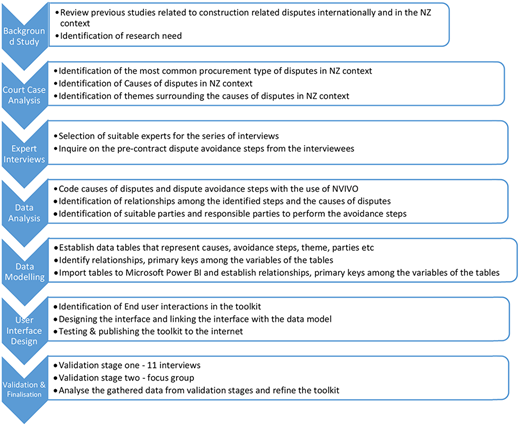
To achieve the mentioned objectives effectively, a proper research methodology has been developed which is composed of a court case analysis to identify the causes of disputes in the NZ context, an expert interview series to identify pre-contract dispute avoidance steps, development of an interactive toolkit to present the findings and the validation process (another series of expert interview and a focus group session) of the toolkit. As a prior step, the causes of disputes along with their significances in the NZ construction industry were identified by conducting a comprehensive analysis of actual court cases in NZ (Silva et al., 2025). This article primarily presents the industry expert’s insights on the pre-contract dispute avoidance steps and the developed interactive toolkit. This section describes more details regarding the research philosophy, data collection process, toolkit development process and the toolkit validation process. The overall research process has been summarised in Figure 1; however, this particular paper presents the findings of the expert interviews and the developed interactive toolkit (from Steps 3 to 7 in Figure 1).
4.1 Research philosophy and research approach
Research philosophy concerns the nature of knowledge and the methods through which it is acquired or developed (Saunders et al., 2023). Most research philosophies fall between two extreme research philosophies, namely, subjectivism (reality is shaped by human experiences and perceptions) or objectivism (reality is independent of human perception) (Saunders et al., 2016). Relying solely on either subjectivism or objectivism has led to various debates, prompting researchers to explore ways to combine both perspectives, allowing for multiple interpretations of reality – this approach is known as pragmatism (Mingers, 1997; Tashakkori and Creswell, 2008). This study is guided by research questions from a literature review rather than a predefined theory. It focuses on dispute causes and pre-contract dispute avoidance, relying on case studies and industry insights to understand the evolving nature of reality. Prioritising research objectives over specific methods, this study takes a pragmatic approach, balancing between objectivism and subjectivism.
Research design typically follows either a deductive approach, which tests existing theories using collected data, or an inductive approach, which develops theories by identifying patterns in observed data (Saunders et al., 2023; Tan, 2002). This research primarily aimed at identifying pre-contract dispute avoidance measures based on the industry experts’ perspectives. Hence, the researcher gradually developed the findings instead of trying to confirm a pre-established theory or foundation, making the inductive approach the most suitable for the entire research process.
4.2 Data collection and analysis processes
In all, 34 causes of disputes and five surrounding themes of those causes in NZ construction industry were identified initially from the court case analysis (Silva et al., 2025). Following the court case analysis, a series of expert interviews were carried out. The identified causes were taken into the attention of the expert interviewees and enquired about possible measures during the pre-contract stage to avoid the causes and the potential disputes. Purposive sampling is used when there is no defined population or database (DB) to select participants from, and the researcher relies on their judgment to choose suitable participants (Fellows and Liu, 2015). As no defined population was available and expertise was determined based on the researchers’ opinions, purposive sampling was chosen. In other words, the data the researchers expected to obtain were not necessarily linked to a specific profession or any defined population. Therefore, the authors opted to gather data from interviewees with a specialised knowledge and/or experience about a subject matter (about construction contracts and/or dispute) rather than from a broader population type (such as profession). The selected 14 industry experts had at least 15 years of experience in construction contract management and/or construction disputes. The selected interviewees’ professions, experiences and identification codes are summarised in Table 1.
Profiles of expert interviewees
| Interviewee code | Current Profession/position | Overall experience | Experience in New Zealand |
|---|---|---|---|
| Respondent A | Technical Director – Project Management | > 18 years | 12 years |
| Respondent B | General Manager – Operations | > 25 years | > 18 years |
| Respondent C | Technical director – structural engineering | > 20 years | 10 years |
| Respondent D | Director | 28 years | 28 years |
| Respondent E | Founder/director | 24 years | 24 years |
| Respondent F | Managing director | 31 years | 31 years |
| Respondent G | Estimating manager | 22 years | > 10 years |
| Respondent H | Chief executive officer | > 32 years | 21 years |
| Respondent I | Senior quantity surveyor | > 30 years | 16 years |
| Respondent J | Senior quantity surveyor | 25 years | 10 years |
| Respondent K | Commercial manager | 18 years | >11 years |
| Respondent L | Planner – Major projects | 26 years | 12 years |
| Respondent M | Senior quantity surveyor | > 28 years | > 10 years |
| Respondent N | Senior associate contracts | > 20 years | 13 years |
The 14 expert interviewees provided many pre-contract dispute avoidance steps, which were analysed manually with the assistance of NVIVO software. During the analysis process for each identified pre-contract dispute avoidance steps, following aspects were analysed:
in-depth ideas of the avoidance steps;
relationships among the identified steps and the causes of disputes;
the most responsible/suitable parties to perform those avoidance steps; and
the most suitable pre-contract stage to perform the avoidance steps.
4.3 Database development process of the interactive toolkit
A primary objective of this study was to develop an interactive toolkit to avoid potential disputes in the pre-contract stage. “An interactive system is designed to involve the user in the exchange of information.” (Cambridge University, 2024). The researchers have attempted to present the gathered information regarding the causes and dispute avoidance steps in an interactive way, allowing the users to engage with the developed toolkit during its run-time.
After analysing the gathered data from the court cases and the expert interviews, the nature of the data, including their relationships, was recorded methodically in tabular forms with unique identification numbers (primary keys). Subsequently, the data was modelled as shown in the fifth step of Figure 1 by considering the basic principles DB modelling. DB modelling, which is paramount for a successful application, is the process of learning about the data and developing a data model that accurately demonstrates the information landscape of the focused phenomenon (Hoberman, 2014).
Although researchers have not intended to develop a high-end application as the outcome, certain principles and processes related to application/DB development processes were followed. For an application or DB, six stage development lifecycle comprised of DB analysis, DB conceptual design, DB logical design, DBMS selection, DB implementation and DB management could be followed (Zygiaris, 2018). Following Table 2 summarises brief ideas of DB development process and how did the researcher used the principles when developing the toolkit.
Database development process
| DB lifecycle stage | Description of the lifecycle stage | Methods followed during the development of toolkit |
|---|---|---|
| DB analysis | The information needed from the DB is defined | Identified the end-user’s requirement (user’s selection criteria, illustrations and level of details in the toolkit) |
| DB conceptual design | Entities and their relationships are defined | Main data entities were identified (causes of disputes, dispute avoidance steps, pre-contract stages, parties and themes of causes of disputes of disputes) The relationships and primary keys of each entities were identified Relationship logics among the variables were established using the data modelling options in Microsoft Power BI |
| DB logical design | The conceptual design advances to design a relational database model | |
| DBMS selection | The nature of the database (distributed / centralised), security was considered to select a database | Opted for a simple Microsoft excel file as the database. The Microsoft Excel database was linked to the power BI report and that report was published to the Web However, the published report only allowed the end-user to retrieve the data; therefore, database security was not compromised |
| DB implementation | Data was entered and reports were generated | In Microsoft Power BI, two tables for causes of disputes and avoidance steps and a “force-directed graph” that illustrates the relationship between causes and avoidance steps were created |
| DB management | Database maintenance options (backing up and restoring) | In addition to the primary database, few backups were created and saved securely |
Following the data modelling stage, the next step was to develop the toolkit user interface using Microsoft Power BI. While providing informative data visualisations being the primary purpose of Microsoft Power BI, it also facilitates data sourcing and modelling analysis and act as an integration platform with other Microsoft services (Greg, 2019). Microsoft Power BI has been selected as the primary tool for developing the interface of the toolkit, as it provides a streamlined method to link the collected data stored in an Excel spreadsheet. Another reason was that the research aimed to develop an interactive report (based on the stored data in excel spreadsheet) which required to be published online for further validation sessions from industry practitioners.
As explained before, the gathered data were coded and stored in an excel spreadsheet. Then, a live link between Microsoft Power BI and Microsoft Excel was established. Once the data is transferred to Microsoft Power BI, following characteristics were considered:
data tables and their columns (variables);
variables that are uniquely identified in each table (primary keys); and
relationships among the variables (one to many, one to one and many to many).
By considering the above factors, the data model has been developed as shown in Figure 2.
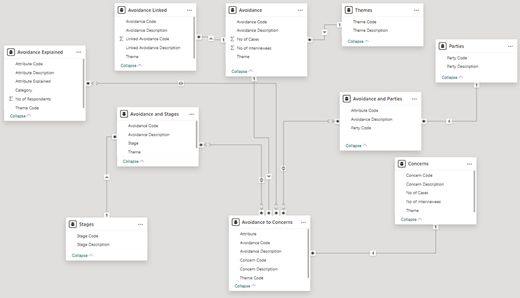
As illustrated in Figure 2, ten boxes represent ten data tables or data entities and attributes in each table shows the column names. Lines that connect entities depict the relationships among the variables; for example, “Concern Code” variable in “Concerns” table keeps a one-to-many relationship with the “Concern Code” variable in “Avoidance to Concerns” table.
4.4 Interactive tool development process – tool interface development process
After modelling the data, next step was to develop the user interface of the toolkit. The interface was prepared in a way to allow users to visualise causes/concerns of disputes and related pre-contract dispute avoidance steps based on the user’s preferred pre-contract stage, party and theme. The visualisation options available in Power BI, namely, slicers, tables and force-directed graphs (hereinafter referred to as objects), were used to develop the user interface as indicated in Figure 3.
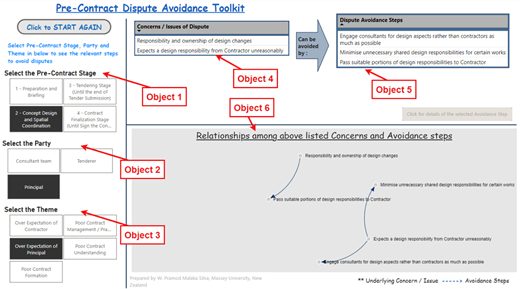
The objects shown in Figure 3 are linked to one or few variables in the data model. The six objects shown in Figure 3 were categorised as slicers, tables and a force-directed graphs. The three slicers (Objects 1–3) allow users to filter data based on pre-contract stages, parties and themes. Two tables (Objects 4–5) display causes of disputes and pre-contract dispute avoidance steps based on user selections, enabling further configuration of relationships. The force-directed graph (Object 6) visually represents the relationship between causes and avoidance steps based on selected criteria. All these objects are linked to several tables in the data model such as stages table, parties table, themes table, concerns table and avoidance descriptions table.
4.5 Validation process of the toolkit
Validating a research outcome is about checking the correctness of the study by verifying the collected, analysed and interpreted data (Tashakkori and Creswell, 2008). The main outcome of this study; pre-contract dispute avoidance toolkit was validated by a two-stage validation process comprised of a series of interviews with the experts in the subject area and a focus group session. The overall validation process is summarised in Figure 4.
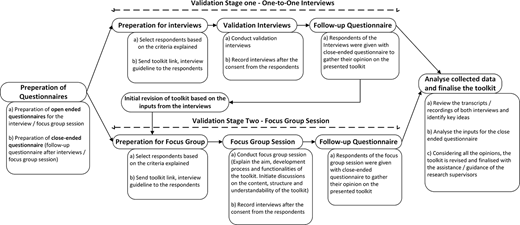
During both the validation stages, the content (identified dispute avoidance steps, causes/issues of disputes and relationships between causes and avoidance steps), the structure of the toolkit and the overall understanding and the user-friendliness were the three questioned areas/sections. Open-ended questionnaires for both validation stages were developed, covering the aforementioned three areas to gather more elaborative and comprehensive answers from the respondents.
For the validation interviews, the industry experience in the NZ construction industry has been the main criteria in selecting respondents; however, few respondents with an academic/research background have also been selected to gain a more wholistic opinion. Therefore, 11 respondents with a minimum of 10 years of overall industry experience and/or research expertise (at least 5 years in NZ) in construction contract management and/or construction disputes were selected for one-to-one semi-structured interviews during the first validation stage. The respondents’ details of the validation interviews are shown in Section 1 of Table 3. The respondents were contacted to arrange a convenient time and mode for the interviews. They were provided with an open-ended questionnaire, an online link to the toolkit and guidelines on its use to prepare in advance. After the validation interviews, each respondent received a close-ended questionnaire to assess their level of agreement on the three mentioned areas (content, structure and the understanding of the toolkit).
Respondents’ profiles
| Validation stage | Respondent code | Current position/profession | Overall experience |
|---|---|---|---|
| Validation stage 1 – One-to-one Interviews | IA | Technical Director | 25 years |
| IB | Postdoctoral Candidate | 13 years | |
| IC | Projects Planning Manager | 22 years | |
| ID | Contracts Manager | 25 years | |
| IE | Quantity Surveyor | 11 years | |
| IF | Lecturer in Construction Law | >10 years | |
| IG | Executive General Manager – Major Projects | 14 years | |
| IH | Associate Director – Cost Management | >20 years | |
| IJ | Contract Performance Manager | 12 years | |
| IK | General Manager (Commercial and Finance) | 20 years | |
| IL | Co-founder/Quantity Surveyor | 10 years | |
| Validation stage 2 – Focus group session | FA | Commercial Manager | 18 years |
| FB | Commercial Manager | 20 years | |
| FC | Senior Quantity Surveyor | 10 years | |
| FD | Estimator | 8 years | |
| FE | Quantity Surveyor | 9 years |
Focus group interviews bring together small group of respondents to discuss a subject matter, and it provide exciting and interesting opinions within a shorter timeframe and is also considered as comparatively inexpensive qualitative research strategy (Sekaran and Bougie, 2016; Saunders et al., 2016). Researchers believed that focus group session would be important in addition to an interview series for a toolkit validation process because it allows for interactive discussions, diverse perspectives and real-time feedback exchange, which may not be fully captured in one-on-one interviews. Therefore, following the first validation stage, a focus group session was also conducted to further validate and refine the developed toolkit. Respondents who had at least eight years of experience (at least four years in NZ) in construction contract management and/or construction disputes were selected for the focus group session. Section 2 of Table 3 shows the profiles of respondents in the focus group session. All the selected respondents were provided with a link to the toolkit, a session plan, introductory guideline about the toolkit and a questionnaire to allow them to review the toolkit beforehand. Considering the convenience of the respondents, a suitable time and a suitable mode (online mode) were selected. During the focus group session, firstly, an introduction (on the overall research and the toolkit) and few examples of the toolkit were presented. Then discussions on content, structure and understanding were initiated. The entire session was recorded with the permission of all the respondents. After the focus group session, a questionnaire with close-ended questions was sent to all the participants to capture their responses.
5. Findings
This section mainly presents the interactive toolkit with by explaining the user flow diagram of the toolkit and by explaining the content using two examples. Additionally, this section elaborates the content of the toolkit (causes of disputes and dispute avoidance steps) which was identified from the court case analysis and the expert interviews.
5.1 Findings from the court case analysis – causes of disputes
A qualitative and a quantitative analysis of 35 legal cases in NZ construction industry had been carried out as a prior step. Based on the previous step of this study regarding 35 court cases in NZ, majority of cases were attributable to payment issues, quality issues and disagreements on variation entitlements, and also, it has been ascertained that majority of cases had followed lumpsum contracts and followed traditional procurement route (Silva et al., 2023a). Further, the qualitative analysis of the court cases identified 34 core causes of disputes, their dependencies and five surrounding themes as shown in Figure 5 (Silva et al., 2025). Based on the court case analysis, the most significant cause of dispute was lack of understanding of the Construction Contracts Act, followed by poor work quality and improper payment schedules (Silva et al., 2025). A visual attribute map in Figure 5 depicts how these causes interconnect.
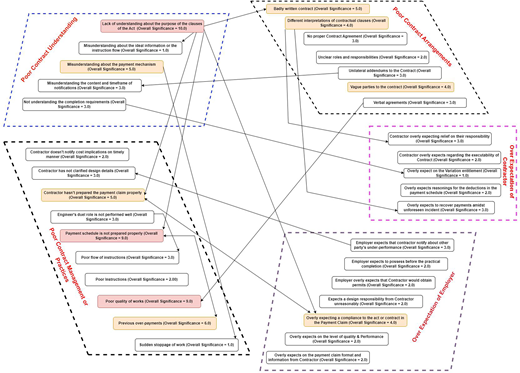
Attribute analysis map of causes of disputes
Source: Figure courtesy of Silva et al. (2025)
5.2 Findings from the expert interviews – dispute avoidance steps
After identifying the causes and broad themes of causes of disputes, the research focus was then shifted towards pre-contract dispute avoidance steps which was inquired from experts in the NZ construction industry. The identified themes of causes of disputes from the prior “court case analysis” was the basis for the expert interview series. In other words, pre-contract dispute avoidance steps were investigated under the five themes, and the main findings are summarised in Table 4. Overall, the expert interview series has identified 84 measures to minimise disputes in traditionally procured construction projects in NZ, highlighting the importance of clear communication, better preparation and proactive contract management to reduce conflicts in the post-contract stage (Table 4 only shows the most commonly indicated measures). Further, the experts emphasised that most dispute avoidance measures should be taken during the “tender preparation and pricing stage” (Technical design – A stage) focusing on clear documentation, risk allocation and realistic expectations.
Pre-contract dispute avoidance steps
| Poor contract understanding | Over expectations of contractor |
| Be clear about the allocation of risks | To hold expectation management meetings |
| Tenderer to identify its portion of risk | Contractors should inform about the alternative products at early stage |
| Educate the Principal about the construction process | Get clear about the scope that Contractor quotes |
| Be clear about responsibilities | Tenderer should not overly expect on the Principal’s knowledge on the project |
| Define and use a standard method of measurement | |
| Detailed and accurate design documentation | |
| Draft the contract in clear and simple language | |
| Poor contract management and practices | Over expectations of principal |
| Involvement of Competent people to understand the contract administration well | Be clear on what Contractor should design and what documentations should provide |
| Contractor should keep in mind to inform Principal and submit any claims in a timely manner | Agreement on quality and standard criteria beforehand |
| Setting out reporting requirements in the Contract | Engage consultants for design aspects rather than contractors as much as possible |
| Training and learning from past experiences | Understand where Principal’s design risk finishes and where Contractor’s risk starts |
| Tenders to establish training and learning opportunities | |
| Poor contract formation | |
| Document the scope clearly | |
| Develop the design into a greater extent during pre-contract stage | |
| Selecting competent Principal’s representatives | |
| Document and summarise pre-contract correspondences | |
| Manage significant missing items, drastic qty variances and errors in a SOQ in a BID well | |
| Understanding the current market conditions when drafting the contract | |
| Tenderers should be given sufficient time to price |
5.3 Pre-contract dispute avoidance toolkit for New Zealand construction industry
As explained in the methodology and introduction section, the developed toolkit aims to provide a more interactive solution for the construction industry practitioners during the pre-contract stage to avoid potential disputes. The toolkit is limited to construction projects in NZ, which follow the traditional procurement path. The users are able to select a pre-contract stage, party and a theme to see the relevant issues/causes of disputes and pre-contract measures to avoid potential disputes. Further, users can select a particular avoidance step to see more details (how to perform that avoidance step, what parties and pre-contract stages will be more appropriate to perform that step). By mapping out the interactions of the user, below user flow diagram (Figure 6) illustrates the functionality or the logic process of the toolkit.
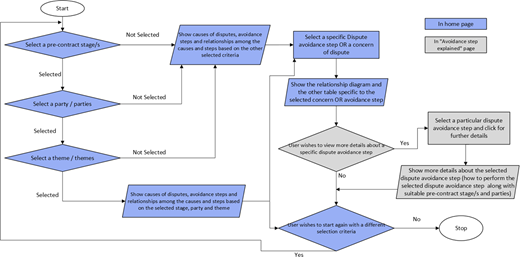
The toolkit consists of two pages, namely, the home page and a “avoidance step explained” page. The home page (the functionalities are illustrated in blue colour in Figure 6) allows users to select pre-contract stage, party and theme and to see concerns of disputes and to visualise concerns of disputes, dispute avoidance steps and relationships among the concerns and avoidance steps. Secondly, the “avoidance step explained” page (the functionalities are illustrated in ash colour in Figure 6) receives the selected dispute avoidance step from the home page as an input and visualises:
further details as to how to perform the selected dispute avoidance step;
most responsible and suitable parties to perform the selected avoidance step; and
most suitable pre-contract stage/s to perform the selected avoidance step.
The interactive toolkit provides numerous concerns and avoidance steps based on user’s selection criteria. Two examples are presented in Figures 7 and 8 and explained further about those examples in the next paragraphs.
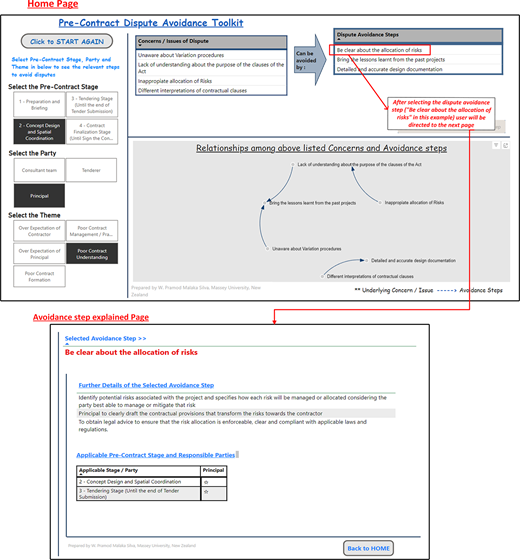
In Example 1, user has selected “concept design and spatial coordination stage” as the pre-contract stage, “Principal” as the party and “poor contract understanding” as the theme. In other words, user wanted to see pre-contract avoidance steps applicable for the principal during the second pre-contract stage (concept design and spatial coordination stage) which would minimise concerns around poor contract understandings. Based on this selection, toolkit has suggested three avoidance steps, and also, it shows four concerns/causes of disputes which could be minimised by actioning the suggested avoidance steps. Further, force directed graph located at the bottom of the home page illustrates the suggested avoidance steps and potential concerns that can be minimised by actioning the avoidance steps. For instance, in this example, as illustrated in the force directed graph, “bringing the lessons learnt from the past projects” could be useful:
to minimise lack of understanding about the purpose of the clauses of the Act; and
to minimise unawareness about the variation procedures.
Similarly, all the suggested dispute avoidance steps and the related avoidable causes/concerns of disputes are shown in the “force directed graph”. Once the user has selected a particular dispute avoidance step in the home page, the toolkit directs the user to the next page that explains the avoidance step in detail. In this Example 1 (Figure 7), identifying the risk profiles, drafting contractual provisions around the risk transformations and obtaining legal advices are listed to further explain the selected avoidance step (be clear about the allocation of risks). Further, the toolkit emphasises that the “concept design and spatial coordination stage” is the most appropriate stage and that the principal is the most responsible party in making clear about risk allocation.
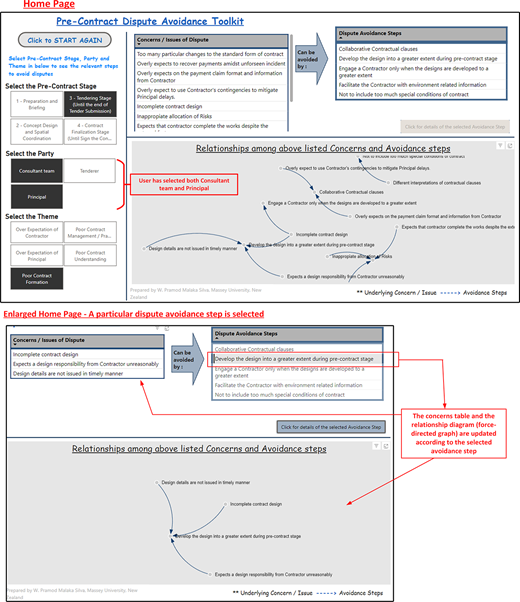
The developed toolkit allows to configure dispute avoidance steps that are common to several pre-contract stages, parties and themes (multiple selection). For instance, in Example 2 (Figure 8), user has selected two parties, namely, principal and the consultant team, to visualise dispute avoidance steps that are relevant to both the selected parties. This multiple selection functionality is relevant when selecting pre-contract party and the themes as well which allows user more flexibility. If a user is interested to focus only on a particular cause/concern of dispute or a dispute avoidance step, then he/she can select any avoidance step/concern as illustrated in Example 2 to visualise only the relevant attributes that are linked to the selection. For instance, in Example 2, user has selected “develop the design into greater extent during the pre-contract stage”, and the relationship diagram has automatically updated to configure three causes/concerns which could be minimised by performing the selected dispute avoidance step.
5.4 Findings from the toolkit validation stage
As explained in detailed in the methodology section, the toolkit validation process was comprised with two stages, namely, one-to-one validation interviews and focus group session. In each stage, open-ended questions were raised to gather the respondents’ opinions on the content, structure and the overall understandability. Following every validation interview and the focus group session, the participants were provided with a follow-up questionnaire (predominantly close-ended questions) which was basically intended to understand the respondents’ agreeability on above-mentioned three areas. In other words, qualitative findings were derived from the responses to the open-ended questions in both the validation stages, and quantitative findings were gathered from the responses to the closed-ended questions in follow-up questionnaires. Following paragraphs explains the qualitative and quantitative findings from both the toolkit validation stages.
In the initial toolkit (before the validation), the pre-contract stages were not displayed in the chronological order and that concern has been raised by three of eight respondents, and therefore, the pre-contract stages were re-organised chronologically and even labelled the number of the stage as prefix to display it in more logical and intuitive manner. Respondents IA and ID found it difficult to understand the definition or the time scope of the pre-contract stages in the initial toolkit; IA said, “rather than using the stages in ‘RIBA plan of work’ as it is, you may simply use preparation and briefing, design and coordination, tendering, contract signing stage”. In contrast to that, IE mentioned that “I’m comfortable with the pre-contract stages as I believe almost all the practitioners are well aware of the RIBA stages”. However, the stages suggested by IA were more clear, and they were aligned with the concept of stages in “RIBA plan of work”; therefore, stages were renamed as “preparation and briefing stage”, “concept design and spatial coordination stage”, “tendering stage” and “contract finalisation stage”.
The initial toolkit had four parties, namely, “employer”, “tenderer”, “preferred tenderer” and “engineer/designer”, and that categorisation was questioned by several respondents. Respondents IC and IG pointed out that having two separate parties as “tenderer” and “preferred tenderer” could be misleading, and those two entities represent two status of a one party and recommended merging those two distinct entities into one party as “tenderer”. Respondent IA recommended replacing “engineer/designer” with “consultant team” to encompass a broader range of professionals who provide expert advice, design and management services. Further, two participants in the focus group session opined to use “principal” rather than “employer”, as the term “principal” is widely used in NZ context and even specified in NZ standard conditions of contracts and the term “employer” could be misunderstood with employer and employee relationships by some industry practitioners. Considering the comments, the toolkit is refined with three parties as “principal”, “consultant team” and “tenderer”.
The comments received for the content of the toolkit were also considered when refining the toolkit. Respondent IG added:
[…] after the contract and the associated designs are established, parties realise that the established designs are not as detailed as they expected. Later on when the design changes, it becomes harder to keep on top of those changes and leads to disputes around variation entitlement. Therefore, I think design responsibility could be stand as an own theme as it is crucial.
However, when deriving themes, researchers have considered the fundamental nature (being more underlying/root causes) and the broadness of causes of disputes, therefore, decided to not to form a new theme “design responsibility”, as it is not as fundamental (a resultant theme from other theme/s or attributes under other themes rather than being fundamental) and not broad as compared to the existing themes. In the initial toolkit, few dispute avoidance steps related to “early contractor involvement” were included. However, those steps were removed as questions were raised as to why an entirely different procurement method was suggested as dispute avoidance step when this toolkit was meant to focus solely on traditional procurement path. Respondents IG and IH emphasised to include more dispute avoidance steps in the areas of principal’s timing expectations and quality requirements, and they have proposed several measures as well. By taking into account their comments and re-reviewing the interview transcripts of prior expert interviews, several pre-contract measures were added to the toolkit.
Structure or the interface of the toolkit was also questioned during the validation stages. Respondent IC recommended to prioritise the dispute avoidance steps; hence, the initial toolkit was further refined in a way that the dispute avoidance steps are listed according to the frequencies of responses for each avoidance step as indicated during the prior data collection stage. Regarding were interested in the way that the relationships among causes and avoidance steps were visualised, for instance, IA added “it’s quite innovative what you’ve done in terms of the relationships” and IF added “nice visualisation, tried to present relationships nicely”.
The gathered responses from follow-up questionnaires after validation interviews and focus group session are summarised in Table 5. Table 5 shows the feedbacks (under five-point Likert scale) received under three main enquiry areas, namely, structure, content and overall understanding.
Results summary from validation stages
| Area of enquiry | Point of enquiry | Strongly disagree | Disagree | Neutral | Agree | Strongly agree |
|---|---|---|---|---|---|---|
| Structure | The four pre-contract stages are suitable when presenting the dispute avoidance steps effectively | 0 | 0 | 1 | 11 | 4 |
| The five themes effectively cover the causes / issues of disputes | 0 | 0 | 1 | 12 | 3 | |
| The structure of the toolkit is meaningful | 0 | 0 | 0 | 11 | 5 | |
| The way that the concerns/issues of disputes and avoidance steps are linked (relationships) is meaningful | 0 | 1 | 0 | 10 | 5 | |
| Content | The avoidance steps generated under “Poor Contract Understanding” theme are suitable to avoid potential disputes | 0 | 0 | 1 | 11 | 4 |
| The avoidance steps generated under “Poor Contract Practices” theme are suitable to avoid potential disputes | 0 | 0 | 0 | 9 | 7 | |
| The avoidance steps generated under “Poor Contract Formation” theme are suitable to avoid potential disputes | 0 | 0 | 0 | 12 | 4 | |
| The avoidance steps generated under “Over Expectations of Contractor” theme are suitable for avoiding potential disputes | 0 | 0 | 3 | 11 | 2 | |
| The avoidance steps generated under “Over Expectations of Principal” theme are suitable to avoid potential disputes | 0 | 0 | 1 | 11 | 4 | |
| Overall understanding | Overall, the toolkit is user friendly | 0 | 0 | 0 | 13 | 3 |
| Overall, the toolkit is understandable | 0 | 0 | 1 | 9 | 6 | |
| I believe that this toolkit is useful during the pre-contract stage to avoid potential disputes in the NZ construction industry | 0 | 0 | 1 | 10 | 5 |
The toolkit’s structure was evaluated, focusing on the overall framework, the presentation of relationships among concerns and avoidance steps, pre-contract stages and themes. Most respondents either “agreed” or “strongly agreed” with these aspects. Similarly, respondents provided positive feedbacks for the dispute avoidance steps that are generated under five themes as well. In the follow-up questionnaire, all the participants were clearly agreed to the fact that the toolkit is user friendly, and 15 of 16 participants were responded that the toolkit is understandable. Although most of the respondents believed that the toolkit could be useful in avoiding potential disputes in NZ construction projects, few have argued whether this type of toolkit would actually be used by industry practitioners. For instance, respondent IH mentioned “given that parties actively ignore the existing recommendations, I’m not sure if parties would actually use this toolkit”, and IF mentioned:
This sounds a cool and innovative toolkit, however whilst practitioners can utilise this as a reference, their competencies and other characteristics would also impact on a smooth project with less disputes.
6. Discussion
The main aim of this research is to develop an interactive toolkit that illustrates pre-contract measures to avoid potential post-contract disputes in a meaningful and user-friendly way. Although the dispute avoidance had not directly been investigated, several previous studies produced tools and frameworks to predict future disputes considering the pre-contract and/or existing attributes. For instance, Naji et al. (2020) presented a model based on fuzzy logic incorporated with SEM that can evaluate the likelihood of dispute occurrence in traditional construction projects; Molenaar et al. (2000) presented a SEM for describing and quantifying the fundamental factors affecting disputes predominantly arising out of construction contract itself. Further, by taking into people, process and project factors into account, Diekmann and Girard (1995) developed a logistic regression model to predict future disputes of a particular construction project. The mentioned three studies used statistical methods to forecast the probabilities of disputes; however, the toolkit presented in this study generates dispute avoidance steps based on the preferred criteria by the user. With an objective to mitigate potential disputes because of the contractor’s involvement during the early pre-contract stage, Finnie (2021) developed a framework for two stage early contractor involvement processes in NZ. The Finnie’s framework is mostly relevant to the post-contract stage and projects intended to follow early contractor involvement process, whereas this study focuses on the pre-contract stage of traditionally procured projects in NZ. Even though the mentioned dispute prediction methods and the research on early contractor involvement provide constructive mechanisms or frameworks to foresee and minimise potential disputes, they were neither fully aligned with the focus of this study nor intended to produce an interactive solution for dispute avoidance. Moreover, the proposed interactive toolkit is applicable to the contract type and the procurement type which is reportedly more prone to construction disputes in NZ; hence, this main finding is unique to the most needed type of contract in the NZ construction industry.
Although several previous studies did not produce a constructive framework, toolkit or similar to avoid construction related disputes, they still provided important recommendations to avoid disputes and highlighted points of concerns to mitigate disputes. For instance, Kumaraswamy (1997) identified “insufficient contract administration” as a proximate cause of dispute, and Parikh et al. (2019) highlighted instances where the contract is managed very poorly such as delays in construction site handover process, delayed payments, stoppage of work by employer and poor quality of construction. This study acknowledges the issues identified by previous studies and highlights additional issues like time constraints on claims/reports and poor communication, while recommending practical measures to improve contract management and practices. Relevant concerns under the “poor contract understanding” theme (in this study) were also highlighted in few previous studies as well; Norwegian study by Omar et al. (2019) emphasised that not being able to understand the specifications in the tender document and the construction contract as a cause of dispute; and a Turkish study by Cakmak and Cakmak (2013) emphasised the vagueness of contract documents and the varying interpretations as causes of disputes. Case studies of this research clearly pointed out the “lack of awareness of the purpose of the clauses of construction contracts act” as the most significant cause of disputes in NZ – a concern not identified in previous studies. However, none of these previous studies have recommended measures to enhance the understanding of the construction contract which is addressed by this study by providing pre-contract dispute avoidance steps covering areas of the understanding on risk, pricing and using the knowledge and experience effectively.
Several previous studies have suggested few measures to form the construction contract effectively. For example, Ramachandra and Rotimi (2011) recommended to secure financial guarantees early in contracts and include pre-qualification criteria to assess the financial status of the parties in NZ construction sector. Another NZ study by Yiu et al. (2021) recommended investigating the other parties’ background, including the financial stability, before entering the contract. Another study in Singapore by Aibinu (2009) pointed out the importance of pre-contract agreement and negotiation on the methods to evaluate the impacts of delays and disruptions including the requirements of evidence of claims, software to configure construction programme, formula for quantifying unabsorbed head office overhead and ownership of the construction float. The stated two NZ studies [Ramachandra and Rotimi (2011) and Yiu et al. (2021)] emphasised the importance of strengthening the payment-related clauses in the contract and the checkings of the background of the other parties, while the Singaporean study by Aibinu (2009) provides more indepth recommendations to avoid potential disputes arising out of time-related conflicts. Similarly, the toolkit developed in this study also recommends many steps to ensure a smooth payment procedure and recommends to check the background of the other party. In addition to those areas, the developed toolkit provides pre-contract measures in the areas of management of warranties, management of the design development and collaboration as effective methods in forming the contract.
7. Conclusions and contributions of the research
The main aim of this research is to present findings about pre-contract dispute avoidance steps in an interactive and meaningful way. To achieve this aim, a court case analysis was conducted to identify the causes of construction-related disputes followed by a series of semi-structured interviews to gather opinions on pre-contract measures to avoid potential disputes in the NZ construction industry. Considering commonalities of those causes identified during the court case analysis, five themes of causes of disputes were derived. Moreover, four pre-contract stages were discerned from the RIBA plan of work, and the identified pre-contract measures were categorised under those stages. To produce an interactive solution, Microsoft Power BI application was used as the data modelling and visualisation platform.
The developed toolkit carries three types of outputs, namely, dispute avoidance steps, causes/concerns of disputes and relationships among the causes and avoidance steps. Those outputs are generated by the user’s inputs on the pre-contract stage, party and theme. Further, the toolkit allows to multi-select party, stage or theme as well as to drill into a particular dispute avoidance step to understand it in a detailed manner and also to visualise relationships between the focused avoidance step and its linked causes/concerns. These functionalities ensure that the toolkit is developed in a user-centred manner with a high level of flexibility and a scalability. The initial toolkit has undergone a two-stage validation process (a series of one-to-one interviews and a focus group session with industry practitioners in NZ construction sector) where the opinions were enquired on the toolkit’s structure, content and overall understanding. Several functionalities and contents were improved based on the responses from the interviews and focus group sessions.
The understanding of the construction contracts needs to be enhanced in the areas of risk allocation, responsibilities, schedules and construction processes. Knowledge from past experiences, employee competencies and establishment of information expectations are essential for effective contract practices which would minimise potential disputes. Experts have also emphasised better management of tender errors, improving design development in the pre-contract stage and ensuring pricing scope clarity as important measures to perform during the pre-contract stage to achieve a dispute less post-contract stage. Overall, the toolkit has provided many recommendations to all the involved parties across four pre-contract stages. Most of the avoidance steps are related to the “tender preparation and pricing stage” (Technical design – A stage); hence, it is worth paying more attention to that particular stage.
This study has identified pre-contract dispute avoidance steps for the construction contract type which is more prone to disputes (lump sum contract). Practitioners from contractors, consultants and clients can use the suggested dispute avoidance steps with an expectation of a conflict less post-contract stage. Further, the users can configure relevant avoidance steps of any preferred pre-contract stage/s. This research offers several valuable benefits to academic researchers. It enhances the understanding of construction-related disputes by identifying five key themes of dispute causes, providing a solid foundation for further exploration in dispute management. Methodologically, it demonstrates the effectiveness of combining court case analysis with semi-structured interviews, offering a replicable approach for studying dispute prevention. The research also highlights the innovative use of Microsoft Power BI for interactive data modelling and visualisation, encouraging future studies on the application of digital tools in academic contexts.
8. Research limitations and further research
The research aims to develop a dispute avoidance toolkit for NZ’s construction industry. Data on dispute causes, avoidance steps and feedback on the toolkit were collected from the NZ construction sector, making the findings most relevant to this context. An analysis of NZ legal cases showed that most disputes arise from traditionally procured projects on lumpsum contractual arrangement, leading the remainder of study to focus on that area. As a result, the toolkit is specifically designed for traditionally procured construction projects on lumpsum contractual arrangement in NZ. Although this study included 35 court cases and 14 expert interviews, the conclusions are shaped by the specific contexts of these cases and participant opinions which impacts the generalizability and quality of its findings to a certain extent. Additionally, the effectiveness of the toolkit depends on project-specific constraints and the competencies of its users.
As this toolkit is limited to traditionally procured projects, its suitability could be tested in projects where other procurement methods are used or could develop an entirely new toolkit that provide pre-contract dispute avoidance measures for another type of procurement method. Moreover, the basics of this toolkit such as its data model and data visualisation process could be used as a fundamental structure to further develop this toolkit incorporating a wider population aiming at providing more in-depth pre-contract dispute avoidance steps. Given the growing trend of language models, there is also an opportunity to feed the outcomes from this toolkit as an input to a language model to train it to steer more reliable and specific conversations about pre-contract dispute avoidance measures.

