


Low profit margins, high turnover and heavily transaction-oriented nature of the construction industry hinder the opportunities for innovations in low-carbon mechanisms. The complex and lengthy supply chains created by the involvement of multiple stakeholders make carbon emissions tracking complicated. The construction industry lacks a mature carbon ecosystem, even if there are inevitable inherent carbon emissions in material use that require carbon offset. Meanwhile, carbon trading allows such offsets, yet its adoption is markedly limited in the construction industry. In contrast, other industries engage in advanced carbon trading practices, supported by technologies such as blockchain, enabling greater transparency, efficiency and governance. This study aims to examine the potential of blockchain technology in enhancing carbon trading practices in the construction industry through cross-sectoral insights.
Using a preferred reporting items for systematic reviews and meta-analyses (PRISMA) framework, a total of 260 publications were examined to extract quantitative trends, while 72 were reviewed for thematic insights.
The findings revealed that blockchain-integrated carbon trading research is a growing research domain. Several industries have researched improving transparency, efficiency and governance of carbon trading through blockchain integrations. A framework is developed to enhance carbon trading practices in construction, offering practical pathways for strengthening its carbon ecosystem and accelerating decarbonisation goals.
This study bridges the gap in existing theories on how cross-sectoral insights can be used to enhance carbon trading in construction. This study holds practical significance for the construction industry, since blockchain-enabled carbon trading offers data-driven solutions to accelerate the transition to a decarbonised construction industry.
1. Introduction
Although the construction of buildings and infrastructure reflects a country’s economic progression, these activities severely affect the degradation of the ecosphere with increased resource depletion and pollution (Asiedu et al., 2025; Kukah et al., 2025b). It has been noted that the construction industry accounts for approximately 39% of the global greenhouse gas emissions, while being a main contributor to the perpetual rise of the global average temperature (Geng et al., 2025). Numerous solutions to climate change issues have been introduced in the recent past, and among these innovative approaches, carbon trading markets are renowned for their ability to effectively offset carbon emissions (Su et al., 2024a; Zou et al., 2025). Unlike the conventional climate change solutions, which mostly follow command and control approaches, carbon trading is a market-based practice that is focused on the increased participation of individuals and entities in carbon trading through market-based incentive mechanisms (Murali et al., 2024; Tetteh et al., 2025). Based on a number of merits, including the creation of economic opportunities, market flexibility and the promotion of cleaner technologies, carbon trading is practised as a key emission reduction and carbon offset method in numerous industries all over the globe (Boumaiza and Maher, 2024).
In the current context, the use of carbon trading practices is relatively lower in the construction industry compared to other industrial sectors (Kukah et al., 2024). Due to the heavily transaction-oriented nature of the construction industry and limited adoption of advanced construction methods, the implementation of carbon trading schemes to offset carbon emissions has become further complicated, as these factors lead to inconsistent reporting standards, coordination issues, inefficient processes and low transparency in carbon market operations (Song et al., 2017). In particular, construction projects are characterised by fragmented subcontracting chains, temporary project-based contracts and dispersed carbon-related data across multiple independent actors (Jiang et al., 2025; Rathnayake et al., 2025). These structural features increase the risks of information asymmetry, double counting of emissions, opportunistic behaviour and weak accountability in carbon credit transactions (Xu et al., 2025; Zhang et al., 2025). Furthermore, research indicates that there are misperceptions among the industry stakeholders in using carbon trading practices, including cost-centric perceptions and delayed benefit assumptions (Oke et al., 2024). In alignment with this, Kukah et al. (2025a) also observed that lack of trust, lack of awareness and higher transaction costs are barriers for the development of carbon markets in the construction industry. It was further noted that the construction industry lacks a robust mechanism to ensure the transparency and traceability of carbon trading operations, which directly impacts the credibility and reliability of carbon markets in the construction industry (Rathnayake et al., 2025).
While centralised databases or Internet of Things (IoT)-based tracking systems may improve data storage and enable tracing, they typically rely on a trusted intermediary and do not inherently resolve cross-organisational trust deficits or governance fragmentation or suit the dynamic nature of the industry (Makhdoom et al., 2018; Touhami and Belghachi, 2024). Given the multi-stakeholder and temporary nature of construction projects, an effective technological intervention must therefore address not only data capture but also decentralised verification, shared accountability and tamper-resistant transaction governance (Oke et al., 2024; Kukah et al., 2025b; Rathnayake et al., 2025). In comparison to traditional centralised systems, blockchain technology, being a revolutionary innovation, has proven its potential in devising effective mechanisms through decentralised, immutable, secure and transparent platforms for the development of a wide range of sustainability practices, including carbon trading (Boumaiza and Maher, 2024; Li et al., 2025). The non-hierarchical structure of blockchain networks eliminates the risk of total system breakdowns caused by single points of failure, which enhances the trustworthiness and transparency of system transactions (Abiodun et al., 2025). In addition, blockchain’s consensus mechanisms and distributed ledger architecture enable shared verification of transactions without requiring a dominant central authority, making it structurally compatible with fragmented, project-based ecosystems such as construction (Rodrigo et al., 2020; Rathnayake et al., 2025). Blockchain instruments such as smart contracts can enhance the efficiency and integrity of monitoring, reporting and verification practices in current carbon markets while ensuring proper governance of carbon trading operations (Marchant et al., 2022). Accordingly, numerous blockchain solutions such as peer-to-peer trading platforms, token-based economies and carbon footprint traceability systems are designed and tested in existing studies for various industries, including the energy sector (Hua and Sun, 2019; Tian et al., 2022; Dai et al., 2023; Huang et al., 2023a; Zhang et al., 2024), transportation sector (Li et al., 2021; Lu et al., 2022; Sun et al., 2023; Yu and Wang, 2023) and the manufacturing sector (Fu et al., 2018; Wang et al., 2023; Wang and Zhang, 2024; Xu et al., 2025).
Carbon trading systems function within sophisticated institutional arrangements that are influenced by stakeholder expectations, industry standards and regulatory constraints (Anwar et al., 2021). Likewise, in the construction industry, coercive and normative institutional influences explained by the institutional theory impact organisational behaviour as a result of growing carbon disclosure regulations, sustainability certification programmes and investor and client pressure on environmental, social and governance (ESG) requirements (Gao et al., 2023; Tetteh et al., 2025). Organisations embrace innovations, according to institutional theory, not only to increase efficiency but also to improve legitimacy, strengthen governance credibility and fulfil external expectations (Jeong and Kim, 2019; Anwar et al., 2021). Furthermore, industries frequently face mimetic pressures, as organisations follow successful strategies from other industries to reduce perceived risks (Lee et al., 2022; Tetteh et al., 2025). In this regard, it is possible to view cross-sector developments in blockchain-enabled carbon trading as institutional responses to issues with transparency and governance in carbon markets (Hartley et al., 2022). Therefore, examining how other industries have leveraged blockchain to address similar institutional constraints provides a theoretically grounded basis for exploring its potential to strengthen the carbon ecosystem of the construction industry.
Despite the wide range of benefits demonstrated by blockchain technology across other sectors, its applications in the construction industry remain markedly underexplored (Rathnayake et al., 2025). Meanwhile, several studies have examined blockchain-based carbon trading solutions for the construction industry. These include a blockchain-powered carbon emission estimator (Rodrigo et al., 2024), a conceptual blockchain-enabled carbon trading and tax management platform (Blumberg and Sibilla, 2023), early-stage trading platforms (Shu et al., 2022), tokenised incentive mechanisms (Woo et al., 2020) and non-fungible token-based carbon trading platforms for construction (Rathnayake et al., 2025). However, existing research has not yet provided a comprehensive and synthesised understanding of the broader potential of blockchain technology in improving the carbon ecosystem of the industry by addressing the construction-specific needs of carbon market developments. More importantly, research to date has largely overlooked the transferable knowledge that can be drawn from other industries that are relatively mature in using blockchain-based carbon trading innovations to offset carbon emissions. In an effort to extract transferable cross-sector knowledge to tailor solutions to the complex carbon offset needs in the construction industry, this study aims to examine the potential of blockchain technology in enhancing carbon trading practices in the construction industry through cross-sectoral insights. To achieve this aim, three research objectives (ROs) have been established, i.e. RO1 – To reveal the progress of research on blockchain-based carbon trading; RO2 – To explore blockchain-based carbon trading solutions in industries other than construction; RO3 – To develop a framework on how blockchain can be used to improve the carbon trading needs in the construction industry through cross-sectoral blockchain solutions. At its core, blockchain plays a primary role in ensuring the transparency, security and reliability of carbon trading operations in construction (Rathnayake et al., 2025). This underscores the greater significance of this study’s findings for the development of the carbon ecosystem in the construction industry, which is an essential foundation for achieving the decarbonisation goals of the built environment.
Building on the background established in Section 1 for blockchain-enabled carbon trading applications in the construction sector, Section 2 comprehensively presents the methodology conducted to achieve the aim of the study. Followingly, the findings of the systematic literature review are presented in Section 3 afterwards. Next, by mapping the findings to the needs of the construction industry, a thorough discussion is presented in Section 4 with a framework tailored to leverage carbon market developments in construction through cross-sectoral blockchain insights. Finally, in Section 5 and Section 6, future research directions and the conclusion are presented.
2. Method
This study is aimed at examining the potential of blockchain technology in enhancing carbon trading practices in the construction industry through cross-sectoral insights. Cross-industry learning is considered highly reliable since it generates knowledge supported by evidence from proposed and pilot-tested solutions, which are documented in existing literature (Ghansah and Lu, 2023, 2024; Yan et al., 2024). At the same time, the systematic literature review approach is well-established in research for identifying trends and gaps while deriving evidence-based answers to research questions (Senaratne et al., 2023; Lira and da Silva, 2025). Therefore, a systematic literature review was conducted following a bibliometric analysis and thematic analysis to reveal the research trends and to explore the lessons that can be learned from industries that have proposed solutions in integrating blockchain technology into their carbon market mechanisms. Based on established protocols for systematic literature reviews, the preferred reporting items for systematic reviews and meta-analyses (PRISMA) framework was followed as illustrated in Figure 1, since the PRISMA method provides systematic and strategic guidance in conducting a transparent, comprehensive and consistent review of the existing body of knowledge (Sunny et al., 2022; Abiodun et al., 2025).
 The vertical P R I S M A guided screening process flowchart is divided into Identification, Screening, Included, and Analysis stages. Records identified from databases, Scopus and Web of Science, total 464. After removal of 160 duplicates, 304 records are screened. Exclusions include language not English, 14, and publication types outside journal articles, conference proceedings, and book chapters, 30. Reports sought for retrieval total 260, with zero not retrieved. Reports assessed for eligibility total 260. Further exclusions are not related to carbon trading applications, 44, not related to blockchain integration into carbon markets, 12, and publications other than journal articles, 132. Included studies are 260 for quantitative analysis and 72 for qualitative analysis. Final analysis branches to quantitative analysis, 260, linked to R O 1, and qualitative analysis, 72, linked to R O 2 and R O 3.
PRISMA-guided research process
Source: Authors’ own work
The vertical P R I S M A guided screening process flowchart is divided into Identification, Screening, Included, and Analysis stages. Records identified from databases, Scopus and Web of Science, total 464. After removal of 160 duplicates, 304 records are screened. Exclusions include language not English, 14, and publication types outside journal articles, conference proceedings, and book chapters, 30. Reports sought for retrieval total 260, with zero not retrieved. Reports assessed for eligibility total 260. Further exclusions are not related to carbon trading applications, 44, not related to blockchain integration into carbon markets, 12, and publications other than journal articles, 132. Included studies are 260 for quantitative analysis and 72 for qualitative analysis. Final analysis branches to quantitative analysis, 260, linked to R O 1, and qualitative analysis, 72, linked to R O 2 and R O 3.PRISMA-guided research process
Source: Authors’ own work
The search string used to retrieve studies related to blockchain and carbon trading is: (“blockchain” OR “block chain” OR “distributed ledger*” OR “immutable ledger*”) AND (“carbon trad*” OR “emissions trad*” OR “emission trad*” OR “carbon emission trad*” OR “carbon emissions trad*” OR “carbon market” OR “carbon credit*”). Accordingly, as of 28th June 2025, a total of 464 publications were initially identified from Scopus and Web of Science databases. Literature search was limited to only these two databases to ensure the inclusion of high-impact, peer-reviewed publications with a strong academic credibility (Wuni et al., 2019; Ghansah and Lu, 2023). Besides, they provide a broad interdisciplinary coverage across engineering, environmental management, sustainability and construction research, which aligns with the cross-sectoral and application-oriented focus of this study (Cabeza et al., 2020; Pasko et al., 2021). While the exclusion of specialised technical databases such as IEEE Xplore and the ACM Digital Library may limit access to highly technical blockchain implementation studies, the review prioritised interdisciplinary databases that capture governance structures, carbon market mechanisms and application-oriented integration across sectors. The search was limited to journal articles, conference proceedings and book chapters since these sources are well-known for upholding strict peer-review standards and academic quality (Rodrigo et al., 2024). Accordingly, a total number of 260 articles were retained after removing the duplicates, non-English research and publications other than journal articles, conference proceedings and book chapters. These publications were quantitatively interpreted to reveal the progress of research on blockchain-based carbon trading (RO1); thereby, a bibliometric analysis was carried out to identify the trend of publications and keyword co-occurrence, since it evidently emphasises the evolution and the prominent research focus in a particular research domain (Rodrigo and Atapattu, 2025). This approach allows mapping both the emerging topics and knowledge gaps, while providing a foundation for extracting cross-sector insights applicable to construction carbon markets. For keyword analysis, the VOSviewer software was used since it provides sufficient features to visualise the relationships and clusters among frequently used terms in a selected set of studies (Wuni et al., 2019).
After establishing the bibliometric trends, the initially identified papers were examined thoroughly to ensure that only the contextually relevant publications were included in the qualitative phase of the study. At this stage, explicit inclusion and exclusion criteria were applied. The inclusion criteria comprised: studies published in peer-reviewed journals; studies primarily focused on carbon trading, emission trading systems or related carbon governance mechanisms; and studies proposing or empirically examining blockchain-integrated solutions within carbon market contexts. As mentioned in Figure 1, a total of 72 articles were retained after removing research papers that did not meet these inclusion criteria. The exclusion criteria included: studies not directly related to carbon trading or carbon market mechanisms; studies discussing blockchain applications unrelated to carbon governance; publications other than journal articles. The qualitative study was limited to journal articles since they offer more comprehensive discussions with in-depth analysis while providing detailed methodological insights, which are highly significant for qualitative interpretations.
The quality of the selected papers was assessed using a structured quality assessment criteria aligned with the objectives of the study. The quality assessment included four steps, i.e. (1) peer-reviewed publication status, (2) clarity and transparency of research design, (3) explicit relevance to blockchain-enabled carbon trading or related carbon governance mechanisms and (4) sufficient conceptual or empirical depth to support cross-sectoral synthesis. This quality appraisal was conducted after the application of the inclusion and exclusion criteria to ensure methodological rigour and analytical robustness of the final sample. This approach ensured the inclusion of academically robust and conceptually relevant studies for the qualitative analysis phase of the study. Meanwhile, thematic analysis is considered an effective approach in identifying and interpreting thematic patterns within qualitative data (Ghansah and Lu, 2023). It allows systematic identification and categorisation of cross-sector blockchain applications, while providing a theoretically informed basis for developing the proposed framework. Accordingly, the selected 72 papers were thematically analysed to explore blockchain-based carbon trading solutions in industries other than construction (RO2) and to develop a framework on how blockchain can be used to improve the carbon trading needs in the construction industry through cross-sectoral blockchain solutions (RO3).
3. Findings
The publication trends, keyword patterns and thematic insights of the review are presented in this section. The analysis of publication trends and keyword patterns provides quantitative interpretations of the emerging research domains and existing gaps in blockchain-based carbon trading. In contrast, the analysis of thematic insights provides the qualitative interpretations of the blockchain-based carbon trading applications in industries other than construction with transferable insights that respond to construction-specific needs while forming the basis for the development of a tailored framework for blockchain-enabled carbon trading practices in construction.
3.1 Publication trends and keyword co-occurrence for blockchain-based carbon trading research
This section presents the findings of the bibliometric analysis conducted to reveal the progress of research on blockchain-based carbon trading (RO1). For this purpose, the publication trend and keyword co-occurrence were analysed.
3.1.1 Trend of publications.
The yearly trend of publications reflects the evolving academic interest in a research area over time (Tijani et al., 2021). Accordingly, Figure 2 illustrates the trend of publications of research related to carbon trading and blockchain technology, highlighting the growing relevance of this research area across the years.
 The line chart plots the number of publications by year from 2017 to 2025, with a dotted trendline increasing overall. Publication counts are 1 in 2017, 11 in 2018, 8 in 2019, 22 in 2020, 17 in 2021, 43 in 2022, 48 in 2023, 81 in 2024, and 29 in 2025. Counts rise from 2017 to 2018, dip in 2019, rise in 2020, dip in 2021, then increase strongly through 2024 before falling in 2025. The highest value is 81 in 2024. The lowest value is 1 in 2017. A legend identifies Number of publications and Trendline.
Trend of blockchain-based carbon trading publications
Source: Authors’ own work
The line chart plots the number of publications by year from 2017 to 2025, with a dotted trendline increasing overall. Publication counts are 1 in 2017, 11 in 2018, 8 in 2019, 22 in 2020, 17 in 2021, 43 in 2022, 48 in 2023, 81 in 2024, and 29 in 2025. Counts rise from 2017 to 2018, dip in 2019, rise in 2020, dip in 2021, then increase strongly through 2024 before falling in 2025. The highest value is 81 in 2024. The lowest value is 1 in 2017. A legend identifies Number of publications and Trendline.Trend of blockchain-based carbon trading publications
Source: Authors’ own work
It is important to note that blockchain-integrated carbon trading has gained scholarly attention in recent years, since the first academic publication appeared in 2017, as indicated in Figure 2 of the study. A growing trend can be observed thereafter, even if there are minor fluctuations in 2019 and 2021. The number of publications in 2024 has increased by approximately 69% compared to the previous year, with a growth from 48 publications to 81 new publications, indicating that the research activity in this area has been intensified recently. Even if this study was conducted in the first quarter of 2025, the identification of 29 publications implies that blockchain-based carbon trading research continues to attract considerable interest among scholars in this research domain.
3.1.2 Identification of research hotspots: Keyword co-occurrence analysis.
Keyword co-occurrence analysis unveils the prominent research areas within a specific research domain (Rodrigo et al., 2024). Using the VOSviewer software, this study conducted a keyword analysis on the 260 articles on blockchain and carbon trading applications and the results are presented in Figure 3 of the study.
 The keyword network diagram contains connected nodes centred on blockchain, carbon, carbon trading, carbon markets, and carbon emissions. Four dashed labelled cluster areas surround groups of terms. Cluster 1 is Technological innovations in carbon market and includes blockchain, carbon, emission controls, digital storage, information management, and supply chains. Cluster 2 is Policy frameworks and climate governance and includes climate change, smart contract, internet of things, Paris agreement, Kyoto protocol, and transparency. Cluster 3 is Low carbon management strategies and includes carbon credits, low emission, carbon sequestration, carbon capture and utilisation, carbon accounting, and trading platform. Cluster 4 is Initiatives in energy management and sustainability, and includes sustainable development, power markets, electricity trading, energy policy, smart grid, decentralised finance, and artificial intelligence. Numerous connecting lines link nodes across all clusters.
Keyword co-occurrence analysis of blockchain-based carbon trading publications
Source: Authors’ own work
The keyword network diagram contains connected nodes centred on blockchain, carbon, carbon trading, carbon markets, and carbon emissions. Four dashed labelled cluster areas surround groups of terms. Cluster 1 is Technological innovations in carbon market and includes blockchain, carbon, emission controls, digital storage, information management, and supply chains. Cluster 2 is Policy frameworks and climate governance and includes climate change, smart contract, internet of things, Paris agreement, Kyoto protocol, and transparency. Cluster 3 is Low carbon management strategies and includes carbon credits, low emission, carbon sequestration, carbon capture and utilisation, carbon accounting, and trading platform. Cluster 4 is Initiatives in energy management and sustainability, and includes sustainable development, power markets, electricity trading, energy policy, smart grid, decentralised finance, and artificial intelligence. Numerous connecting lines link nodes across all clusters.Keyword co-occurrence analysis of blockchain-based carbon trading publications
Source: Authors’ own work
As illustrated in Figure 3, the identified keywords were clustered into four categories based on their conceptual similarities and the clusters were termed as follows: (i) technological innovations in the carbon market, (ii) policy frameworks and climate governance, (iii) low-carbon management strategies and (iv) initiatives in energy management and sustainability. A key mutual feature of all four clusters is their focus on carbon emission control, which is also reflected by the frequent occurrence of the term “emission control” in Figure 3. This suggests that blockchain-integrated carbon trading research emphasises innovative technological solutions for managing and controlling carbon emissions. However, it is important to note that most keywords are related to blockchain and carbon trading dynamics in general, and there is less emphasis on keywords related to carbon offset in specific industrial contexts, except for the keywords related to the energy sector. This implies the gap in existing blockchain and carbon trading knowledge towards the innovative solutions in improving carbon market operations to decarbonise highly energy-intensive sectors such as construction.
3.2 Thematic findings on using blockchain for carbon trading: Evidence from other industries
During the thematic review, the selected 72 papers were analysed following a qualitative approach to explore blockchain-based carbon trading solutions in industries other than construction (RO2). The review synthesises the literature into six blockchain taxonomies since introducing taxonomies is a proven measure of organising and outlining the knowledge in a structured and systematic way, which enables a clear understanding of different blockchain applications (Labazova et al., 2019). Previous studies related to carbon trading and blockchain integrations have classified blockchain implementations on the basis of distinct application domains (Casino et al., 2019; Labazova et al., 2019; Sunny et al., 2022). Based on this foundation, this study introduces the six blockchain taxonomies listed below, reflecting the key application areas of blockchain-based carbon trading solutions identified in the existing literature:
Trading infrastructure and market design: Enhancing the market infrastructure and design is among the primary objectives of integrating blockchain into carbon trading systems, since blockchain has the potential to increase the authenticity of digital assets by enabling immutable storage and end-to-end tracking of items such as carbon credits (Labazova et al., 2019; Tsai, 2025). Therefore, in different contexts, blockchain technology is applied to address the carbon market’s limitations related to the market architecture and trading operations (Muzumdar et al., 2022).
Transparent carbon accounting (tracking, monitoring, reporting and verification of data across value chains): The distributed ledger technology of blockchain systems improves the efficiency of tracking, monitoring, reporting and verification of data across value chains without the need for any third-party involvement (Parhamfar et al., 2024). Therefore, blockchain is used to increase the transparency of carbon credit transactions, while presenting verifiable proof of carbon offset mechanisms (Muzumdar et al., 2022; Tsai, 2025).
Autonomous transaction management: Smart contracts enabled by blockchain technology are used for carbon trading as a measure of autonomous transaction management since it eliminates the enforcement agency requirements while automatically ensuring the compliance of the contracts on predefined conditions (Parhamfar et al., 2024; Abiodun et al., 2025). Moreover, the proof-of-work and proof-of-stake consensus mechanisms of smart contracts can be used to fulfil distinct purposes, such as promoting energy-efficient trading activities and ensuring the immutability of carbon credit transactions (Labazova et al., 2019).
Reputation mechanisms and incentivisation: Blockchain is applied in carbon trading in different contexts to incentivise and establish reputation mechanisms among industry stakeholders as a measure to increase passive engagement in carbon markets (Khaqqi et al., 2018; Hua et al., 2020; Abiodun et al., 2025). Research suggests that blockchain effectively reduces the resistance among global stakeholders in participating in carbon trading activities through several features, including reputation scoring and tokenised incentive systems (Golding et al., 2022; Tsai, 2025).
Security and privacy: The development of security and privacy-oriented systems has been possible in numerous contexts due to the peculiar features of blockchain technology (Casino et al., 2019). The decentralised nature of blockchain systems guarantees data integrity and tamper resistance (Tsai, 2025). Therefore, blockchain is integrated into carbon markets to ensure the reliability of the records while securely transmitting information about market operations (Pan et al., 2019; Abiodun et al., 2025).
Integration and governance of policies: Better carbon governance is among the key purposes that are fulfilled by deploying blockchain technology in carbon trading platforms (Kim and Huh, 2020; Li et al., 2021). Blockchain enhances governance of carbon markets by enabling transparent policy enforcement through delegated consensus mechanisms (Muzumdar et al., 2022).
As a part of the thematic analysis, the distribution of the publications within the blockchain taxonomies was examined while analysing the publication frequency across various industrial sectors. The results are visualised in Figure 4 of the study.
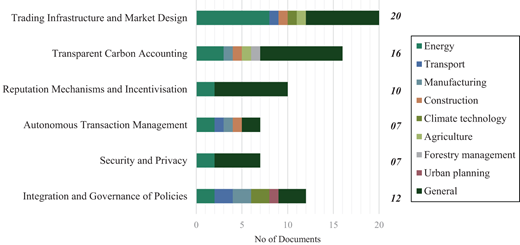
Sectoral distribution of carbon-trading literature within blockchain taxonomies
Source: Authors’ own work
Sectoral distribution of carbon-trading literature within blockchain taxonomies
Source: Authors’ own work
Figure 4 reveals that the majority of the blockchain-based carbon trading papers are focused on trading infrastructure and market design, while the least have focused on autonomous transaction management, security and privacy. It is critical to point out that the energy sector has publications for all six blockchain taxonomies identified in this study, which manifests the energy sector’s extensive publication coverage in the field of blockchain-based carbon trading systems. This dominance may be attributed to the energy sector’s relatively higher digital maturity, established emission monitoring frameworks and early adoption of decentralised energy trading models (Hua et al., 2020; Boumaiza and Maher, 2024). Although transport and manufacturing sectors are the second most represented, a pronounced gap exists relative to the energy sector. Other sectors, including construction, agriculture and forestry management, are minimally represented in the literature. Given that construction is a highly carbon-intensive sector with complex supply chains and fragmented governance structures (Kukah et al., 2025c; Rathnayake et al., 2025), its limited representation suggests a significant research gap rather than a lack of practical need. Eventually, these findings highlight a concentration of blockchain-based energy-related carbon trading applications, while several energy-intensive sectors, such as construction, remain relatively neglected. This uneven distribution of evidence underscores the importance of cross-sectoral synthesis, as conducted in this study, to inform sectors where blockchain-enabled carbon trading mechanisms are still underexplored.
A detailed categorisation of the findings from the existing literature related to the blockchain applications in carbon trading in industries other than construction is presented in Table 1 of the study. In addition to categorising blockchain applications in carbon trading, Table 1 also outlines the industries where these applications are deployed, with the benefits observed by these industries for leveraging blockchain to improve carbon market operations.
Blockchain-based carbon trading solutions in industries other than construction
| Taxonomy of blockchain applications | Examples of blockchain-based carbon trading applications | Target industries | Industry-specific benefits |
|---|---|---|---|
| Trading infrastructure and market design |
| Energy sector (Hua and Sun, 2019; Tian et al., 2022; Wang et al., 2022; Huang et al., 2023b; Zhao and Luo, 2023; Boumaiza and Maher, 2024; Zhang et al., 2024; Zhao et al., 2024) |
|
| Marine ecosystem (Zhao et al., 2022) |
| ||
| Urban public transport sector (Yu and Wang, 2023) |
| ||
| Agriculture industry (Pengna et al., 2024) |
| ||
| Transparent carbon accounting (tracking, monitoring, reporting and verification of data across value chains) |
| Energy sector (Ashley and Johnson, 2018; Dai et al., 2023; Wen et al., 2024) |
|
| Fashion apparel manufacturing industry (Fu et al., 2018) |
| ||
| Forestry management (Sun et al., 2021; Briales and Flinn, 2023) |
| ||
| Agriculture industry (Khanna and Maheshwari, 2024) |
| ||
| Autonomous transaction management |
| Energy sector (Huang et al., 2023a; Zhang et al., 2023) |
|
| Road transportation sector (Lu et al., 2022) |
| ||
| Manufacturing and retailing sector (Wang and Zhang, 2024) |
| ||
| Reputation mechanisms and incentivisation |
| Energy sector (Hua et al., 2020; Li et al., 2024) |
|
| Security and privacy |
| Energy sector (Huang et al., 2023b; Wen et al., 2024) |
|
| Integration and governance of policies |
| Energy sector (Wu et al., 2024; Wang et al., 2025) |
|
| Road transport sector (Li et al., 2021) |
| ||
| Urban planning (Zhang et al., 2022) |
| ||
| Manufacturing sector (Wang et al., 2023; Xu et al., 2025) |
| ||
| Port operations sector (Sun et al., 2023) |
| ||
| Cleantech sector (Zhang et al., 2023; Zhijun et al., 2023) |
|
3.2.1 Blockchain applications in carbon trading infrastructure and market design.
As Table 1 depicts, numerous blockchain applications have been proposed to enhance the infrastructure and design of carbon markets, and among these applications, peer-to-peer trading platforms are evident in multiple contexts. For example, in the energy sector, blockchain-based trading platforms have been used for the reasonable distribution of energy resources to promote a low-carbon economy and reduce the costs of traditional carbon trading systems (Hua et al., 2020; Boumaiza and Maher, 2024), while peer-to-peer trading platforms were used in the marine ecosystem to increase investments in blue carbon sink projects and foster attention to develop marine resources (Zhao et al., 2022). Furthermore, in the energy sector, a cross-chain-enabled collaborative market framework (Wang et al., 2022), a blockchain-enabled dual carbon trading platform for compliance and voluntary carbon markets (Zhao and Luo, 2023), linkage trading platforms based on mutual recognition (Zhao et al., 2024) and joint trading platforms (Tian et al., 2022), have been designed to enhance the trading infrastructure and market design. A blockchain-enabled carbon trading platform with real-time tracking has been used for a similar purpose in the urban public transport sector (Yu and Wang, 2023), while the agriculture industry has used a low-code blockchain platform for carbon credit trading (Pengna et al., 2024). Eventually, the common focus of these applications is to improve the intelligence and efficiency of carbon market operations and carbon ecosystems, which can be insightful for complex industries such as construction.
3.2.2 Blockchain applications in transparent carbon accounting.
Leveraging blockchain to enhance the efficiency of tracking, monitoring, reporting and verification of data across value chains is evident in carbon markets of multiple industries, and examples include the energy sector’s blockchain-based carbon metering and settlement system with digital identities (Wen et al., 2024) and a blockchain-driven carbon asset management system for data deposit certification and traceability management (Dai et al., 2023). In the forestry management sector, blockchain has been integrated with the Stackelberg differential game model to improve the transparency and efficiency of transactions through game-theoretic behaviour (Sun et al., 2021). A blockchain-driven non-fungible token trading platform has been designed in the agriculture industry to ensure traceable environmental impacts through improved transparency in carbon accounting (Khanna and Maheshwari, 2024). Even if the nature of blockchain implementation varies by context, overall, these applications guarantee the visibility and credibility of carbon emissions data and carbon credit transactions (Fu et al., 2018; Briales and Flinn, 2023; Wen et al., 2024).
3.2.3 Blockchain applications in autonomous transaction management.
According to the examples presented in Table 1, it is evident that blockchain models integrated with Stackelberg game theory are used in several industries for carbon offsets through autonomous transaction management (Huang et al., 2023b; Wang and Zhang, 2024). For instance, the energy sector’s blockchain-enabled smart bi-level carbon trading system (Huang et al., 2023a) and the manufacturing sector’s blockchain-based smart supply chain emission reduction model (Wang and Zhang, 2024) indicate how the Stackelberg framework offers a structured way for decentralised entities of a system to interact and make optimum decisions autonomously. On the other hand, the road transport sector has proposed a blockchain-enabled automated emission trading system based on emission caps to enable automated carbon emission auditing without third-party involvement (Lu et al., 2022). Collectively, these blockchain applications powered by smart contracts improve the efficiency and security of carbon market mechanisms while reducing the costs related to intermediary parties in traditional carbon trading systems (Lu et al., 2022; Huang et al., 2023b; Zhang et al., 2023).
3.2.4 Blockchain applications for reputation and incentive mechanisms.
Blockchain offers reliable solutions for increasing the motivation among industry players in participating in carbon trading through reputation and incentive mechanisms (Khaqqi et al., 2018; Wang et al., 2021). An incentivised peer-to-peer trading framework for carbon trading has been proposed by Hua et al. (2020) to optimise the behaviours of the prosumers in the energy sector in achieving energy balance and reducing carbon emissions. Furthermore, according to X. Li et al. (2024), a blockchain-based carbon trading system with optimised profit distribution for incentivisation in the energy sector can ensure reliable and efficient energy distribution with increased incentives for transferring to clean energy solutions. In general, these applications serve the development of carbon markets through increased motivation and accelerated adoption of carbon offset practices (Hua et al., 2020; Li et al., 2024), which could be highly beneficial in developing the carbon ecosystems of the construction industry.
3.2.5 Blockchain applications in security and privacy enhancements.
The cryptographic features and decentralised nature of blockchain systems play a key role in enhancing the security and privacy of carbon trading systems (Kazi and Hasan, 2024; Su et al., 2024b; Yang et al., 2024). Therefore, blockchain technology has been used in the energy sector to improve the security and privacy of carbon market operations (Huang et al., 2023a; Wen et al., 2024). For instance, Wen et al. (2024) proposed a blockchain-based carbon metering and settlement system with digital identities to ensure the verifiability and traceability of data, while eliminating the risk of data manipulation. Similarly, Huang et al. (2023b) designed a blockchain-enabled smart bi-level carbon trading system driven by Stackelberg game theory, which supports autonomous decision-making while also enhancing the privacy of the operations through limited data exposure and secure coordination among trading agents. Collectively, these applications promote participant privacy and data protection in large-scale carbon markets, which is instrumental for the long-term success of carbon trading systems (Huang et al., 2023b; Huo et al., 2024; Wen et al., 2024).
3.2.6 Blockchain applications for integration and governance of policies.
The scalability and interoperability of carbon markets, regulatory compliance and market transparency directly rely on proper carbon governance, and blockchain has the potential to provide improved governance mechanisms to accelerate the development of carbon markets (Kim and Huh, 2020; Li et al., 2021; Sun et al., 2023). Example applications include the road transport sector’s blockchain-enabled policy framework for emission trading for upstream, midstream and downstream entities (Li et al., 2021), the urban planning sector’s blockchain-based carbon trading system to acquire trading reference information in resource-based cities (Zhang et al., 2022) and the port operation sector’s blockchain-based dynamic incentive contract model for governments (Sun et al., 2023). In general, these applications ensure better carbon governance through the eradication of fraud, improved data availability and increased vision for the government to regulate carbon markets through blockchain’s automated compliance and traceability features (Li et al., 2021; Zhang et al., 2022; Sun et al., 2023). Furthermore, Y. Wang et al. (2025) designed a blockchain-enabled unified carbon trading framework for regulatory authorities, consumers and producers of the energy sector to increase pollution control and enhance social welfare while facilitating government regulations. Similarly, an improved carbon regulation scheme with a benchmarking mechanism influenced by blockchain solutions (Wang et al., 2023) and the regulation of greenwashing in carbon trading through blockchain solutions (Xu et al., 2025) have been implemented in the manufacturing sector to facilitate better management of carbon trading systems. Despite the contextual differences, these applications have adopted data-driven mechanisms to optimise carbon market administration, which is extremely crucial for carbon trading operations in complex and fragmented sectors such as construction.
In summary, the thematic review identified six key blockchain taxonomies in carbon trading with distinctive characteristics and benefits that extend across a variety of industries. Therefore, the potential of blockchain in leveraging carbon trading through improved infrastructure, transparency, automation, motivation, security and governance has been highlighted by these findings. Even if the nature of blockchain applications varies by context, the fundamental principles provide valuable lessons to address similar challenges in other industries, such as construction. On this note, the following discussion maps these findings into the distinctive landscape of the construction industry by applying the insights that can be drawn from other industries in overcoming the need for improving carbon ecosystems in construction.
4. Discussion on the needs for improving carbon trading in construction and potential cross-sector blockchain solutions
Carbon trading has been introduced as an emerging domain to reduce carbon emissions through carbon offsets in the construction industry (Kukah et al., 2025c). However, the complexity and data integrity issues related to carbon trading have significant implications for carbon emissions tracking in construction (Rathnayake et al., 2025). Even if carbon trading provides valuable solutions to the intensifying climate change impacts of the construction industry through carbon offsets, it is not widely adopted due to several factors, including a lack of cost-effective schemes and transparency issues (Oke et al., 2024). Numerous technologies have been integrated into carbon markets to improve their productivity, including blockchain, yet their effective implementation has been hindered due to a lack of proper knowledge in both technological and industry-specific contexts (Perera et al., 2020; Alberte et al., 2024; Rathnayake et al., 2025). To bridge this gap, this section deeply examines the need for improving carbon trading in construction, with potential blockchain solutions that have been deployed to date in industries other than construction.
4.1 Effective cost reductions in adopting carbon trading systems
Higher transaction costs act as a primary limiting factor in adopting carbon trading systems in the construction industry (Kukah et al., 2024; Oke et al., 2024). Furthermore, there are many other costs, including account registration fees and annual fees, which make carbon trading a costly solution in mitigating carbon emissions (Zou et al., 2025). Specifically, in the construction context, the uncertainties in emission calculations further intensify the cost implications of carbon trading systems (Geng et al., 2025). In contrast, the energy sector participants have used blockchain-based solutions to reduce the cost of carbon trading through peer-to-peer trading platforms (Hua and Sun, 2019; Tian et al., 2022; Zhao and Luo, 2023), a blockchain-enabled smart bi-level carbon trading system driven by Stackelberg game theory (Huang et al., 2023b) and blockchain-driven smart carbon trading process optimisation frameworks (Zhang et al., 2023). In the urban public transport sector, deployment of blockchain-enabled real-time tracking has allowed them to reduce operational costs and improve operational efficiency of carbon emissions tracking (Yu and Wang, 2023). A low-code blockchain platform for carbon credit trading has also been recognised as a cost-effective solution for carbon trading in the agricultural industry (Pengna et al., 2024). Implementing these initiatives can be fundamental to the success of carbon trading in construction since cost-effective carbon trading solutions have a profound impact on the construction organisations and developers while also supporting the government’s objectives (Zou et al., 2025).
4.2 Improved trust in carbon trading systems
Lack of trust severely restricts the development of carbon markets since there have been incidents of carbon fraud and misrepresentation while deploying carbon trading schemes in the construction industry (Kukah et al., 2025a). Thus far, the fragmented nature and the limited knowledge sharing in construction have inherently led to trust and transparency issues when adopting innovative systems in the industry (Edirisinghe, 2019; Rathnayake et al., 2025). In the energy sector, the use of blockchain-based carbon metering and settlement systems with digital identities has enhanced the trust, reliability and consistency in statistical and settlement methods in carbon emissions tracking (Wen et al., 2024), while the forestry management professionals have used blockchain solutions to guarantee responsible timber sourcing through sustainable and legal methods by improved traceability, visibility and accountability of operations (Briales and Flinn, 2023). These applications serve as a cornerstone for the development of carbon markets in the construction industry since the existence of carbon trading schemes in construction directly relies on the awareness and trust towards value alignments in emissions trading (Oke et al., 2024; Nguyen et al., 2025).
4.3 Improved carbon governance
Improved carbon governance constitutes a key factor in carbon trading in construction since it is connected to many other benefits, mainly including the cost-effectiveness and improved reliability of carbon trading systems (Oke et al., 2024; Kukah et al., 2025a). Research suggests that better carbon governance within construction organisations allows the management to institutionalise carbon offset practices for effective emission reductions and cost savings while gaining a competitive advantage (Oke et al., 2024). For instance, the use of a blockchain-enabled policy framework for emission trading for upstream, midstream and downstream entities has allowed the road transport sector to minimise the fraud and double counting in carbon trading systems (Li et al., 2021). In the manufacturing sector, improved carbon regulation schemes with benchmarking mechanisms influenced by blockchain solutions and the regulation of greenwashing using blockchain-based carbon trading schemes have ensured improved decision-making support while also improving social welfare through carbon trading solutions (Wang et al., 2023; Xu et al., 2025). Further examples include an automated business compliance detection tool for smart contracts in carbon trading (Wu et al., 2024) and a blockchain-enabled unified carbon trading framework for regulatory authorities, consumers and producers (Wang et al., 2025), which are introduced in the energy sector to standardise carbon trading schemes and improve the transparency for better carbon governance. Drawing insights from these implementations is crucial to carbon emissions tracking and trading in construction industry since improved carbon governance directly impacts the carbon market dynamics in construction (Liu and Yin, 2024).
4.4 Financial incentives
Large-scale adoption of carbon trading schemes in the construction industry heavily depends on the financial incentives, including tax credits and government subsidies (Oke et al., 2024; Kukah et al., 2025a; Rathnayake et al., 2025). However, in the construction context, there is an apparent shortage of financial incentives for the participants in the carbon markets (Oke et al., 2024; Zou et al., 2025). In contrast, blockchain solutions have been introduced in the energy sector to incentivise carbon trading, and examples include incentivised peer-to-peer trading frameworks and carbon trading systems with optimised profit distribution (Hua et al., 2020; Li et al., 2024). These applications have effectively reduced carbon emissions while optimising the behaviour and motivating the participants in the carbon market (Hua et al., 2020). Furthermore, with the equitable distribution of profits and increased incentives, the speed of convergence is also improved among the stakeholders in the energy sector (Li et al., 2024). These applications are critical for the future practices in construction-related carbon markets since financial incentives can significantly contribute to addressing the issues that revolve around capital-intensive carbon trading schemes with higher financial flow mechanisms (Oke et al., 2024).
4.5 Improved transparency on the information
The credibility and assurance of carbon emissions tracking in carbon markets heavily rely on the transparency of carbon trading schemes (Liu and Yin, 2024). However, the complex nature of the construction industry significantly complicates maintaining transparency on information, which increases the vulnerability to fraud in most innovative carbon reduction applications, including carbon trading systems (Basheer et al., 2024; Kukah et al., 2025a). Solutions have been introduced in other industries, including forestry management, to improve the traceability, visibility and accountability of supply chains through blockchain-based carbon credit systems (Briales and Flinn, 2023). Further industrial examples include the energy sector’s blockchain-enabled unified carbon trading framework for regulatory authorities, consumers and producers (Wang et al., 2025), the apparel manufacturing sector’s blockchain-supported emission trading scheme driven by “emission link” for carbon emissions tracking (Fu et al., 2018) and the urban planning sector’s blockchain-based carbon trading system to acquire trading reference information in resource-based cities (Zhang et al., 2022). These initiatives have enhanced the transparency, immutability and accountability of carbon emissions tracking while also increasing the availability of comprehensive trading reference information (Fu et al., 2018; Zhang et al., 2022; Briales and Flinn, 2023; Wang et al., 2025). A thorough understanding of these applications is significant for the construction industry since transparency is among the key factors that shape the industry’s pathway towards a low-carbon future through effective carbon trading solutions (Jayarathna et al., 2025; Rathnayake et al., 2025).
4.6 Improved awareness and motivation among construction stakeholders
Even if there are plenty of carbon trading opportunities for construction organisations, the awareness and motivation to participate are relatively lower among construction stakeholders (Oke et al., 2024; Kukah et al., 2025a). In the green power sector, a collaborative blockchain model for carbon trading with a market synergy mechanism and cross-chain technology has been introduced to increase collaboration among the sector stakeholders in carbon trading mechanisms (Zhang et al., 2023). Blockchain applications in carbon trading, driven by the Stackelberg differential game model and blockchain-influenced carbon regulation schemes with a benchmarking mechanism, have been employed in forestry management and manufacturing sectors to increase the participation and investments in carbon markets (Sun et al., 2021; Wang et al., 2023). In the energy sector, the motivation and collaboration among the stakeholders towards carbon trading have increased using a cross-chain-enabled collaborative market framework (Wang et al., 2022), a biform game model framework combining the noncooperative and cooperative games to explore competitive and cooperative investment strategies (Zhang et al., 2024), and a blockchain-enabled smart bi-level carbon trading system driven by Stackelberg game theory (Huang et al., 2023a). Learning from these applications holds a significant value for the construction industry to overcome the existing perceptual barriers for the development of carbon markets, which mainly includes the uncertainties towards the cost and return of carbon trading solutions (Kukah et al., 2025a).
4.7 Improved security
The security of systems constitutes a key factor in promoting carbon trading in the construction industry (Oke et al., 2024; Kukah et al., 2025a). Lack of security to safeguard the participants in carbon trading directly impacts the adoption rates of carbon trading systems in the construction industry (Oke et al., 2024). Specifically, a blockchain-enabled smart bi-level carbon trading system driven by Stackelberg game theory (Huang et al., 2023a) and a blockchain-driven smart carbon trading process optimisation framework (Zhang et al., 2023) have been used to develop anonymous and secure market platforms for carbon trading in the energy sector. With a high level of automation, these solutions can provide increased privacy to the participants in the carbon markets (Huang et al., 2023b). It is imperative to learn from these applications since blockchain can play a key role in protecting the safety and integrity of the construction industry’s carbon market (Jayarathna et al., 2025; Rathnayake et al., 2025).
4.8 Minimised intermediation of third parties
The complexity in the construction supply chains inadvertently encourages a higher third-party involvement for carbon market operations, which creates trust issues for the market participants (Kukah et al., 2025a). Therefore, minimised intermediation of third parties is critical for the successful development of carbon markets in the construction industry (Oke et al., 2024; Kukah et al., 2025a). Cross-sectoral examples include the blockchain-enabled policy framework for emission trading for upstream, midstream and downstream entities and the blockchain-enabled automated emission trading system based on emission caps, which are introduced in the road transport sector to automate carbon emission auditing without third-party involvement and for the disintermediation of central authorities for carbon trading solutions (Li et al., 2021; Lu et al., 2022). With the lower involvement of third parties influenced by such applications, the risks and vulnerabilities associated with intermediary actors can be minimised, and it will improve the construction organisations’ trust towards carbon trading in decarbonising the construction industry (Kukah et al., 2025a).
As the above discussion highlights, the major challenges for carbon trading applications in the construction industry have been effectively addressed in other sectors using blockchain solutions. While the sectors reviewed differ from construction in several key aspects, their blockchain-based solutions provide transferable mechanisms. For instance, the energy sector often involves continuous grid operations and smart, tech-enabled consumers who produce their own power (Ashley and Johnson, 2018; Dai et al., 2023; Wen et al., 2024), whereas construction projects are comparatively short-term and often lack digital infrastructure (Oke et al., 2024; Kukah et al., 2025a). Nevertheless, decentralised ledgers and automated smart contracts can support carbon data recording and compliance across fragmented, short-term projects (Huang et al., 2023a; Jawalkar et al., 2024). In transport, blockchain platforms for carbon tracking leverage real-time data integration and route optimisation (Yu and Wang, 2023), which can be adapted to construction logistics to enhance transparency in material transport and site emissions reporting. Manufacturing and forestry management projects typically operate with structured workflows and long-term monitoring (Sun et al., 2021; Briales and Flinn, 2023), whereas construction supply chains are more project-specific (Kukah et al., 2025b). However, blockchain-enabled traceability and immutable record-keeping can similarly ensure accountability across subcontractors and temporary teams (Kukah et al., 2025a; Rathnayake et al., 2025). These mechanisms allow construction stakeholders to coordinate carbon data, ensure compliance with regulatory requirements, and build trust among fragmented industry participants, demonstrating that cross-sectoral insights are applicable when adapted to the digital maturity, stakeholder complexity and project temporariness inherent in construction. On this note, the following section introduces a framework to consolidate these findings and provide practical guidance on how blockchain applications can be used to establish an effective and efficient carbon market in the construction industry.
4.9 Framework for leveraging blockchain to enhance carbon trading in the construction industry through cross-sectoral blockchain solutions
Following a detailed analysis of the key needs in improving carbon trading in the construction industry, which include enhanced cost-effectiveness, trust, transparency and carbon governance, it is clear that a more organised and structured approach is required to respond to these needs. Aligning with the institutional theory, these challenges reflect broader institutional pressures related to regulatory compliance, legitimacy and governance credibility that shape organisational behaviour within carbon markets (Gao et al., 2023; Tetteh et al., 2025). In this regard, the construction industry can benefit by learning from other sectors, which have used blockchain solutions to improve carbon emissions tracking and other carbon market mechanisms. Such cross-sectoral learning may also be understood as a form of institutional alignment, where industries respond to similar governance constraints by adopting comparable technological solutions (Hartley et al., 2022; Kukah et al., 2024). These insights from other sectors can be contextualised for the construction industry by using a framework that maps the cross-sectoral blockchain solutions to construction-specific needs (RO3). Accordingly, Figure 5 presents a framework for leveraging blockchain to enhance carbon trading in the construction industry through cross-sectoral blockchain solutions.
 The wide multi-column framework is titled Framework for leveraging blockchain to enhance carbon trading in the construction industry. The first column lists taxonomies of blockchain applications: Trading infrastructure and market design, Transparent carbon accounting, Autonomous transaction management, Reputation mechanisms and incentivisation, Security and privacy, and Integration and governance of policies. Arrows connect these to construction industry needs in the second column, including effective cost reductions, improved trust, improved carbon governance, financial incentives, improved transparency of information, improved awareness and motivation, improved security, and minimised intermediation of third parties. The third column provides cross-industry examples from sectors such as energy, transport, manufacturing, forestry management, agriculture, urban planning, fashion apparel manufacturing, cleantech, and port operations. The fourth column lists anticipated benefits for the construction industry, including reduced costs, stronger participation, improved transparency, fraud reduction, privacy, automation, accountability, investment growth, and carbon emission reductions.
Framework for leveraging blockchain to enhance carbon trading in the construction industry through cross-sectoral blockchain solutions
Source: Authors’ own work
The wide multi-column framework is titled Framework for leveraging blockchain to enhance carbon trading in the construction industry. The first column lists taxonomies of blockchain applications: Trading infrastructure and market design, Transparent carbon accounting, Autonomous transaction management, Reputation mechanisms and incentivisation, Security and privacy, and Integration and governance of policies. Arrows connect these to construction industry needs in the second column, including effective cost reductions, improved trust, improved carbon governance, financial incentives, improved transparency of information, improved awareness and motivation, improved security, and minimised intermediation of third parties. The third column provides cross-industry examples from sectors such as energy, transport, manufacturing, forestry management, agriculture, urban planning, fashion apparel manufacturing, cleantech, and port operations. The fourth column lists anticipated benefits for the construction industry, including reduced costs, stronger participation, improved transparency, fraud reduction, privacy, automation, accountability, investment growth, and carbon emission reductions.Framework for leveraging blockchain to enhance carbon trading in the construction industry through cross-sectoral blockchain solutions
Source: Authors’ own work
As Figure 5 depicts, the categories of blockchain applications provide the foundation for addressing the key needs to enhance carbon trading in the construction industry. In other words, the developed framework manifests how blockchain can be used to improve the carbon trading needs in the construction industry through cross-sectoral blockchain solutions (RO3). For example, similar to other sectors such as the energy sector and forestry management sector, if blockchain is deployed to improve the infrastructure and market design in the construction industry’s carbon trading operations, it will provide effective cost reductions while improving the awareness and motivation among the construction stakeholders towards participating in carbon markets. Eventually, the construction sector can benefit from long-term organisational success, increased investments in carbon markets and most importantly, through effective carbon emission reductions. Furthermore, it is important to note that the application categories, i.e. transparent carbon accounting, autonomous transaction management and integration and governance of policies, have the most impact on the construction-specific carbon trading needs. This implies that when integrating blockchain mechanisms into carbon trading in construction, the applications related to these categories should be prioritised for optimised outcomes of the integration.
4.9.1 Implications of maturity levels of blockchain applications for transferability to construction.
During the analysis, it was revealed that the blockchain-enabled carbon trading systems presented in existing literature demonstrate varying levels of technological maturity, ranging from conceptual policy frameworks and analytical models to simulation-based prototypes and limited pilot implementations. Several studies propose conceptual or model-based designs without real-world deployment, including Industry 4.0 integrated emission trading scheme architectures (Khaqqi et al., 2018), blockchain-enabled forestry carbon sink game-theoretic models (Sun et al., 2021) and policy-level road transport emission trading frameworks (Li et al., 2021). These conceptual and policy-level models provide architectural blueprints, governance structures and regulatory integration strategies that can inform construction carbon market design. Others validate system feasibility through simulations or laboratory testing environments, such as peer-to-peer energy trading systems (Hua et al., 2020), cross-chain collaborative carbon markets (Wang et al., 2022) and reputation-based distributed emissions trading mechanisms (Hu et al., 2020). These simulation-based prototypes demonstrate technical feasibility, consensus mechanisms, smart contract automation and reputation-based compliance systems under controlled conditions, reducing uncertainty around system functionality. A smaller subset reports prototype-level development or pilot testing under semi-real conditions, including low-code carbon credit trading platforms (Pengna et al., 2024) and pilot-based peer-to-peer energy trading initiatives (Boumaiza and Maher, 2024). These pilot and prototype implementations offer early empirical insights into transaction efficiency, cost reduction and fraud mitigation. Together, these studies collectively establish technical plausibility, governance innovation and performance potential, even if large-scale carbon markets are still emerging. For the construction sector, where carbon trading mechanisms are comparatively underdeveloped, these staged developments provide a progressive knowledge base rather than ready-made systems, supporting adaptation rather than direct replication.
Eventually, it can be noted that this framework acts as a blueprint for the successful implementation of blockchain-enabled carbon trading solutions in construction, reinforced by proven lessons from other industries. By bridging cross-sectoral blockchain insights with construction-specific needs, a strategic foundation is provided by this study for improved carbon trading operations in construction through data-driven solutions that enable transparent, efficient and scalable carbon market practices in the construction industry. Notwithstanding these contributions, it should be acknowledged that the proposed framework is conceptual in nature and has not yet been empirically validated within real construction project environments. The operationalisation of blockchain-enabled carbon trading across temporary and fragmented construction project structures, which are characterised by multiple subcontractors, heterogeneous digital capabilities and short-term contractual relationships, would require context-specific technological and governance adaptations (Kukah et al., 2025a; Rathnayake et al., 2025). As such, the framework is intended to serve as a theoretical and strategic guide that highlights potential pathways for implementation rather than a tested implementation.
5. Actionable future research directions
Building on the results of the in-depth analysis of bibliometric and thematic studies, despite the continuous growth in the field of blockchain and carbon trading, this study found several gaps in the existing knowledge that need to be addressed to enhance blockchain-integrated carbon trading practices in the construction industry. Accordingly, Table 2 presents the future research directions and the corresponding research questions that need further exploration, categorised under the three key research domains discussed in this study.
Actionable future research directions to improve carbon trading in construction through blockchain integrations
| Research domain | Future directions | Research question | Suggested approach |
|---|---|---|---|
| Construction industry | Addressing construction industry-specific barriers in implementing blockchain for carbon trading | How can industry-specific barriers be addressed to improve carbon trading in construction using blockchain? | Qualitative interviews with stakeholders |
| Refining and validating the framework developed in this research | How can cross-sector insights be integrated to improve carbon trading in construction using blockchain? | Qualitative interviews with stakeholders, pilot case studies | |
| Blockchain | Exploring the potential to optimise the scalability, regulatory compliance and interoperability of blockchain systems across the construction industry’s fragmented supply chains | How can blockchain platforms be developed with improved scalability, regulatory compliance and interoperability to support complex supply chains in construction? | Designing, building and testing a blockchain system, technical validation |
| Carbon trading | Examining strategies that can improve carbon emissions tracking and reporting in the construction industry through cross-sectoral blockchain solutions | What are the strategies that can enable improved carbon emissions tracking and reporting in construction through cross-sectoral blockchain solutions? | Quantitative surveys with experts in construction and blockchain |
As Table 2 explains, this study highlights several knowledge gaps that require further investigation to improve the use of blockchain in construction-specific carbon markets. These implementation uncertainties highlight important avenues for future research, particularly in relation to empirical validation, pilot implementations and the development of interoperable digital infrastructures capable of supporting blockchain-enabled carbon trading in construction contexts. It is crucial to conduct studies in addressing construction industry-specific barriers in implementing blockchain for carbon trading to develop actionable strategies to improve the carbon ecosystem of the construction industry. Refining and validating the framework developed in this study through empirical studies will provide a clear pathway for integrating cross-sectoral insights into complex construction supply chains. Furthermore, development of a blockchain platform to optimise the scalability, regulatory compliance and interoperability of construction-specific carbon trading systems is essential to ensure efficient, secure and transparent market operations. Additionally, defining actionable strategies to integrate successful cross-sectoral blockchain solutions in carbon emissions tracking and reporting is essential for the effective development of the construction industry’s carbon markets and the advancement of the industry’s decarbonisation goals.
6. Conclusion
The low profit margins and high turnover of the construction industry hinder the opportunities for low-carbon innovations. Besides, the lengthy and complex construction supply chains further complicate carbon emissions tracking through traditional methods, which reflects the need for advanced solutions such as blockchain-enabled carbon trading to enhance the carbon ecosystem of the construction industry. Learning from other industries with a developed carbon ecosystem, this study examined the potential of blockchain technology in enhancing carbon trading practices in the construction industry through cross-sectoral insights. It was revealed that blockchain-integrated carbon trading research is a growing field of study with a special focus on low-carbon management strategies, initiatives in energy management and sustainability, technologies and carbon markets and policy and climate agreements. Following a comprehensive thematic interpretation, this study further consolidated the existing knowledge into a framework that clearly conveys how different blockchain application domains support in addressing construction-specific carbon trading needs and improving the carbon ecosystems of construction by drawing evidence from other industries. The findings revealed that when blockchain mechanisms are integrated into different domains, including transparent carbon accounting, autonomous transaction management and policy integration and governance, the construction industry’s carbon markets can benefit from effective carbon emissions tracking, cost reductions, improved trust, transparency and security in market operations, and improved awareness and motivation among construction stakeholders in data-driven trading mechanisms. Furthermore, it was revealed that the construction industry can derive further value, including long-term success for construction organisations through increased profits and market shares, optimised behaviours of construction stakeholders in reducing carbon emissions and increased decision-making support in effective carbon emissions management.
From a theoretical perspective, this research contributes by bridging the existing knowledge from different industries on integrating blockchain-enabled solutions to improve carbon trading practices in the construction industry. Accordingly, this study extends institutional theory to blockchain-enabled carbon trading in construction by showing how institutional pressures shape the adoption of technologies that enhance transparency and governance and explain cross-sectoral transfer in response to shared institutional constraints. Beyond its conceptual contribution, the proposed framework has practical implications for industry stakeholders and policymakers by providing a structured blueprint for integrating blockchain-enabled carbon trading into construction workflows. The framework further supports industry practitioners to align project-level embodied carbon accounting data, such as data generated from lifecycle assessment tools, with market-based carbon trading mechanisms. It can directly improve data transparency and traceability of construction-related carbon trading systems through advanced data governance, and smart contract-enabled monitoring, reporting and verification processes. At the policy level, the framework can assist construction authorities in creating standards and recommendations based on cross-sectoral blockchain implementations that support reliable, transparent and interoperable carbon trading processes in the construction industry.
While this study used Scopus and Web of Science to capture interdisciplinary research on blockchain-enabled carbon trading, the exclusion of specialised technical databases such as IEEE Xplore and the ACM Digital Library may have limited the inclusion of some technically oriented blockchain implementation studies. Given that several blockchain architectures, consensus protocols and smart contract frameworks are frequently discussed within engineering-oriented venues, future reviews may benefit from incorporating these databases to further strengthen the comprehensiveness of the evidence base. Further research is directed towards refining and validating the framework developed in this research through empirical studies that focus on implementing blockchain-enabled carbon operations in construction to understand the practical challenges of the integration. Additionally, future work is needed to address gaps related to barriers for adopting blockchain-based carbon trading systems while assessing the scalability, regulatory compliance and interoperability of blockchain systems within complex supply chains in construction. It is highly important to note that investigations in enhancing the construction industry’s carbon trading practices through innovative blockchain solutions encompass both the development of carbon markets and the establishment of a sustainable built environment with the capacity to address the longstanding barriers in achieving its decarbonisation goals.
The authors would like to acknowledge the financial support provided by Faculty of Science, Engineering and Technologies, The University of Adelaide, Australia through SET Early to Mid-Career Researchers (EMCR) Grant 2024.

