The educational value of well-developed collaborative learning activities has been demonstrated in both traditional and online learning environments (Felder & Brent, 1996; Hiltz & Benbunan-Fich, 1997; Smith & MacGregor, 1992). For educators, however, the difficult part is knowing how to start the development process and what to include in a collaborative learning activity. The purpose of this article is to provide a systematic roadmap for designing online collaborative learning activities. By following the instructional design model presented here, educators can produce well-planned, interactive, collaborative learning activities that encourage teamwork and social negotiation, and challenge students to construct their own understanding of new information.
For most traditional classroom instructors, designing collaborative learning (CL) activities for a distance learning course is no easy task. Questions like “What needs to be included in an online collaborative activity?” “How should the class be grouped?” and “How will student performance be measured and graded?” are just a few of the many questions that come to mind. The goal of this article is to help the average instructor answer these and many other difficult questions by providing a “how-to guide” for creating online CL activities. To accomplish this goal, the paper is organized into four sections: (a) rationale—a discussion of the need, purpose, and value of online CL; (b) procedures—a description of the step-by-step procedures for designing online CL activities; (c) design model—a discussion of how the step-by-step procedures can be organized into a general CL design model; and (d) analysis—a short discussion of how each stage in this general model is similar to and/or different from the Dick and Carey model, a traditional instructional systems design (ISD) model.
Rationale
In a traditional face-to-face classroom, the burden of communicating course material resides primarily with the teacher (Felder & Brent, 1996). In this paradigm, the teacher is responsible for lecturing, designing individual and group assignments, and grading. In most online courses, however, much of the burden is shifted to the students, as they are required to assume increased responsibility for their own learning. With this shift toward a more learner-centered environment, the instructor also assumes a new and often unfamiliar responsibility: providing students “with opportunities to learn independently and from one another” (Felder & Brent, 1996, p. 1).
A well-designed and developed CL activity fits perfectly into this new, learner-centered paradigm. Collaborative learning is a term that describes an educational approach characterized by students interacting in groups with other students, with teachers, and with the course material (Smith & MacGregor, 1992). This type of learning is “learner-centered rather than teacher-centered and knowledge is viewed as a social construct, facilitated by peer interaction, evaluation and cooperation” (Hiltz & Benbunan-Fich, 1997, p. 2).
The educational value of well-developed CL activities has been demonstrated in both traditional and online learning environments (Felder & Brent, 1996; Hiltz & Ben-bunan-Fich, 1997; Smith & MacGregor, 1992). Some of the benefits of student-centered CL activities include “increased motivation to learn, greater retention of knowledge, deeper understanding, and more positive attitude toward the subject being taught” (Felder & Brent, 1996, p. 1). As a fundamentally constructivist idea, CL activities also encourage social interaction, teamwork, and knowledge construction as students work in purposeful ways with new information, ideas, and skills that are embedded in rich contexts. Examples such as collaborative writing, cases studies, and debates all require that students be actively engaged in course content, becoming immediate practitioners instead of distant observers (Smith &
MacGregor, 1992).
Procedures
Although the pedagogical benefits of using CL activities in a distance learning course are undeniable, the practical side of actually creating effective CL activities is difficult. There are, however, a number of step-by-step procedures that, when followed, can help remove some of the guesswork from the design and development process. The following is a list of questions to ask and procedures to follow when creating online CL activities. These steps fit into an overall design and development model for CL activities that will be discussed in more detail in the next section.
1 Establish Your Overall Instructional Goal
What is your overall instructional goal? This question should begin the design and development process and represents the first of four planning stages. This is a very broad stage where you determine, on a macro scale, what you want your students to get out of the activity. At this stage, you should also begin to think about the structure of your course and how a CL activity could fit into that structure, as well as with your students’ experience level and the course content. Some practical questions to consider include “Where would a CL activity logically fit into the class?” “How large is the class?” “What are the student demographics?” “How experienced are the students with CL activities?” and “How well do the students know one another?” (Cooper & Robinson, 1997).
2 Identify Collaborative Learning Activity Objectives
The next step in the planning process is to identify, more specifically, the learning objectives that you expect your students to achieve by the end of the CL activity. It is important to keep in mind that most CL activities do more than just improve student achievement. They also require that students use social skills, work together in teams, and deal with the multitude of problems that can occur during group assignments (i.e., conflicting schedules, communication problems, and personality clashes). Additionally, course objectives must be clearly defined in this stage. Is the goal of the activity to help students master concepts and facts, or do you intend for the CL activity to enhance student skills and change attitudes? These questions should be addressed in this stage, keeping in mind the idea that CL activities, by their constructivist nature, tend to promote advanced cognitive outcomes such as analysis, synthesis, and evaluation (Driscoll, 2000). Finally, both your overall instructional goal as well as specific learning objectives must be well developed; they will need to be clearly articulated to your students when you write your activity instructions (see Step 5, below).
3 Choose an Overall Collaborative Learning Strategy
The third step in the planning process is to choose from a variety of CL activities, based on the specific learning objectives identified above. One important item to consider in this stage is do you want your CL activity to require synchronous (i.e., chat rooms, instant messages, and phone meetings) or asynchronous (i.e., e-mail and threaded discussion boards) group interaction? Bear in mind, your answer to this question need not be limited to one or the other. Blended activities that utilize both synchronous and asynchronous communication technologies may be more appropriate and may allow you to capitalize on the benefits of both. For a more complete list of things to consider when choosing between synchronous and asynchronous interaction options, see Similarities and Differences Between Modes of Communication, by Jeong (2002).
Another important item to consider when choosing an overall CL strategy is instructor feasibility. Specifically, how difficult is it going to be for you (or another instructor) to facilitate, monitor, and grade the CL activity? Additionally, if you plan to include multiple CL activities into one course, how feasible is it to do these things week after week? CL activities require a significant time commitment on the part of the students, but they also increase instructor workload. Do not underestimate your time commitment; it may be greater than the time required to prepare and deliver a traditional lecture (Cooper & Robinson, 1997).
Although a complete list of online CL activities is outside the scope of this article, the following list is provided to give you a better feel for some of the available options. Types of online CL activities include: (a) student debates, both synchronous and asynchronous; (b) collaborative writing activities; (c) group Web-development projects; (d) case study examinations; (e) discussion groups; (f) peer editing activities; and (g) information collections. For additional CL ideas, please visit the following web resources:
Doing CL,http://www.wcer.wisc.edu/nise/CL1/CL/doingcl/DCL1.asp
What is Collaborative Learning,http://learningcommons.evergreen.edu/pdf/collab.pdf
Collaborative Activities,http://www.wvu.edu/~ruralnet/current/whatare.htm
Online Collaborative Projects,http://eduscapes.com/tap/topic1.htm
Computers in Teaching and Learning,http://www.staffs.ac.uk/cital/collab.html
4 Plan Collaborative Learning Activity
The final step in the planning process is to determine the specifics of your chosen CL activity. Items to consider include:
How are students to be grouped? Generally speaking, the shorter the activity, the smaller the groups, and heterogeneous groups are normally better than homogenous groups (Cooper & Robinson, 1997). Additionally, groups can be manipulated to ensure maximum interaction. For instance, a debate might be organized such that students with differing opinions on a topic are grouped together, thereby encouraging them to interact and negotiate group consensus.
How structured is the CL activity? Normally, the less experience your class has with CL activities, the more structure you will need to provide (i.e., you will have to give them well-defined end points, establish individual roles within the group, and provide a step-by-step method for completing the task). As the class gets more experience with CL, the structure of your activities can be loosened (i.e., you can give them more open-ended assignments, let the group decide specific roles, and provide little or no specific instructions for completing the task).
5 Write Step-by-Step Instructions
Once you have planned your CL activity, it is time to write step-by-step activity instructions. This step is extremely important, as the activity description is the first thing students will reference if they have questions concerning the assignment. Step-by-step instructions should include activity objectives, concepts to be covered, the activity timeline, activity structure, the specific deliverables, student and group success criteria, and student assessment criteria (i.e., grading). Remember that inexperienced students will not only need more structure in their activity, but will likely need more detailed instructions as well.
6 Develop Assessment Tools
The final step before you implement and test your newly developed CL activity is to determine exactly what assessment tools will be used to grade student performance. Deciding how to grade CL activities is one of the most challenging aspects of the design and development process. This is because
collaborative activities often have several goals—individual learning on the part of each student, the successful functioning of a team, and a collaborative product that may be measured against diverse criteria. In other words, one reason why it is difficult to evaluate collaboration is that you must examine the process as well as the product of the group’s work. (Enerson, Johnson, Milner, & Plank, 1997, p. 3).
One way to address this challenge is to combine process grades with final product grades to produce an overall grade. While assessing the final product is fairly straightforward, assessing the process can be more difficult. It can be accomplished, however, by monitoring and observing group interactions and by requiring that each student evaluate his or her fellow group members. Final product grades and process grades can then be weighted based on your specific activity objectives. However you decide to grade your CL activity, remember to “inform the students of the grading policy at the start of the project, so that your expectations for the assignment are clear” (Enerson et al., 1997, p. 3). Finally, provide regular feedback to your students both during and after the CL activity. Frequent feedback will help all participants know if they are on the right track and will eliminate surprises at the end of the activity (Cooper & Robinson, 1997).
Collaborative Learning Design Model
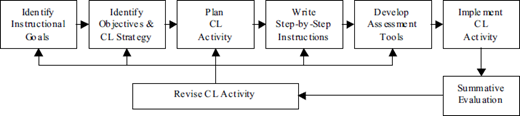
All of the questions/procedures listed above can be organized into a general CL design model (see Figure 1). This model is a derivative of the Reiser and Dick model, a traditional ISD model originally created for teachers, not instructional designers (Gustafson & Branch, 1997). The original teacher-oriented model emphasizes instructional planning, an idea that is consistent with the CL design model presented here. To address some of the CL-specific procedures discussed in the previous section, the Reiser and Dick model has been modified to include identification of a general CL strategy and writing of step-by-step activity instructions. The revised CL model also includes a summative evaluation stage (described in detail below), something not specifically addressed in the Reiser and Dick model. For more information on the Reiser and Dick model, see Gustafson and Branch (1997).
Although most of the stages in the CL design model were discussed in detail in the previous section of this article, the following discussion is designed to complete the explanation of the CL activity design model. It includes information on the entry point for the model, summative evaluation, and revision of your CL activity.
Entry into the C ollaborative Learning Design Model
For most instructors considering online CL, the logical entry point into the CL design model is stage one—identify instructional goals. That being said, it is not unusual for an instructor to begin the process at another stage. For example, you might discover an interesting CL activity that you would like to try in your online course. In this case, the activity may already have step-by-step instructions, as well as established assessment tools. With those stages already addressed, you should still plan to identify an overall instructional goal and specific learning objectives. Likewise, you should consider some of the items inherent to the planning of a CL activity, including student grouping, activity structure within your online class, and your students’ experience level with CL activities.
Implementation and Summative Evaluation
Once you have planned your activity, written your instructions, and developed assessment tools, you are ready to implement and evaluate the CL activity. Unlike a large ISD development project that undergoes testing and formative evaluations throughout the design process, it is likely that your first chance to evaluate your activity will be just after its implementation. The summative evaluation stage is your chance to determine the degree to which your original instructional goals and learning objectives have been realized (Gustafson & Branch, 1997). In this stage, you should obtain student reaction to determine how much they enjoyed the CL activity being used. You should also evaluate student learning by comparing the results of the activity with your established learning objectives. The question to ask here is “Have the students met the objectives and learned from the CL activity?”
Collaborative Learning Activity Revision
Well-designed CL activities are never fully complete, and revision is an ongoing process. As a general rule, activity revision should reflect the information gathered in the summative evaluation phase. Based on “student performance on each objective and student attitudes towards your instructional activities” (Gustafson & Branch, 1997, p. 43), you should make appropriate changes. As Figure 1 indicates, revisions to your CL activity can be made at various stages in the design model. For instance, after evaluating an activity, you might decide that although the students enjoyed the activity, your learning objectives were not met. In this case, you might either make changes to the CL plan itself or consider using the activity in another portion of the class, taking advantage of the learning outcomes that your students did attain. Alternatively, you might find that although your students enjoyed the activity, you were not able to effectively measure their learning outcomes. In this case, you would want to go back and redesign your assessment tools.
Finally, the process of revising a CL activity can, in and of itself, become an effective CL activity. For example, you might try a CL activity early in an online course and then later ask your students to recommend ways to revise and improve on the original design. The advantages of this strategy are twofold: (a) you have effectively turned one CL activity into two; and (b) your students, with an entirely different perspective than yours, will likely discover problems and recommend improvements that you could not have imagined.
Analysis
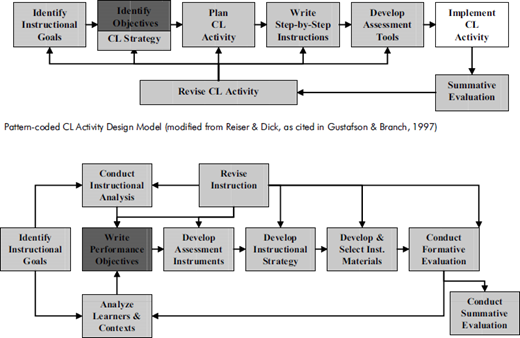
While the CL design model presented here is a derivative of the Reiser and Dick model, it is also similar to another classic ISD model, the Dick and Carey model (Gustafson & Branch, 1997). Figure 2 shows the CL design model and the Dick and Carey model side-by-side. The stages of both models are pattern-coded to show similarities between the two. Although, in most cases, the stages do not match up one-for-one, they are very similar. For example, in the CL model, the first stage, identify instructional goals, is very broad. This single stage, however, is equivalent to, though less comprehensive than, the first three stages in the Dick and Carey model, which include identify instructional goals, conduct instructional analysis, and analyze learners and contexts. Likewise, the CL model identifies only summative evaluation, while the Dick and Carey model specifies both formative and summative evaluations. Finally, while both models recognize revision as an integral part of the design and development process, the CL model places the revision stage after the activity has been implemented, while the Dick and Carey model emphasizes revision before, during, and after each step of the process.
Ultimately, the differences observed between these two models reflect a fundamental difference in their intended use. The CL model is designed primarily with a classroom orientation and is useful to professional teachers creating online distance learning activities. As such, this model is fairly simple in its conceptual framework, providing teachers with a general road-map to follow (Gustafson & Branch, 1997). The Dick and Carey model, on the other hand, is designed primarily with a system orientation and is of interest to highly trained instructional designers developing entire courses. As such, this model assumes “that substantial resources will be made available to a team of highly trained developers” (Gustafson & Branch, 1997, p. 57),
requiring much more front-end analysis, testing, and revision.
Conclusions
It is clear that students who participate in well developed CL activities realize significant learning benefits (Felder & Brent, 1996; Hiltz & Ben-bunan-Fich, 1997; Smith & MacGregor, 1992). The difficult part, however, is knowing how to start the development process and what to include in your activity. The purpose of this article is to provide you with a systematic roadmap for doing just that. By following this process, modified from a traditional design and development model, you can produce well-planned, interactive CL activities for your online courses that encourage teamwork and social negotiation, and challenge students to construct their own understanding of new information.
“THE EDUCATIONAL VALUE OF WELL-DEVELOPED COLLABORATIVE LEARNING ACTIVITIES HAS BEEN DEMONSTRATED IN BOTH TRADITIONAL AND ONLINE LEARNING ENVIRONMENTS.”
—ANTHONY R. ARTINO, JR.
About the author