

Online course design is a critical factor in supporting academic success and degree completion. Increasing student diversity in today’s higher education institutions indicates the need to provide inclusive learning environments to mitigate the completion gap. The current study examines formative midsemester student surveys in an online business management course through the lens of Universal Design for Learning (UDL) and retention models. The UDL framework consists of engagement, representation, and action and expression. Engagement focuses on motivating learners, representing alternative ways to present content, and action and expression on providing opportunities for learners to give evidence of achievement in different ways. Retention theories account for the importance of academic engagement. Findings indicate that content presentation, course structure, application assignments, teamwork and instructor presence are central to learning. Features that are supportive of learning also present challenges for some learners.
Students in today’s higher education institutions are increasingly diverse regarding race, ethnicity, religion, family background, country of origin, linguistic skill, socioeconomic status, gender and sexual orientation (American Council on Education, 2023). Despite increased access for these populations, more is needed for student success, particularly in degree completion. In the US, six-year graduation rates for first-time, full-time undergraduates are 74% for Asian students, 64% for White students, 54% for Hispanic students, 51% for Pacific Islander students, 40% for Black students and 39% for American Indian/Alaskan Native students (National Center for Education Statistics, 2019). Similar gaps occur in the UK, where Black student completion rates are 7.8% lower than those of White students, and rates for students from low socioeconomic areas are 6.7% lower than those from wealthy communities (Custer, 2023). These data indicate a compelling need for universities and academic staff to design courses and adopt pedagogical strategies that support completion goals, such as those announced by the UK Office for Students that 80% of full-time students should progress to the second year of their studies, 75% should complete their programs of study and 60% should advance to further study or professional work within 15 months post-graduation (Custer, 2023).

The current study examines how course design for an online introduction to organizational behavior course sought to engage students and support learning and, by extension, degree completion. Formative midsemester surveys were examined for insights into students’learning experiences. The course emphasizes organizational behavior theories and concepts and cross-cutting skills, or those applicable across disciplines, such as critical thinking, problem-solving, application of learning and communication (Finlay, Aborn, Ruddy, & Miller, 2021; Hart Research Associates, 2015). The design goal for the course was to support a range of learning approaches and provide multiple pathways for students to illustrate their knowledge. Results were analyzed through the lens of UDL principles (CAST, 2023; Firchow, 2016; Kennette & Wilson, 2019) and retention models (Astin, 1999; Bean & Metzner, 1985; Kirby, 2015; Spady, 1971; Tinto, 1993). Inclusive practices in management education can motivate students to continue their education and develop the mindsets and skills to innovate, create new knowledge and develop the employees they manage in their future workplaces to impact organizations and society positively.
UDL has previously been associated with the idea that resulting learning outcomes can encourage retention and degree completion (Davies, Schelly, & Spooner, 2013), but exploration of this outcome has been minimal. An Australian study of pre-service teachers found that multiple means of representation and engagement supported increased engagement as measured by LMS log files and student satisfaction surveys and decreased attrition for study units when compared with pre-intervention data (Garrad & Nolan, 2023). Recent reviews have determined the need for research that identifies the effects of UDL course design (Oliveira, van Munster, & Gonçalves, 2019), particularly in higher education (Almeqdad, Alodat, Alquraan, Mohaidat, & Al-Makhzoomy, 2023; Roberts, Park, Brown, & Cook, 2011), where change management is fraught with difficulty (Fovet, 2020). In short, research is needed to understand better how module and course design in higher education impact learning (Minsi, 2023). The goal of this qualitative study was to explore the following research question: How do design and pedagogical features impact student self-perceptions of learning?
Literature review
Two areas of research and associated theory have the potential to provide insight into students’experiences in the Introduction to Organizational Behavior course. These areas, Universal Design for Instruction (UDI), of which UDL is an application and well-established retention models (Astin, 1999; Bean & Metzner, 1985; Kirby, 2015; Spady, 1971; Tinto, 1975) are next examined to identify elements associated with student learning, retention and persistence. The National Student Clearinghouse Research Center, 2023 defines retention as returning to the same university in the second year and persistence as returning to any university in the second year. As such, retention may be seen as an institution-facing measure of success and persistence as a student-facing measure of success (Tandet, 2023). However, researchers typically define retention as continued enrollment from first to second year, while persistence is continued enrollment until graduation (Burke, 2019). The latter definitions are followed in this research.
Universal design for instruction
The principles of UDI aim at designing learning processes and products usable by all regardless of gender, culture, learning style, age, skill or ability (Burgstahler, 2002). The guiding tenets are usable, accessible and inclusive. UDI entails equity—accessible and helpful instruction to accommodate a range of learner abilities; flexibility—the provision of method and assignment choices; perceivability—equal access to information, clear and intuitive instruction; inclusivity—pace and skill variation, minimizing physical exertion, size and space considerations for physical mobility and seating; and fostering learning communities— interaction and communication (Scott, McGuire, & Shaw, 2003).
Applying these principles to today’s diverse higher education students suggests that flexibility (choice of methods for learning and assessment) and inclusivity (learner pace) are particularly relevant for those balancing work, study and home responsibilities (Osam, Bergman, & Cumberland, 2017). Equity (accessible, useful instruction) and perceivability (explicit instruction) are critical for those coming to higher education from a range of educational and home backgrounds, while fostering learning communities (interaction, communication) is especially salient to online learning and establishing a sense of belonging, which impacts retention (Ahn & Davis, 2019). While UDI and its corollary for designing curriculum, UDL, aids learning for students with disabilities, its application to instructional design is a common practice and has the potential to improve teaching and learning for all (Reinhardt, Robertsone, & Johnson, 2023).
Universal design for learning
Concerns with degree completion and associated government-directed goals in the UK (Custer, 2023) and performance-based funding trends in the US (Kelderman, 2019) indicate the need to consider improving teaching quality to enhance student success and completion. One approach is the application of UDL principles to guide objectives, assessments, methods and materials that meet student needs and make learning inclusive (CAST, 2023). Inclusive pedagogies can improve success across student populations. The framework is based on the why, what and how of learning, precisely, engagement, representation, and action and expression. Engagement focuses on motivating learners, representing alternative ways to present content, and action and expression on providing opportunities for learners to give evidence of learning in different ways. A study involving cafeteria-style grading in which learners had a choice of assignments illustrates the principle of engagement in that over a third of students were motivated to complete more assignments than needed to earn the highest possible grade (Hanewicz, Platt, & Arendt, 2017).
Faculty members can be trained to apply this model. The author’s university, for instance, offers a UDL certificate, which comprises 15 weeks of readings, application assignments and colleague interaction. Participants explore ways to design their courses and instruction to“further learners’ abilities to access, build, and internalize knowledge” with the ultimate aim of developing “learners who are purposeful and motivated, resourceful, and knowledgeable, and strategic and goal directed,” (Reinhardt, Robertsone, & Johnson, 2023), thus reflecting the critical tenets of UDL. These attributes positively impact student retention, particularly the commitment to goal achievement (Bowles & Brindle, 2017; Glogowska, Young, & Lockyer, 2007; Tinto, 1975; Willcoxson, Cotter, & Joy, 2011).
The certificate is an example of how institutions can change practice to support learner success in an era of widening higher education participation and how they can address challenges with faculty adoption of UDL, such as lack of planning time, resources, collaboration opportunities, technology support (Altowairiki, 2023; Davies, Schelly, & Spooner, 2013; Hills, Overend, & Hildebrandt, 2022; Wilhelm, 2023) and misconceptions about UDL and accommodations (Hills, Overend, & Hildebrandt, 2022). UDL training courses significantly positively affect valuing diversity and integrating related principles into lesson planning and teaching (Rusconi & Squillaci, 2023). Leadership in vision, planning, support and faculty-driven, collaborative processes with ongoing facilitation are precursors to successful implementation (Altowairiki, 2023; Bastoni, Goldammer, Perez, Schwab, & Vobornik, 2023).
UDL principles encourage multiple ways to engage students, present content, provide choice and diversify assessment. All students can benefit from applying these principles (Capp, 2017). Engagement can be as simple as providing goals or assignment rationale and using a standardized template in the learning management system (Lepp & Fierke, 2017; Miller & Humphreys, 2023). Indicating completion time, offering tips for overcoming challenges and developing coping strategies reflect the UDL engagement principle. Providing variation in content delivery, such as slides, videos or article extracts, aligns with the principle of representation. Offering students assessment choices such as quizzes, written papers or graphic representations of knowledge supports the action and expression principle. One study strengthened the ability to demonstrate learning in a discussion board assignment through options for written, graphic or oral posts (Goldowsky & Coyne, 2016). UDL-facing course design and teaching are generally believed to be suitable for all students and, with appropriate institutional support, can be effectively adopted to improve learning outcomes (CAST, 2023; Bastoni, Goldammer, Perez, Schwab, & Vobornik, 2023; Meyer, Rose, & Gordon, 2014).
UDL should also be considered in the context of assessment trends in higher education: (1) technology-enabled assessment, expressly how to adopt traditional practices for online environments, address concerns with academic integrity, rethink the purposes of assessment and increase transparency through assignment instructions, criteria and rubrics; (2) sustainable assessment with formative and summative measures, partnering with students to design assessments and peer and self-assessment; (3) a focus on equity to address student diversity, reduce structural barriers and adjust practices and (4) an emphasis on employability and authentic learning through authentic and meaningful assessment, providing multiple ways for students to portray their learning and supporting collaboration and dialogue among students, staff and industry/community (O’Neil, 2024). These emerging assessment practices support UDI/UDL principles (e.g. equity, perceivability and representation through transparent instructions and criteria; engagement with peer review, self-assessment and reflection; action and expression through goal-setting and multiple types and means of assessment).
Online courses rely on technology for content delivery interaction and assessment and can enhance the use of UDL elements. Higher education institutions generally have requirements to ensure the accessibility of online content for students with disabilities. The author’s university has established a rubric-based quality peer review process, which includes accessibility items and familiar navigation to aid learning for all students, not just those with documented learning accommodations. Online courses can support student needs through media, activities and other resources as guided by quality standards (Parra, 2018). Content in online courses can be presented and assessed in various ways to increase knowledge accessibility and determine achievement for a range of diverse students (Delisio, & Butaky, 2019). The features of ODL are particularly salient to online course design in developing countries where universities are transitioning to e-learning but need more inclusive pedagogies, resources and training for academics and learners and adhere to outdated policies (Minsi, 2023). UDL adoption in online courses entails design and learning facilitation (Altowairiki, 2023).
The empirical validity of the UDL framework has been questioned. An examination of CAST-cited support for one checkpoint, alternatives for auditory information in the category of multiple means of representation, was examined to conclude that the literature was dated, particularly in the critical areas of technology and cognitive psychology; few of the studies involved participants with disabilities. Many studies needed more relevance to the checkpoint (Matthews, Cavanaugh, & Wilson, 2022). The framework must be scientifically justified with an appropriate literature base to support its growing adoption and acceptance. That being said, the current study examines course design features related to the framework through students’ perspectives on how they learn. As such, the focus is on design principles and course components that students view as facilitating learning rather than the framework itself.
Academic engagement and retention
Academic engagement is critical in many student retention models (e.g. Astin, 1999; Kirby, 2015; Tinto, 1975). These models inform the provision of various student support services, course design and pedagogical approaches (Andrade, 2025; Seery, Barreda, Hein, & Hiller, 2021). Tinto’s persistence model focuses on the relationship among multiple constructs, including pre-entry characteristics, incoming goals and commitment to graduation, academic and social integration and the subsequent impact of integration on intentions to persist. A related component in Kirby’s (2015) model of voluntary dropout includes intellectual development as an adaptive aspect of the higher education experience. Precursors to these models also accounted for academic factors. Spady, 1971 includes grades and intellectual development as impacting retention, while Bean and Metzner , 1985 see academic outcomes as critical.
UDI and UDL provide guidelines that support the academic factors represented in retention theories. They provide the course designers and faculty with information on implementing it to support positive learning outcomes. These positive learning outcomes would be hypothesized to lead to retention. Involvement or integration could consist of many of UDI features—making instruction accessible (equity); providing a variety of methods, delivery modalities and assignments (flexibility); clear and intuitive information (perceivability); variation in pace and skill usage (inclusivity) and interaction (learning communities) are all ways to help students be successful (Scott, McGuire, & Shaw, 2003). This success leads to increased academic commitment and retention.
Research has established the relationship between student engagement (both academic and social) on retention and persistence for different populations of students and in a range of contexts (Bean, 1980; Belch, Gebel, & Maas, 2001; Blake, Jindal, & Nowai, 2023; Bowman & Culver, 2018; Forrester, McAllister-Kenny, & Locker, 2018; Grier-Reed, Arcinue, & Inman, 2016; Ishler & Upcraft, 2005; Mosholder, Waite, Larsen, & Goslin, 2016; Ruegg, 2023). One literature review identified three areas of research related to the impact of the study environment on retention: the social system, the academic system and teaching (Qvortrup & Lykkegaard, 2022). The academic system included elements such as academic integration, learning community perception, interaction with and support from faculty, workload, GPA and learning, exam results and experiences, academic features of orientation and support. Teaching entailed quality, study groups, teaching alignment, explicit instruction, feedback, active learning, higher-order thinking, cooperative learning, student research, difficulty perceptions, course coherence and class participation. A number of these factors are related to UDL.
In online courses, affective factors such as motivation and perceptions of the course (Bawa, 2016; Borton & Gregory, 2015), course structure (Gray & DiLoreto, 2016), academic performance and habits (Fraser, Fahlman, Arscott, & Guillot, 2018) and technology skill (Muljo, Perbangsa, & Pardamean, 2017) can impact retention. Associated retention strategies include meaningful and timely feedback, peer interaction (De Freitas, Morgan, & Gibson, 2015), faculty presence (Khalid & Quick, 2016), cognitive engagement (Redmond, Heffernan, Abawi, Brown, & Henderson, 2018) social interaction and collaboration (De Freitas, Morgan, & Gibson, 2015; Warren, 2018), and emotional engagement (Redmond, Heffernan, Abawi, Brown, & Henderson, 2018). These strategies can be mapped to the UDL framework, making it a valuable course design and teaching tool.
Persistence has been previously linked to learning. Graduating students who reported growth in learning, specifically in cross-cutting skills such as critical thinking, leadership, communication, intercultural understanding, diverse perspectives, interpersonal skills and community service, indicated they would return to the same university given the choice again; those who did not recognize similar learning growth indicated they would not seek higher education if they were to make the decision again (Andrade, Miller, McArthur, & Ogden, 2020). This suggests a relationship between learning and persistence; thus, positive learning experiences through UDL and retention models could impact retention.
Research on retention and persistence in higher education is robust, making a full review beyond the scope of this paper. The current study does not examine retention but suggests that UDI/UDL course design relates to the academic integration and involvement components of retention theories and, therefore, the potential to improve retention. The parallels between UDL and completion factors have potential for future research, specifically if UDL-based course design results in achievement, which then leads to retention and persistence, and for which populations of students.
Methods
Participants were enrolled in an online Introduction to Organizational Behavior course required for all business majors. The study occurred at an open-admission university in the US with approximately 45,000 students. Business is one of the largest areas of study, with approximately 6,000 undergraduate students. The study met the requirements for human subject research as determined by the university’s Institutional Research Board, approval number 1540.
Participants were enrolled in 60 online sections of the organizational behavior course over eight 15-week semesters. The course was taught by eight different instructors, all of whom implemented the same assignments. The total number of participants was 960. Formative surveys, administered halfway through the course, consisted of four open-ended questions:
What aspects of the course help you learn best?
Is anything confusing or unclear? If so, explain.
What, if anything, would you like to see change between now and the end of the semester?
(4) What advice would you give your instructor to improve your learning in this course?
Qualitative methods were adopted to understand phenomena related to how and why (Kuper, Lingard, & Levinson, 2008; Patton, 2002; Sargeant, 2012). Participants were selected purposively to inform the research question and understand the studied phenomenon—online learning experiences. Sample size in qualitative studies is not predetermined but ascertained through data saturation, often in the collection stage as the researcher identifies the recurrence of themes. The sample size is sufficiently large when the repetition of information across participants is evident. This study collected data over time through a Qualtrics survey embedded in each course section.
Qualitative data analysis is interpretive and presented in narrative form (Sargeant, 2012). Quality is ensured through the data’s authenticity and the analysis’s trustworthiness. The authenticity of the data was accounted for through purposive sampling and triangulation, specifically the use of multiple theories to provide a range of perspectives through which to interpret the data (e.g. UDL and retention) and multiple data sources (e.g. students from different course sections) (Sargeant, 2012).
The survey data were analyzed using qualitative techniques to understand the students’experiences. Themes were identified using the constant comparative method (Creswell & Poth, 2017). The thematic analysis consisted of coding the data to identify initial themes related to the research question, analyzing the themes to ensure consistent patterns and examining relationships among the themes (Braun & Clarke, 2006; Clarke & Braun, 2013). UDL and retention theories were considered as lenses for understanding the data.
Assignment design
With the increasing diversity of students in higher education institutions and gaps in their success rates, creating innovative pedagogies to support academic achievement and completion is crucial. As established, UDL lends itself to responsive and inclusive teaching and learning practices. Examples of assignments for the organizational behavior course involved in the study are as follows, categorized by the three areas of UDL. Accounting for all three-course design principles results in learning gains for all learners (Almeqdad, Alodat, Alquraan, Mohaidat, & Al-Makhzoomy, 2023). The course lead instructor wrote the eBook referred to.
Engagement. Engagement entails maximizing student interest through choice, autonomy, relevance, value and authenticity and minimizing threats and distractions (CAST, 2023; 2023b, 2023). In the Introduction to Organizational Behavior course, students work in teams to document their learning in an ePortfolio, a high-impact educational practice (Kuh, 2008; Kuh, O’Donnell, & Schneider, 2017; Watson, Kuh, Rhodes, Light, & Chen, 2016), and one which entails technology-based assessment, peer review, self-reflection and collaboration between students and industry partners (O’Neil, 2024). Students can choose management challenges and autonomy over ePortfolio page design (color, layout, design and graphics). They establish a foundation for effective teamwork with a team charter outlining roles and responsibilities, reflecting on individual and collective strengths and weaknesses midsemester and setting goals for improvement. The culminating assignment is a community consulting project, allowing students to see the relevance and value of their learning in an authentic situation. Students participate in data collection and analysis to determine solutions to organizational issues and reflect on their learning. Threats are reduced with a clear assignment schedule, milestones, a set pattern for each learning module and communication tools such as LMS announcements, messaging and Microsoft Teams channels.
Representation. Content in the course is presented through “management minute” lectures by the professor, videos, readings, an interactive eBook and LinkedIn training. These multiple forms of representation provide increased accessibility, clarity and comprehensibility of course content (CAST, 2023; 2023b, 2023). Platforms for content delivery offer options for text size, visualizations and infographics, video closed captioning and transcripts, and image captions and descriptions. Each module begins with an overview briefly introducing the topic, learning objectives and assignments.
Action and expression. Students can show evidence of their learning in multiple ways. They compile artifacts in team ePortfolios and complete quizzes and interactive activities in the eBook. They have a choice of self-evaluation activities for each topic, which include terminology mastery, self-assessments and reflection. The eBook offers media-rich learning tools for interaction and response. Students complete a team reflection at midterm, review their team charters, identify strengths and weaknesses and set goals. They give formative feedback and ratings to team members throughout the course and summative feedback and ratings at the end, all of which count toward the final course grade. This enables monitoring of progress, strategy development and goal setting.
Results
Based on analysis of the survey data, themes were identified and categorized as learning opportunities and learning challenges (see Tables 1 and 2). Themes within these categories are discussed in the following sections. The results were not quantified; however, they are presented in the tables in order of frequency. Quotes in the tables are generally presented in their entirety to preserve the overall meaning rather than being spliced apart and included under separate themes. This shows the relationships among the themes and how students connected course components. This section emphasizes direct quotes from students, representing their lived experiences and selected to represent each theme and its defining characteristics. The students’ own words best convey their learning journeys.
Learning support themes
| Themes and characteristics | Sample quotes |
|---|---|
| Content presentation - eBook features- knowledge checks, interactive activities, terminology and self-assessment, layout | – The interaction in the eBook is awesome, it’s very helpful. The information is concise and to the point. Most textbooks go on and on and on and on and you get the point - no one wants to keep reading something boring. This book keeps your attention |
| – I believe with the setup with the eBook makes it extremely easy to do the management challenges. The eBook provides everything we need to know to do the homework assignments well | |
| – The textbook is very engaging and helps me retain more that I normally do from other classes textbooks | |
| – I really like that the book is interactive and that the terms are listed at the top. I sometimes feel like I don’t know what things I’m supposed to be paying attention to since so many textbooks are filled with completely useless information (fluff). It is very helpful to have a book that is actually geared towards learning rather than helping me fall asleep! | |
| – The ease of access to the textbook and homework. I like how the textbook isn’t too wordy. There are many graphics which really help me learn | |
| – I really like all of the application options throughout the textbook, so it isn’t just straight words that I have to memorize. It gives me a chance to practice what I just read and apply it to more real life situations which is also helpful | |
| – I think the way that the activities and knowledge checks work is as good as it can get. It forces me to read all the information and helps me retain it better than typical lecture style lessons | |
| – I have loved all of the assessments that are a part of the activities we do. They always remind me myself, if that make sense | |
| – So far the aspect of the course that has helped me learn the most about myself has been the little tests I can take at the end of each chapter to see how I am doing in different areas | |
| – I like the layout and interactive features of the textbook. It’s probably one of the best I’ve experienced during my college years | |
| Course structure and design - modules, overviews, consistency, due dates, overviews, videos, extra credit | – I appreciate the structure of this course and how it actually makes me feel like there’s context for the content of the class and a narrative that’s constructed over the course |
| – Having our assignments being due the same day every week | |
| – Clear and simple directions to assignments/projects | |
| – I love the structure of this class. It’s helped me to develop a learning routine and manage my class work efficiently | |
| – The modules are very well structured and give a clear path of what to do, and where I should be. Organization helps me a lot | |
| – Honestly? Not having exams. The nontraditional structure is more conducive to a stress free, laid back learning experience. When I have to study for exams, all I careabout is being able to regurgitatethe information to get a good grade. Exams do not teach someone content. They are a measure of one’s failure to memorize information with no way to learn from our mistakes. Quizzes like those offered in the topic sections allow us to go back and look at what we missed, learn from our mistakes, and try to synthesize the information for another attempt | |
| – I liked the modules where we work on the activities and then have quizzes, and an application assignment at the end of the chapter! | |
| – I appreciate the way it is organized,and one module builds up on the other. It is very interesting and based on reality, so I understand it better and the real world. It helped me to look back on the organization I worked for and made me realize the current organization I am working for | |
| – I enjoy the quick, concise videos that teach a quick little tidbit about organizational behavior. I think the apply section of the textbook helps me process the different material as well - that’s when I apply to my own job/organization that I work for | |
| I love being able to hear the introductions to the week from you, in an online class it’s a nice way to connect. The extra credit helps motivate me to look at what we’re doing before the night it’s due | |
| Teamwork - discussion and learning from others, development of leadership and teamwork skills, helping each other, gaining new perspectives, building community, selfunderstanding | I love the group assignments and being challenged to work with others even though this is an online class |
| I think the hands on experience and working and meeting weekly with our team has been the most effective in helping me learn and grow in the class | |
| I really like how we are required to do much of our work in a team. With groups, the material we are covering in the course is easily applicable because we are handling teams of people on a weekly basis | |
| I really enjoy the group assignments. I like hearing other people’s ideas. Honestly a lot of the time I just don’t think of ideas. Then when someone else says something it is like mind blowing that I didn’t think of it | |
| Working in a group has helped me learn how to be an effective group member and helps get a feel of what real life work environments might be like | |
| I like the fact that we get put into groups. I believe that being in a group for the class is one of the best aspects, for example, if someone in our group doesn’t understand a certain topic, we can all help out, so no one is left behind. I do learn the best when I can get different explanations and opinions | |
| The aspects of this course are helping me understand concepts of how to better myself and how to understand and apply concepts of emotion, work ethic, diversity, and more into my own life. I really have enjoyed this class; it has helped me learn best knowing how I can benefit from gaining knowledge on others’ backgrounds | |
| Real-life application - analyzing real-life scenarios (management challenges); applying concepts to teamwork; seeing how concepts can be applied to the workplace | This course is helping learn what it is like to be in a workplace. One big thing is relationships are key to being successful in a workplace in any position you are in at a workplace. Just knowing how to work with others makes a big difference |
| Reading the topics and then being able to take concepts we learn from the books and write them in our ePortfolio. The assignments where we give an example and a theory helps me understand the theories and concepts better. And then also commenting on others’ ePortfolios and reading what they have learned from the book theories | |
| I think the apply section of the textbook helps me process the different material - that’s when I apply to my own job/organization that I work for | |
| I have enjoyed the homework assignments as the reading and Interactive assignments help me apply principles that are talked about in the text | |
| I think the ePortfolio pages on concepts from the reading are what is helping me learn the best. It is helpful to have to find some situation that me or one of my team members has experienced that relates to what we have read about | |
| Applying the theories to situations really solidifies the knowledge in my head | |
| The readings provide insightful information that can be effectively applied in the workplace. While reading, I am constantly reminded of scenarios at work or in my personal life where I could be applying a given theory to that situation. Reading the text is helping recognize those scenarios more so I can act quickly to resolve them | |
| The eBook is really helpful, but I learn the most from the chapters when we need to use aspects of those chapters on additional assignments | |
| I’ve loved our textbook program. Having the reading and assignments all in the same place has absolutely helped me understand and then apply what I’ve learned | |
| Talking with teammates about what there is to do and applying it to the assignment | |
| The challenges have been good for me to apply what I am learning to real world examples | |
| Instructor presence - feedback, announcements, assignment clarifications, mentoring, collaboration | Honestly, probably what’s helped me learn the most is from watching your example as a mentor. You care so much about our success and learning and provide ways to effectively learn how to do something correctly, even after we fail the first time. Like when you let us redo some of the points on one of the management challenges because we missed a section by accident. That was so encouraging to me and is how I want to be a mentor to others. I feel it is so much more effective |
| I like the collaboration with the instructor. I’m able to ask questions and she’s able to give additional feedback. I feel I can come to her about anything without judgement or impatience | |
| You do a great job of sharing exactly what we need to do to succeed. This makes it possible to get a good grade if I am willing to put in the work | |
| If I have questions, the professor answers really quickly through canvas |
Learning barrier themes
| Themes and characteristics | Sample quotes |
|---|---|
| Nothing - satisfaction with course structure, instructions, organization | No not really. Everything so far has been clear |
| No - I feel like instruction is clear and easy to understand | |
| I haven’t found anything to be unclear yet. Everything seems to flow well and clearly | |
| Nothing is unclear. The course is laid out in a clear and effective manner. I understood the course expectations from the beginning | |
| Everything so far has been presented very clearly and is very easy to understand. The eBook makes everything easy to follow along with the modules tab | |
| So far, everything has been wonderfully detailed and clear. The coursework is well-organized, and the example documents clear up any confusion | |
| I think the way the course is set up is amazing. I haven’t experienced a class like it! | |
| No advice, I think everything is going great | |
| Nothing. you are doing AWESOME | |
| All the composition of this course is well structured in the stages of preparation, study, and review | |
| Start-up uncertainties - unfamiliar assignments and grading systems, delivery platforms | The first management challenge was a little unclear at first and what was expected in the content and design of our page. The example sites helped but it was still a bit confusing |
| The grading system on group projects; somehow I got a 9.1 and someone in the same group as me got a 8.7. I just don’t understand how we are on the same project and getting different scores | |
| Navigating at first was confusing and unclear because i was trying to figure out how to make everything work. Sometimes I get confused as to where I am at after an activity or knowledge check. I have had it make me do it again or say I didn’t get it done so I have to triple check on the Canvas end and make sure I turned in the assignment right | |
| There are three separate platforms we use. Peerceptiv, our eBook with included homework, and Canvas. Having these three separate tools feels busy and confusing | |
| It would be helpful to be able to see what the correct answers are for any questions we miss in the knowledge checks | |
| I don’t love the textbook assignments, especially the prompts at the end of the chapter are redundant and just ask the same thing each time | |
| I’m not sure I can pinpoint something as utterly unclear. Sometimes the way the teams’ assignments were written did get a little misinterpreted by the different teammates. However, it was only a matter of attention and time before we communicated the true purpose of the assignment | |
| The management challenges could be explained a little more in detail as to what you are expecting | |
| Sometimes the challenges can be... I get lost on what exactly we are supposed to do, what part, and how. Sometimes I feel like we are writing too much, and other times I feel it’s not enough. Also, with the challenges, are we supposed to add the entire issue, or do we respond to the issue? | |
| No, I do not feel anything has been confusing. I think the only thing was I came into the class expecting it to be a regular normal functioning class and that was not the case. Which is good and I like it just not what I expected | |
| Teamwork - social loafing, unequal participation, communication, personality | I think it is too late for the course to be changed but I can change my attitude on group work to make it a little bit more enjoyable for myself |
| I would like that there was more individual work than group work, so I don’t have to depend on others | |
| It has been hard trying to have to write a management challenge response with 4 other people. It is hard to write a paper as a group and would be easier if there were tasks that each person needed to do, and each week rotate on the tasks | |
| Not so much in the class, but there are some team members in my group who have contributed hardly anything. Maybe more accountability throughout the semester to you and to their grade would make every member feel more of a responsibility to the project | |
| I wish I could put less of my grade on my teammates. And it’s not that they aren’t willing to work or anything, but sometimes, it feels like I am babysitting to make sure things get done correctly and the writing quality is greatly lacking | |
| As much as I have tried to talk to my teammates about answering every part of the question, they do not, and I can’t keep telling them for the entire semester. I also can’t fix writing quality, as it is something that is taught over whole courses and semesters. I wish there was an option to just do it myself | |
| I wish the other people in my team would actually put in the same amount of effort as me, rather than forcing me to initiate and complete work, especially when I am not the leader of our group | |
| I feel like we are learning a lot about what makes a good workplace and what issues can arise when people have not learned this stuff. But I feel like we haven’t learned specific solutions to these issues, more like a general idea that, managers shouldn’t do this or be this way. But how do you fix a person’s personality? I hope we learn more about solutions before the end of the semester |
Learning opportunities
Overwhelmingly, students identified content presentation in the interactive eBook as central to their learning.Theycommented onspecificfeaturessuch astheknowledge checksandactivities, structure, succinct content and helpfulness of the material in preparing them for application assignments. The next most frequently mentioned aspect was the course structure and design. Students appreciated the consistency of the modules, clear instructions, introductory videos, assignment sequencing and the non-traditional ePortfolio assessment. Teamwork was also viewed positively by students, indicating the helpfulness of discussing content and assignments, collaboration, gaining new perspectives, support, application opportunities and personal growth as salient to their learning, making this the third central theme.
The fourth theme, application, illustrates how learning concepts and theories in the eBook and team discussion resulted in the ability to apply the information to real-life scenarios and to their team functioning. Aspects of this theme show that teamwork gave students direct experience working with diverse others, similar to a work environment and that the content applied to their work experience. The final theme is instructor presence. This received fewer mentions than the previous themes, possibly due to the online modality, with most of the content presented through interactive materials rather than lectures. However, the comments illustrate students’ appreciation for timely responses, helpful feedback, revision opportunities and mentoring.
Learning challenges
Regarding aspects of the course that students found unclear, suggestions for change or advice for the instructor, responses were overwhelmingly “nothing.” Responses indicated that students were satisfied with the course, its design and their interaction with their peers and instructors. See Table 2 for sample responses and illustrative quotations. These positive comments support the key themes identified in Table 1. They point out the effectiveness of the course design and instruction.
The students responded to the survey at midsemester, giving them time to become familiar with the course structure and components. Items most frequently mentioned as confusing generally entailed initial start-up uncertainties. Specifically, these included needing to understand certain eBook features, such as how to find correct answers to the knowledge checks or how the team and peer review assignments were scored. However, students could generally navigate the course, its platforms and technology tools.
Challenges and recommended changes were related to some of the same aspects of the course identified as helping students learn, such as teamwork, which was the most frequently mentioned item after nothing and start-up uncertainties. Teamwork comments indicated frustration with unequal participation, preferences for solo work, lack of collaboration, grading concerns and personality differences. The comments illustrated students’ need to understand effective teamwork and their ability to plan, organize, lead and control all management aspects emphasized in the course. Some expected the instructor to determine and divide up teamwork tasks.
Further observations
Some comments reflected individual perspectives but were non-representative of the students’lived experiences. These included recommendations for more lenient grading, different due dates or no due dates, fewer assignments, not having a consulting project due to personal time constraints,dislikeof onlinecourses andrequests for in-person sessions orrecordedlectures.A few students commented on the upcoming project and needed help understanding what to do.
These non-representative comments contribute to a greater understanding of the student experience and indicate the inevitability that expectations and personal preferences vary. The richness of the data, large sample size, multiple sections of the course and different instructors provide robust support for the themes.
Important to note is the interconnection of the themes. For example, preparation from the eBook led to the ability to apply information. The latter was strengthened by team discussion and sharing of diverse perspectives. Instructor support and clarification contributed to a sense of connection and the ability to get additional direction when needed.
Discussion
UDL was not used as a framework for the design of this course. However, many of its features Distance Learning are represented in the quality assurance rubric the author’s university uses to approve online courses. The course was designed with the learner experience in mind. As indicated in the assignment design section, many of the features can be mapped to UDL guidelines. UDL and retention theory are used as possible frameworks to understand the findings and how students learn. The themes identified several aspects of UDL, as follows (CAST, 2023), lending general support for the framework.
Multiple means of engagement (why) – themes indicated that students learned effectively through an interactive learning platform, real-life assignment choices, scenarios and application opportunities, team-based learning, clear objectives and course structure, self-assessment and reflection activities, and timely feedback.
Multiple means of representation (what) – student responses indicated the value of interactive multimedia content presentation, infographics and opportunities to transfer and apply concepts.
Multiple means of action and expression (how) – themes illustrated the value of various means of response such as ePortfolio pages, interactive quizzes and tools, technology-supported learning and team and instructor communication.
Although the content and structure of the course are consistent across course sections, instructors have the autonomy to make modifications. Differences in feedback, communication and other variables across sections should be considered. Instructors can filter survey results to access those applicable to their section and respond accordingly. See Appendix for an example of an instructor’s response to students. In this way, instructors demonstrate the importance and impact of student feedback, consistent with the UDL principle of engagement, explicitly fostering collaboration and community (CAST, 2023).
Although retention was not measured at the course or institutional level in this study, factors related to the academic integration aspect of key retention theories were evident (Astin, 1999; Bean & Metzner, 1985; Kirby, 2015; Spady, 1971; Tinto, 1975). Themes indicated students’ academic engagement in learning course content, supported by the eBook, online course modules, assignment instructions and team collaboration.
An essential finding of this study is the value of a formative midcourse survey through which students can reflect on and share their experiences and instructors can respond. The survey provides feedback that an instructor would likely only receive in end-of-semester evaluations. Knowing what students are struggling with allows instructors to mentor more effectively.
Instructors can use the UDL guidelines to consider what aspect of the learning experience may need attention (CAST, 2023). For example, they may need to focus on multiple means of representation to provide more options for comprehension and ways for students to transfer their knowledge to real life. Alternatively, they might focus on action and expression to help students set goals and plan their studies and collaborative assignments more effectively. Learning to understand and work with people is a vital aspect of the course, as are the managerial skills of planning, organizing, leading and controlling (accountability). As such, negative feedback about teamwork is a sign to the instructor that the student needs to acquire these skills. The instructor can then provide additional support. In other cases, the information the students need is in the course, but students may need further direction.
Limitations of the study include that it occurred in a single institution and single course, albeit with multiple instructors and sections. Qualitative findings are not generalizable as they represent the experiences of participants. However, the sample size is large and reflects experiences in multiple course sections over the span of eight semesters. Overall, the findings show the efficacy of a carefully structured and well-planned course that departs from traditional lecture and assessment practices. Although individual preferences for learning vary, students overwhelmingly appreciated the interactive eBook design, teamwork and ePortfolio application assignments, which differed from approaches they had experienced in other courses.
UDL accounts for learner diversity in ways that most retention theories do not. Individual characteristics such as personality, social norms and cultural and educational backgrounds are difficult to control or measure in retention models (Burke, 2019). In some studies, personal challenges are more prevalent in students’ deliberations regarding departure than institutional or academic factors, suggesting the need for holistic approaches (Nieuwoudt & Peddler, 2023). Given the changing demographics of higher education institutions, these factors must be considered. UDL-focused approaches have been established as leading to achievement (Meyer, Rose, & Gordon, 2014), which can lead to academic engagement, thereby improving the retention and persistence gap. Further research is needed to substantiate this.
Conclusion
The design features highlighted in this study address common challenges that students face, such as unfamiliarity with online courses, lack of motivation, limited opportunities to provide formative feedback and the inability to apply theory to practice (CAST, 2023). UDL strategies provide different pathways for completing learning activities (Miller & Humphreys, 2023). As instructors identify challenges related to course content, pedagogies and delivery modalities, they can apply strategies supportive of the UDL principles of engagement, representation, action and expression and determine appropriate responses.
This study provided insights into how students learn in a required online organizational behavior course. It demonstrated the value of course design frameworks such as UDL and the importance of considering retention-related factors. Educational transformations such as those implemented in the course prepare students for future work contexts where they will need cross-cutting skills such as teamwork, critical thinking and communication to solve challenges and innovate. In this way, management education can lead to outcomes for effective change in organizations and society.
References
Further reading
Appendix
Instructor response example
Thank you for your feedback about the class. I very much appreciate the insights.
What helps you learn best?
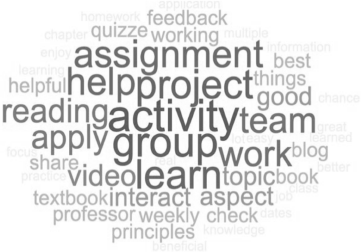
Many of you are enjoying working with your teams to do assignments. You like the mix of individual and group work. You like discussing the concepts with your teams and feel you learn more that way. Many of you mentioned the readings, videos and activities in the eBook and instructor feedback as helpful. Some of you mentioned that you like the videos on the Start Here pages. Here is a word cloud of your comments about what helps you learn best.
What is confusing or unclear?
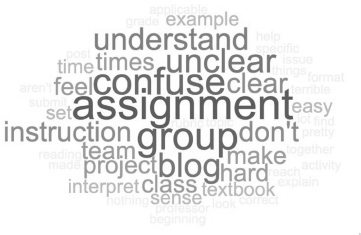
Most of you are satisfied with the class, but some have had trouble understanding what to do on the group assignments. Some of you indicated that the first few weeks were hard, but then you figured things out. Some said that the assignment instructions had too much information. Others have had challenges with team members interpreting the instructions in different ways. One of you commented that it seems like the instructions are meant “to get us to apply our own thinking.”
What you would like to change?
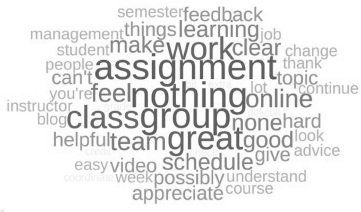
You made some great suggestions about what you would like to change. Here is a word cloud of your ideas. More details follow in the next section.
What specific advice would you give your professor?
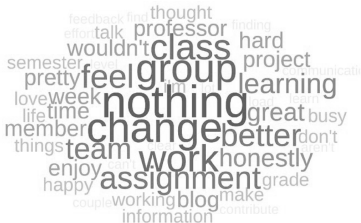
I appreciate the suggestions. I have categorized them into themes below.
Navigating the ePortfolio assignment instructions – there are a variety of approaches to the assignments; the solutions and designs for each team will be different. The purpose is to see if you understand and can apply what you learned. I have simplified the instructions for the following two assignments to see if that works better.
Working with your teams – getting people together sometimes can be challenging. Here are some ideas:
Give everyone responsibility. Be conscientious about deadlines. People want to contribute. Cut your teammates some slack if they need it. Pair up and work together.
Plan ahead. Submit early. I’m happy to give you feedback.
Get issues in the open. Tell people how you feel. Find out how they feel. Try the STATE method. I’ve had students tell me they used it, and it worked.
Apply what you learn in the course - planning, organizing, leading, controlling, communication, managing conflict, understanding differences, motivation, goals, leadership...
You will review your team’s effectiveness and set goals in an upcoming assignment. Team leaders also submit reports during the semester, letting me know how things are going. You will give each other up to 50 points at the end of the semester for your contributions.
eBook – A few of you indicated a lot of information to digest in the eBook. I have added slides to your Canvas modules foreach eBook topic. These cover the main points of each eBook topic and may be helpful for review as you take the Knowledge Checks. They will also be a valuable resource for your projects when you are looking for applicable theories. Remember that you can do the Knowledge Checks twice; you can check your answers and see explanations for each answer choice. Some questions require you to synthesize information or draw conclusions. These are critical thinking questions; you will need help finding the answers directly in the book. Please review the Test Taking Tips. Pair up with a team member to do the questions if that helps you learn. I will review any questions you think need to be revised. Just let me know.
Please send me a message any time. I’m happy to meet with your teams as well. My goal is to make this course a great experience for you.
