Introduction
One day, as I was getting off work, my mobile phone indicated that I had a new message. It was Ms. Perez, my daughter’s virtual school teacher, who was seeking my help in order to ensure that my 11th grader completed her assignments for her online course. Until then, she could have a failing grade. I called Ms. Perez back, left her a voicemail promising to take care of the issue. As soon as I walked in the house, I addressed the situation with my daughter and gave her 2 days to be current with her work. I also offered her my support in case she did not quite understand what she needed to do. Two days later, Ms. Perez called me back to thank me for my support and told me that my daughter earned an “A” for the semester because she fulfilled all the requirements. In turn, I expressed my heartfelt gratitude toward her for contacting me and reminded her that she could get in touch with me by any means when it comes to my child’s academic performance.
This personal experience is directly related to the topic addressed in this article: the impact of parental involvement on student achievement in Florida Virtual School. Research indicates that children tend to perform better in school when there is parental involvement. Makgopa and Mokhele (2013) concur that every adult, including parents and teachers, are accountable for student learning. Mulligan (2013) attributes student academic success to the level of parental involvement in schools. Such assumption has been proven to be true for face-to-face classroom instruction and evidenced by students’ achievement, test scores, and research; is it also true for online classes?
The global evolution of technology has a significant influence on every aspect of our society, especially the educational system. Nowadays, learning through online courses is a worldwide practice. The number of students attending classes asynchronously is increasing considerably, especially in the United States where a great number of states offer distance learning opportunities to students from kindergarten through Grade 12 as part of the public school system.
When parents are deciding or helping their children decide on a school, they are faced with the choice between a traditional program where the child is physically in school, a virtual program where the classes are given completely online, or a combination of both (Rauh, 2011). Either one of these choices requires their complete attention. Their involvement does not stop after they make their decision regarding the type of schooling they want to enroll their child in. Actually, it has only begun because subsequent choices will have a sig-nificant impact on academic achievement. This article aims to investigate how parental involvement influences the educational performance of students and offers some suggestions on ways to get parents involved in virtual settings, mainly in Florida.
Parental Involvement: Overview
Researchers, scholars, educators, school administrators, and parents have assigned a variety of definitions to the term “parental involvement.” Hashmi and Akhner (2013) attribute parental involvement to everything that parents do to enhance the academic performance of their children, which includes the way they provide their support at home and communicate with the schools. For the U.S. Department of Education (2001), it is the ongoing partaking of parents and families in students’ learning. Lareau (2000) asserts that it comprises all activities that parents do such as reading to children, talking to them, teaching them the alphabet, attending conferences, and events and meetings that are taking place in the schools. In other words, parental involvement can be defined as the relationship that is developed between parents, families, and schools where all stakeholders have a common goal: to bolster students’ learning. It encompasses what parents do at school and at home to strengthen academic performance. It is so important that every year, every parent, teacher, and student in Florida’s Broward County School District sign an agreement that is called the “compact form,” which lays out everyone’s roles and responsibilities in student learning. All schools receiving Title-I funding—schools that have 51% or more students who qualify for free/ reduced-price lunch—are required to have a parental involvement plan that is developed by both schools and parents and revised yearly by all parties.
In order for parental involvement to occur and be effective, schools must provide parents with diverse opportunities to play their part in their children’s education. Educators must realize that it is a crucial element in resolving many educational issues (Fan & Chen, 2001), whether these issues happen at home or in the classroom. As a result, educators must be open to this framework by maintaining constant communication with families. This way they will be more likely to overcome most of the challenges that hinder parental involvement.
Florida Virtual School: Background Information
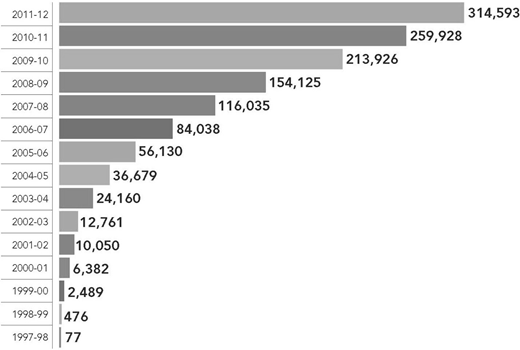
Florida Virtual School (FLVS) began to provide online courses to children in kindergarten to Grade 12 in 1997 as part of the state public school system with its own governing board. It was accredited in 2001 by the Commission on International and Trans-Regional Accreditation and the Southern Association of Colleges and Schools. During the initial year, FLVS served only 77 students (Johnson, 2012). As years passed, enrollment increased consid-erably—from 55,000 in 2005-2006 to 80,000 in 2006-2007 (Johnson, 2012). During the academic year 2011-2012, FLVS offered about 120 courses, including AP courses, to more than 148,000 pupils with the support of over 1,800 staff members. The Digital Learning Act of 2011 had a significant impact on the expansion of FLVS. It mandated that all Florida students entering the ninth grade in 2011-2012 take at least one online class as part of the requirements to graduate from high school. The school population is not only in the 67 districts in the State of Florida, but also throughout the nation and abroad.
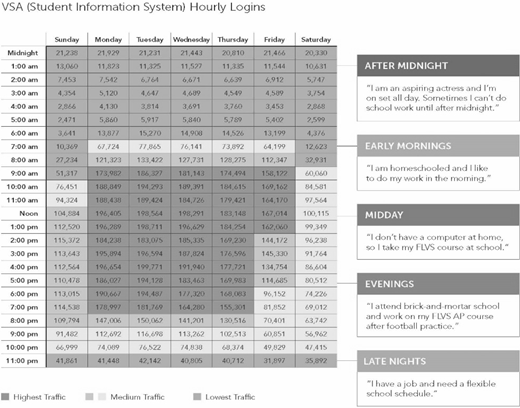
Florida Virtual School aims to provide “quality, technology-based education” that will make every learner successful. Students learn at their own pace and have more control over their learning than they do in face-to-face classrooms. Instruction is individualized to meet the unique educational needs of every student. Teaching is no longer about fitting all students in one room and having them reading the same page (Young, Birtolo, & McElman, 2009). The schedule is flexible. There is no set place and time to complete classwork (see Figures 1 and 2). Parents receive guidance and support from educators and counselors so that they can better assist their children.
FLVS utilizes a wide variety of devices and tools for instruction, including mobile phones, e-mail, the Web, and text messaging. Because these tools are already familiar to most learners, they make the teaching and learning process easier and more interesting. As long as they are used effectively by both the instructor and the learner to deliver quality instruction, successful learning will take place.
The Future of Florida Virtual School
As technology-based instruction has taken a different turn, online learning, or distance education, has experienced a remarkable evolution. Virtual school has expanded so quickly, it makes it a difficult task to predict what it will look like in the future. Julie Young, president and chief executive officer of FLVS, notes that,
In a field as rapidly changing as online learning, it is sometimes hard for even us to know what will come next. Planning for the future, however, is a necessary and exciting undertaking, and we know that some of what we’re planning will need to be adapted to meet technology changes and other developments in the coming years. (Florida Virtual School, 2012)
Nonetheless, FLVS’s administrators and the governing body must plan strategically to avoid surprises. In an article published in the Sun Sentinel on December 10, 2013, Karen Yi described the Broward School District’s plans that will affect more than six schools in the County due to “declining enrollment and drops in student performance.” These strategies will include the opening of the district’s first online technical high school. This online technical school is scheduled to open next year. It will offer a blended model—both online instruction and face-to-face classes. About 33 programs will be offered and only 150 freshmen will be able to attend during the first year.
Parental Involvement in Florida Virtual School
Planning for the future of education should of course include parents and families. They are vital stakeholders and their involvement has a positive impact on students’ achievement. FLVS must provide parents with opportunities to play their role in the academic performance of learners. Epstein et al. (1997) proposed a framework of six ways to get parents involved in schools: (1) providing parents and families with parenting skills and help schools in understanding families, (2) communicating effectively with parents and families about student progress and school happenings, (3) providing volunteer opportunities for parents and families, (4) creating prospects for parents and children to learn together at home, which includes homework and curriculum related activities and projects, (5) allowing parents and families to be part of the school decision making process by encouraging them to be part of advocacy groups and committees such as Parent Teacher Association, Parent Teacher Organization, school councils, forums, other organizations, and (6) matching parents, families and the community with resources and services that are available to meet their needs. When Epstein et al. suggested these six types of parental involvement, technology-based schooling was not as popular as it is today. They were proba-bly looking at the traditional schooling where students and teachers meet in a classroom to teach and learn. Even though education is changing, these propositions to get parents involved still apply to technology-based programs. Florida Virtual School should utilize these strategies in order to ensure that students receive adequate level of support from parents in order to be successful.
Parenting
FLVS can provide parenting classes to families, not only with child-rearing skills, but also to help them understand the appropriate ways to utilize technology so that they are able to monitor their children’s online activities. Technology affects our society positively and negatively as well. Parents must be informed about what their children are exposed to when surfing the Internet. As part of the parenting program, some parents could attend workshops and seminars to learn skills such as creating and accessing e-mail, navigating through websites, and even learning computer programs. Just as Title-I funded schools have done it, FLVS could find funds that would allow online parents to voluntarily attend conferences that aim to offer them with the skills and the knowledge they need to be more technology savvy, better assist their children and mentor other students.
Communicating
Educators must have access to parents by a variety of means. One of the quickest and surest ways is via e-mail. This is why it is necessary that parents learn that skill in the parenting program. This way, the line of communication between FLVS and the home would be more accessible and parents would be informed of their child’s progress in online classes and stay current on graduation information.
Volunteering
There may not be enough opportunities for parents to volunteer in virtual schools as they do in traditional face-to-face classrooms. A needs assessment could be done to determine parents’ availability and possibilities to support students’ learning. For instance, there might be a regular meeting online where educators and parents can meet and discuss just about anything regarding the online learning experiences. Those who are computer savvy and educated enough can tutor other students online; however, proper background checks and close monitoring must be conducted to protect our children and parents as well. As a result, students will receive more individual attention and those whose parents are unable to support them at home would have a mentor or a tutor to assist them.
Learning at Home
Florida Virtual School can provide information to parents regarding the curriculum and the required skills to pass a class. Parents can also be informed about the different calendars and deadlines to ensure that students are on point with assignments. They can also offer additional assistance to their children. Just like the regular school system, FLVS can assign projects and research activities for families to complete together. This way, children will build their self-confidence and develop a more optimistic approach toward learning.
Decision Making
Almost anything that can happen in a traditional classroom can also take place at a distance. Therefore, FLVS could find ways to implement a web-based parent teacher association and even conduct school advisory council and forum meetings at a distance. Parent would receive a calendar with meeting dates and reminders. As a matter of fact, it would be more effective than the face-to-face meetings because those who are unable to attend could always listen to the recordings at a later time. This would allow parents to give their input on decisions regarding budgets and policies that impact education and they would have firsthand information about any upcoming changes. Parents would also be able to network with other families and be more confident about cyber learning.
Connecting with The Community
Florida Virtual School could have a presence on the parent page, linked to various websites that offer services that could be helpful to parents and families. These services may include but are not limited to health, literacy, counseling, employment, focus groups, recreation, immigration, and any other agencies that are in their surroundings that can assist them with any issues they may have. This way, parents would know where the community resources are and be able to utilize them to meet the needs of their families.
Barriers to Parental Involvement
Challenges are a part of everything we do and most of the time they bring excitement to our daily lives. Of course getting parents involved is a challenge. It is already a very difficult task to get them to come to the traditional schools even for a simple conference. In low socioeconomic areas, especially, it is hard to reach them even on the telephone. Some barriers to parental involvement in synchronous schools are numerous. Some parents do not speak English and are unable to communicate with faculty and staff or read and understand the letters or the flyers; some are not literate enough to provide homework assistance; others have to work more than one job because at least one of the parents is not present in the home; a number of parents/guardians are either too young and immature or too old with health issues. There are a number of families who are just not interested or may have conflicting schedules.
Computer illiteracy, lack of Internet access, and insufficient funding can be added to the above-mentioned challenges to cyber schooling. Schools should never assume that parents have easy access to technology either at home or elsewhere (Ramirez, 2001). Mulligan (2003) added that school administrators and educators have some control over the level of parental involvement, for they are the ones planning the meetings, open houses, conferences, and so forth. Consequently, FLVS must find ways to overcome these barriers by implementing efficient parental involvement programs that would benefit not only students but parents as well. The six types of involvement proposed by Epstein et al. (1997) could be a starting point, with appropriate funding allotted specifically to these programs.
Benefits Of Parental Involvement
Wright and Bogotch (2006) assert that the effectiveness of parental involvement depends on the schools’ attitudes toward parents, and they must have the willing-ness to accept and work with them. Many students are not as autonomous (Moore, 2007). They may not be capable of selfdirected learning due to lack of discipline, self-motivation, and determination. If distance learners are not autonomous or selfsufficient, it will be very challenging for them to succeed. Subsequently, they rely on their parents’ support in order to complete their virtual school requirements.
As an educator and a doctoral student, I should not have waited for my daughter’s online teacher to inform me that she failed to fulfill her online course requirements. I should have known better and been more involved and proactive. Asking your child “did you do your assignments?” or just assuming they did is not parental involvement. As a parent, I should have been there for my high school child the same way I was there when she was in elementary and middle school. Shumow, Lyutykh, and Schmidt (2011) affirm that parental involvement decreases when their children are in high school. They also suggest many possible explanations as to why parents do not provide as much assistance in high school as they did in elementary school. One explanation has to do with demography. Shumow et al. determined that parents with higher level of education are more apt to be involved at the high school level because they are better prepared to provide their assistance. It is unlikely to find less-educated families involved in high school due to the strenuous curriculum. This group of parents would greatly benefit from the involvement program that would offer online parenting classes and literacy classes in order to get involved in their children’s education from kindergarten all the way to high school and even beyond.
Parental involvement means better test scores and higher achievement. It also forces teachers to raise the bar and provide students with meaningful teaching and learning experiences. When parents are around, educators do better than their best and children perform to the highest level. Such action will result in better grades and a higher graduation rate. By creating a substantial parental involvement program, FLVS would invest in parents who would become more self-sufficient and students who would be willing to learn and achieve successfully.