E-learning has become a common tool for improving individual performance in today’s organizations and institutions. Improving the performance of people is, after all, a worthy ambition, and learning is a frequent contributor to success. But the path from the ambition of improving performance to the accomplishment of useful results can be a difficult one. From e-learning to mentoring and from traditional training to employee retention, improving performance almost always requires more than just one improvement activity. As a consequence, we should view e-learning as just one potential component of any effort to improve either individual or organizational performance.
While visions, missions, and strategic plans are valuable and necessary foundations for accomplishing beneficial results, you can only improve performance by selecting, designing, and developing capable activities. Yet, to begin you must know what it is you are trying to accomplish. In other words, you must know the problem if you are going to select, design, and develop solutions that are intended to improve performance. Thus, effective approaches to improving performance don’t rely on any specific activity, intervention, or solution to accomplish desired results. As we know, learning activities such as training and e-learning can only address a limited number of issues that lead to less than desirable performance (specifically, issues related to knowledge, skills, attitudes, and abilities). In addition, e-learning activities do not address outdated processes, limited resources, lack of supervisor feedback, poor recruiting, inad-equate performance appraisals, or policies that punish desired performance, to name just a few.
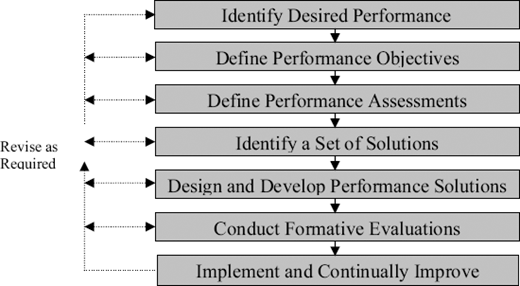
Equally, you do not want to rely on a training approach, instructional design approach, an even an e-learning approach to improving performance in your organization. Rather, apply a systematic process for selecting, designing, and developing a system of multiple activities based on their individual and combined abilities to accomplish desired results (see Figure 1).
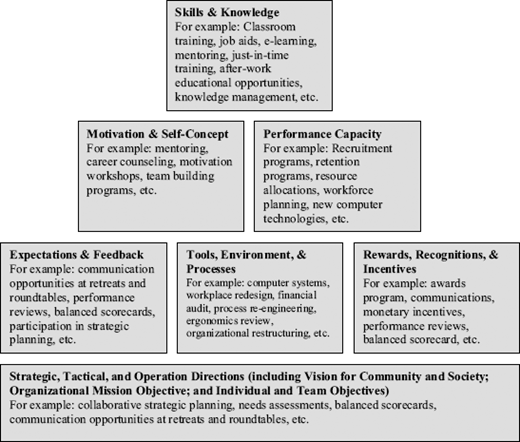
Using this process, you can assess the capabilities of various potential improvement activities before choosing the right combination for achieving results in your organization. From mentoring programs and leadership seminars to e-learning and electronic performance support, you should evaluate all of your options rather that sticking to just the ones you know best (see Figure 2 for examples). You can then address complex challenges and opportunities, rather than creating random acts of improvement through quick-fixes. You can even blend activities that individually and collectively to improve performance (such as, mixing career planning, health and wellness programs, and workforce planning; or combining recognition programs, e-learning, job aids, and a performance appraisal system).
As you can see, e-learning alone can rarely address complex performance challenges and achieve sustainable, beneficial results. While e-learning may frequently be part of your improvement plan, you should embed it within a more comprehensive approach that addresses performance problems from multiple perspectives; this allows you to capitalize on the strengths of e-learning, while not depending on it to accomplish everything by itself.
Focus first and foremost on the measur-able results you want to accomplish and then look at all of your options for implementing useful improvement activities. Use e-learning wisely and it will be a great tool for your improvement efforts.