Introduction
Jamaica’s Vision 2030 Plan is designed to move the country to developed nation status by the year 2030. It includes a number of sector plans. One of these is the Training and Workforce Development Sector Plan (2009). This plan identifies “inflexible delivery modalities” (p. 25) as a weakness in the SWOT (strengths, weaknesses, opportunities, and threats) analysis of training and workforce development in Jamaica. The plan identifies the promotion of distance education/training programs as a strategy and the provision of distance education delivery as an action to increase learning opportunities, toward achieving the goal of creating a learning society. The plan names the Human Employment and Resource Training Trust, National Training Agency, HEART Trust/ NTA, commonly referred to as HEART, as one of the agencies responsible for implementation of this strategy.
This article presents a SWOT analysis of the introduction of distance education in Jamaica’s technical vocational education and training (TVET) system by the HEART Trust/NTA. This analysis is guided by Rogers’ diffusion of innovations theory and instructional technology and distance education best practices. The SWOT analysis is a tool used to analyze an organization’s internal environment for strengths and weaknesses, which are based on factors over which the organization has control. It also examines the external environment for opportunities and threats, which are based on factors over which the organization has no direct control. A SWOT analysis can be a useful planning tool for organizations as it allows for the development of a broad understanding of an initiative so key decisions can be made about it (Morrill, 2007).
THE SWOT analysis of the introduction of distance education in Jamaica’s TVET system by HEART must occur within a defined context. Therefore, this article will first provide an introduction to the demographic environment of Jamaica and then provide an overview of the place of TVET in Jamaica. Next, it will explore characteristics of TVET that may make implementation of distance education in this stream of education different from its use in the traditional education system. Once the contextual base is set, the SWOT analysis of HEART’s introduction of distance education will follow. The article will conclude with recommendations for improving the approach to the introduction of distance education in the country’s TVET system.
Jamaica: A Demographic Overview
Jamaica is an island nation located in the northwestern Caribbean Sea, approximately 90 miles south of Cuba. With a population estimated at 2,717,991 people at the end of 2013 (Statistical Institute of Jamaica, 2015), Jamaica is the most populous country in the English-speaking Caribbean (Commonwealth of Learning, 2015). Based on the 2014 gross national income per capita, the country is classified by the World Bank as an upper-middle-income nation (World Bank, 2015). Jamaica is ranked 96th of 187 on the UNDP Human Development Index and is classified as a high human development nation (UNDP, 2014). This means that the country is considered to have a high level of social and economic development based on life expectancy at birth, mean years of schooling, expected years of schooling, and gross national income per capita.
Despite these seemingly positive standings, Jamaica’s economic growth is severely challenged by high debt and unemployment. Jamaica’s debt to GDP ratio was at 140% at the end of the 2014/ 2015 fiscal year, although this number has been declining, which makes it among the highest in the world (World Bank, 2015, March 30). However, due to recent debt restructuring and fiscal contraction efforts, including a 4-year Extended Fund Facility entered into with the International Monetary Fund in May 2013, Jamaica’s debt to gross domestic product ratio has been declining (World Bank, 2015, March 30). The unemployment rate in Jamaica stood at 13.2% at April 2015, with youth unemployment at 34.2% (Statistical Institute of Jamaica, 2015). Technical vocational education and training is believed to be a large part of the solution to Jamaica’s high unemployment rate and to stimulation of the country’s economic growth and development.
TVET in Jamaica
TVET has captured the attention of multilateral organizations, regional communities, and nations worldwide. These agents have recognized the potential of this stream of education to transform economies and drive national growth and development. According to Marope, Chakroun, and Holmes (2015), TVET “is steadily emerging as a winner in the ‘race to the top’ of global debates and government priorities for education and national development agendas” (p. 11). With its strong history of TVET, Jamaica is no exception.
Jamaica has long recognized and sought to nurture the growth of TVET in the country. In 1982, the country’s parliament passed the Human Employment and Resource Training (HEART) Bill in order to address the problem of underemployment in the country (HEART Trust/NTA, n.d.a). The Act established the Human Employment and Resources Training Trust (HEART Trust). It also required that all private sector firms contribute to the work of the HEART Trust through payment of a compulsory levy on emoluments paid to employees (The Human Employment and Resource Training Act, 1982). The HEART Act was amended in 1991 to include the National Training Agency (HEART Trust/ NTA, 2006) and so the HEART Trust became the HEART Trust/NTA.
The HEART Trust/NTA is an agency of the Ministry of Education and its role is “to finance and regulate training programs with the objective of producing a skilled, certified workforce consistent with the needs of the economy and the labor market” (HEART Trust/NTA, 2006, p. 20). It works to achieve this mission through its 29 technical vocational education and training (TVET) institutions across the island, comprised of workforce colleges, TVET institutes, academies, and vocational training centers (HEART Trust/NTA, n.d.-a). Additionally, the organization develops partnerships with churches, youth groups, trade groups, and other stakeholders across the island to implement community training initiatives. HEART also works with industry partners to support on-the-job training and certification of employees. These points of access provide training and certification options in a wide array of occupational areas in various industries, including building and construction, agriculture, information and communications technology, automotive services, tourism and hospitality, and electrical engineering. TVET certification is in the form of the National Vocational Qualification-Jamaica (NVQ-J) which is granted by the National Council for Technical Vocational Education and Training (NCTVET). The NCTVET is an arm of the HEART Trust/NTA and is Jamaica’s certifying body in TVET. Attainment of an NVQ-J certification is proof of an individual’s competence in a qualification and the person’s ability to perform to workplace standards.
HEART trains tens of thousands of persons each year (see Figure 1). According to the 2012/2013 Annual Training Report, 107,758 persons were enrolled in HEART supported programs in the 2008/2009 fiscal year and this number declined to 76,064 by the 2012/2013 year (HEART Trust/NTA, 2014). The decline in numbers was linked to a reduction of targeted enrollment due to a shift in focus on training for higher level qualifications and reduction in HEART-funded programs.
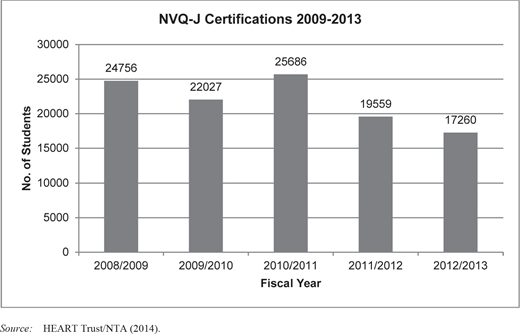
Between 2008/2009 and 2012/2013 a total of 109,288 NVQ-J certifications were awarded (HEART Trust/NTA, 2014). Figure 2 shows the breakdown of certifications per year.
Despite the impact that HEART has had on individuals, employers, and industries through training and certification, there is still room for growth. Distance education, once effectively implemented and managed, has the potential to bolster the contribution of the organization to the transformation of Jamaica into a developed nation, while enabling Jamaicans to engage in gainful employment or create their own jobs.
Distance Education in TVET
Distance education has been defined as “institution-based, formal education where the learning group is separated, and where interactive telecommunications systems are used to connect learners, resources, and instructors (Schlosser & Simonson, 2009, as cited in Simonson, Smaldino, Albright, & Zvacek, 2012, p. 7). Its roots were planted over 160 years ago and so it has long been used to overcome distance as a barrier to accessing education and training (Simonson et al., 2012). In Jamaica, distance education has been used by the University of the West Indies since 1958 (Thomas & Soares, 2009). More recently, online distance education is being utilized more widely by other postsecondary and tertiary education providers in the country. So, distance education is no new phenomenon in Jamaica. However, its use in technical vocational education and training, particularly through the HEART Trust/ NTA, is fairly recent.
Distance Education in the HEART Trust/NTA
The HEART Trust/NTA has been carrying out distance education implementation activities for at least six years (K. McKenzie, personal communication, July 1, 2015; S. Morgan, personal communication, August 7, 2015). HEART’s mission speaks to the important role of flexibility in the TVET system. Its mission is as follows: “The HEART Trust/NTA is committed to the systematic design, development and delivery of an integrated, flexible and responsive TVET system, enabling a productive workforce for national priorities and global competitiveness” (HEART Trust/NTA, n.d.-b, para. 2). The organization has demonstrated a degree of commitment to creating a flexible TVET system through its adoption of distance education. This is evident in the development of a strategic objective to realign the HEART Trust/NTA “to facilitate the development of a flexible and responsive TVET system” and the inclusion of delivery of distance programs as a key performance indicator on the corporate balanced scorecard (HEART Trust/ NTA, 2013, p. 4).
While other arms of HEART are involved in the implementation of distance education in the TVET system, the Educational Technology Management Unit (ETMU), one of three units in the Learning Resources Development Department, is at the center of HEART’s implementation efforts. The ETMU is tasked with ensuring that the required technology infrastructure is in place throughout HEART institutions and the community training initiatives. The unit is also responsible for capacitating instructors and other staff to effectively design, develop, deliver, and support online teaching and learning.
The organization employs a blended delivery method whereby modules are repurposed or developed for online delivery to complement face-to-face delivery. Instructors who are interested in or mandated to develop courses for blended delivery, work with the ETMU to design and develop the modules.
Strengths
Diffusion of innovations theory is commonly used for gaining insight into the process of diffusion and adoption of an innovation in a social system such as HEART. Rogers (2003) defines diffusion as “the process in which an innovation is communicated through certain channels over time among the members of a social system” (p. 5). According to Rogers, individuals choose to adopt or reject an innovation such as distance education after going through the innovation-decision process. Whether or not an individual chooses to adopt an innovation is based on their perceptions of the following attributes of the innovation:
relative advantage, which is how advantageous the individual perceives the innovation to be based on factors such as economic benefit, convenience, and prestige;
compatibility, which has to do with how consistent the innovation is perceived to be with the individual’s values, experiences, and needs;
complexity, which is the perceived difficulty of the innovation;
trialability, which has to do with the degree to which the innovation can be tested on a trial basis; and
observability, which is how visible the benefits of innovation are to others (Rogers, 2003, p. 16).
The greater the perceived relative advantage, compatibility, trialability and observability are and the lower the perceived complexity, the more likely the individual is to adopt.
Creating an appropriate environment that facilitates the success of distance education is vital for any organization that is implementing distance education (Simonson et al., 2012). As part of its implementation of distance education, the Educational Technology Management Unit has been leading a number of initiates aimed at acquiring and developing the infrastructure needed to support distanced education, increasing awareness of the benefits of distance education, training instructors in online course development and delivery, and repurposing content for online delivery. Recent activities are driven by the ETMU’s 2014–2016 Strategic Plan (Educational Technology Management Unit, 2014), which identifies a number of activities for implementing distance education, including the following.
acquisition of technologies to facilitate online delivery and learning;
set up and management of the Moodle Course Management System to facilitate online delivery and learning;
training of instructors in the repurposing of content for online delivery.
promotion and integration of virtual learning communities to facilitate knowledge sharing and collaboration among learners and instructors;
development of a distance education policy;
development of an open education resource policy;
development and implementation of standard operating procedures for distance education;
development of a distance education strategic plan; and
professional development in distance and open learning concepts and systems.
Development of appropriate technology infrastructure, training and support of instructors, and development of relevant policies are all consistent with best practices for distance education. The ETMU’s initiatives also address the various attributes of innovation. For example, instructor training in repurposing of content for online delivery allows the instructor to experiment with Moodle during and after training. Training also addresses complexity, as individuals who may come to training with preconceived notions that use of Moodle is a complex activity, often realize, due to ETMU’s practical, engaging, and supportive approach to training, that the task is easier than they thought.
Another strength is in HEART’s funding. Distance education can be costly. However, HEART has a reliable source of funding in the HEART Tax which is a compulsory 3% levy on emoluments paid to employees by private sector employers in the country. While this is identified as a strength, it is important to note that availability of funds does not guarantee that it will be allocated as needed to support effective implementation of distance education. In fact, this is evident in some of the weaknesses of HEART’s attempts to implement distance education.
Weaknesses
According to the Commonwealth of Learning (2015), 23 of HEART’s institutions have begun online delivery. However, the number of instructors that have adopted and are implementing distance education in the TVET system is not clear. Whatever the number, discussions with members of the Educational Technology Management Unit’s implementation team suggest that the adoption rate is low and implementation has been slow (K. McKenzie, personal communication, July 1, 2015; S. Morgan, personal communication, August 7, 2015). Instructors play a key role in the successful implementation of distance education.
Rogers (2003) describes three types of innovation decisions: optional innovation decisions, collective innovation decisions, and authority innovation decisions. Optional innovation decisions leave the individual free to choose whether to adopt or reject the innovation. Collective innovation decisions require the members of the social system to come to a consensus on adoption or rejection. Authority innovation-decisions occur when a few of the persons in a system who have power, authority, or relevant expertise choose whether to adopt or reject on behalf of the system without the input of all members of the system. Although an authority innovation decision was made to adopt distance education in HEART’s TVET system, not all instructors are currently required to adopt. Consequently, many instructors choose not to adopt. This may be attributed to perceptions of relative advantage, compatibility, trialability, observability, and complexity of distance education (Rogers, 2003). For example, instructors have indicated their concerns with the increased workload that would result from adoption of distance education without any increase in compensation (D. Fearon-Houston, personal communication, August 5, 2015; L. Gordon, personal communication, August 7, 2015). This suggests that perception of the relative advantage of adoption is low.
ETMU’s lack of sufficient human resources with the requisite expertise to effectively and efficiently implement distance education throughout the TVET system is another weakness. According to Simonson et al. (2012), instructional technology and distance education specialists should play an important role in online learning through the provision of training in the pedagogies of teaching online; lack of this expertise is a major barrier to its success. The authors state,
Most educational institutions do not employ trained, professional instructional technology consultants whose functions are to assist faculty in online course development and the creation of learning objects. Many of those that do offer such consultants instinctively target these positions for elimination when budgets get tight (Simonson et al., 2012, pp. 133–134).
Interestingly, this is precisely what occurred in HEART. The ETMU, up to 2012/2013 had started working with distance education specialists (one in each region) to provide support to the system. However, these relationships were abruptly ended in 2013, leaving the ETMU with just two full-time staff to work on distance education (an acting educational technologist and the manager, ETMU) with support of an instructor, who is also a distance specialist, working with the unit two days per week (S. Morgan, personal communication, August 7, 2015). Even prior to this, the unit experienced a reduction of staff complement with the removal of two educational technologist positions and the administrative assistant position from the unit structure. Needless to say, the ETMU is now severely understaffed and is in no position to make the desired impact on the implementation of distance education in the TVET system.
Simonson and Schlosser (2009) emphasize the need for a systems approach to the design, development, and implementation of distance programs and courses. They state, “distance education programs require a careful planning process that includes systematic design and implementation. There will be success if all the pieces of the plan receive the same attention as the most obvious” (p. 3). HEART falls short where this best practice is concerned. HEART’s mission speaks to use of a systematic approach to the design, development, and delivery of a flexible TVET system (HEART Trust/NTA, n.d.-b). This implies the creation of plans to guide the design, development, and delivery of TVET offerings. Although the ETMU has identified a number of documents for development, including a distance education policy, standard operating procedures for distance education, and a distance education strategic plan, these have either not been developed or have not yet been approved, which means they are not yet being used.
The greatest weakness of HEART’s introduction of distance education is in the lack of an implementation plan. While the organization has been engaged in important initiatives to implement distance education, the effectiveness of these initiatives is limited due to lack of a comprehensive plan to guide diffusion and implementation. Any attempt to implement distance education should be done only after a plan of action has been created. According to Simonson et al. (2012), “No organization should enter into the distance education marketplace without a clearly thought through plan that has gained the consensus approval of all key players…. The absence of a realistic business plan is a foremost reason why online learning ventures fail” (p. 319). Without a plan, the organization is missing critical components that impact success of implementation.
Successful education and training relies on the interplay between the organization as a whole, instructors, and students. Preparations must be made, before beginning implementation, to ensure readiness for the innovation. Therefore, a plan for distance education should consider and address organizational, instructor, and student readiness for innovation. Organizational readiness speaks to issues such as planning for implementation, revision or creation of institutional policies, ensuring availability of resources (including appropriate human resources and technology infrastructure), developing mechanisms for quality control, identifying instructor rewards for adoption, and providing student support services (Simonson et al., 2012). Instructor readiness should focus on areas such as faculty support (with consideration for increase in workload and compensation), training and support with course development and delivery, and intellectual property rights for creations of the instructor and others players involved in course design and development (Simonson et al., 2012). Student readiness should focus on assessment of student possession of requisite attributes for successful online learning and provision of support throughout the program (Simonson et al., 2012).
Opportunities
The HEART Trust/NTA currently trains and certifies tens of thousands of persons each year. However, there are still large numbers of unskilled and uncertified persons who need to be trained and certified. Although HEART has access points islandwide through its own institutions and community training initiatives, distance and time remain a challenge. Through distance education, HEART has the opportunity to expand its offerings and reach more people.
The development of programs in HEART is labor market driven. Where the organization, through labor market research, recognizes a demand for an occupation, the organization responds by developing qualifications and programs to supply the market. One of the challenges that the organization encounters is, while the demand exists, the pool of experts in Jamaica may be limited. This is especially the case in emerging markets. Distance education not only increases access to students in geographically dispersed locations, it also facilitates breaking of the distance barrier for instructors. Through distance education and its attendant technologies, the opportunity now exists for HEART to tap into technical expertise that may exist outside of Jamaica in order to facilitate instruction, either as instructors or as resource persons. This provides the opportunity to strengthen the quality of programs being offered by the organization.
Threats
One of the greatest threats to the success of distance education in Jamaica’s TVET system is the low social perception of TVET and the associated stigma. This impacts the profile of learners who do engage in TVET. In the Caribbean, TVET has long been a “dumping ground” for at-risk and unattached youth along with underperforming school leavers. This has resulted in and perpetuated the perception of TVET as a place for those who are not academically inclined and are unable to meet the standards of what has been called the Caribbean Region’s “elitist education system” (Caribbean Association of National Training Agencies, 2012, p. 4). While great strides have been made in removal of this traditional image of TVET, the stigma still persists and acts as a barrier to engagement in skills training by all types of learners for fear of being stigmatized. Consequently, many of the learners who are involved in TVET may not possess the skills and abilities needed to facilitate successful online learning. Simonson et al. (2012) indicate that successful online learning requires learners to assume responsibility for their learning and so the general cognitive ability of learners must be appropriate. Simonson et al. (2012) state:
Students of average or high ability at distance sites have demonstrated achievement at levels similar to or better than those of students in origination sites. In fact, this is true of students in distance education classes as a whole compared with students in traditional classrooms. This is not to suggest that students in distance classes are smarter, but capable students tend to succeed in distance learning situations (p. 225).
The nature of technical vocational educational and training also poses a threat to successful implementation of distance education in the TVET system. While TVET programs vary in the degree of theory and practical elements, they are generally very practical. Where the theoretical aspects of the program may be easily taught via distance, teaching and assessing practical parts of the program may be more difficult. For example, building construction is a skill area that is very practical. It relies on use of large spaces and specialized equipment to facilitate learning. Development of a fully online program in such highly practical qualifications may be neither appropriate nor effective; in this case, blended delivery may be best. Course developers will have to understand the nature of TVET and be mindful of this when designing and developing courses for online delivery.
The final threat to successful implementation of distance education in the TVET system is the impact of politics on HEART. A degree of instability exists in HEART because of its tie to political change in the country. Over the years, a change of government has resulted in a change of focus of HEART or the way in which it carries out its functions. However, diffusion of an innovation takes time. Sufficient time is required to allow individuals to move through the innovation-decision process and for adoption of the innovation throughout the system (Rogers, 2003). Disruptions brought about by change of government may slow diffusion and adoption of distance education in the TVET system.
Conclusion
This SWOT analysis was not a fulsome analysis of the implementation of distance education. It represents the perceptions of only a handful of persons from key stakeholder groups within the organization (administrative and instructor groups) and was limited by access to data, such as implementation initiatives outside of the Educational Technology Management Unit. Nevertheless, this SWOT analysis has highlighted some of the areas of weakness and threats that the HEART Trust/NTA should be concerned with if the organization hopes to successfully introduce distance education throughout the TVET system. Based on the identified weaknesses and threats, there is sufficient cause for the organization to conduct a more comprehensive analysis of implementation so that a complete understanding of implementation activities can be developed and strategic decisions can be made about how to improve its efforts.
The identified weaknesses, namely lack of a general plan for implementing distance education; shortage of appropriately qualified distance education administrators to lead initiatives to achieve organizational, instructor, and student readiness; slow diffusion of distance education as an innovation, and low instructor adoption suggest that HEART was not ready to implement distance education. Whether or not a comprehensive SWOT analysis is conducted by the organization, I suggest use of Rogers’ diffusion of innovations theory as a framework for developing a comprehensive plan for implementation of distance education in the TVET system and should incorporate best practices mentioned in this article. Additionally, the plan should include strategies to fortify the identified strengths, correct the weaknesses in the current approach to implementation, capitalize on opportunities for success, and mitigate identified threats.
About the author