Frequently I find myself mentoring faculty and staff, both within and outside my school/university about designing new online programs, incorporating best practices for teaching online, as well as supporting online learners. Although I have learned many valuable lessons since I started teaching online in 2001 and directing an online graduate program in 2011, I recognize there will always be much to learn about teaching, learning, and managing a program online. Too often, however, administrators’ immediate focus when starting a new online program is on the instructors and “converting” face-to-face courses to online ones if the program already existed as a face-to-face program, and not also the resources needed to ensure quality marketing, communication, monitoring, and student support—all key factors to an online program’s success. Yet, a variety of high quality resources exist that can help administrators, faculty/instructors, and staff plan, design, develop, implement, and evaluate new online programs. Although there is no specific roadmap for any institution, organization, or corporation for creating an online program, the following resources might be helpful in determining one’s unique pathway for success.
Starting a New Online Program: Where do you Begin?
Clearly each organization, corporation, or institution will have different procedures for starting an online program. Often a first step is a needs assessment and a marketing analysis that demonstrate a need for the online program. Subsequently, once a need is established, there are internal procedures that must be completed for approval—well before a program’s launch. For example, at George Washington University, any new programs must be approved at the school and university levels; however, there are many steps that must be completed before being approved at these levels (e.g., creation of a business plan and marketing analysis, among many other requirements). These required institutional procedures might also serve as a blueprint for how to go about creating the new online program. Similarly, companies often require a plan that includes the goals, objectives, budget, timelines, and procedures for offering professional development online. Numerous organizations have myriad materials available to support such endeavors. The following is a list of many such organizations:
United States Distance Learning Association (USDLA)—sponsor of this publication: https://www.usdla.org/
e-Learning Guild: http://www.elearn-ingguild.com/
International Association for Online Learning: http://www.inacol.org/
International Council for Open and Distance Education: http://www.icde.org/
Online learning Consortium: http://onlinelearningconsortium.org/
Each of these holds conferences, publishes journals, and offers many other learning opportunities (e.g., webinars), which are also frequently free. Additionally, many also offer professional development and networking opportunities within these organizations. This is not a comprehensive list; even so, I have found these to be beneficial for initiating online learning programs.
One organization, the International Association for Online Learning, has developed a site entitled, How to Start an Online Learning Program: A Practical Guide to Key Issues and Policies (see: http://www.online-programhowto.org/). Although the International Association for Online Learning focuses on K–12 online and blended programs, this is an excellent resource that any organization or institution might wish to consider reviewing before starting a new online or blended program. Many of the issues and policies highlighted are pertinent to most organizations and institutions. The following steps are from an infographic that summarizes several major items to consider when implementing online programs:
How to Start an Online Learning Program: 10 Steps to Implementation
Clarify goals
Get to know your state policy
Get/hire the best people
Consider partners
Pick a platform
Leverage online learning tools and capacity to blend schools
Staffing
Provide guidance on self-blends
Marketing
The same infographic also includes eight key issues: (1) Funding, (2) Policies, (3) Budget/Staffing, (4) Administrative Systems, (5) Curriculum, (6) Teachers, (7) Students, and (8) Quality. Levy’s (2003) list of factors to consider (in higher education settings), consisted of: (1) Vision and Plans, (2) Curriculum, (3) Staff Training and Support, (4) Student Services, (5) Student Training and Support, and (6) Copyright and Intellectual Property. Some of these are evident in the Rovai Composite Persistence Model.
Rovai’s Composite Persistence Model
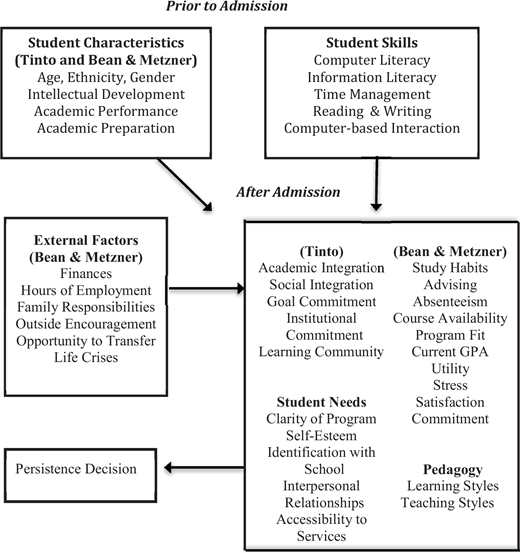
Rovai developed the composite persistence model in 2003. His model provides a framework for designing online programs that take into account factors that affect student persistence. Rovai’s model synthesizes and builds on Bean and Metzner’s (1985) and Tinto’s (1975, 1987, 1993) persistence models, which center on on-campus students (and not online ones). The model, as Figure 1 illustrates, consists of student characteristics and skills that affect student persistence even before applying for admission, as well as numerous internal and external factors that affect their persistence after admission. Comprehension and a plan for addressing these factors can help administrators and instructors of online programs and courses better understand and institute supports to help increase online students’ persistence, as well as help explain why they might or might not be achieving their goals. And, while this model is designed for online institutions of higher education, many of the factors also apply to other levels of education (i.e., K–12), as well as corporate, non-profit, and government settings.
About the author