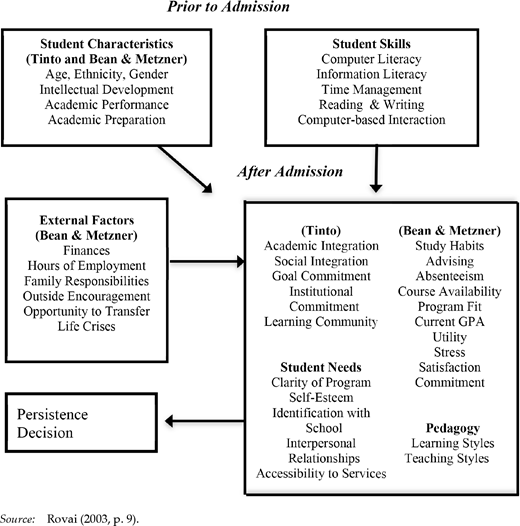
Often, when we consider the factors that foster student persistence in online courses, we think of Rovai’s (2003) composite persistence model, a conceptual framework of factors that affect student persistence in online education. Rovai developed the model by synthesizing and building upon Bean and Metzner’s (1985) and Tinto’s (1975, 1987, 1993) persistence models which focused on brick-and-mortar classrooms and not online ones. Rovai’s model, as illustrated in Figure 1, consists of student characteristics and skills that exist before students apply for admission, as well as numerous internal and external factors after admission that affect student persistence in online programs. Missing from the students’ characteristics are students’ socioemotional learning and wellness (or student well-being) which have emerged as important factors for promoting students’ persistence and success.
According to the National Center for Chronic Disease Prevention and Health Promotion, Division of Population Health (2018),
well-being includes the presence of positive emotions and moods (e.g., contentment, happiness), the absence of negative emotions (e.g., depression, anxiety), satisfaction with life, fulfillment and positive functioning. In simple terms, well-being can be described as judging life positively and feeling good. (para. 7)
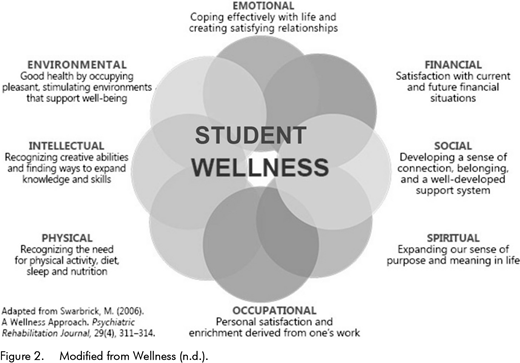
Yet, student well-being should be viewed more holistically (Tuckwiller & Milman, 2019); that is, it should consist of social, physical, psychological (emotional), environmental, financial, intellectual, occupational, and/or spiritual aspects, as Figure 2 illustrates.
How Can Online Instructors Cultivate Student Well-Being?
There are myriad ways in which instructors might cultivate students’ well-being. Yet, we must emphasize that fostering student well-being involves multifaceted approaches—no single approach or strategy will likely suffice. Below are a few suggestions for what online instructors can do:
Cultivate a welcoming learning community: Feeling welcome and as essential contributors/stakeholders in a learning community is vital. This also helps students feel more connected to their peers and the instructor, as well as develop a sense of belonging, essential in online courses. We encourage instructors to start with a welcome video and/ or email even before classes start and to maintain a regular instructor presence throughout the course. Compared to fully face-to-face environments, in blended and online environments, there is a higher risk that students may feel disconnected from their peers or instructors. Using explicit language to let students know that belonging is a fundamental value of the course, and providing educational opportunities for students to connect over common interests, values and goals can support an environment that strengthens each student’s sense of belonging.
Provide timely, effective, and open communication: Effective and open communication is essential for promoting students’ well-being because they know what is expected of them and that they can reach out to instructors for help. Moreover, it is important to communicate in a timely manner before it will be too hard or too late to address a problem. When instructors communicate, an effective strategy to promote understanding is rephrasing a student’s question. Also, instructor tone is important, particularly in email communications where there is more room for interpretation.
Proactively check-in and nudge: We have found that sometimes a simple check-in or nudge will help instructors learn about challenges students are facing so they can then either help them locate the necessary supports or at least offer encouragement or sympathize with them. A nudge such as an email asking them to participate more can also show the instructor cares and has high expectations.
Engage students in learning: Students need to be and feel engaged in their learning by learning from and with their peers and instructor. Online discussions and collaborative assignments can help promote engagement and learning community, among other benefits. Further, opportunities to engage in dialogues with others about the purposes and meanings identified in their learning experiences and their relationships to students’ broader life experiences and goals can add additional layers of purpose and course engagement.
Foster students’ agency. Although it may at first glance appear that challenging course content and assignments can frustrate students, challenges actually provide excellent opportunities for students to persist through difficulty and realize additional capabilities of which they may not have been aware. An important part of “making this work” in blended and online courses is an explicit acknowledgment from the instructor that the challenges are intentionally designed to provide students with opportunities for agency and persistence. As an agent of the institution, the instructor has an opportunity to shape the environment in such a way that students can develop an advanced sense of agency, intentionally persist through a known challenge, and explicitly focus on the realization of additional individual capabilities. Sharing these insights with the instructor and/or peers can help students capture what they have gained as a result of the course in these domains of well-being.
Build in opportunities for self-reflection and support of students’ metacognition: Requiring students to reflect on their learning in informal and formal ways is important and promotes students’ metacognition. Explicitly noting transformation as one of the goals of the course and letting students know they will reflect on how their educational experiences transformed them can bring a heightened awareness to students about their growth, which can contribute to their sense of well-being. A particularly powerful reflection strategy can be the merging of an individual reflection of how one has transformed over the course of a learning experience to maximize one’s potential and a subsequent reflection on how the self-realization of that potential may contribute to the common good. This connects for students their individual growth to the greater common good, adding additional opportunities to develop their sense of purpose, meaning and agency, all of which contribute to postsecondary student well-being.
Support collaborative work with team charters: Working in virtual groups can be particularly stressful. Requiring students to develop team charters that spell out the team’s expectations, communication plans (e.g., how frequently they will communicate, within what time frame, and how), roles, responsibilities, deadlines will help teams function better because they know what is expected.
Encourage well-being practices: Instructors can encourage students’ well-being by explicitly encouraging they get enough sleep, exercise, and time with their friends and family (or by themselves!).
Point students to necessary supports and resources: Instructors should share pertinent resources and support services with students that might improve their well-being such as the university counseling center or writing center, if they exist.
About the author's