We often read or hear about how important engagement is, most likely because it has been positively linked to student “achievement, satisfaction, and persistence” (Kuh, 2009, p. 694). This is often the case not only in face-to-face learning settings, but also in online and blended learning settings. However, engagement means different things to different people in different contexts. In fact, Axelson and Flick (2011) contended, “few terms in the lexicon of higher education today are invoked more frequently, and in more varied ways, than engagement” (p. 38). Numerous types of engagement exist—behavioral engagement, civic engagement, community engagement, cognitive engagement, emotional engagement, learning engagement, school engagement, and student engagement— just to name a few. Clearly, engagement is a construct with varying definitions and typologies (Coates, 2007) depending on myriad contextual factors. Therefore, it is important for designers, researchers, and practitioners, when referring to engagement, to provide their definition of this construct. In this column, I introduce several scholarly definitions of engagement.
Much of today’s literature about student engagement stems from Astin’s research and theory of student involvement (Axelson & Flick, 2011), as well as Kuh’s (2003) definition of student engagement, and Astin’s and Kuh’s leadership, along with numerous other researchers, on the development, creation, and administration of the National Survey of Student Engagement (“NSSE timeline: 1998–2009,” para. 3). Astin (1984/1999) conceptualized the theory of student involvement to consist of “five basic postulates” (Astin, 1984/1999, p. 519) which are:
Involvement refers to the investment of physical and psychological energy in various objects.
Regardless of its object, involvement occurs along a continuum.
Involvement has both quantitative and qualitative features.
The amount of student learning and personal development associated with any educational program is directly proportional to the quality and quantity of student involvement in that program.
The effectiveness of any educational policy or practice is directly related to the capacity of that policy or practice to increase student involvement (Astin, 1984/1999, p. 519).
He developed this theory because of “the tendency of academicians to treat the student as a kind of ‘black box’” (Astin, 1984/1999, p. 519). However, it is Kuh’s definition that is most often cited in the higher education literature. According to Kuh (2003), student engagement is “the time and energy students devote to educationally sound activities inside and outside of the classroom, and the policies and practices that institutions use to induce students to take part in these activities” (p. 25).
Other researchers, such as Fredricks, Blumenfeld, and Paris (2004) and O’Brien and Toms (2008), have also sought to define engagement, resulting in a more complex understanding of this concept. For example, Fredricks et al. (2004) conducted a literature review of school engagement and found that it is “multidimensional” (p. 61), consisting of behavioral, emotional, and cognitive engagement, as the following summarizes:
Behavioral engagement draws on the idea of participation; it includes involvement in academic and social or extracurricular activities and is considered crucial for achieving positive academic outcomes and preventing dropping out. Emotional engagement encompasses positive and negative reactions to teachers, classmates, academics, and school and is presumed to create ties to an institution and influence willingness to do the work. Finally, cognitive engagement draws on the idea of investment; it incorporates thoughtfulness and willingness to exert the effort necessary to comprehend complex ideas and master difficult skills. (p. 60)
An important aspect of the three dimensions of engagement is the frequent overlap of these constructs, as well as others that help define engagement.
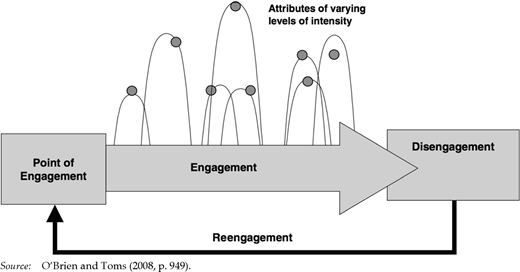
The multifaceted nature of engagement is also evident in a study by O’Brien and Toms (2008), whose purpose was to define engagement vis-à-vis technology through a “critical multidimensional literature review and exploratory study” (p. 938). In their study, they determined that engagementis a process that consists of a:
“point of engagement”—this is when engagement begins—and it may also involve “reengagement”—when participants returned to the activity (p. 943);
“period of engagement”—this is when participants “focus on their task and the application, the novelty of the experience, their level of interest, and their perceptions of challenge, feedback, and user control inherent in the interaction” (p. 943);
“disengagement”—this is when participants stop on their own volition or when the conditions of their environment require them to stop participating/being involved (p. 944).
In their model (see Figure 1), it is clear that the level of intensity of engagement varies within the period of engagement. They also discovered three “threads” of engagement based on sensual, emotional, and spatiotemporal attributes. These are depicted in Table 1.
Clark and Mayer (2016) have focused their description of engagement on two particular forms that they have found to be pertinent to e-learning: behavioral and psychological engagement. They explained, “Behavioral engagement refers to overt actions taken by a learner during a lesson intended to improve learning” (Clark & Mayer, 2016, p. 219), whereas, “psychological engagement promotes learning that helps learners to achieve the instructional goal by engaging in relevant cognitive processing during learning” (Clark & Mayer, 2016, p. 219). Behavioral engagement involves what learners do (e.g., read, click, answer, type, etc.) and psychological engagement consists of the “mental activity that promotes achievementof the learning objectives” such as “mentally organizing the material into a coherent structure” (Clark & Mayer, 2016, p. 223). For Clark and Mayer (2016), two critical features of engagement are that: (1) “psychological not behavioral engagement … leads to learning” (p. 220) and (2) psychological engagement may occur with or without behavioral engagement.
Designing instruction to foster student engagement, therefore, should involve at minimum, careful thought about how students are to interact with the content, with their peers, and with their instructor(s) with attention to the mental activity (psychological engagement) the interaction(s) will promote, as well as what they are expected to do (behavioral engagement). Engagement is a complex, multidimensional concept that requires some unpacking when we refer to it—and its benefits— in teaching and learning.