Many teachers are initially exposed to online education as students in graduate courses. They likely must develop new competencies to be successful learners in the online environment. Increasingly, these online students have the opportunity to become online instructors in virtual K-12 schools or community colleges, or at least to offer supplementary Web-enhanced instruction to their traditional students. Success in online teaching requires specific competencies, and training is not generally available to K-12 teachers. This article suggests ways that college instructors can help develop online teaching competencies of students by employing creative teaching and interaction strategies within content courses. Modeling good online teaching is important, but should be supplemented by direct instruction in online teaching techniques, and meaningful opportunities for students to take on the online teaching role. Important outcomes for the graduate student could include greater understanding of teacher/student roles in online instruction, more marketability and flexibility in teaching jobs, increased confidence and knowledge to act as technology leaders in their schools, and a more highly developed critical eye toward offerings of virtual schools. Upon completion of graduate degrees, these teachers may also become valuable partners as adjunct faculty or online course facilitators in teacher education programs in colleges and universities.
Introduction
The online instructor can seem like the Wizard of Oz to students. More than in a face-to-face setting, the skills and processes necessary to deliver online instruction are shielded by the curtain of the course management system and, in the best cases, obscured by the ease with which experienced online course designers make available the course components. Most students do not care to go backstage but, increasingly, online graduate education students are interested in pursuing the possibility of teaching online in virtual high schools, grade schools, or community colleges.
Many teachers will have the option to teach online in virtual high schools or community colleges, as well as to offer Web-enhanced instruction at all levels. But how do they learn to take over the controls of “Oz” behind the curtain? This article will describe three methods of involving graduate students in online course design without offering a dedicated course in online instructional design. Peer-to-Peer, Big Sister, and Action Research are three online teaching inclusion models that have been used to develop competencies needed for online teaching within the context of online graduate content courses.
Virtual high schools are, virtually, everywhere. The report of the Peak Group, Virtual Schools Across America: Trends in K-12 Online Education 2002, (as cited in DeSchryver, 2004) identified 88 K-12 virtual schools and estimated the total number of students to be 275,000 in 2001-2002. At least 14 states have state-sanctioned, state-level virtual schools in place, and there are indications that more than 50% of U.S. secondary schools are offering online courses or exploring doing so in the near future (“Seven Things,” 2000). Other types of organizations that offer virtual schools include college and university-based high schools, consortia, local education agencies, charter schools, and nonprofit and proprietary private schools. While the students attending these schools represent only a small proportion of all high school students, rapid growth is expected. One study projects a tripling in online students over the next 2 years, while another predicts a long-range growth rate of 40% per year (“Seven Things,” 2000).
With the increase in students, there will be an increase in the need for trained teachers. Part-time and full-time online teaching is already an option for many K-12 teachers. Those who can demonstrate online teaching skills will be in demand as these K-12 virtual school programs continue to grow (Bowman, 2002). Nearly all the virtual schools offer and require specific teacher training. Established schools are taking various approaches, using online training or in-person training, from in-house or vendor capabilities. Concord Virtual High School (VHS), a consortium, created an extensive 26-week online teacher training course. Florida VHS, on the other hand, conducts in-depth teacher training workshops face-to-face. Vendors such as CLASS.com, Inc. provide on-site teacher training workshops, as do eCollege, Lotus, and other vendors. On-site, virtual, and mixed-method approaches all appear to be effective (Clark, 2000).
Intuitively, it seems that it would be important for online teachers to have been online students at one time. Leslie Bowman has worked in the Online Teacher Training Course for the Michigan Virtual High School. She reports high standards for quality of instruction and teachers. According to Bowman, the teacher training course indicated a “belief that in order to have successful online students, there must be successful online teachers who have also been online learners themselves” (Bowman, 2002).
There seems to be an opportunity for teacher education students to develop online teaching competencies at the same time as they are developing online learning competencies. There has been much written about the specific competencies needed for online teaching, mostly centering on technical skills along with moderating and facilitating discussion and chat groups (Kearsely, 2000; Rosenberg, 2000). Maor (2003) posed a “four hats” metaphor of pedagogical, social, managerial, and technical actions as a useful way to think about the wide range of these competencies. She examined the activities of an online teacher in relation to creating a learning community. When wearing the pedagogical hat, an instructor asks questions, provides instruction, stimulates discussion through probes, gives feedback, synthesizes comments and provides links to outside resources. Donning the social hat involves communicating, supporting, and setting a positive tone. The managerial hat requires course and unit design and oversight of student work. When wearing the technical hat, the instructor helps and guides technology use.
Competencies in all areas cannot be developed in the context of a single graduate class. However, in each of the following models, students are able to peek behind the curtain, try on the wizard’s hats and take a reflective look to see if the hat fits. These course-integrated experiences may guide them toward or away from future online K-12 teaching opportunities.
Setting
The context of the instructional setting is a Department of Curriculum and Instructional Technology in a state university of approximately 10,000 students. The department offers master’s (MEd, 5th year) and education specialist (EdS, 6th year) programs in instructional technology, and a doctoral program in curriculum and instruction. The education specialist program is 100% online; the other programs include both face-to-face and online courses. WebCT is commonly used as the course design and management system.
Teaching to Teach Online: Peer-to-Peer Model
In our online courses at all three program levels, it is common for groups of students, or individual students, to be given responsibilities to moderate a discussion group, post a case study, or present the results of a project for peer review. The Peer-to-Peer Model is used within a course with all of the students at the same program level. To carry out these activities, students don’t necessarily have to have access to backstage in the course, but they do benefit from direct instruction and expert review of their activities prior to posting. I have found that teaching to teach only by example works even less well online than in a face-to-face setting.
E-moderating has been likened to driving a car, with the moderator driving the discussion (Salmon, 2000). The moderator speeds up or slows down the discussion as needed, goes to interesting places, and backs out of dark alleys and one-way streets when needed (Innovation in Teaching and Education Technology Fellowship, n.d.). Like driving, students must be taught how to moderate to do it well—learning by trial and error in public is not pleasant for either the teaching peer or the learning peers.
I require my students to read and follow recommendations for e-mod-erating (Salmon, 2000) and give them practice assignments in small (four to five), private groups that are preferably self-selected. Each student takes a turn moderating a discussion on a course-related topic; I join in as a ringer to challenge them with more difficult situations. When I think that a student needs specific guidance that might be embarrassing or sensitive, I reply privately to him or her. I follow recommendations by setting an easy initial question and keeping the structure simple (Innovation in Teaching and Education Technology Fellowship, n.d.). I try to stress the importance of social comfort, camaraderie, and mutual caring. Once the students have become comfortable and effective moderating in the small groups, I assign them e-moderation duties within a larger group (12-15) and continue to monitor their performance and give both public and private feedback. I encourage students to ask for my advice about how to handle sensitive situations before posting any message.
There are technical skills that support the e-moderation skills. I teach the students simple HTML codes that can enhance the interest and readability of messages within WebCT. For example, the moderator for a particular discussion thread always writes in blue, allowing his or her messages to stand out for the rest of the class.
Grading discussion activities can be difficult. My approach is for students to create a reflective cap-tioned artifact at one or two points in the term. They select messages of their own, mine or of other students that have contributed significantly to their learning. They then compile those messages, save them in PDF format, and do a reflective analysis of the artifact. They add comments and other graphic features that guide me in understanding what the compiled messages mean to them, and how they affected their learning. I then grade the resulting paper as a whole, rather than having assigned grades during the activity. This deferred grading works well for me and seems to allow the students to bring together their thoughts for the term.
In a similar way, case study or scenario construction and response can and should be taught. Posting of a student project (e.g., narrated or annotated PowerPoint, movie, WebQuest) for instructional use by other students can be extremely valuable—but only if the peer posting has had adequate expert review and been instructed in how to clearly write the directions for use (e.g., deadlines, grouping, where to post, who to ask for assistance). If the goal is to have students practice as effective instructors, they must have the tools and the incentives to offer effective instruction. Otherwise, you will end up mediating at best, or doing the teaching with less-than-adequate instructional materials at worst.
Peer-led activities can go beyond the types described above. However, when students are teaching their own peers (all in the same class), it is important to assure quality, and to inject your own expertise. It’s also important to bring to the students’ attention that they are learning to teach online. An excellent project may be for them to develop an instance of online instruction that could be used with students they teach, and to have them do formative evaluation with their own students. They may have access to a course management system through their own schools, or a free system on the Web may be used.
Teaching to Teach Online: Big Sisters Model
The Big Sisters Model is employed within an online course with students at different program levels. I’m sure that big brothers could do this as well; but so far all the students I’ve tried this out with have been women, hence the name. My Big Sister model involves enrolling students at a higher program level in a course at a lower program level as unofficial teaching assistants (we don’t have that designation at our university). Students earn elective credit in the class, work through all of the content, and carry out teaching tasks assigned by the instructor. Some of the tasks are administrative, some facilitating, some design-oriented, and some independent and self-contained.
The teaching assistants were first required to fully explore and map all of the functions they had available to them as students. Subsequently, they were given teaching assistant access and designer access, and continued to map the functions. In order to learn the administrative and technical skills of WebCT out of sight of the students, private playspaces were created for each of the teaching assistants. The playspace consisted of a blank organizer page released only to that one student. They had designer access and could build their own course within a course, starting from that page.
The last time I employed this model, we were using a version of WebCT that had limited access levels. During the first 2 weeks of the course, when the teaching assistants were developing their technical skills, I was attentive to privacy issues. No grades or student numbers were available to the teaching assistants (TAs), and all student work and feedback was public.
Activities were carefully scaffolded over the course of the term, with a requirement for the teaching assistant to show mastery of a skill before going on to a higher skill. The culminating project for each teaching assistant was basically running the class for a week, attending to all duties during that time. The Big Sisters kept reflective journals, and constructed reflective cap-tioned artifacts that demonstrate growth in online teaching skill over the term.
It was a challenge to maintain essentially two classes in one. However, the benefit and goodwill generated made it worth the effort. The teaching assistants were experienced practitioners, working as, respectively, a library media specialist and a technology coordinator The assignments they developed concerned copyright and computer ethics, and demonstrated strong relevance for the school setting. Each was well done, and has been incorporated into the course as learning objects.
Throughout the term, the TA’s and I met in a private discussion group. We discussed teaching and learning issues, and they told me what they were reading in the literature. We had many teachable moments, such as one in which I reprimanded the entire class for not completing an assignment on time. I did not mean for the TAs to complete the assignment but they got the message along with everyone else. After apologies all around, I was able to ask them what they thought of the tone and language of the reprimand. This led to a series of exchanges with the TAs in which I posed sticky situations and asked them to write possible responses. This serendipitous exercise homed in on one of the most difficult parts of online teaching, affective communication. As one of the students wrote at the end, “It was so exciting and scary to watch as the online students worked on the assignment I had designed. Even though we’d reviewed and reviewed it, the directions still weren’t as good as they could be. I’ll have to get a lot better to be able to get together a whole semester’s worth of assignments!”
Teaching to Teach Online: Action Research Model
As indicated earlier, our department has multiple program levels. In this model, a student action researcher was in the same program as her research subjects, but was at a much more advanced point in the program. At the education specialist level, students are required to conduct an action research project and report the results in an article in the Action Research Exchange, a locally-housed online journal. Students assemble their research proposals, literature reviews, articles, and other documentation into an electronic thesis as the final fulfillment of degree requirements.
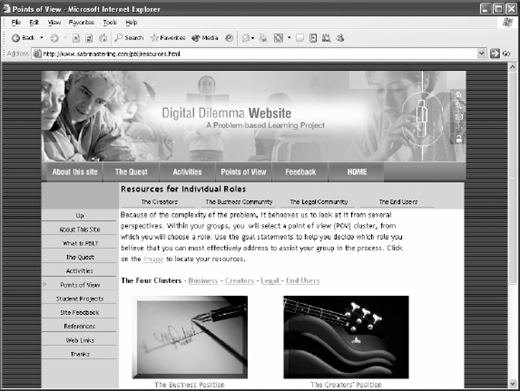
One thesis student indicated great interest in both online instruction and problem-based learning (PBL). She had been exposed to online PBL in the first course of the education specialist program. She returned to this course five semesters later to implement a more elaborate online PBL as her action research project for her EdS thesis. Developed based on the guided design model, Digital Dilemma addressed computer ethics as it applies to music file sharing on the Internet. The Website can be viewed at http://www.sabrinasterling.com/pbl/
The study was designed to measure not only the effects of the online problem-based learning project on graduate student achievement, but to develop a rich description of students’ experience during the instructional process. For the full results of the study, see the student’s article in the Action Research Exchange, “Online Problem Based Learning” by S. J. Sterling (2004).
The challenges of simultaneously teaching and researching for both the thesis student and the course instructor were enormous. The design and development of the problem-based learning module was completed in the previous semester. The PBL project was designed to meet specific course objectives, and included assessments to measure individual and group achievement. The multimedia, self-contained module was housed on the student’s own Webpage and linked to from the online course. The design included discussion activities that made use of the threaded discussion areas of WebCT. Prior to the beginning of the course, the student and instructor worked together to decide on duration and timing that would support both the course objectives and facilitate the completion of the thesis in accordance with departmental and university deadlines.
An action researcher seeks to gain insight and develop reflective practice, along with goals of effecting positive changes in school environment and student outcomes (Mills, 2004). The action researcher is not required to stay outside, but can be a participant in the study. The thesis student’s research questions reflected this perspective. She did want to look at the effects of the PBL project on individual and group achievement, but she also focused on formative evaluation issues such as what issues would arise, which resources the students would find most useful, and how the project could be improved. Most importantly, she wanted to understand the experience of the students, of herself as designer/ facilitator, and even of the course instructor.
At the beginning of the term, the thesis student lurked in the class, forming impressions about the students from their postings. Based on her impressions, she suggested groups that she thought would be functional. The instructor formed the groups and introduced the thesis student to the class. They were informed that everyone would be required to participate in the PBL project as a standard part of the course, but that they could opt out of their results being included in the study. The instructor assured the students that grading was her responsibility.
The thesis student found out many things that we who regularly teach online know. She observed that things did not always go as planned. She found that students do not read instructions. She realized that the choice of topic (filesharing) was more foreign to the graduate students than it was to the fourth grade students who had served as her trial users. She had a hard time allowing the PBL process to unfold gradually without her intervention. As she reflected at the end of the project, “Trust the process. The problem-based learning project model along with the literature describes the process as cumbersome for both teachers and students in the initial stages” (Sterling, 2004, p. 8).
She learned about the importance of being an online teacher as well as a designer of online instruction, summed up when she wrote, “I must confess that I designed the intervention with the belief that I was going to be able to create the ultimate online learning experience. In the back of my mind I had convinced myself that with the right bells and whistles, the students would be able to work without my assistance”(Sterling, 2004, p. 8).
The learning continues, as the student is now teaching an online course as an adjunct faculty member. The professor who designed the course she is teaching and I are acting as mentors. In a recent e-mail, she asked about handling students who did not show up on a timely basis. She said, “I don’t want them to think that I am a spy, but it does have me concerned. Any thoughts?” My voice of experience replied, “Send a short and friendly e-mail expressing your hope that all is well. This does three things—let’s them know you’ve noticed their absence, creates a record of your concern, and encourages them through friendliness.” It is great fun to have someone to whom to give these hard-won pearls of wisdom!
Conclusion
Many teachers are exposed to online courses as learners in graduate courses. They likely were not taught this way earlier in life, and so have to develop a number of competencies to be good learners in this setting. As online instructors, we should not limit the students to learning to be learners when we can also enhance and extend their teaching skills through modeling, direct instruction, and sharing the teaching role with them. As teachers experience and appreciate the pedagogical, social, managerial, and technical aspects of online teaching, they can make informed decisions about interest in pursuing online teaching opportunities. They will become more marketable, and will become better and more critical consumers of virtual schools. Teachers can become valuable partners as adjunct faculty, adding their background and experience as facilitators in courses they once took. Even if the students decide not to pursue online teaching opportunities, the activities could still be worth the effort. Instructors and students often interpret online experiences differently; giving the students a taste of teaching online may help us all.
About the authors