Introduction
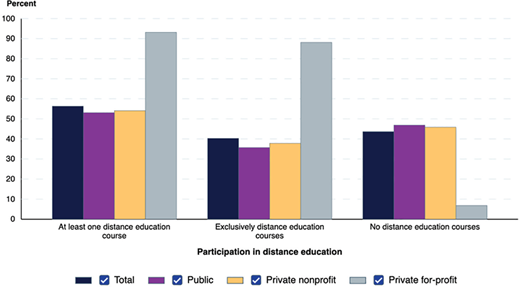
We live in an exciting time in history when “tele driving” is reality (Fox 13 Seattle, n.d.). In this technologically advanced time in history, distance learning has become a preferred mode of instructional delivery in higher education. According to a national survey (Bharadwaj et al., 2023), since the pandemic, for about 69% students, the preferred mode of instruction is fully online, blended or hybrid instruction. Only about 31% of students preferred face-to-face instruction. About 55% of instructors preferred face-to-face instruction. In this survey, 22% of students reported a lack of sufficient access to computers and 40% reported internet instability as issues concerning access to distance learning. Because of the pandemic, the number of remote learning institutions and students has increased more than ever before (Champlain College Online, 2023). According to a comprehensive national survey of the National Center for Educational Statistics (2023) [doesn’t agree with reference cite], about 1.3 million students at the postbaccalaureate level took distance learning courses and about 1.8 million were enrolled in at least one distance learning course. See Figure 1.
From 2019 to 2021 there is a rise and fall of postbaccalaureate undergraduate students enrolled in at least one distance course and who enrolled in distance learning courses exclusively. In 2021 about 56% of undergraduate students enrolled in at least one distance learning course compared to 71% in 2020, and 42% in 2019. About 40% undergraduate students took distance learning courses exclusively in 2021, 52% in 2020, and 33% in 2021. This indicates a rise in the enrollment within distance learning classes as compared to pre-pandemic. Additionally, students begin to return to the in-person classroom as they return to campus. Therefore, post-secondary institutions continue to provide a variety of options for students in the post-pandemic academic environment to best meet their needs.
In 2017, about 38% of adult students aged 23 and up rated online learning better than face to face in “meeting the needs of adult students” compared to 77% in 2013. In 2017, about 18% of students aged 17–22 rated online learning better than face to face in “meeting the needs of traditional aged students” compared to 53% in 2013.
When looking at the history of distance learning, according to Sleator cited in Gershon (2020), it traces back to the eighteenth century, as correspondence courses, thanks to the postal service. Compared to correspondence courses delivered via traditional postal service that could take days and weeks depending upon the locations of the instructors and students, in the twenty-first century, unprecedented technological developments such as the Internet, Zoom, and Google have made distance learning possible in real time, online, from anywhere in the world. For example, instructors could develop a full course within a learning management system and have regular weekly virtual class meetings with students distributed geographically via the Zoom platform. When all students in a course could not meet online regularly, an asynchronous course delivery mode is a possibility. However, from a pedagogical standpoint, depending on the content (e.g., chemistry), there are missing factors in online learning.
Some missing factors of online learning are hands-on use of equipment and face-to-face interactions with the instructors to help students understand difficult to grasp concepts that require conversations with the instructor, and above all real-world learning experiences. Teaching hands-on science labs in a face-to-face environment generates a higher level of confidence that the students could use the lab equipment and carry out experiments by building the technical and psychomotor skills over virtual labs as rated by instructors according to the Science Interactive (2023). A challenge not frequently identified with offering labs online is the need for highly specialized equipment which is not available at home. The combination of virtual labs and hands-on laboratory have complementary affordances as compared to only virtual or online hands-on (Kapici et al. 2019) indicating that face-to-face experiences have some value. With specific guidance from the instructor, online students can gather the materials, conduct hands-on experiments, (for example, floating a metal paperclip on water due to surface tension) video record, and share their videos with the instructor for evaluation. Arguably, no computer-based simulation of the same experiment would replace the real-world experiences associated with hands on learning. For pre-service teachers in training to teach elementary students, real world hands-on experiences in conducting science experiments are critical, because the elementary students they will teach need concrete experiences to develop misconception free, meaningful understanding of abstract science concepts (Contant et al., 2018; Kumar, 2023).
For the past 20 years, the freshman attending college or university find transiting from high school to academic life is difficult (Tinto, 1998). Designing of the very flexible online event enhances the ability for students to connect with their instructors, an important element of student success in the Tinto student support model (Tinto). Although the pandemic to an extend has driven a good portion of students to online learning, how to create situations where online students will invest the time to come to campus and meet their instructors and each other remains a question that is pedagogically valid.
Challenge
Due to scheduling challenges, the department determined that the undergraduate instructional technology courses online addressed scheduling issues for classroom space. The issue is that these courses, when taught on campus, required three-hour blocks. The challenge was finding another class with similar time requirements to balance out the alternate day for classroom scheduling (instructional technology on Tuesday and another class on Thursday). However, some educational technology requires hands-on experience to emulate how the future teachers would be using the technology in their future classroom. This led to a new issue, how to have students come to campus attending a fully online classroom for these experiences.
The classes that needed these hands-on experiences were undergraduate classes in the pre-service education program that taught students how to integrate technology into the K–12 classroom. The department offers two levels of instructional technology courses. One is an entry level class into the education program taken by students in their first or second semester attending the university. The other class is a senior level course taken after acceptance into the educational degree program. Most of the students will go into the teaching profession upon graduation. Three different instructors teach several sections of these classes.
To entice students to join us on campus, the event needed to be relevant and interesting. The event also needed to meet an educational goal within the class. The answer was to have a robotics day for educators. Educational robots are very engaging with the pre-service teachers being able to quickly initiate the invention cycle while using block code programming to code the robots to accomplish tasks. Robots also teach the basics of electrical engineering, mechanical engineering, and computer science. To accomplish the tasks, the students are using computational skills to solve the problems and the invention cycle to improve their robot’s performance. Robots are very interesting, creating a curiosity for the students about what educational robots are like.
The best way to experience robotics is through hands-on experiences. Students could use virtual robots, however, programming an educational robot is a totally different experience as compared to making a cartoon move on a screen. Robots are a great way to teach hard science and computational thinking. Robots introduce students to engineering and science fields of physics, electrical engineering, mechanical engineering, and computer science. These are fields that teachers are not adequately prepared to teach because they have inadequate knowledge or misconceptions of engineering (Christian et al., 2021). Academic experience of students before college influences career aspirations, so the lack of pre-college experience (Ashfold et al., 2016) in engineering impacts the willingness to go into these fields. For these reasons, teaching robotics to K–12 students is important for preparation of students in these fields and generating excitement in the use of the robots by future teachers.
The challenges to teaching robotics only line is similar to teaching science labs online. Robots require apps or programs on a computer, tablet or mobile device to operate. The robots themselves are expensive to purchase individually as part of the class material expense by the student. To mail a class robot to the students is expensive as well. Checking out robots would require the additional expense of hiring additional staff to manage the check out system. The best process is to have a tablet associated with the robot requiring the potential loss of both the robot and the tablet if the students did not return the checked-out items.
Another challenge faced the instructor on the online instructional technology course. The department required the course to be 100% online and it course was labeled as 100% online in the course catalog each semester as a way of informing students what type of course they were taking. The instructors cannot require attendance on campus of the students, so the event had to be enticing to encourage voluntary participation. However, realistically the instructors knew that travel to the campus and the various work and class schedules of the students was also an issue. The event could not be offered online on campus and needed other flexible options for attendance.
The challenge in offering an opportunity to students to interact with robots for both the students that can attend in person and those that can attend only online led to the following questions:
How to create experiences where online students will invest the time to come to campus and meet their instructions, each other, and interact with the hands-on experiences when there is not requirement to attend?
Is it possible to create an instructional experience that would allow for various levels of interactivity based on a flexible modality approach?
Can the experience promote positive attitudes toward the integration of robotics into their classroom activities?
The instructional goal of the event was to increase the likelihood that the preservice teachers would use robots if available to them in their future classroom. For this to occur, the students would need to realize the following based upon their experiences:
The students would enjoy learning using the robots.
As teachers they would be able to teach the coding required for the robots.
They could see themselves teaching robotics.
The Robotics Day Event
The live event took place in a large room available on campus. Around the room were stations with different robots. Volunteers guided the participants through a set of activities. The different stations had Little Bits, educational Lego robots, Mini Sphero, Dash, and VEX robots. A university high school robotic instructor also brought drones and robots made by the robotics competition team for demonstration. The participants then rotated through the different stations.
The livestream event had to involve a vastly different thought process to ensure that all the participants were getting an equivalent experience. Because they could not interact with the robots. Volunteers running the stations. However, the demonstrations would not capture the ability to speak to the educational robotics experts in the room. To replace that experience, a faculty member MCed the event and during the expert interviews for the livestream audience a person monitoring the chat passed on questions. Interviews also included students who had interacted with robots. The students shared their experiences with the robots and their thoughts about using the robots in the classroom.
One of the professors edited the recorded version and posted the event online in two different formats. The first format was a recorded version of the livestream event with splash screens to introduce the different speakers and the movement of the cameras removed, so it was a shorter video and a longer unedited version of the day’s events. The second format was the livestream event segmented by the different interviews to create shorter clips. Students could then watch several of the short, segmented clips.
The final choice of the students was to participate in an online unplugged robotics activity. The unplugged activity required the use computational thinking skills to design a robot to accomplish a task. The students then labeled the parts of the robot and outlined the steps the robots used to complete the task. The students used drawing tools to draw the robots.
Methodology
The method for this study was qualitative using data gathered through a survey and sign-in sheet. The survey was a brief survey with seven questions. Those questions were to ensure that the event accomplished its primary goal of increasing the willingness of teachers to use robots to teach computations skills. The data collected about the attendance occurred through a digital sign in form. The researchers realized that the attendance would be low because this was on the extension campus. Making the livestream so important.
Results
Because of the varies delivery mediums, the total number of participants was 145. Participants included a variety of individuals including staff, students, and children of the students. The breakdown was 36 in person and 10 virtual. Another 99 students watched the recordings. The survey results came from those that attended the event. Of those participants that attended, 14 agreed to answer the survey.
Overall, the attendees believed they would implement the robots in a classroom setting (see Table 2). The highest rated score was the belief that the children would enjoy using the robots (4.21) followed closely by the pre-service teachers who enjoyed learning about the robots (3.93), and they desired to learn more at 3.77. Surprisingly, the pre-service teachers rated that thought they could learn basic coding skills because of the event highly as well (3.50)
Discussion
The event was successful in reference to all research questions. The first question was determining if students would come to campus for an event that was interesting to them. The answer to that question was yes and they were also willing to set aside time to attend the livestreaming event. Over time, the event will become popular with the students, which will allow them to prioritize the experience and increase attendance by the students at the event.
The event also accomplished the instructional goal as intended by convincing the pre-service teachers they are capable of learning basic programming and willing to use the robots in the classroom related to question two. The students were willing to learn more about basic programming, understood that the children would enjoy robotics activities, and willing to use robots in their future classrooms.
The event had additional benefits which were precious. To run the event, the graduate students and students that had graduated from the master’s program volunteered for the event. This created a great mix of undergraduate, graduate, and postgraduate students. The students were excited to meet their instructors. They wanted to share their experiences in the class with their instructors.
This study could not differentiate between the levels of willingness to incorporate robotics in future classrooms by the pre-service teachers based upon the delivery mode they engaged with Robotics Day because of the small sample size. Future events using robots should gather more information about how the students engaged with the robots through the on-campus, livestreaming, recordings, or unplugged activities. Due to challenges in the implementation of the follow-up survey for online participation, the researchers were unable to gather information from that group of participants. However, that issue will be resolved in future events to determine if difference in the pre-teacher efficacy would be different based upon their experiences with the robots through the delivery mode.
Future Directions
The audience for future HyFlex events will expand. Many classroom teachers have asked if a livestream event could be available for their students to join as a class. The next event will have a dual purpose to accommodate that request and to continue meeting the instructional goal of the Hyflex event to increase pre-service teachers’ self-efficacy in the teaching of code and robotics in their future classrooms. A more robust survey could capture those self-efficacy skills. A pre and post test could determine the growth of the self-efficacy skills as a result of the interaction with the robots and the delivery mode so the level of growth can be measured and compared.
Conclusion
The event met both goals. Students who came to campus could meet their instructors and connect with other students in their classes or with graduate students that were in the instructional technology program. The event also accomplished the educational purpose of the event in exposing the teachers to hands-on technology of robots and enabling them to see themselves as a teacher teaching basic coding skills and computational skills using the robots. The livestreaming of the event and recording of the event provide broader exposure to those students that are time or place bound and unable to attend. The unplugged event was a good alternative for other students.
About the author