The Instructional Design for Online Learning (IDOL) specialization at Capella University is a dynamic online graduate program that produces graduates who are sought for their skills and expertise. IDOL is a program that is part of an accredited, online university that provides adult learners with high-quality education in a flexible, online format. What contributes to IDOL’s successes with their learners and in the ID field? As is often the case, the whole is greater than the sum of its parts. Capella has created a strong, energetic program by focusing on the elements that contribute to the success of its graduates in the marketplace. This article explores some of the factors that experience has shown are foundational to its success.
WHAT IS IDOL AT CAPELLA UNIVERSITY?
Professionals with expertise in instructional design for online learning are in demand and are important to the changing learning environments made possible by the rethinking about learning, the Internet, and other distance learning technologies. Capella University, founded in 1993, offers graduate degree programs in business, education, human services, information technology, and psychology, and bachelor’s degree programs in business, information technology, and public safety. The IDOL specialization began in 1997 with a master’s degree and was followed in 1999 with the PhD degree. The IDOL specialization now has a decade of fine-tuning its graduate programs, and enrollment in both the MS and PhD programs continues to grow.
WHO ENROLLS IN IDOL?
Learners in IDOL are usually professionals in their fields who are returning to school to gain additional skills and knowledge about instructional design in the online environment with a goal to lead the online education agenda within their organizations. At Capella University, enrollees are called “learners” rather than “students.” The term learner more aptly describes the working adult women and men enrolled at Capella and in IDOL. Capella is the only accredited, online institution that provides IDOL degrees at the master’s level, and at the current time, only one other institution offers an online PhD in this area.
The master’s degree in IDOL prepares professionals working in educational institutions, corporations, the military, health care, and government agencies to achieve a high level of competency in instructional design in order to advance their careers and serve their organizations. The master’s program focuses on the practice of instructional design and prepares instructional designers to solve real-world problems by applying theory and best practices. The goal of the IDOL master’s degree is to create practitioner-scholars who can implement systems and strategies for analyzing and resolving problems, synthesize theory into application of instructional and performance interventions, implement methods for online delivery, manage projects, and have an understanding of software tools that make the process efficient and effective.
Extending the focus beyond the master’s degree, the goal of the IDOL doctoral degree is to create scholar-practitioners who have developed research skills and can apply theory and research strategies to implement instructional and performance solutions, and begin to share knowledge through scholarly research, publications, and presentations. The PhD degree in IDOL prepares professionals to lead and manage instructional challenges in a variety of online settings in various work settings as well. The focus is on the theory and leadership of instructional design. PhD learners move beyond the master’s level competencies to consider the higher levels of analytical and critical thinking related to research, theory, and leadership in instructional design.
HOW IS IDOL GROWING?
Capella University is committed to academic excellence and has grown to more than 19,000 current learners from all 50 states and 56 countries. Likewise, IDOL continues to grow in enrollment and to attract learners from a diverse population and professional audience. Part of IDOL’s growth and success is due to the focus on successful online interactions and building community at PhD colloquia. A strong benefit of the IDOL programs—the fully online master’s degree and primarily online PhD degree—is that they are accessible to learners who otherwise may not be able to attend traditional learning environments for advanced education.
The demand for training and development specialists and instructional designers is growing. The Bureau of Labor Statistics (http://www.bls.gov/) projects an increase of nearly 28% in training and development specialists between 2002 and 2012; this contrasts with the overall employment growth rate projection of 15%. Meeting this need for an educated workforce requires preparing professionals in instructional design and development.
An estimated 29% of prospective college students now have experience with online education, and an estimated 1.2 million students are pursuing online higher education, according to Eduventures (http://www.eduventures.com/). At current growth rates, by early 2008, 10% of postsecondary students will be enrolled in an online program. Similar growth exists in K-12 and corporate e-learning, creating a need for professionals skilled in designing effective instruction for online delivery. The IDOL program is sought by professionals who are hoping to meet this market need.
LEARNERS: THE HEART AND FUTURE OF INSTRUCTIONAL DESIGN FOR ONLINE LEARNING
Learners in the IDOL program, like Capella learners overall, tend to be motivated, working adults from all walks of life who represent many professional paths. Capella learners are driven to advance their current careers or change careers. They often hold influential decision-making roles and work in a variety of settings, including corporate training, higher education, K-12 education, health care, government, military, and nonprofit organizations.
IDOL’s successful learners are a reflection of the program’s effectiveness. Structural elements in place at Capella and IDOL contribute to learner success, impacting and benefiting learners and their academic achievements. A strong curriculum, learner support, and course design based on current theories of learning and instruction, and dedicated faculty contribute to these successes.
SHARING IDOL’S SECRETS OF SUCCESS
Instructional design best practices dictate that thoughtful program and course design, implementation strategies, and ongoing focus on quality and interaction help steer a program to successful outcomes. IDOL practices these elements for success, through guiding design decisions based on research, working with instructional design professionals within Capella, and building on the strategies that have been shown to bring success in the Capella University learning environment. Once program-level decisions are made, the priority is to create instructionally appealing courses that utilize the appropriate mix of activities, media, discussions, and interactions to provide a robust, interactive course.
ENGAGING COURSE DESIGN
Courses at Capella are designed according to nine essential teaching and learning guidelines. These guidelines are derived by the Capella course development and curriculum leadership and reflect best practices and recent findings in the literature. The guidelines are listed below, followed by examples of three of the guidelines:
Focus on professional impact.
Define learning outcomes as competencies.
Define appropriate indicators of competence.
Develop grading rubrics.
Frame learning as a challenge-driven process.
Provide a supportive structure at the unit level.
Integrate unit activities into final projects.
Add media enhancements.
Encourage learner-to-learner interactions.
Three of these guidelines—6, 7, and 9 —are instrumental in creating high quality, relevant, and engaging IDOL courses:
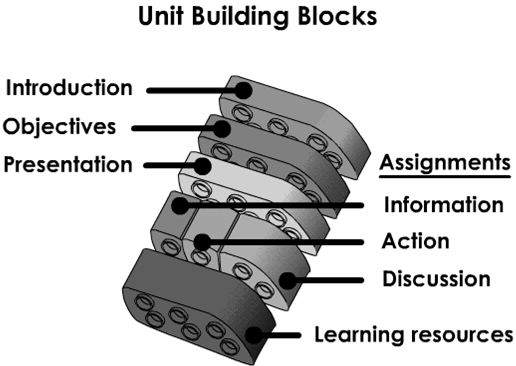
Provide a supportive structure at the unit level: Each unit of instruction is a cohesive whole that connects, like building blocks, to the final course outcome. This structure provides learners with guidance, examples, instructions, resources, activities, and assessments to enable them to successfully meet challenges posed by learning objectives and achieve the course competencies (see Figure 1).
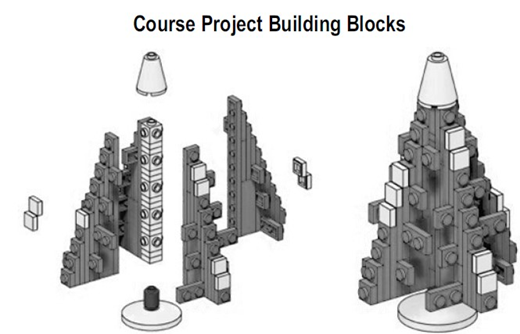
Integrate unit activities into a final project: In most courses, the learning activities in each unit provide the building blocks of the final course project or paper. Learners receive formative feedback from their peers and the instructor at project milestones in order to revise and improve the project elements throughout the course. When unit assignments lead to the development of a final project, the culminating assignment is not an isolated activity that learners scramble to complete at the end of the course; instead, it is the result of a carefully planned sequence of milestones. This course design strategy provides explicit guidance and structure along the way, often resulting in learners producing high-quality projects and academic papers (see Figure 2).
Encourage interactions: Many instructors and learners feel that their involvement with the content and learners and instructor is greater in a Capella courseroom than in a typical on-ground classroom. The expectations to be informed by the readings and to integrate that new learning into responses to discussion questions and to peers means learners must integrate ideas into their present knowledge and share that new information. While it is a different form of interaction, it is often more intense and more in-depth than typical classroom discussion.
RELEVANT CONTENT AND ACTIVITIES IN IDOL
The IDOL curriculum is competency-based and is the result of integration of three sets of competencies: the competencies for instructional designers as defined by the International Board of Standards for Training and Performance Instruction (ibstpi); the ethical standards for instructional designers, also defined by ibstpi; and Capella competencies in research, critical thinking, and scholarly writing established for the university.
Using ibstpi competencies as a guide, courses in the IDOL curriculum are designed to have meaning and relevance to learners, either in current employment or a future role. Examples include:
In the introductory course in instructional design, learners create a design document for a lesson or course.
In the interface design course, learners create a Web site that summarizes and illustrates the essential principles of interface design.
In the theories and models course, learners study instructional design theories and work together to envision changes to existing ID models.
In the course on evaluation and assessment of instructional design, learners create a course evaluation plan, including six evaluation instruments developed during the course.
In the leadership course, learners develop an action plan for a proposed e-learning solution.
FACULTY: QUALIFIED, PASSIONATE, AND ACCESSIBLE
The academic reputation of any university rests on the quality of its faculty, and IDOL faculty are an essential component in the overall success of the IDOL program. IDOL faculty are a diverse group of professionals with experience in a wide range of settings who are recognized experts and have an average of 19 years experience in instructional design. The faculty bring experience and passion to their teaching as both scholars and practitioners.
IDOL attracts outstanding faculty from the United States and the world who value being able to engage in their professional practice as they also teach about it. They have chosen to teach at Capella because they share a passion for teaching and for instructional design, and they adapt well to the demands of online instruction. Currently, IDOL is comprised of a faculty chair, several full-time core faculty, and a stellar group of adjunct faculty who support learners and share their expertise.
Learners enrolled in the IDOL program have extraordinary access to faculty. Although all IDOL courses are asynchronous, modern communication tools enable frequent and substantive interactions between learners and faculty, as illustrated in the following examples:
Interactions in the courseroom. Courses employ discussion threads, in which learners discuss content of course units and through which faculty provide comments and guidance. Many faculty also provide unit summaries, pulling together the diverse ideas of the discussants and enabling the faculty member to share his or her unique experience. The courseroom has its own e-mail system and assignment area where faculty can provide individualized feedback on learner assignments. Faculty establish their unique courseroom protocols, such as frequency and quality of posts, expectations regarding interactions with other learners, encouraging participation in teams and in peer reviews of assignments. Many faculty have expressed the thought that they interact more with learners in their IDOL courses than in a typical on-ground classroom.
Electronic communication. Outside of the courseroom, faculty and learners communicate chiefly via e-mail, instant messaging, and phone calls. Many faculty also hold virtual office hours for their learners, which allows them to contact their instructors at a time when they are likely to receive an immediate answer to a question, and some courses may include an optional synchronous meeting so learners can experience the range of possibilities available with today’s technology.
PhD Colloquia. At three stages during their doctoral programs, IDOL learners come together for 5 days to meet with faculty and other PhD learners from across the university. The time at colloquium is much like a high-caliber professional conference, with keynote speakers, breakout sessions, and networking events. Learners spend nearly a week among an engaging community of scholars, participating in workshops and gaining exposure to diverse perspectives that challenge and expand learner thinking. Colloquium sessions and social gatherings help learners develop academic skills, establish peer networks, strengthen doctoral competencies, and meet with faculty face to face. Support services, such as librarians and writing center personnel, are also available at the colloquia to work with learners one on one.
LEARNER SUPPORT
An important element in the success of IDOL learners is the level of services and support to help them accomplish their goals. The learner support system sets Capella apart from many other learning institutions. Capella learners are not out there in cyberspace by themselves. Rather, there is a powerful support structure devoted to helping learners have a successful, rewarding learning experience. Here are a few of the support structures in place at Capella University for IDOL learners:
Enrollment counselors guide learners step by step through the admissions and enrollment processes.
Academic advisors provide support and assistance throughout the learner’s program. Advisors help learners plan their coursework, navigate the bureaucracy of the institution, and understand the requirements for degree completion.
Financial aid staff help learners explore financing options, including federal and nonfederal loans, grants, and scholarships, and employee tuition reimbursement.
iGuide is a personalized Web portal where enrolled learners can register for courses, apply for financial aid, visit the library, and view the academic calendar. iGuide gives learners secure access to their courses and transcripts, as well as links to Capella’s interactive learning community.
Capella University Library offers a variety of services to help learners and faculty locate information and resources they need. Librarians are available to assist learners by phone, chat, or e-mail, and the university library provides extensive access to scholarly and professional resources.
Support personnel interact with learners on all kinds of matters from administrative issues to coordinating reviews of learner dissertations to smoothing the way to graduation.
Faculty and mentors guide doctoral learners through their educational journey, from their coursework to preparing for the comprehensive examination to choosing dissertation topics.
Learners entering the IDOL program receive support from their very first contact with Capella. After the learner has made the decision to enroll, he or she works with an enrollment counselor to develop a degree completion plan, which lays out required courses. The counselor provides guidance about which courses to take, in which order to take them, recommended course combinations, and when the learner will attend the three required colloquia for PhD learners. All learners begin with the school of education’s orientation to the university, the school, and the IDOL specialization. The first course combines content with useful information and resources to provide new learners with knowledge and skills they need to be successful in their online degree programs, along with a writing assessment, critical thinking skill development, and protocols for searching for appropriate resources, setting the tone for the remainder of their educational journey.
PUTTING IT ALL TOGETHER
Success is often seen as a serendipitous combination of chemistry and events that impact the individuals involved in the experience. At Capella and within IDOL, the focus is on strategies that help increase the probability of creating that positive chemistry and energy, and designing events and activities within the courses and learner interactions to ensure the success of our learners. Faculty, learners, leadership, and well-designed curriculum and support mechanisms all help point the way to that success.