WHAT IS PEARSON
As the global leader in educational publishing, Pearson is a large, multinational company with more than 29,000 employees based in 60 countries. Pearson’s business is comprised of three main units: Penguin Books, the Financial Times, and Pearson Education. Within Pearson Education, the business is subdivided into print and digital components offering customers basal and supplemental instructional materials as well as professional development solutions, all of which are research based. The education group’s mission is “to help students of all ages learn at their own pace, in their own way” (Pearson Education Web site, 2007).
This article addresses a threefold approach to various aspects of distance learning in a corporate setting. Pearson’s New Hire Sales Orientation (NHSO), the Summer Cruise program for educational consultants, and the Connected Training department are the three areas addressed. While these three are nascent efforts in such a large organization, the intention is to start small and design effective models which allow for scaling up as the programs take hold.
ONLINE OFFERINGS
Pearson’s exploration of distance learning is comprised of three unique initiatives. The NHSO offers the sales team a blended approach that takes advantage of anytimeanywhere learning with a level of transparency and accountability through built in reports to help managers get their new hires up to speed effectively. The Summer Cruise program, for existing employees in the Instructional Services group, provides relevant and timely information about product development and new offerings. Lastly, the Connected Training program gives customers a way to gain basic product training in a more efficient, time-saving method.
NEW HIRE SALES ORIENTATION
For the digital sales group, new hires are brought on board as quickly as possible in order to increase productivity and lessen ramp-up time. However, in order to learn complex programs and meet business goals, sales management realized it was necessary to examine current practices and build something new. Kristina Potter, sales development manager, was hired to design a series of self-paced, Web-delivered learning experiences that would allow maximum growth in minimum time. The NHSO is a 10-week self-study program to help new employees in the digital sales group gain an initial orientation to Pearson products, processes, and people.
New employees in the sales department are assigned to NHSO during their first week on the job. Each week, the new employee is assigned a module to complete. The modules consist of a series of brief presentations, exercises, self-study materials, and follow-up tasks. Each day, the new employee has between 1 and 2 hours of material to cover, in addition to meeting with his or her manager, other team members, and customers.
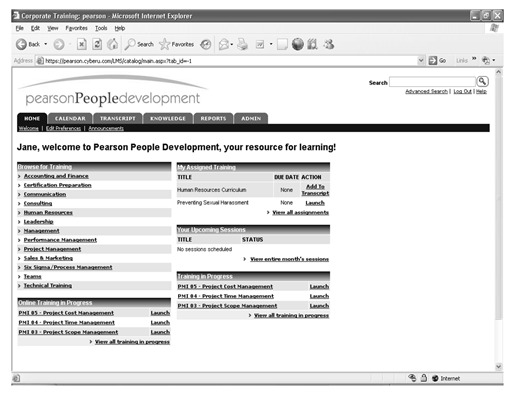
At the start of every week, participants receive an e-mail with an Excel spreadsheet. The week’s activities are listed with suggested timing for each day of the week. The timings are provided as a guideline, not necessarily a requirement. Learners must log-on to the Pearson People Development Network (see Figure 1) to access the self-paced content modules. After viewing the content, the learner completes an assessment and has a task or two to complete off-line. Tasks range from finding a file and printing it out for his or her custom training notebook to calling a team member for a phone interview. Supporting materials for each module are hot-linked in the Excel sheet so that learners simply click on the link to get to the resource.
The modules are designed to cover a variety of topics in increasing order of complexity. Below is an overview of the content by week.
- •
Week one includes basic information from human resources such as benefits and health plans, a defensive driving course, and a course on preventing sexual harassment.
- •
Week two begins introducing other departments in the organization and respective roles they play.
- •
Week three moves into the product suite the individuals will be representing, including model presentations and assignments related to finding product information on the company intranet pages.
- •
Week four introduces and explains the use of specific job tools like the customer database, pricing tool, and expense report system.
- •
Week five takes new hires on a deep dive on the product offerings and either shadowing a colleague or attending a live-product training session at a customer site.
- •
Week six moves the focus to the customer experience with an in-depth look at product implementations.
- •
Weeks seven through 10 break down job tools and activities into microsteps that new hires practice in a safe environment. They learn to create a cost proposal, enter new contacts into the customer database, and hone their sales skills in minitrainings.
Assessments are built in to the modules through multiple-choice quiz questions and surveys delivered through the learning management system. After completion of each module, a score is recorded so that management can view each individual’s progress.
Joshua Brown, a new sales executive, recently completed the 10-week program. He liked the flexibility the program offered because he was able to view material when it was convenient for him. He notes that during a traditional, face-to-face training “certain folks ask a lot of questions that are not pertinent to the whole group [while] this is specific to what I need” and can be done anytime. He prefers the individualized nature of the online experience to large-group trainings. Christy Berarducci, another new hire who went through the program, agrees that she was able to “gain more information and experience in this way than in a week long [on-site] face-toface training.” Christy also commented that “instead of everything being thrown at you at once, I am able to do it at my own pace” which gave her “time to absorb the information” for maximum learning.
SUMMER CRUISE PROGRAM
Pearson’s educational consultants (ECs) in the digital group are product experts who are responsible for delivering training to customers. Thus, they must be kept abreast of all new product developments and features as they are released. As their work schedules are dictated by the traditional school calendar, there is often a downturn in demand for training during the summer months. The Summer Cruise program was designed to take advantage of this down time by offering ECs up-todate product information and polishing their skills and knowledge without taking them away from schools or time with customers. The Summer Cruise program, launched in June 2006, was a way to blend technology resources to respond to different learning styles, scheduling needs, and diverse geographic locations of the ECs.
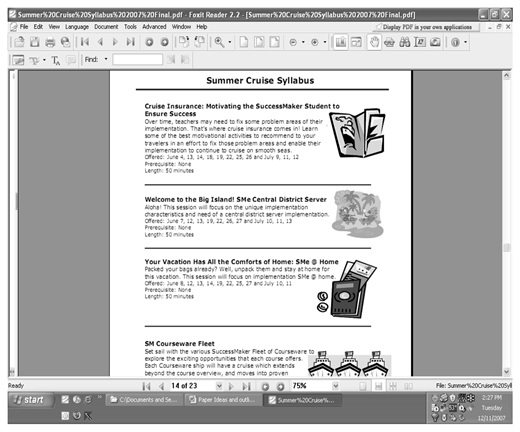
The Summer Cruise series included a catalog of over 55 courses (see Figure 2), which were delivered by training specialists located in the corporate office in Arizona. Training specialists designed the modules to be as hands-on as possible. The sessions were 50 minutes in length. The sessions looked and felt very similar to face-to-face training. The only difference was that the trainer was not physically present in the room. The ease of use for presenters and attendees allowed the focus to be on the content and interaction with participants rather than the technology. Attendees were encouraged to participate and interact. The training specialists took advantage of the ability to share control of their desktop through the presentation software. The remote control allowed attendees to work on the presenter’s computer just as if they were working on their own. This was important because the trainer could demonstrate a process, and then have the attendees demonstrate it also. This was an excellent way to check for understanding. Course evaluations were completed electronically by participants after each course. The feedback was used to fine-tune and make adjustments to each course offering.
Sessions were delivered via GoToMeeting, a Web-based presentation software program. For the synchronous sessions, the facilitators engaged in sharing product updates, modeled new delivery strategies, and hosted question-and-answer time. The live sessions utilized communication tools such as polling, chat, and sharing control of the presenter’s laptop remotely, all in an effort to boost interactivity for participants. All sessions were recorded with Camtasia
Studio software for later use in an asynchronous mode. This allowed for ECs to join some sessions live while attending others at their own convenience. The recorded webinars were hosted on the company intranet and available for download. Some innovative ECs were even able to leverage their iPods as a viewing device for the recorded versions.
Pearson recognized a cost savings of at least $73,000 by offering training for existing employees through the Summer Cruise program in 2007. Instead of flying people in from all over the country, virtual meeting software and conference call lines were used to link people with the knowledge they needed. It is expected that the summer of 2008 will bring another round of remote training for employees based on the success of the previous year’s program. The blended approach, offering both live and recorded sessions for remote employees, is a very sustainable and cost-effective model.
Jan Van Dam, Vice President, Instructional Services—Digital, notes that the increase of effectiveness was seen even after the summer program ended. When ECs went back to a full work schedule in the fall of 2007, the performance rubric used to evaluate them included some reflections from the summer program. The “skills to keep you up-to-date” were requirements for success in the field which the Summer Cruise program provided in an easily accessible and flexible format.
DISTANCE LEARNING IN SCHOOLS
Traditionally, educational publishing companies include (either “free with order” or paid as a separate expense) some type of product training with their print and digital offerings. The customer then chooses when and where to deploy such training. However, the challenges for school administrators include release time for teachers to be away from their students, payment of stipends if training occurs outside of contracted hours, travel delays, weather delays, and scheduling issues. Most school administrators find it a daunting task to organize a training that lasts longer than 30 minutes at a scheduled monthly staff meeting, yet true professional growth comes from sustained study and focused efforts. These factors make distance learning an attractive option for many school leaders.
It was partly in response to this growing need that Pearson decided to scale their DE initiative to include product training for customers. Providing online, remote delivery met the criteria of having flexibility in deployment and also loosened scheduling constraints for school administrators. Modules were designed to be taken in 1or 2hour chunks.
CONNECTED TRAINING
Face-to-face product training has been the norm for Pearson for many years. However, when it became apparent that a new way was needed, it made sense to look to technology for an alternate delivery mode. As Pearson’s customer base has grown more sophisticated in their use of technology for instruction, the Connected Training model was conceived to create efficiency and sustain training for Pearson applications that are currently in use in a school or district. Connected Training is simply a modularized version of all the product training that Pearson ECs conduct, delivered via the Web in brief 1or 2-hour chunks.
School leaders are looking for ways to maximize the hours set aside for training and staff development. Teachers do not want to be bored by a long session that may not pertain to their job responsibilities. With Connected Training, administrators can decide who needs what modules and design a schedule to accommodate small or large groups. Some schools opt to use the connected sessions during grade level planning or at monthly scheduled “in-service” times. They even have the flexibility to include teachers from multiple buildings across a district for the same session. This encourages collaboration among staff members and serves as a built in “user group.”
Connected Training was first offered to customers in the fall of 2005. Since that time, eight specially certified ECs have been delivering between 300-350 hours of training per month in the connected format. This is roughly the equivalent of 50 on-site training days, at a greatly reduced cost for both the customers and Pearson. The trainers are dispersed throughout the United States and work from home offices. The only difference between the connected model and a face-to-face experience is that the trainer is not physically present for the training session. The participants and the trainer interact via GoToMeeting software and a phone line.
In order for schools to participate, they need to have a high speed Internet connection and either a speakerphone or headset capability for all participants to join the audio conference. A projector is recommended for larger groups, but is not necessary. Usually, a contact person (lead teacher or technology facilitator) is designated as the point person on site. The contact’s job is to ensure that everyone is following along and that audio quality is good. The contact can also serve as the virtual eyes and ears for the trainer, making sure that all questions are heard and addressed.
For the trainer, special attention has to be paid to ensure a high level of learner participation. Since the trainer is not able to see the faces and watch reactions, he or she must rely on using a conversational tone coupled with strong inclusion activities and engaging presentations formatted for remote delivery. It is not uncommon for the trainer to use icebreakers or other games as a way to set customers at ease if they have never before participated in a connected session.
Julie Martin, a former connected trainer for Pearson who now works in another department, often relied on specific questioning strategies to keep learner engagement high. Having participants find information in the application they were learning, in a scavenger hunt format, led them to discover features that Julie knew they needed to master in order to be successful. She utilized the voting buttons in GoToMeeting to gauge if more time was needed for a particular activity or as a check for understanding with a concept. “Giving teachers activities to meet the training objectives, like tasking them with running a report, was key,” she notes, because it “forced them to use” the software.
Both customers and trainers expected more challenges than they actually encountered during a connected session. Bev Stone, lab manager at Omaha School in Omaha, AR, explains that she was “very concerned at the beginning, but after the first one, I felt relaxed. We got to cover more [content]. With a person onsite, everyone wants attention” and it can be hard to accomplish the tasks at hand. Initially, Martin, the former trainer, worried that her inability “to see the participants and how they are reacting” would impact the quality of interactions. However, she employed tactics mentioned above and found that asking the right kinds of questions and how she structured learning activities made the difference between a successful experience and a frustrating one.
After one connected session, a teacher remarked to Martin, “Wow! I didn’t know I could learn this much without you in the room with me!” This type of comment was what sold Martin on the connected approach to delivering product training. It gave her the flexibility to create unique and very pointed learning experiences and work with customers based on their immediate needs. From the customer’s point of view, they got the information that they needed at a time and place convenient to them.
CONCLUSION
Pearson has spent a good deal of time and money to develop three distance learning initiatives for their people and their customers. Initial results are encouraging. The NHSO has produced approximately 28 newly trained sales team members since its launch in the fall of 2007. Another group of 11 new hires began the program in January 2008. The Summer Cruise program presented nearly 250 hours of refresher training attended by more than 300 individuals in the summer of 2007 alone. The growth of Connected Training has necessitated hiring of additional trainers to provide remote delivery to customers across the United States. The leadership teams are now looking for ways to expand the reach of each of the three programs in order to reach more people, more effectively, through distance learning.