INTRODUCTION
This article is the story of one of the youngest statewide networks in the United States: Network Nebraska. After reading the title, one could hardly imagine what would be newsworthy or printable about the development of another state network. It is obviously not the first; and almost certainly will not be the last. It's definitely not the largest and almost assuredly is not the smallest.
What this is, however, is a story of determination and vision; about how a relatively small group of persistent people brought about tremendous change in the way that public policy and funding and network services are administered on a statewide basis. It is a story of finesse, risk taking, trust, and bumpy roads along the way. It is a story of heroes and heroines and, if you read to the end, you will get to meet some of these incredible people.
If you are from one of the 40 states that claim a statewide network and you have lived through the growing pains of developing an organization where none existed, you may chuckle and nod your head about reading these personal accounts. If you happen to be from one of the 10 states yet to achieve statewide public networking, you may read with interest the "lessons learned" and "if we had it to do all over again" to avoid similar pitfalls. Network Nebraska is only midway through a 3-year development plan that will interconnect over 330 public K-12 higher education entities and up to 100 nonpublic education systems across the state, all of whom had well-established distance learning relationships and existing telecommunications providers prior to the start of the project.
IN THE BEGINNING‖
After reading numerous accounts of the origins of statewide networks across the United States, it was determined that no single template for change or model of network exactly fit the environment and forces that were at work in Nebraska in 2003.
What was discovered through research was that large-scale public telecommunications networks are much easier to develop if the following components or features are present: A public sector champion or champions (e.g., governor, university president, state senator, commissioner of education); an upfront funding source (e.g., legislative appropriation, federal grant, bonded investment); a public policy mandate (e.g., a gubernatorial initiative, legislative bill, campaign promise); a trusted business unit (e.g., state agency, college or university department, consortium of public entities, 501(c)3); a sustainable funding source (e.g., public services fund, legislative appropriations, user fees); the onset of a disruptive event (e.g., loss of provider, legacy technology extinction, sudden cut in funding, natural disaster) and, to a lesser extent, having a history as an early, established service provider (e.g., Internet services, Web hosting, dial-up connectivity, IP [Internet protocol] networking).
THE IMPETUS
What was unique about Nebraska's network development story is that almost none of these factors existed to get the original network off the ground. There were no huge or sudden disruptions, nor any over-the-top crusader making educational broadband a top priority. However, back in 2003, then-Lieutenant Governor Dave Heineman (now Governor Heineman) and L. Dennis Smith, president of the University of Nebraska, agreed that the State of Nebraska and the University of Nebraska would work together on telecommunications projects for the common good. That single suggestion did create the original impetus for the state's two largest telecommunications resellers (state government, University of Nebraska) to begin collaborating, along with Nebraska Educational Television. Within months, the State Division of Communications and the University of Nebraska entered into the world of competitive Internet provision for the state's K-12 and nonuniversity higher education entities. They also began cooperatively procuring contracts for aggregated backbone transport to serve state agencies and university facilities. And so the Collaborative Aggregation Partnership (CAP) was born, and it exists to this day.
Meantime, in the K-12 world, there existed a dozen or so decentralized distance learning consortia comprised of school districts and neighboring colleges who had banded together originally to exchange synchronous video distance learning classes. The earliest of these formed in 1992 and the most recent in 2002, with 45 late-adopting school districts added in 2003. These 12 consortia were using a variety of incompatible, aging audio/video technologies and were rapidly approaching the end of their long-term (10-year) telecommunications contracts, so something had to be done. The school districts had used lottery monies, federal grants, and local funds to purchase their original analog, motion JPEG, and MPEG2 video equipment over high bandwidth (45Mbps, 100Mbps) circuits, but virtually no escrow funds were ever set aside for technology replacement. Also, the consortias' incompatible video compression technologies and localized and regionalized infrastructure did not lend itself well to statewide distance learning exchange.
Partly in response to the heated debate between the adoption of analog versus motion JPEG technology in the 1990s, the state legislature created the Nebraska Information Technology Commission (NITC) in 1998. Comprised of nine members appointed by the governor (with the lieutenant governor as chair) and confirmed by the legislature, this commission is assisted by five advisory councils (state government, community, education, eHealth, and GIS) and a technical panel. The role of the technical panel is to review requests for technology funding and to set standards and policies to guide the state's future investments in information technology.
The NITC developed nine strategic initiatives in 2004, two of which directly affected educational networking. The first was the Statewide Synchronous Video Network and the other was Network Nebraska. In essence, the Synchronous Video Network was to bring about the unification and interconnection of video distance learning applications, and Network Nebraska was to provide the conduit or transport to interconnect the distance learning classrooms and more cost-effective Internet.
The first legislative appeal to provide funding for the aging distance learning equipment was brought forward in January 2005. Facilitated by a determined group of distance learning coordinators with little experience in legislative lobbying or advocacy, a $30 million video equipment and wide area networking “train wreck" image was painted before the unicameral legislative body. When the debate settled, the legislature denied funding but did agree to launch a 6-month Distance Education Enhancement Task Force to study the issue and to come back before the body in January 2006 with recommendations. As a result of the next session, “LB 1208" was passed by the legislature in April 2006 by an overwhelming margin and signed by the governor to become law, with an effective date of July 2006.
CARROT OR STICK?
Legislative Bill 1208 set out a number of policy, funding, and coordination changes across the state. This legislation tasked the state chief information officer (CIO) with providing access to every public school district and public higher education institution in the state, but it did not require participation. The bill also required the University of Nebraska to assist in this effort.
Since participation was not mandatory, the legislation provided a number of financial incentives or "carrots” for participation. First, it recognized the importance of equipment upgrades by allowing each high school building and educational service unit $20,000 in equipment reimbursements from lottery funds if they joined the statewide network and participated in distance learning. The bill also provided 8 years of lottery funding for distance learning incentives of up to $1,000 for each video course sent, up to $1,000 for each video course received, and additional incentives for sending asynchronous courses or reaching "sparse" or "very sparse" districts with distance learning courses, when delivered over Network Nebraska. The total amount of lottery funds attributed to this project through 2015 is estimated to be about $34 million and is administered by the Nebraska Department of Education.
In order to offset the potential increase in cost of full IP, flexible wide area networking, the legislature also introduced a new telecommunications allowance within the state aid formula that allowed any "equalized" (high need) school district to be compensated for 85% of the post E-rate cost of telecommunications. In effect, with the average state E-rate reimbursement at 67%, the final net cost of telecommunications for these 207 school districts is approximately $5 of every $100. For the 47 school districts that are unequalized, their only benefit is E-rate. Nonpublic school systems may also participate in Network Nebraska but do not receive state aid; only E-rate. Higher education entities do not receive any direct itemized support for telecommunications.
The legislature also provided approximately $1.3 million to a newly formed Distance Education Council to purchase a statewide clearinghouse and scheduling system. This Web-based Renovo Software system allows any school district or college to list their distance learning courses on a statewide clearinghouse and allows any eligible entity to register for the courses. Once the tentative schedule of send and receive courses is finalized, the software system is programmed to become the daily calendar of device control; turning on and off codecs all over the state for every multipoint, recurring videoconference.
WHO'S IN CHARGE?
As mentioned earlier, the state CIO was deemed responsible for providing access to every public education entity in the state by July 1, 2012, but the law did not require any entity to participate. Also, the statute did not provide for any direct funding to the network for development or administration. It specifically required that any administrative costs incurred in building and maintaining the network be paid for by the participants. This presented an accounting challenge early on because there were over 16 months between the time that staff began working on network development and the first revenue appearing from the Network Nebraska Participation Fees.
These provisions challenged Network Nebraska to be customer-centered and economically minded. If the cost of participation became too high, the entities would not join. If only a few entities joined, the network would not achieve its goal of economies of scale of less expensive Internet access through aggregated purchasing or affordable statewide transport through shared backbone costs.
Qualified staff members of the Educational Service Units, or ESUs, as they are called, also responded to the project by assisting with network design and RFP review. ESUs also offered to become the rebilling entities to their member schools for the State of Nebraska. By using the ESUs' standard rebilling mechanisms with schools, the central finance division of the state was able to keep its costs down, consequently keeping the Network Nebraska Participation Fee as low as possible. Without the collaborative assistance of the ESU and college staff helping with network design and support, this project would not have succeeded.
SUCCESS OR LACK THEREOF?
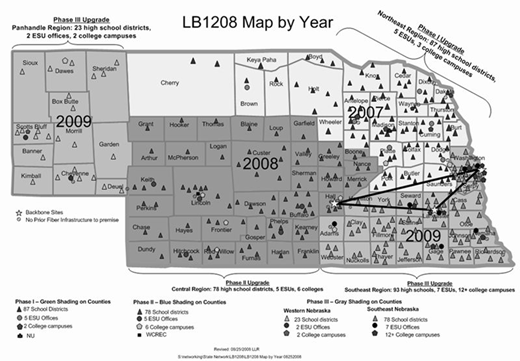
The authors are happy to report that, at the time of this writing, 100% of the southcentral Nebraska institutions (83 school districts/ESUs and 6 colleges) are in the process of joining the network in the summer of 2008. The Phase I upgrade, summer of 2007, saw 100% of the northeast region (92 school districts/ESUs and 2 colleges) join the network. The third and final phase, consisting of over 100 schools and colleges in southeast Nebraska and the panhandle, will join the network in the summer of 2009 (see Figure 2). At project's end, Network Nebraska is expecting to have 100% of all its public colleges and public K-12 districts connected with high bandwidth fiber transport.
It's important to understand that "joining" the network is composed of three main obligations. First, each education entity must commit to a connection of 30Mbps or greater optical fiber for public school districts and 10 Mbps or greater fiber or fast copper Ethernet for nonpublic education systems and smaller colleges. This connectivity can be bid either by the CIO or the local entities, with specifications provided by Network Nebraska as taking them to a certified network aggregation point, one of three in the State. Second, each participant, regardless of size, must agree to assume its share of the Network Nebraska Participation Fee, about $200/month. And third, each participant must, regardless of geographic location, agree to assume its share of the Interregional Transport Fee to help interconnect the three LATA regions of the network, about $95/month (before E-rate). In comparison to other similar statewide networks, these costs are very modest and also represent a fully sustainable funding plan, with no outside or upfront assistance by any state entity.
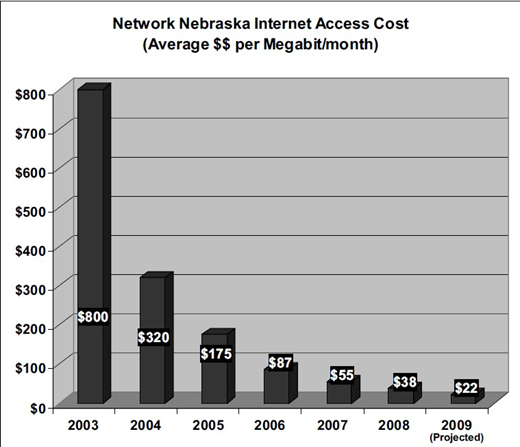
In addition, individual colleges or school district consortia may purchase Internet access off of the statewide contract, currently at $38/megabit/month for 2008-09. This per unit cost has decreased steadily and substantially since the first aggregated Internet access purchase in 2003.
What originally was considered by the network constituents as a funding weakness and lack of support by state government is now considered by the network organizers a determinable strength and more reliable funding model by not being dependent on unpredictable state general funds. With the network management and administrative functions fully funded by participation fees, the focus remains on the services and needs of the customers, partners, and end-users. The measure of success since the beginning of the network has always been “better services for the same or lower prices."
WHAT MAKES IT ALL WORK?
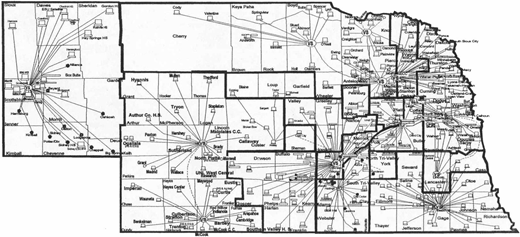
Network Nebraska, as Figure 2 suggests, is not a completely unique infrastructure. There are three large network aggregation points located in Grand Island (308 LATA), Lincoln (402 LATA) and Omaha (402 LATA), that act as the core routing and "choke points" for the Layer 2 network. All 300+ district and college entities belong to one of the three regional Ethernet clouds and are then routed through one of the core network nodes. The three-segment backbone, consisting of 500Mbps to 1000Mbps, then interconnects the three regions. The 28 Nebraska telecommunications companies all play a part in either the backbone transport or wide area Ethernet network. The Network Nebraska engineers, together with their public education partners, have collaboratively decided the approved routers and switches acceptable on the network; IP block addressing schemes; Quality-of-Service (QoS) routing protocols for different types of data; and an informal approach to network troubleshooting and problem resolution. As intented, the network has been extremely reliable since its first days of operation. ESU, college and Network Nebraska staff all share in the monitoring of individual sites' traffic and can, on a moment's notice, shut down a rogue location, if overtaken by viruses or malware. Videoconferencing traffic is prioritized from end to end through the various routing devices and regions to make sure that all multipoint conferences interact with very high quality audio and video with no degradation.
WITH AN EYE TOWARD THE FUTURE?
As with any technical innovation, it takes time for humans to adapt. Even with a statewide, IP-based network infrastructure, it will take time for end-users to discover its power and flexibility. For instance, it is still common for school districts to use only their one former static motion-JPEG room, even though they could be adding several more IP video devices at a fraction of the bandwidth. They will soon discover that they have bandwidth for many more uses and applications. Dan Hoesing, superintendent of four school districts in northeast Nebraska, may be one of those pioneers. In the first year of operation, Hoesing has purchased an additional 17 mobile IP video carts to exchange distance learning courses with his small rural school districts. He reports that they are on schedule to add an additional six carts for the fall of 2008, making a total of 27 distance learning rooms divided among four districts. Hoesing and his four high school principals report that they reached over 860 students each day of the 2007-08 school year with 57 different distance learning classes, and an additional 270+ college credits being earned through dual enrollment classes. Several of the high school seniors were enrolled in enough college courses to be considered full time. It's no wonder why Hoesing was selected as one of eSchool News' Top 10 Tech Savvy Superintendents for 2007. Hoesing's teachers all use Angel Learning Management to augment each of their video courses, which allows students and teachers to interact, exchange assignments, and conduct electronic assessments. The four districts are also experimenting with portable white boards on their codecs' data channel to further enrich the teaching and learning experiences. Dr. Hoesing reported that his four school districts recouped over $200,000 in distance education incentives in the 2007-08 school year to help facilitate further program growth and equipment investments.
Although Nebraska has a rich video distance learning heritage, the Partnership for Innovation (a K-16 consortium of Nebraska instructional officers) recently committed $150,000 in discretionary Perkins grant funds to purchase a 3-year institutional license from the National Repository for Online Courses (NROC). This promises to be Nebraska's first statewide venture into a virtual, online curriculum. The Nebraska Information Technology Commission and Network Nebraska are eager to partner with the Partnership for Innovation to help guide the technical deployment of these content servers. If done strategically, the National Repository for Online Courses courses can be joined by other commercial content on a very robust digital content repository, thereby storing, cataloguing, and retrieving teacher-produced learning objects.
LESSONS LEARNED?
So, when asked "What would you do differently if you had to do it all over again?", The Network Nebraska organizers would contend that the public partnering of K-12, higher education, University of Nebraska, and Office of the Chief Information Officer has gone about as well as it could possibly go. When all the involved entities have such a large stake in the game (i.e., network reliability, increased Internet demand, and finite financial resources), it's easy to stay focused on the ultimate goal; a statewide federated network. While the original LB 1208 legislation offered much in the way of incentives for participation, it did not allow much in the way of top-down control. Therefore, much of the development had to be participative and democratic. This worked well when deciding on a single make and model of router for each site on the network; it did not work so well when the same entities had to decide on a single codec make and model or even the same codec equipment configuration to be deployed. Setting up a multi-tier centralized help desk and trouble-ticketing system was resisted by the K-12 entities and dismissed as unnecessary. Still, school districts and ESUs have begun to trust Network Nebraska to act on their behalf. Success has bred more success.
WHAT'S NEXT on the AGENDA?
At the time of this publication, the Phase II conversion will have been completed and the Phase III Letters of Agency (Erate permission to enter into a consortium) will have been submitted. The interregional transport (backbone) bandwidth will need to be increased for 2009-10 and the statewide Internet access contract will have to be rebid. More work needs to be done to give the customers and partners a formal voice into how Network Nebraska is managed and maintained. And, once all the entities are on board and the network is fully deployed, more attention can be placed on new and emerging technology applications on the network and developing even more collaborative content relationships within and outside the Nebraska.
For more information, visit the following Web sites:
Network Nebraska: www.networknebraska.net
Distance Education Council: www.nebdec.org
Nebraska Information Technology Commission: www.nitc.nebraska.gov
Nebraska Office of the Chief Information Officer: www.cio.nebraska.gov
About the authors