INTRODUCTION
“If the industrial era nourished our physical being, the Age of Access feeds our mental, emotional, and spiritual being.”
–Jeremy Rifkin
The age of information, as ours has been defined, has knocked down space and time distance in all human activities: from politics to religion, from business to personal relations. And education, understandably, couldn't be left out. That is why, today like never before, the world of education is at a turning point, and, especially at an academic level, it needs to relate to the technologies of its age.
A new and diffused demand for instruction is forcing universities to rethink their organizational model. In order to do this, they have to elaborate and combine new languages, concepts, methodologies, and learning strategies.
Taking this into account, the University of Ferrara was one of the first in Italy to create new learning models and start distance education activities through CARID.
CARID
CARID, Research Centre Athenaeum for Innovation and Distance Education, is a multidisciplinary research and education structure that promotes innovation and the practice of teaching/learning through multimedia technologies on the Web. It is one of the most important realities in the development and delivery of distance education in Italy. The center offers courses at a distance for all graduate and postgraduate academic titles: degrees, postgraduate master's, specialization courses, updating, and professional training courses.
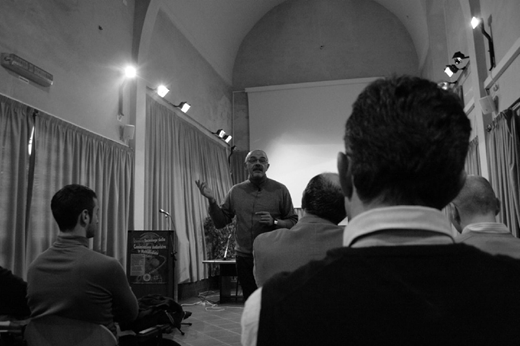
In order to better understand CARID, its activities and its future, we have interviewed Paolo Frignani, director of CARID since 1997 and Professor Giorgio Poletti, head of the educational design team of the structure. The main strength of CARID, according to Frignani, is
the fact that it deals with distance learning but mostly with teaching innovation. And distance learning is part of this innovation. Innovation which means the use of technologies in post-secondary education, in particular in the creation of courses, learning paths completely at a distance or the use of technologies as an added value to traditional teaching.
HISTORY AND PERSPECTIVES
Because in Italy CARID is one of the centers which has been operating in e-learning the longest, it has dealt with the profound changes that this educational model has undergone in the last 10 years. Professor Poletti explains how CARID has adapted to these changes:
I'd say that it followed the evolution of the interactions in the Web. We can't deny that the Internet has given the rhythm to the evolution of the interaction models and therefore of the educational models. The evolution can be summarized in the fact that it started as one-way and it became two-way, so when education used a one-way network you could send a fax, then a book, then a Web site with little interaction but the idea was "I send you something, you're the final recipient." E-learning was a tool but not a new educational model.
As it always happens, when computer science walks in, it ends up modifying the process which had evoked it and improving it.
By increasing the level of interactivity the e-learning model changes as the web does. E-learning tries to create education in the Web and not using the Web as a mere communication medium.
CARID is an extremely dynamic structure that, in the past, was able to adapt to constant changes. That is why we asked Frignani about CARID's future perspectives. He told us that it is right now
evolving into two separate structures which will work together: an "e-learning school," an athenaeum for distance learning which will manage distance and blended education, and "CARID lab," which will essentially have a research purpose on the diffusion of new technology in a postsecondary context.
MISSION AND ORGANIZATION
The mission of CARID is to promote innovation in the practice of teaching/learning models. In particular, CARID has two main objectives: first, “to analyze the methodological and technological aspects of distance education through research and publishing" and, second, “to manage university courses experimentally in a distance modality (integrated with full time traditional activities such as seminars and labs) in collaboration with education, technology and content experts" according to Poletti.
In CARID, the staff is divided into two units, each composed of two team members:
Research Unit
Team A: communication experts involved in training and supporting coordinators and tutors and in analyzing the methodological aspects in research activities.
Team B: instructional designers and programmers in charge of developing the technological platform which supports the learning activities and of developing new models of personal learning environment (PLE)
Operative Unit
Team C: coordinators and tutors who manage the learning activities.
Team D: system analysts and multimedia content producers involved in the management and archive of contents on the platform.
E-learning courses are therefore the result of different professionals who cooperate in order to create efficient and effective learning environments.
THE OPERATIVE MODEL
The operative model of CARID is based on the distance management of five essential elements: design, production, delivery, tutoring, and assessment
DESIGN
The design phase of the courses involves many people who work in team. The group is made up of education experts specialized in different subjects and experts in communication systems and data elaboration. In general, during the design phase the objectives and target learners are defined; the learning strategies and the technical solutions to be adopted follow together with the time to be reserved to individual support.
We asked Poletti how he structures an online module:
It depends on the students and on the level of elaboration it requires. There is usually a first part in which we organize all the paper documents and consulting material, a second phase related to the interaction through a video-lesson, or chat or other synchronous tools and a forum phase which maintains the attention and leads the students.
PRODUCTION
Content experts coordinated by a scientific area manager are in charge of defining the cognitive fields of the learning units and deciding on the tools (printed text, audiovisual support, digital documents) necessary to content delivery.
The development phase consists in preparing the materials needed to carry out the courses. This task is carried out by teachers and researchers who have skills in both distance education and their subject matters.
The objectives, the content, and the procedures are selected and defined in detail together with the timing. The materials are then gathered through tools of exploration and learning of cognitive fields, tools of content delivery, multimedia tools, and assessment tools.
Poletti describes the main difficulties in preparing a learning model destined to online delivery: "It is a problem of adequate time availability for the learning production because if a 1-hour lesson means an hour and a half preparation, to prepare a learning object I need 5, 6, 8, 10 hours of preparation.”
DELIVERY
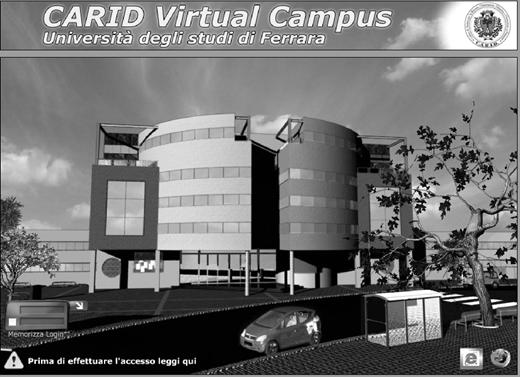
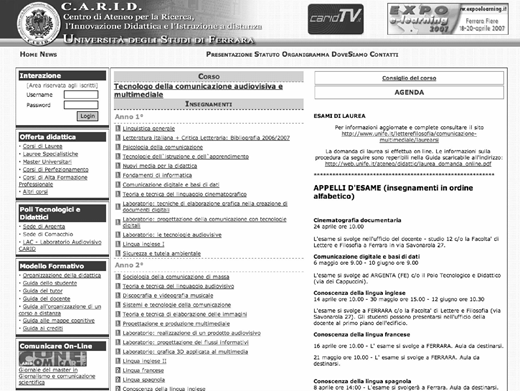
Learning activities managed at a distance are based on the use of a technological platform that the students access through a Web site. The model of distance education applied in CARID and implemented in the online platform is characterized by asynchronous communication among those involved in the learning process: users, tutors, and content experts. The platform is only accessible to them through an identification form: the online user is presented with a general page on the course organization, containing the links to general documents (initial quiz, general forum, news, general info) and the links to the pages of the single subjects; these contain the links to the contents, the exam organization, and to the structured forum.
Printed units are used to lead in the exploration of the cognitive context of the subjects and are integrated with other resources organized in Web pages, interactive hypertexts and hypermedia, and bibliographies.
Assessment and self-assessment is based on a number of questions (generally 25) which match four short answers: each online quiz is immediately followed by the communication of the result on a Web page that includes feedback on why each answer is or isn't correct.
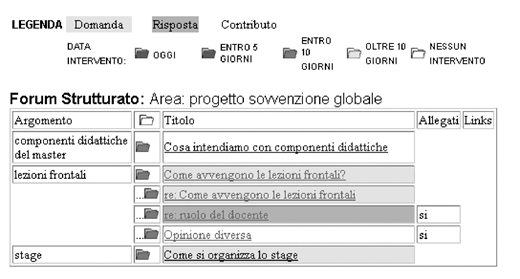
The structured forum is a fundamental tool of asynchronous interaction on the Web among students, tutors, and teachers: it allows users to not only define the title and text of the question, but also to monitor contributors and their exact moment of participation by selecting a topic from the course menu. Because of this organization, each contribution is placed in the correct position within the course context, and because it easily traceable, it optimizes the organization of knowledge gathered through the use of the Web.
We asked Professor Poletti to further deepen the aspects related to the use of the platform by the teachers.
We have a double plan because we have a convention which links the University of Ferrara to the technological pole of Argenta for distance courses and the use of a proprietary platform naturally means that some activities need to be adapted to what this offers, a sort of compromise. On the other hand for both traditional and distance courses we manage and test a series of LMS systems and open source modules mainly toward personal learning environment with the possibility of learning environments in which teachers and learners access to those modules they're interested in.
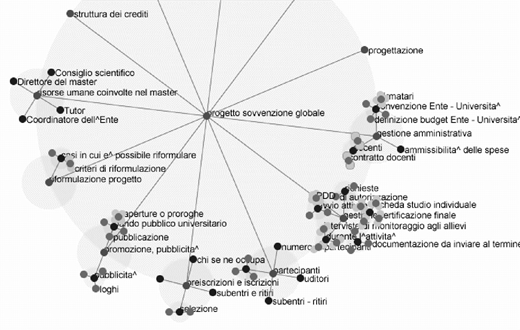
The use of e-learning technologies tends to elevate the level of structure of the cognitive contexts through cognitive maps related to the different courses, which have the double function of communicating the main relations of the subject and of supporting them through forums and quizzes. In other words, the current pattern of navigation inside the single courses is characterized by the presence of option menus, destined to evolve toward a cognitive map in which assessment, contributions, and forum participation can be linked and be visited, at the level of single topic in the learning context; this development entails higher quality in the organization of knowledge and in the definition of the internal logical connections in the cognitive field, providing flexibility, thanks to the possibility, exclusive to the dynamic systems of information such as that adopted by CARID, to easily modify the structure of connections.
In this direction the distance learning platform follows these guidelines supported by innovation in hardware and software:
Knowledge is organized in cognitive maps in which the contributions are constantly updated, whether produced by teachers, experts, tutors, or users, in the form of resources, links, and forums.
Documents are written through digital tools that require the progressive definition and differentiation of a new interactive and multimedia language, characterized by certain grammar and symbols.
Learning is customized and registered by structuring and transmitting the contents within structured maps. Tools, modules, and personal contributions are registered in the data warehouse of distance education, allowing tutors to deeply analyze the educational process.
These three lines come together in CARID in the design of an e-learning platform that answers to the diffusion of a structured communication culture, in relation to the potentialities offered by the current technologies.
TUTORING
Each student can rely on adequate services of support and educational assistance that builds the interaction process by eliminating the condition of physical distance. Learning assistance is provided during the entire learning path through appropriate communication media and face-to-face conversations. Qualified and competent staff carry out the function of "tutor" who not only provide general technical information, but also detailed information on the contents of a specific course.
To better understand the function of such an important figure, we have interviewed tutor Alessio Pellegrini, who answered in this way to the question on his activities toward the learners:
It depends on the academic year. At first we do orienteering, we answer e-mails and phone calls to provide information on the courses. Then we organize the initial seminars. Then just before the beginning of the lessons we give learners access to the platform and allow them to familiarize with it in order to solve the main problems and show how the course works. During the year we organize internships, labs and seminars, providing answers to possible doubts.
Pellegrini adds that on these occasions the relation with students becomes informal, and
it gets easy to understand problems especially when at the beginning it's difficult for them to understand how courses are managed and the university system in general. As they go on they solve this problem connected with distance. We try to help by organizing seminars and labs where study groups are created and sharing occurs. This kind of relationship is encouraged in appropriate spaces in the platform.
ASSESSMENT
In distance education, maybe more than in other learning situations, it is necessary to constantly assess learning activities and the participation of students. The evaluation system implemented in CARID provides constant information through an initial analysis of the characteristics of the students, a constant monitoring of the mandatory and spontaneous interactions in the forums, intermediate tests, and final verifications.
In order to fully understand the evaluation model used in CARID we have asked Poletti, who tells us:
Until now we have had two separate evaluation methods according to whether they were for graduate or postgraduate courses. For degrees there are formally three evaluation moments: interaction through a forum during the entire length of the course; a self-assessment stage through structured tests with an immediate feedback; a final written or oral face-to-face examination.
In master's there is a triple evaluation: one on the interaction on the web, (forum participation, language use, interest in the topic) which carries about 20, 25% of the final score, one on a series of timed tests on the web, and the third phase of a more traditional final exam in presence which carries about 50% of the result.
CARID has progressively acquired and consolidated the necessary technological and methodological skills and tools for the management of e-learning courses for each of the phases described.
ONLINE STUDENTS
At the end of this analysis the question is how the students of CARID deal with online learning, on how they use the interactive tools made available by the structure and what kind of relationship they have with the other actors of the e-learning courses.
An interesting consideration on the relation between online teachers and students is offered by Poletti, according to whom:
distant learners are the most present ones. The relationship with them assumes a continuity which is rare with students in presence. Traditional students know that the lesson is the topical moment and if there's a reception room they come to ask for explanations but they see these moments as the direct support to their learning and they have books at home. Distant students have instead the idea that they should be somehow supported so usually we use continuative relationship devices such as emails.
In order to better understand the point of view of the students, we spoke with Enrico Margotta, enrolled in the second year of the degree course “Technologist in Audio-visual and Multimedia Communication," who told us about his learning experience. First, we dealt with the relation between students and teachers:
The relationship with students is a little particular because you don't see them every day. When it happens that you meet someone who you've seen at other exams, then you chat, you get to know them. Otherwise it's hard to have a strong relationship. With teachers, it depends; generally they're very helpful.
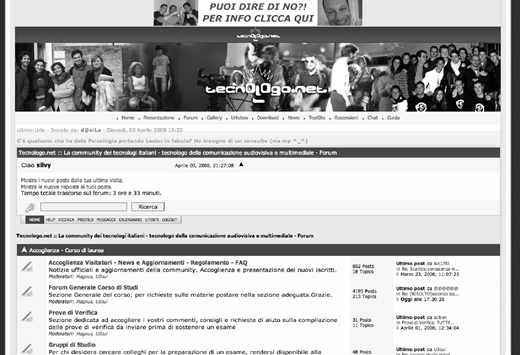
The next point was on the tools that are used daily. Margotta told us that most of the activities are carried out on the platform but that he also finds the site www.tecnologo.net very useful to share information and materials on the degree course with other students.
Tecnologo.net is a virtual community created by and completely managed by students and doesn't have an administrative link to the University of Ferrara. Students exchange information and material to easily deal with the learning activities. They also organize face-to-face moments out of learning obligations.
THE INNOVATIONS OF CARID
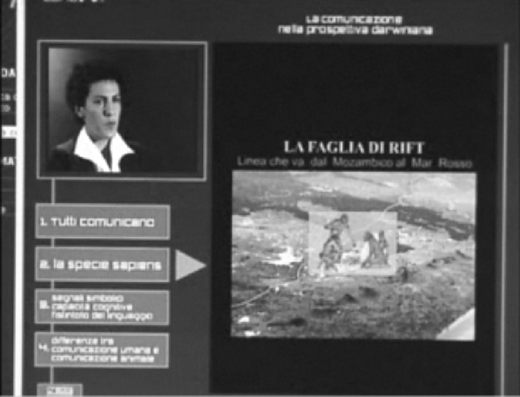
A fundamental part of the activities of CARID is research and educational innovation. An example of such activities is the latest success of CARID: CaridTV. The idea of this new application is explained to us by Frignani: "We tried to put together and use not only computer science but also video in the management of distance courses for students in order to create a television format which is highly interactive.”
In order to comprehend how this application will be used within the teaching model of CARID, Professor Poletti tells us about how he is working to implement this tool within his courses and which are the main difficulties:
At this moment we are still designing CaridTV, we haven't used it within a course, except for spot interventions, to introduce some seminars but we haven't integrated in our course yet. I'm thinking of using it synchronously for documents, that is giving the chance to provide handouts in the moment I'm discussing them, sort of like what happens in class.
Thanks to the project CaridTV, CARID has recently won the prize Aldo Fabris with the following notation: "The project allowed CARID to develop a university web-tv 'Carid-tv' able to implement and deliver multimedia learning materials, enabling the audience to access a variety of personalized learning paths." [Note: At its sixth edition, the Prize "Aldo Fabris" intends to point out universities, schools, companies, public administrations and people who have created and developed learning projects which are marked by impressive results in learning obtained at an individual, team and organizational level through the promotion of the growth and development of the people and working communities.]
CONCLUSIONS
The origins of the success of CARID, says Frignani, are in "having believed in e-learning" and in “having created a degree course which has a double objective, that of being innovative and it is still today the only one in the National area, and that of being completely delivered at a distance.”
CARID understood the importance of some fundamental concepts in e-learning, but today the world view of e-learning is changing: the enormous interest in interoperability of platforms for content exchange, the development of new technologies of document management opens the way to a modular classification of the cognitive supports, which is a true base of sharing and integration. Research in CARID is aimed at giving value to its great assets of contents in relation to their structure and interchange with other organizations in the field.
About the authors