INTRODUCTION
Higher education is moving more toward using distance delivery systems with every term. Faculty members are being expected to convert their courses to either completely online or at least partly online delivery. This transition places faculty and students under tremendous pressure to accomplish the same learning objectives by using many different strategies than were previously used. Current faculty have varying degrees of comfort with the technologies which are used to deliver education at a distance. Current students in nursing programs have for the most part experienced only or mostly face-to-face lectures. While most of today’s higher education students have become comfortable interacting with supplemental online materials, they have not usually been totally dependent on distance education methods for content delivery.
As distance education delivery permeates higher education, faculty and students must become more skilled and comfortable with these methods in order to enable a successful educational experience.
Meeting different learning needs of students is a challenge that faculty face no matter what delivery system is used. The educational system relies on instructional resources that require reading. But the generation of students entering higher education now has grown up in a world oriented to visual information. They watch videos, television, and movies. They access videos on the web. Some even make their own videos and upload them to the web. This is clearly not the same type of student that existed when the current faculties were undergraduate students.
This article is aimed at describing the experiences of nursing faculty who were “challenged” to reduce the number of face-to-face hours of class time and replace them with online course delivery for an undergraduate nursing course: Nursing Care of Women, Children, and Families.
Review of Literature
Chickering and Erhmann (1996) specify seven principles of good practice for undergraduate education:
Encourage contact between students and faculty;
Develop reciprocity and cooperation among students;
Encourage active learning;
Give prompt feedback;
Emphasize time on task;
Communicate high expectations; and
Respect diverse talents and ways of learning.
These recommendations emphasize the importance of active learning. Students must interact with the content, apply it, and make it part of themselves in order to learn. The most effective instruction is that which gets the learner actively involved. Merely sitting and listening is less effective than engaging in some type of active learning exercise.
The nursing curriculum is densely packed with information that is new to the average student. One of the challenges of nursing faculty is to help learners master as much information as possible in a limited period of time. This includes new vocabulary, physiological processes, and nursing care.
Nursing students must master text information that must be read from textbooks and professional journals, and develop a deeper understanding of the process of nursing care. In order to assist the learner to achieve this level of mastery, learning research has found that presenting information in a dual mode is helpful (DiGiacinto 2007). Multimedia is ideally suited to delivering information using dual coding. Using visuals with synchronous narrative is the preferred delivery method for novice learners in order to minimize cognitive load. Mayer and Anderson (1992) found that students who watched animation as they heard narration did better when solving transfer problems than students who were exposed to these as separate experiences. DiGiacinto (2007) found that learners can perform more problem solving when the information is presented to them using narrative form accompanied by animation rather than text accompanied by animation.
Online video can also increase access to course resources. This is especially true for students who face challenges to attending class in person or those who want to relisten to lectures. A study of undergraduate nursing students in South Australia found that having access to video streamed lectures enhanced their learning. They watched the videos to review previously attended lectures, to prepare for exams, and view lectures that they had missed. They also watched the lectures to prepare for class and exams. They appreciated the ability to rewind back over areas of content that they needed to review to increase their understanding (Bennett & Glover, 2007).
Faculty who have converted nursing courses to online delivery and instruction have found that they had to devote a significant amount of time to learning to use the technology. Brown found that online instruction required about 40% to 50% more instructor effort when compared to traditional classroom delivery (Bennett & Glover, 2007). Learning the technology along with teaching the online course greatly increased the workload (Brown, 1998).
Background
The faculty who teach the Nursing Care of Women, Children, and Families course at a major nursing school were instructed to convert their traditional face-to-face (web-enhanced) course to online delivery. This was a result of a state of the university address by the university president in 2008, in which he stated:
Deliver a highly integrated, technologyinfused curriculum that is reflective of and responsive to the evolving learning styles of our students. We must emphasize innovation in the delivery of curriculum with a focus on diverse learning styles and clinical competencies for the twenty-first century. [The college]—working collaboratively across school and departmental lines—must continue to develop and deliver a nimble, technol-ogy-infused curriculum that is reflective of the needs of multigenerational learners—baby boomers, Gen Xers, and the Millenials. (Rahn, 2008)
This course is taught at two campuses, utilizing videoconferencing technology for cross-campus lectures. During the past several years, course materials such as the course calendar, syllabus, and assignment guidelines have been available on the course management system (CMS). Otherwise, instruction has been in the traditional face-to-face lecture. The content of the course has been delivered by face-to-face lecture and assigned readings in the textbook.
The New Course
Due to the limited time for development and the predilection of the students to expect lecture delivery, it was decided to make audio lectures available to them from their CMS in the course web page. Most of the lectures were recorded using a combination of Audacity and PowerPoint. A few lectures were recorded using the software Tegrity.
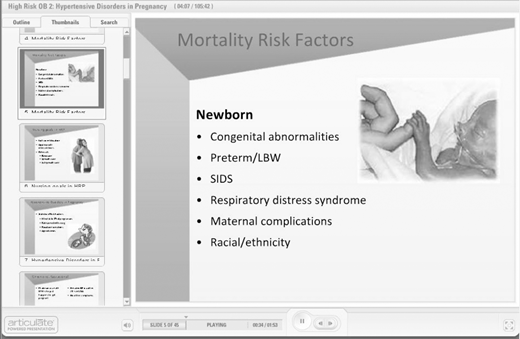
The instructors recorded each PowerPoint slide’s lecture notes as a separate audio file using Audacity. Both the PowerPoint file and all of the sound files were sent to the instructional technology (IT) department for processing. The IT staff used a software package called Articulate to “marry” these files together. Articulate converts the files to shockwave files. This process enabled them to upload the resulting product to the CMS course site, where the students could access and listen to the lectures at their convenience. Students loved the ability to select certain slides on the left side of the screen and listen to just those slides. This enabled them to replay these slides for review prior to exams (Figure 1).
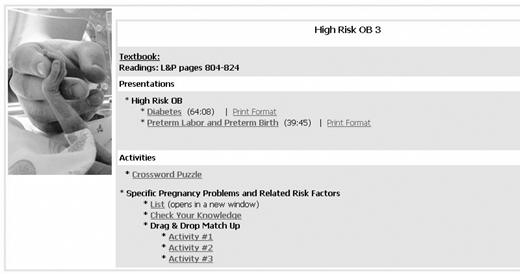
As supportive documents, PowerPoint Notes in PDF form were also available for students to print and use if desired. The links to these were next to the links to the lectures (Figure 2).
Students could click on the links to lectures and print out the handouts to use as they listened to the audio lecture. The required readings were listed on each module as well. Links to the activities were listed at the bottom of each module (Figure 2).
Good instruction also includes strategies to get the learner active in the learning process (Chickering & Erhmann, 1996). This requires special techniques when teaching by distance. To increase the learner activity, several activities were developed for each of the learning modules. Examples of these are crossword puzzles, matching games, Jeopardy games, and concept maps. The faculty created some of these using free programs such as Hot Potatoes. Other games were created by faculty collaborating with the IT specialists.
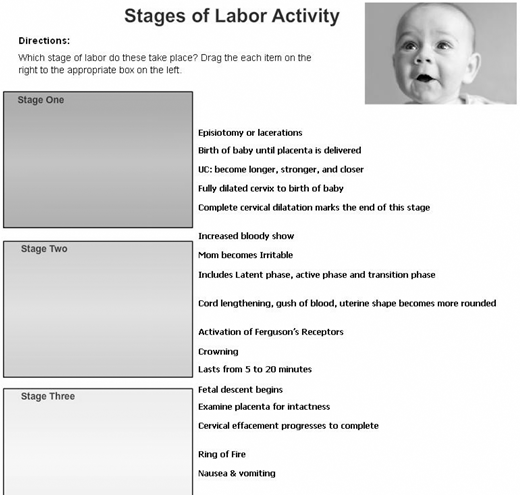
Crossword puzzles help the students to learn the specialized lexicon of the nursing field. Matching games and games requiring that they place items in the appropriate “bucket” enable the students to test their understanding of processes (Figure 3).
To increase the visual appeal of the material, appropriate videos are linked to the learning modules. These videos were chosen to visually represent processes that are often difficult to grasp and have in the past been depicted using video. For example, several videos depicting animated childbirth are available from the module that covers labor and delivery (Figure 4). Good sources for these videos are Google Scholar or YouTube. The recorded lectures are enhanced with well-chosen graphics and previously created learning objects.
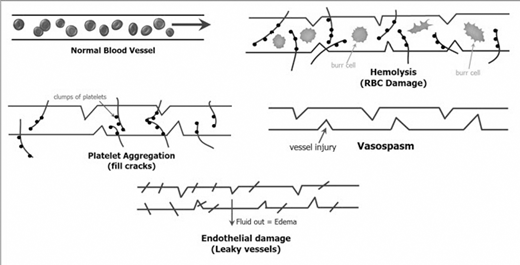
In the lecture on complications of pregnancy, a graphic depicting the HELLP syndrome was created by one of the faculty. The HELLP syndrome is a specific rare condition that occurs during pregnancy. This graphic is included in the PowerPoint slide on which the HELLP syndrome is discussed. Also, an interactive game was created using this graphic (Figure 5).
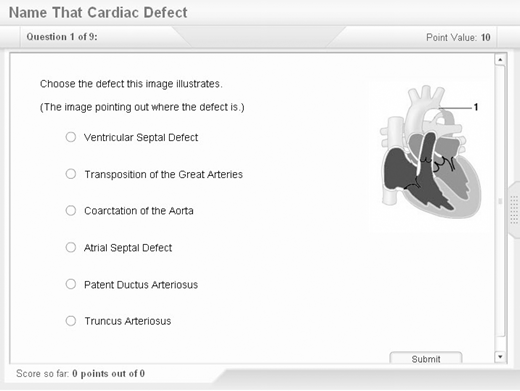
Another game was created which enabled the students to test their understanding of the common congenital heart defects that are seen in pediatrics. A graphic of the defect is shown and the students select the correct name out of a list. Students receive feedback whether they chose the correct or incorrect option (Figure 6).
Outcome
Most students have had favorable reactions to these new resources. They state that the games were a welcome change of pace from just reading the textbook. The games also gave them a chance to test the degree to which they understood the material. Several students commented that this course site was the best-organized site that they have experienced in their program experience.
Conclusions
Teaching in the online environment requires more time than traditional methods (Bennett & Glover, 2007), and a collaborative team to guide students through a successful experience. The faculty must preview all linked resources to make sure they are appropriate. For example, videos on sites like YouTube must be previewed to make sure they meet the educational objectives, don’t contain objectionable content, and remain available for the course. Faculty must have access to IT specialists to help design and develop a visually appealing and easily navigable course site.
Ideas for interactive activities were inspired by experience in previous terms helping students learn challenging concepts and processes. For example, during test taking, students have demonstrated weaknesses in knowing the course vocabulary. This inspired the creation of the crossword puzzles. On previous exams, students often had trouble answering questions on the HELLP Syndrome. This inspired the creation of the HELLP Syndrome activity. The graphic originally was drawn on paper and shown to the face-to-face class using a document camera. This graphic was duplicated using computer software and converted to a learning object.
Making this conversion to mostly online delivery required many more hours of the faculty than the hours needed for face-to-face delivery. One faculty member had never created a PowerPoint presentation. This faculty required a lot of instruction and support to learn how to use PowerPoint and Audacity. The files for these lectures were too large to e-mail to the instructional designers and had to be divided into smaller files and compressed to be acceptable to the e-mail system.
Creating the activities was a collaborative effort between faculty and the instructional designers. Since more than one group was involved with getting these resources online, the process took a week or more to create and get uploaded on to the course website for each activity. For this first offering of the redesigned course site, the goal was to get the module materials loaded in time for their scheduled appearance in the course calendar. For future offerings of this course, faculty will have time to fine-tune and increase the number of activities for the students.
The Internet is a dynamic environment, so course sites that rely on it for some of their content must be dynamic as well. Online resources such as Internet links must be rechecked periodically to make sure they still work and they are still there.
Designing activities and recording lecture may sound difficult, but this course design is well within the skills of most faculty members, and is worth the additional effort.
About the author