Learning Theories and Pedagogical Practice
In this article, socioconstructivism and, more recently, connectivism are acknowledged as the learning theories that most influence our information and communication technology (ICT) pedagogical practice as e-learning course deliverers at Fernando Pessoa University.
Constructivism is based on basic principles such as: knowledge is not transmitted, but constructed actively by the student; learning is, simultaneously, an active and reflective process; the interpretation that students make of the new experience is influenced by their previous knowledge; the social interactions introduce multiple perspectives in the learning process; learning requires the understanding of the whole as well as of the parts, and these will have to be understood in the context of the whole. Consequently, learning must be centered on contexts and not on isolated facts.
If constructivist theory considers that learning is an active process of knowledge construction, as a result of the interaction of man with the environment, in this context, the tutor participates as a facilitator or stimulator of the learning process. The e-learning projects, which adopt this model, generally allow students to learn from a basic content that will have to be reconstructed in accordance with their previous luggage and rhythm. Students are stimulated to appeal to their own resources to carry out the proposed tasks. In this model, the hypertext resources, simulators and collaboration tools (chat, discussion, forums, whiteboard, wiki, etc.) are some of the main tools of computer science that can be used in distance education (Schlosser & Simonson, 2002).
However, the increasing complexity of knowledge, as well as the rise of educational networks gives origin to a social constructivist approach, which considers generic skills of collaboration, problem solving, and creating new knowledge as very important goals. Finally, connectivism, a new learning theory proposed by Siemens (2004), is characterized by the “amplification of learning, knowledge and understanding through the extension of a personal network.”
In accordance with this theoretical background, in this article I shall focus on instructional practices that tend to replace learning models based on individual learning by those based on cooperation and aiming at acquiring basic social competences and, especially, communicative strategies, social abilities, negotiation, and leadership skills. Likewise, these experiences seem to prove a shift in the role of the teacher, changing from being a mere contents transmitter to a learning adviser who facilitates the access to information, its transformation into knowledge, and its practical application to new changing contexts (Garrison & Anderson, 2003; Moore & Anderson, 2003).
More specifically, I shall refer to two different occasions where the wiki, a Web 2.0 learning tool, was used in language classes: a class of intermediate Portuguese for college students whose mother tongue is Spanish, and a class of Portuguese communication techniques for Portuguese students. In the first class—nursing undergraduates—learners were divided into small groups and were instructed to create a glossary of health and medical terms. In the second class, a postgraduation course for nurses, students were asked to write branching stories, in which readers actively participate in the story plotline.
Wiki—Web 2.0 Learning Tool to Promote Collaborative Work
Nowadays, language instructors can benefit from the affinity of learners for social networking through a wide range of Internet tools to promote those skills in an educational setting in order to maximize student-student interactions outside the classroom.
As a Web 2.0 tool, wikis can be generally described as collaborative websites in which information can be rapidly added, modified, or deleted. Extrapolating this practice to the classroom, several positive pedagogical applications and benefits can be achieved: wikis can be used as writing practice exercises, allowing both individual work and group work.
One of the greatest advantages of a wiki lies in its collaborative nature; that is, students share a common goal and each one feels the need to contribute with his or her best to a project. Thus, students do not compete. On the contrary, they collaborate, enhancing mutual help and solidarity. It also allows the development of accountability, since each student knows that others and the final product depend on his or her contribution.
The use of wikis relies on the notion of learning as a social process, which, as such, takes place when interaction between teacher and students, but also among students, is intensified (Alexander, 2006; Ebersbach, 2006; Peña-López, Córcoles, & Casado, 2006).
Methodology
The general purpose of this article is twofold: (1) to examine learners’ perception of possible advantages in the use of wikis in language courses and (2) to examine learners’ perception of the quality and quantity of collaboration that wikis do, in fact, promote.
The pool of participants for this study considered 27 Spanish college students from several third-year Portuguese language classes (winter term 2007) (Experience 1), and 18 Portuguese postgraduate college students of a Portuguese communication techniques class (spring term 2009) (Experience 2). Every class had the same instructor.
The students were familiar, from the beginning of each course, with the collaborative platform, Sakai, used as a complement to onsite classes, since these were blended-learning courses. They were asked to use the wiki tool inside the platform. (Note: The Sakai project develops and distributes the open-source Sakai CLE, an enterprise-ready collaboration and courseware management platform that provides users with a suite of learning, portfolio, library and project tools: http://sakaiproject.org/portal. The Sakai platform has been adopted at UFP-UV–Uni-versidade Virtual, since 2004: https://elearning.ufp.pt/portal)
The Experiences
In both experiences, learners were asked to form groups of four to five members.
For the glossary project, one purpose of using a wiki was to promote collaborative work. Students were not competing, since they were not doing exactly the same thing, but each student knew he or she was contributing to a common project and the fulfilment of the project relied on each student’s participation. This strategy increases, in every student, the notion of accountability, since each one is responsible for part of the work, and nobody wants to be to blamed for the failure of the project. Additionally, using a wiki, each step of the work is shared by everybody involved (teacher and students). Consequently, the work of each student is perceptible, not only to the teacher, as often happened in more conventional teaching strategies, but also to their colleagues.
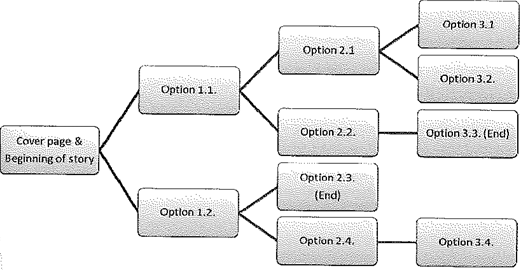
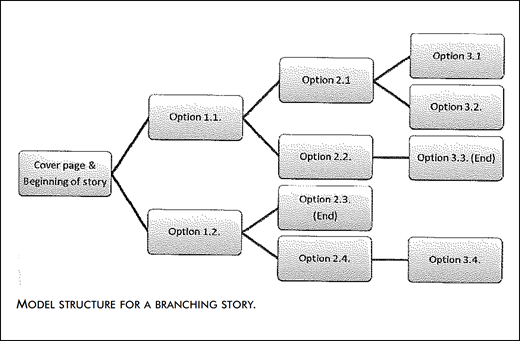
In Experience 2 learners were given time to brainstorm ideas for the main plot of their story. Figure 1 shows the blueprint that was shown to the students as a model structure for their branching stories.
In a branching story, the reader begins reading a story but does not progress page after page until reaching the end of the narrative. Rather, the reader is constantly presented with a series of choices that determine the outcome of the plot. Thus, although one can certainly talk about sequentiality, it would not be correct to characterize it as linear.
In fact, each selection the reader makes will take him or her to a random page in the book. This wiki branching story begins with an initial paragraph, which includes in itself the first set of internal links from which the reader selects one to set the next action in the story. Each choice the reader makes will take him or her to a new entry and then a new set of choices is presented. Besides promoting collaborative work, another major purpose of this work was to practice narrative skills inspired by episodes of students’ professional experience.
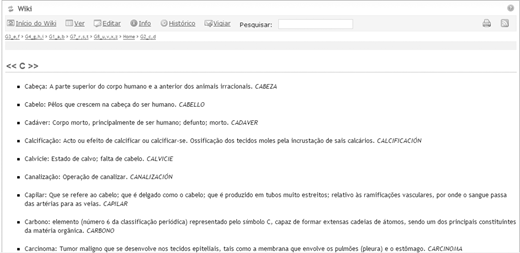
In both experiences, the duration of the project was one month. Each group had 2 weeks to prepare a first draft. Then, corrections were gradually included according to the instructor’s comments. Figure 2 shows a screenshot of part of the page of one group for the glossary.
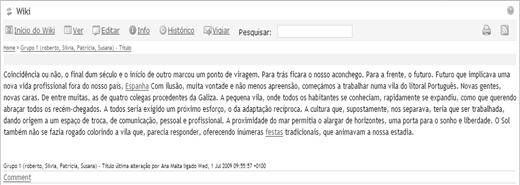
Figure 3 presents a screenshot of the first page of the branching story created by one group (the first set of choices available to the reader appear as hyperlinks).
Participants filled out an online questionnaire on their perceptions about their linguistic gains with the experience as well as about the success rate of group work interaction while working on the wiki project. There were nine questions, for which the possible answers were strongly agree, agree, neutral, disagree, and strongly disagree:
I enjoyed participating in the wiki project;
The wiki project was a learning experience;
My group colleagues and I collaborated well together;
I would have preferred individual work;
I was able to use the target language and what was covered in class (grammar, vocabulary, cultural contents);
I consulted/checked with resources other than our class textbook to figure out language specific questions (grammar);
One of the students in my group (that can include you) took over a leadership role;
Everybody in my group was equally involved in the process and the creation of wiki content; and
My group was successful in creating an informative webpage.
Results
According to the responses to Questions 1 and 2 on the learner’s opinion about the learning experience, more than half of the participants (62%) enjoyed participating in the wiki project and over three quarters (78%) claimed to have learned something as a result of their participation in the project.
Questions 3 and 4 fell upon students’ perceptions of the collaborative nature of the task. The answers to Question 3 reflect that 85% of all participants think that they collaborated well with their colleagues, while question 4 indicates that nevertheless, 32% of the students would have preferred individual work.
Questions 5 and 6 aimed to find out how useful the project was to enhance participants’ linguistic skills. An overwhelming majority (92%) stated that they were able to use the structures and content that they had been learning in class for the development of their wiki. A similar number of students confirmed that they had sought help from external sources to edit their wiki.
Questions 7, 8, and 9 tapped into participants’ perception of how well group work was divided among team members. Responses showed that more than two thirds had a leader in the group who divided up the work and made sure that they were on track and complying with the set deadlines. In reply to question 8, a large majority of students declared that the work was well divided among group members. Finally, an even larger majority of participants considered that they were successful in generating a quality end product.
Conclusions
Given the answers to the questionnaire, as well as the products achieved, these wikis proved to be positive learning experiences in general terms: participants enjoyed working on a project in which they could use their language knowledge, in a flexible manner and have the cooperation and comradeship of their colleagues. In terms of gains in linguistic knowledge, students replied positively to the possibility of using grammar structures and content that they had learned in class.
Regarding the social and collaborative aspect of the project, the majority stated they had worked well together in groups, although a considerable number of students declared their dislike for group work. This relative discomfort with working collaboratively may be linked to the fact that some students do not like to depend on others, considering different levels of knowledge and commitment or different paces. Also the fact that the instructor assessed their final product with one group grade only may have been felt unfair by those students who may eventually have put more time and effort into the project. These may have felt that the grading system was not fairly evaluating each participant’s contribution.
About the author

Acknowledgment:
The support from Fundação Fernando Pessoa and Nova Southeastern University is gratefully acknowledged.