Introduction
The intersection of learning and technology has complex implications for gender. The relationship between technology-driven learning modalities like online and hybrid courses in postsecondary education and academic performance is a topic of great study and also great speculation.
If, as many researchers and authors believe, women learn differently than men, then they excel in different learning environments from their male counterparts. Hybrid courses are uniquely positioned to take advantage of the perceived inherent strengths of the way women are thought to learn. But all hybrid courses are not created equal. Different types of hybrid structures need to be recognized, researched, and analyzed to determine implications for gender and recommendations for use in an effort to increase the achievement of women learners. Presented here are four models of hybrid course structures for investigation, adoption, and research.
Women as Learners
Do women have unique characteristics as learners that might have repercussions for effective online and hybrid course models? Popular beliefs about women as learners include the theory that women have a predilection for subjective and affective learning methods. A second popular belief postulates that women learn in a relational manner, focused on drawing connections (Hayes, 2001, p. 38). This second theory would indicate that women might be predisposed to excel in online environments that espouse social constructivism, as many contemporary learning management systems do.
Indeed, recent research in brain functioning may support this theory, as findings of a 1999 study by Hales indicates that “more parts of women’s brains are active in certain cognitive tasks than in men’s brains.” This evidence has been used to suggest that women’s brains are therefore more connected (as cited in Hayes, 2001, p. 38). Though final conclusions regarding this supposition are not yet widely accepted, it does provide an interesting basis to support the theory that women are uniquely positioned to be effective online learners. This suggested aptitude necessitates a new look at the design of hybrid learning environments to maximize the achievement of women as adult learners.
Women and Online Learning
Much has been made of the assumed disadvantage of women when it comes to technology-formatted education. This disadvantage was attributed partially to studies conducted in the late 1990s which subsequently spread to become the academic equivalent of an urban legend.
More recent studies indicate that this assumed disadvantage is virtually nonexistent. In a study on gender differences in performance in online environments conducted over the years of 2002–2004 with 1991 learners at the Open University in the United Kingdom, results indicated that “women’s access to technology and enrolment in the online version of the course was comparable to men’s” (Price, 2006, p. 353). Conversely, the study found that women were significantly more academically successful in the online version of the course than were their male counterparts, with a greater percentage of women than men completing the online course. Additionally, women were “twice as likely to pass the online version” (Price, 2006, p. 353). These dramatic findings—regardless of whether they can be attributed to women’s presumed advantage for “connected” learning—inform and expand our understanding of the success of women in online educational environments.
This same study explored whether there were disparities in the access that women have to technology and the Internet. It found that women’s and men’s access was remarkably similar. The question then becomes, “Why do women achieve highly online?” This article explores hybrid models that may be even more effective in supporting women’s achievement in a blended learning environment.
Women in Hybrid Courses
Though there is a lack of conclusive evidence in research on women relating to hybrid courses, a recent study exploring gender, self-efficacy, and academic performance found that women in hybrid courses using online discussion modalities demonstrated higher self-efficacy than males, which correlated directly with academic performance (Lin & Overbaugh, 2008, p. 1006). Though the authors noted that “the overall effect size was small, so implications should be offered with caution,” these findings are consistent with other studies about women’s academic performance in online formats (Lin & Overbaugh, 2008, p. 1006).
There are many resources for effective online instructional design that could be correlated with the perceived aptitude of women for connected or relational learning styles, using instructional strategies like project-based learning, collaborative learning, and social constructivism. There are virtually no resources, however, associated with different types of hybrid learning experiences.
The discussion of the effectiveness of hybrid learning—and much of the research—is limited to the presence or absence of the two combined components that make up hybrid learning: face-to-face instruction and online instruction. But just as all face-to-face learning experiences are not structured in the same manner, and all online learning experiences are not structured the same manner, it is important to acknowledge that not all hybrid experiences are structured the same way.
What models could be created for effective instructional design of hybrid learning that would speak to the perceived strengths of women’s learning styles? The hybrid models proposed herein attempt to address just that.
Hybrid Models of Learning
The models put forward here are named descriptively. In practice, they can be customized to individual faculty and institutional needs and may be combined in logical pairings. Some are more suited to one subject area than another, though many subjects traditionally thought of as occurring in a highly independent way, such as mathematics, (which itself is more and more commonly being taught in a collaborative fashion) can be taught using these models.
The Flip Model
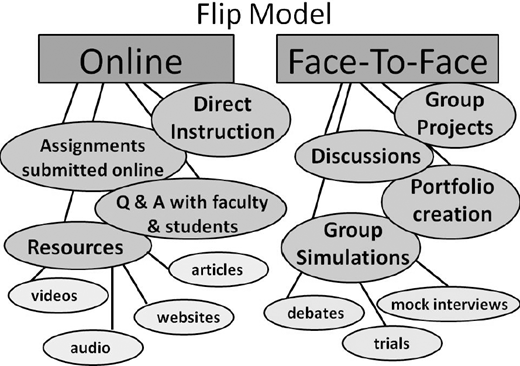
The Flip Model is best described as the reverse of a traditional hybrid course. Instead of lecture occurring in the face-to-face course, the online time is spent in direct instruction, with the materials and resources delivered via a variety of media formats including text, video, audio and animations. It should be noted that the online portion here is not intended to house lecture captures (video of instructors lecturing), but rather a range of robust resources that are delivered using the most appropriate technology. The online portion of the course also houses discussion forums for general questions, like instructor-led Q & A, inquiries about the details of assignments, and other instructional housekeeping particulars. Assessments—including quizzes, papers, reflections, and projects—are all submitted online.
The face-to-face portion of the class is reserved for group work on projects, engaging learner-led discussions, work on portfolios, analyzing case studies, and group skill simulations (e.g. mock trials, debates, interviews, etc.). The face-to-face time, then, becomes an environment ideal for connected learning in context; something at which women excel (see Figure 1).
This model is best used for courses that have the potential for a high level of learner-to-learner interaction, such as political science, sociology and psychology, performing arts, and literature. This model would also be effective for science courses in a lab setting, where learners work in groups on experiments or discussions of theory in person. It is also ideal for courses that require the creation of a body of work such as a comprehensive portfolio—courses like those in media production, digital design, and fine arts. The Flip Model is also appropriate for courses that require collaborative creation with individual reflection.
The Instructional Split
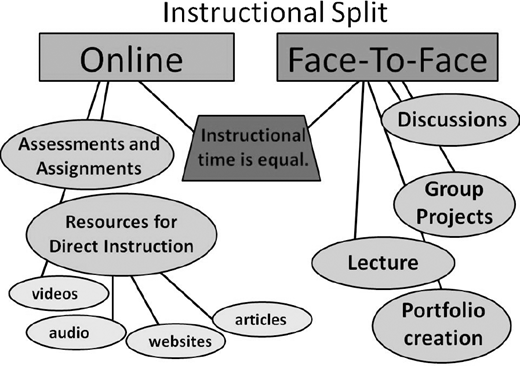
This model uses a ratio of direct instruction equal to the break of the model. So, if 30% of the instructional time of the course occurs face-to-face, then approximately 30% of the face-to-face class is spent in direct instruction (i.e., direct noninteractive delivery of information in any modality, most commonly lecture but also via other types of media). Therefore, in this example, 70% of the online time would be spent in direct instruction. The rest of the time not devoted to direct instruction would be filled with a variety of other instructional strategies and activities, including discussions face-to-face and online, assessments in-class and online, group projects in both environments, et cetera. In short, the activities and resources are determined. The time allotted to these activities and resources in the face-to-face and online environments is in direct proportion to the time commitment breakdown of the class itself (see Figure 2).
This model allows for a very integrated approach to the course, using collaborative activities, activities designed for the learner in seclusion, and technology-driven resources in both modalities. The type of activity or assessment can be in the modality for which it is best suited. For example, if in-class writing assessments are necessary, online assessments can be created and auto-graded by the learning management systems, thereby allowing instructors to focus their time on the higher-level, more integrated course objectives.
This model is best used for courses that require skill acquisition and skill application, interpretation of information, or have a need for a variety of assessments.
Online in the Classroom
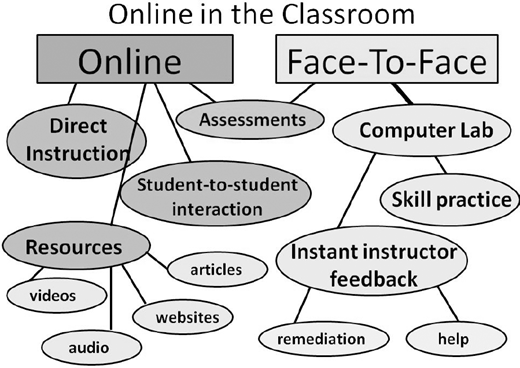
The Online in the Classroom Model requires the use of a computer lab for the face-to-face portion of the class. In this face-to-face lab environment, learners practice skills with the instructor present and available for immediate remediation. Assessments may also be completed in the face-to-face environment.
In the online portion of the class, skill practice can continue with additional web-based resources. Assessments may also be done online. The focus of the online portion, however, is generally the learner-to-learner interaction, which occurs almost exclusively online. A recommendation for structure is to include things like virtual study groups, where learners either practice skills together online or apply those skills in online group projects (see Figure 3).
Skill-based courses match well with the Online in the Classroom Model, along with courses that require access to software loaded on college computers. This allows for the demonstration of skills with specialized technology equipment. It is also ideal for hybrid math courses that utilize publisher web-based content or other online practice.
The Cohort Exchange
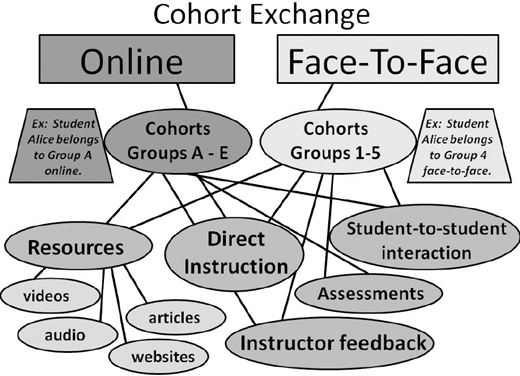
This model incorporates two distinct, consistent groups of learners working together towards solving contextualized problems, creating or designing work product, or discussing issues from multiple perspectives. In this model, learners belong to one group of fellow learners online, and belong to a different group of learners face-to-face. So each learner participates in two different groups. The overall class, however, has more than two unique groups online and two unique groups face-to-face. The specific number of groups online and face-to-face would be determined by the number of learners in the course.
The learners who use this model are therefore exposed to a highly collaborative learning experience, and one in which they attain and share knowledge as part of two distinct learning communities. This is a contextualized model in which women may excel academically (see Figure 4).
Good matches for this model are courses that require discussion and/or the development of cooperative working skills. The Cohort Exchange complements courses that can be organized into larger project-based assignments with real-world implications, and courses where learners need to assume different roles in different contexts, focusing on information sharing. Lower-level courses may not fit with this model. This model best meets the needs of higher-level courses with complex objectives.
Conclusion
There has been no significant research to date on the effectiveness of specific hybrid models and the implications of those models for gender. The premise as presented in this paper is that hybrids are inherently best suited for women. The goal, however, is to create online environments and activities that continue to increase women’s achievement at the postsecondary level while creating equally engaging and dynamic learning environments for men. This can result in higher academic performance, retention, and degree completion for both. Further study of different types of hybrid courses is needed to analyze their effectiveness, correlate it with gender, and work to improve outcomes for both genders.