Introduction
In the fall of 2003, Darcy Hardy made a pitch to the United States Distance Learning Association (USDLA) Board of Directors to let her coordinate an event that would both celebrate the advances women have made in the field of distance learning and provide these practitioners of like minds with a network of advisors, mentors, collaborators and friends. Regardless of the constituency the women might represent (K-12, higher education, corporate, government, military, telehealth, etc.), Darcy told the board that by bringing them together it could only benefit the field. She knew firsthand the challenges faced in developing strong distance learning programs and organizations, and she also knew what it meant to break through the proverbial glass ceiling. She told the board it was time for USDLA to take a leap of faith and let her pull this different kind of special interest group together. And she wanted to create an event that closed with something other than a golf tournament. The event would be called the International Forum for Women in E-Learning, or IFWE. When asked by a fellow board member if she was going to also create a similar event for men, Darcy responded, “No, because then it would be IFME” (Hardy, 2011). The board and chief executive officer of USDLA supported the idea and believed in her enough to give her the green light. USDLA created a community framework that was targeted and focused in ways that had not been done before and so the IFWE community was born.
One Lecturer’S Story
At the fourth IFWE, Darcy Hardy and Ellen Wagner invited me to share a few words about my professional experience during their featured videoconference. My head said “You can’t do that; those two are giants in distance learning”; my heart simply screamed “Yes!” without missing a single beat. So I stood up, took the microphone, smiled at the camera, and let my able peers in Albuquerque, New Mexico hold me up as I shared my story with new acquaintances in Berlin, Germany. That sort of individual empowerment is what IFWE is about for many women in distance education. The following reflections give concrete examples of how IFWE inspires change within my teaching practice, challenges my research focus, and makes a difference in my world—everywhere, all of the time. They are intended to spark innovation by other leaders, practitioners, and decision makers in the field.
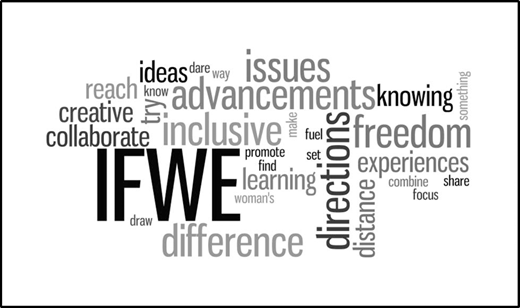
Specifically, I will relate elements of all four annual conferences to the seven statements, summarized in Figure 1, that comprise The IFWE Challenge (http://www.usdla.org/ifwe2010). To put this in context, I am barely one of the “young boomers.” I grew up in a small town surrounded by a big city and enjoyed an enriched, albeit sheltered, childhood. I successfully completed academic training in geosciences, which was almost wholly male-dominated in the early 1980s. I climbed my way up the ladder in the petroleum industry. Then I was intrigued by these things called personal computers and enjoyed a second career with start-ups in radio-frequency identification, factory automation, imaging, and videoconferencing. Except for the marketing, training, and secretarial personnel, I found myself in another arena driven mostly by men. Stressed by surviving the dot com period, I earned my terminal degree online and moved into higher education which has proved to be challenging and rewarding over the past decade.
My impetus for writing this article is not about gender, but because of it. The IFWE experience showed me how to tap into talents and abilities I never would have thought possible. IFWE programs look like those for every other professional conference I attend; however, the subtleties of how it is put together and put on magically cultivate a lasting synergy when attendees, at all stages of their careers, come together. IFWE is a unique conference designed by women for women. As stated on the website, “The intimate format makes it possible for all attendees to be actively involved in participating in the IFWE community” (USDLA, n.d., What Can You Expect From IFWE?).
“People Like US”
IFWE Challenge: If We Reach Out, How Inclusive Can We Be?
The majority of my colleagues and friends who see me working have eventually asked: What does WWXD mean? There is a bright orange minibumper sticker with those big bold block letters on my laptop, printer, and hard drive. Ellen Wagner distributed them at IFWE 2006. Her opening keynote explained how consumer technology crazes impact on the future of learning. With powerful graphics and energetic points, she convinced us that we were all eWarriors, forging the newest best practices in the field of eLearning, just as Xena: Warrior Princess used her formidable fighting skills to help people in the American supernatural fantasy adventure series. Hundreds of women now ask themselves “What would Xena do?” when facing “battle” in most any setting!
Staying true to the course, Wagner delivered “PLU” lapel pins to IFWE 2010. When Hardy welcomed us to Albuquerque, she asked us to wear them like our conference badges. Trusting her leadership and knowing that it held significance, we all smiled on recognizing the same pins being proudly worn by attendees at ONLINE EDUCA BERLIN during the live discussion hosted on the last day of both conferences! PLU stands for “People Like Us,” meaning that we share similar beliefs, resources, needs, and intentions. Like many other influential groups, we each seek out ways “to recognize, nurture, and embrace the human potential of everyone in [y]our life, [y]our community, and [y]our workplace” (Olcott & Hardy, 2006, p. 14).
IFWE is not just a common interest group; it is a community of like-minded individuals who naturally identify with Xena and each other. Thanks to the Internet, the concept of community no longer has geographical limitations. Thanks to USDLA, the sense of community fostered by IFWE transcends space and time because of seemingly silly, simple blazes like WWXD and PLU. Individual conversations are continued via e-mail and other meetings. Of course, you can find IFWE on Facebook! The great thing about our all being involved in distance learning is that we do value meaningful connection. Annual face-to-face gatherings with colleagues from around the globe are thereby all the more special.
Belly Dancing Workshops
IFWE Challenge: If We Dare to Be Creative, What Freedom Can We Find?
Balancing professional agendas, family responsibilities, daily necessities, and personal needs is trickier than ever in this age of virtually unlimited possibilities. It is true, we do tend to teach in the ways we were taught, to lead in the ways we were led, and to learn from others’ experiences and to draw on their expertise. That was all much easier when we knew what to expect and understood what needed to be done. Anyone reading this article can appreciate that the ways we work and play in today’s digital society continue to change at an unprecedented rate.
In the midst of the broad intellect assembled at a narrowly focused professional meeting, you cannot begin to imagine how surprised I was to find myself holding two shiny zills and wearing a fourtiered gold-coined chiffon hip scarf at my first IFWE preconference workshop! (Yes, there are photos on Facebook.) That is so not my style, typically. However, since a respected university regent and my own vice-chancellor were sporting the same garb, I figured it was some secret to success! In fact, the invitation to “shimmy and shake” at the belly dancing workshop has become one of the more popular IFWE traditions. Most all attendees—with or without rhythm and dance experience—have donned the bells and scarves to discover a great way to tone and exercise any body type.
More to my surprise than the outfit, the experience showed me the physical power of being female and the beauty of individual character. I had taken that essence for granted in my approach to integrating educational technologies and distance learning leadership even though I overtly incorporated it in my personal life and my teaching practice. Now I can appropriately use it to my advantage to bring something new to the table. Theory does not effect change; people do. Teachers, in particular, must be encouraged to exercise playfulness, ingenuity, and creativity. Always a matter of context, “play” is the free spirit of exploration, doing and being for its own pure joy. Technique is acquired by “the practice of practice, by persistently experimenting and playing with our tools and testing their limits and resistances” (Nachmanovitch, 1990, p. 42). IFWE provides a tangible opportunity for participants to gain organized knowledge to make practical changes in education.
Mobile Roundtable Dinners
IFWE Challenge: If We Share Ideas and Combine Our Experiences, What Advancements Can We Fuel?
Borrowing from the website again, IFWE is an opportunity to share ideas, learn about distance learning programs and products, gain a better understanding of being a leader in the field. It provides participants with a wonderful opportunity to establish new relationships and contacts with others involved in distance learning. The format of the event allows attendees to learn about relevant topics from many different points of view. (USDLA, n.d., What is IFWE?)
That—true collaborative learning—has happened for me on various levels at each IFWE conference. Since most participants do travel to the relatively small gatherings, the hospitality committee plays an important role in creating opportunities for interaction in suitable environments.
The mobile roundtable dinners provide one example of how this is achieved. The committee makes reservations at recommended restaurants for whoever signs up for one of several topics of current interest. Transportation is arranged so that the group remains coherent from start to finish without the bother of often frustrating and potentially confusing details. Open to the possibilities, I ended up sitting beside the chief executive officer of a nationally recognized distance learning program. The serendipity is in that I was poised to launch an online degree program. There was no readily available model for such leadership at my institution. Over the course of the meal I learned how to ensure success for my fledgling program with the benefit of my new friend’s experience.
At IFWE 2007, two colleagues and I presented another example of how IFWE connections impacted that same project. “Accepting the IFWE challenge, first issued in the fall of 2004, initiated a long-term relationship that guided the design and delivery of the three-course research sequence in the online … degree” (Nix, Barksdale, & Ledbetter, 2007, p. 1). Although the design and methods of that collaboration will be of interest to some, the most pertinent part of that presentation now is how each of the three collaborators answered the IFWE challenge, literally. Note that in addition to the formal paper and presentation poster, there is an IFWE Challenge poster at http://www.utdallas.edu/~rnix/#Research. The professional development and personal growth of at least these three professionals continues to be impacted by the IFWE ideas and ideals.
Gift Basket Giveaways
IFWE Challenge: If We Focus on Distance Learning, What Directions Can We Set?
By now you likely are starting to read between the lines of the official IFWE conference programs. Another fun tradition that everyone looks forward to with great anticipation is the gift basket giveaway. For me, this is another powerful expression of the creativity of the innovative women who attend IFWE. I was honored to donate baskets to the 2006 and 2007 conferences. Even though my officemates were not able to attend themselves, we shared our own unique insights and gained a shared experience by putting together a basket to represent our pride in our projects. At registration, IFWE participants receive a numbered ticket. There certainly is no need for added incentive to attend the combined sessions where someone draws a matched ticket from the fishbowl. Since you must be present to win, there are often several gasps and moans when the call is close!
The enticing baskets and boxes, and an occasional sombrero, are rivaled only by the time and effort that IFWE presenters dedicate to their sessions. IFWE sessions address the personal, social, and economic scalability of new approaches to implementing, evaluating, and institutionalizing applications of new technologies in corporate, government, education, and consulting fields. Exploring emerging opportunity at an intimate level, the annual conference themes reflect similar changes in the roles and expectations of IFWE’s members: Dancing on the Glass Ceiling, Riding the Waves of Change, Catching the Dream, and Rise to the Challenge.
The titles of past presentations evidence the importance of planned and spontaneous exchanges that could only happen at IFWE. Some topics are timeless, like overcoming faculty resistance to new technologies. Many are fleeting as better, faster, and cheaper solutions are released and updated regularly. But the lessons learned about how to adopt new tools and adapt to new trends are transferrable across multiple contexts. Because of the deep connections encouraged in the IFWE milieu, the necessary expertise in diverse areas is available “on request” through the extensive network actively maintained between meetings.
Spa Treatment Exclusives
IFWE Challenge: If We Don'T Try Something, How Will We Ever Know?
USDLA’s initiation of IFWE marks a critical “tipping point” in my career in higher education. A newscaster recently pronounced that “Men have the man cave; Women have the mom cave” (Tam, 2011). Regardless of your personal opinion of either, the fact remains that more and more people are creating their own personal space for relaxation, renewal, and reflection. My favorite author said it well when she was selected to write her credo in one of six cottages at Hedgebrook, located on Whidbey Island in Puget Sound: “I am aware that I am the recipient of a generous and unexpected gift of … a sense of order, a recognition of beliefs, and a direction of prose … all three at once” (Zwinger, 2000, p. 4). Indeed “IFWE is a time for attendees to listen, think, talk, network, reflect, dream and learn” (USDLA, n.d., What is IFWE?).
If you noticed the IFWE venues, you may have picked up on the fact that the conferences are hosted by nice enough hotels or resorts with impressive spas. That spa component is not optional and may be the deciding factor on where we meet—seriously. As critically as digital communication skills in distance education today, the spa facilities at IFWE conferences do matter! That is because the IFWE founders are not just crafty planners with wellness agendas, they are diva directors with a passion for supporting the human beings who are or may become our leaders, practitioners, and decision makers. The planning committee brokers fantastic deals during off seasons and builds in “free” time for networking, catching up with the office, or simply not working at work for a change.
I internalized this during one of our more unusual networking activities. The local Girls Inc. chapter taught us how to make our own dream catchers in the Native American tradition. Picture a ballroom with 20+ round tables covered with beads and feathers and reeds and twine. No, not very high-tech, but the perfect venue for exploring what really matters at the heart of what each person working within those various groupings discussed throughout the guided exercise.
The “Secret Handshake”
IFWE Challenge: If We Collaborate, What Issues Can We promote?
Only “the powers that be” in the USDLA office know which IFWE registrants are eligible for “secret handshake” privileges. It is beyond the scope of this article to explain this totally upright deal! The point of mentioning this item is to reiterate that the only way to comprehend the magnitude of what IFWE is all about is to experience it either first-hand or as a beneficiary of its influence on those who are catalyzing transformative change in distance learning.
Mary Lynn Pulley dedicated her life’s work to searching out keys to resilience. At the Center for Creative Leadership she investigated the effects of the massive corporate downsizings and restructuring of the early 1990s. Even though it may not seem so dramatic in the field of distance learning, any change involves loss. How you deal with that is up to you. Pulley noticed that some people “bounced back” better than others. In terms of personal identity, meaning, and purpose, “the changes fell primarily along two different dimensions: the degree to which they changed assumptions about themselves and the degree to which they changed assumptions about their work” (Pulley, 2010, p. 76).
Thankfully, because of the IFWE Challenge, I have not had to lose my job recently to “reclaim my soul” and recharge my internal motivation to improve my position. In a world where everything seems to be changing faster and more unpredictably than ever, what matters most is being attended to by the current and upcoming leaders who share the IFWE vision. For example, CORE4Women is an outgrowth of a self-realized IFWE collaboration.
CORE4Women supports and encourages those who seek to empower themselves through online education … is a social network where women access information and resources to attain their educational goals with the assistance of experienced mentors … values a woman’s right to self-fulfillment and increased potential through education while recognizing the positive impact mentoring can have on the success of women. (CORE4Women, 2008, Mission)
If WE? We Are!
IFWE Challenge: If We Draw Upon a Woman’S Way of Knowing, What Difference Will it Make?
These few scant examples hopefully serve to show that the princess eWarriors and diva directors, belly dancers and dream catchers, and expert teachers and life-long learners of IFWE not just can but are rising to the challenges facing distance learning professionals.
IFWE itself is a testament to forwardthinking people of action and the importance of endeavors of the United States Distance Learning Association. Brief in comparison to its accomplishments, IFWE’s history is summarized in an interactive timeline at http://www.dipity.com/rnix/IFWE/.
In closing, whatever your gender or capacity, aspire to lead by example and continue to learn from experience. It makes a difference in ways you might never imagine.