Problem-solving style refers to consistent individual differences in the ways people manage change and deal with complex, open-ended opportunities and challenges (Selby, Treffinger, Isaksen, & Lauer, 2004; Treffinger, Selby, & Isaksen, 2008). Although style is just one factor among many (e.g., knowledge and experience, mindset, motivation) that influence a person's natural responses to problem solving and change, it has theoretical and research support and practical relevance for instructional design and delivery in working with university students. We concur with Millman's view:
Whether one agrees with the notion that students today are different or not, it is imperative that educators, employers, and instructional designers shift their focus from “how students today might be different” to “how should I design instruction to meet the needs of my target audience” and “what do I need to change to meet the needs of my learners?” … [This] means making thoughtful, informed decisions about how to engage learners in the process of learning, accepting learners for who they are, understanding learners’ strengths and weaknesses, helping them build on their strengths and diminish their weaknesses, and capitalizing on their [learning styles]. (2009, p. 60)
Information about a person's problem-solving style contributes to instructors’ efforts to design and deliver instruction that is differentiated, engaging, challenging, and successful (Treffinger et al., 2008). Knowledge of one's style also enables students to work from their strengths, while developing areas of weakness.
VIEW: A Model and Measure of Problem-Solving Style
For this study, we assessed style using VIEW: An Assessment of Problem-Solving Styles (Selby, Treffinger, & Isaksen, 2007a, 2007b). The VIEW model involves three dimensions: orientation to change (OC), manner of processing (MP), and ways of deciding (WD). Each dimension is a continuum, anchored by two styles.
OC considers a person's preferences regarding novelty, structure, and authority and includes the explorer and developer styles. Explorers seek novelty and thrive on risk and uncertainty. They find structure (especially when imposed externally) limiting and confining, and prefer to work with authority at a distance. Explorers create many unusual and original ideas that, if refined, might offer innovative solutions (although they may prefer to leave the refining to others as they move on to new challenges). Developers are concerned with practical applications and task realities, using their creative and critical thinking in ways that others clearly recognize as relevant and useful. They find workable possibilities and guide them to successful implementation. Developers are careful, methodical, and well organized, and seek to minimize risk and uncertainty. They are comfortable with details and structure, which they find helpful in moving work forward efficiently, and with authority close-at-hand. The popular view of creativity as “thinking out of the box” describes an explorer's approach; Developers are more likely to “think better inside the box.”
MP involves external and internal styles. Individuals who prefer the external style draw their energy from interaction with others, discussing possibilities, and building on others’ ideas. They seek a great deal of input before reaching closure, are regarded as good team members, and often appear full of energy. Preferring action to reflection, they may appear to rush into things before others are ready to proceed or before ideas have been considered thoroughly. Those with an internal style look first to their own inner resources and draw energy from their reflection. They prefer to consider ideas on their own before sharing them with others, embarking on action only after careful consideration. Internals may become engrossed in inner events, ideas, and concepts and might be perceived by others as pensive or withdrawn.
WD considers the individual's preferences when making decisions, and includes the person and task styles. Individuals with a well-defined person style emphasize first in their decisions people's feelings, the need for harmony, and positive relationships. Often seen as warm, friendly, and caring, they are quick to become aware of and to respond to the needs of others. They seek solutions or decisions that everyone can “buy into.” Individuals with a task style tend to look first at choices and decisions that are logical and can be justified objectively. They prefer making judgments that are based impersonally on well-reasoned conclusions, but they may be perceived (especially by those with a person style) as cold or uncaring.
The VIEW problem-solving style measure (Selby et al., 2007a, 2007b) is a web-based assessment of the model's three dimensions and six styles. For OC, scores range from 18 to 126, with lower scores representing the explorer style and higher scores the developer style. For MP and for WD, the scores can range from 8 to 56. For MP, lower scores represent the external style, and higher scores the internal style, and for WD, lower scores indicate the person style and higher scores the task style. Validity and reliability data for VIEW have been reported by Selby et al. (2007b); additional technical reports and a research bibliography can be downloaded at www.creativelearning.com/problem-solving-styles.html or at www.viewstyle.net. VIEW has been applied with more than 27,000 subjects worldwide in more than 20 countries, including responses from 3,325 college and university students.
Problem-Solving Styles of Distance Learners
The present research involved 112 students enrolled in distance learning courses on creativity and creative problem solving (mostly graduate students) at two U.S. universities, one in the Midwest and one in the Northeast. The participants’ average age was 36, with a range from 20 to 60, and 82 of the students (73%) were female. Although this exploratory study did not involve a random or representative sample, it was an initial effort to study problem-solving styles and their implications for distance learning; it may point the way to promising opportunities for future research and effective practice. Table 1 presents the VIEW assessment results for this sample of distance learning students, and compares the distance learning group's results with those of the higher education group and the total VIEW worldwide database.
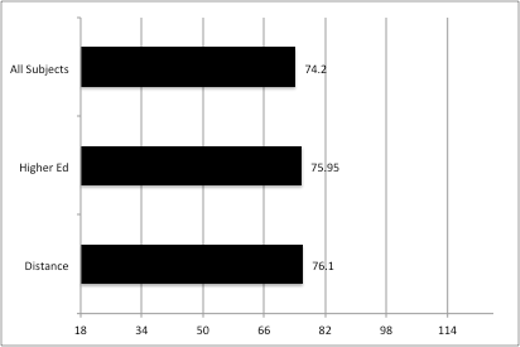
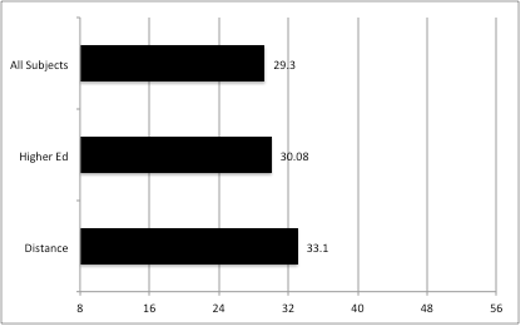
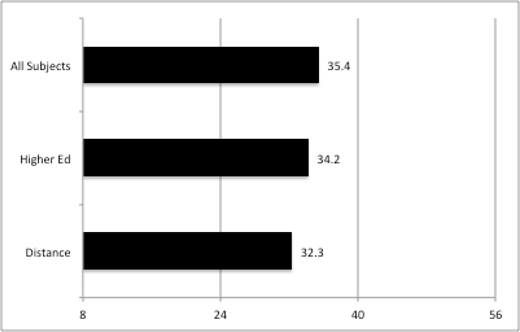
As indicated in Table 1 and Figure 1, the average OC scores of the distance learning students (76.1) did not differ significantly from either the larger sample of college and university students (75.95) or the full worldwide database (74.2). For MP (Table 1 and Figure 2), the distance learning group's scores ranged from 10–56, spanning nearly the maximum possible range and their mean score differed significantly from the other two groups. Distance learning students (M = 33.1) scored significantly higher, or internal in their style preference, than either the higher education group (M = 30.08; t = 3.35, p < .001) or the total VIEW database (M = 29.3; t = 4.41, p < .0001). For WD (Table 1 and Figure 3) the range of scores of students in the distance learning group was 9–56 and their mean score again differed significantly from the other two groups. Distance learning students (M = 32.3) were significantly lower, or person oriented in their style preference, than either the higher education group (M = 34.2; t = 2.32, p < .02) or the total VIEW database (M = 35.4; t = 3.69, p < .0001).
Implications for Instruction
Of course, there may be many reasons why students enroll in distance learning courses. They may need credits to complete a degree, for example, or they might be professionals seeking certification, recertification, or other forms of professional credentialing—or they might simply be interested in learning about the topic or exploring what may be for them a “new” mode of instruction. Instructors must be prepared for diversity of background, interests, and learner characteristics, and be ready to address the same breadth and variety of learner characteristics among distance learning participants—or potentially even greater variety than they might encounter in any other instructional setting. Each of the three problem-solving style dimensions (OC, MP, and WD) has implications for instructional differentiation and effectiveness. Based on experiences with the students with whom we have worked in distance learning courses, we will share several implications for each dimension.
Orientation to Change
In relation to OC, the distance learning group was diverse rather than homogeneous, and included students with well-defined explorer styles, well-defined developer styles, and many students with moderate OC style preferences. If this result is confirmed in additional studies with larger samples, it suggests that students who participate in distance learning courses demonstrate a broad array of learning characteristics and needs. It would be erroneous to assume that students who opt to participate in distance learning are “a certain kind of individual.” Distance learning may appeal to explorers if it initially appears to be a novel way of taking a course or offers opportunities for perceived freedom from the constraints of a traditional classroom setting, and to developers if it appears to be a well-organized, structured approach to practical, relevant content. Table 2 presents some implications of OC differences for instruction.
Manner of Processing
On this dimension, as indicated in Table 1 and Figure 3, there was also a broad distribution of scores, including students with well-defined external and well-defined Internal styles and many students with moderate style preferences. The students in the distance learning group, however, differed significantly from the other groups, demonstrating a greater preference for the Internal MP style. This result was not unexpected, since we had anticipated that students who opted for a distance learning course rather than a traditional classroom setting might be attracted by the opportunity to work alone rather than to meet socially with a group on a regular basis, and thus would be more likely to have an Internal style. We might hypothesize that the broad range of styles on this dimension was influenced by the appeal of the content of the course, which for external students might have transcended their natural preference for a course context offering regular group interaction and face-to-face social exchange.
In distance learning, it may be challenging to respond to the need to provide avenues or vehicles for participants with an external style to engage in social interaction; they want to “chat.” On the other hand, internals may want “to be left alone,” although over time, they can feel comfortable sharing with trusted peers. It may be an error, particularly in a group with larger numbers of internal participants, to demand (or “force”) participation or grade on group participation. We learned not to mistake lack of energetic interaction for disinterest in the content or lack of engagement. In the distance learning setting, internals may find an opportunity to pursue sustained learning and reflection without the distractions of externals and the stresses of interaction (especially spontaneous interaction that tends to move too quickly for them). Table 3 presents some instructional implications of MP differences for instruction.
Ways of Deciding
Once again, as on the other two VIEW dimensions, the distance learning group included a broad range of students, including some with well defined person style preferences, well-defined task preferences, and many with moderate preferences. The significant difference between the distance learning groups and the other comparison groups may in part reflect the high percentage of female students in the distance learning group, since there is a tendency in the full database for more females to have a person than a task style, and the reverse for males. Students who prefer the person style consider personal and interpersonal dimensions (“the human element”) in their learning. Students with a task style enjoy learning that addresses “difficult issues,” searching for logical support and objective evidence or documentation—experiences they view as rigorous, intellectually challenging, and complex. They may avoid courses or content that they view as “cute,” superficial, or frivolous. Task style learners may perceive distance learning as an opportunity to avoid the “distractions” of interpersonal issues. Table 4 presents some instructional implications of WD differences.
Summary
In this article, we presented a model of students’ problem-solving style preferences and described implications of each style for distance learning instruction. Attention to style differences is an important consideration in designing, differentiating, and delivering instruction, as important in distance learning as in a live, in-person classroom context. We presented data from an exploratory study involving 112 university students enrolled in distance learning courses, comparing their results with data from more than 3,000 other college and university students and a worldwide data-base of more than 27,000 persons.
Understanding problem-solving style and its implications for distance learning (as well as for effective instruction more broadly) offers many opportunities for future research and development. We need to replicate these studies with larger and more diverse student samples, and expand the inquiry to other student populations and course areas, for example. In addition, in this report we considered only the implications of style differences among students; future research might investigate the influence of instructor's style on the design and delivery of instruction, and the interactions that may exist between the instructor's and students’ styles. It would also be valuable to examine the role of style in guiding students in working effectively in teams and project groups, experimental studies of style-mediated instruction, the differential effects of style-based instruction and feedback on student learning and productivity.
About the authors