




The use of cases in instruction has a long history, especially case methods for professional education such as law, business, medicine, and teacher education. The role and application of cases vary in purpose, cost, topic, and learners. Recently, multimedia cases using the affordances of computers and Web technology have been introduced. However, these case approaches have rarely been applied for online learning. In this article, we introduce the basic components of online case-based learning and suggest three ways of using cases in instruction.
Interest in the use of cases, in different forms, has grown dramatically (Naumes & Naumes, 1999; Shulman, 1992). The uses of cases in instruction vary significantly. In the instructional design field, some refer to cases as coherent examples, real or contrived, that exemplify a concept (for example, Collins & Stevens, 1983; Gagne & Medsker, 1996; Merrill & Twitchell, 1994). In professional education, such as case-law and case-study medicine, a case epitomizes a specific “real-life” event in which multiple aspects are detailed and elaborated to make apparent the relationships among antecedent circumstances, the relevant “givens” associated with the situation, and eventual outcome(s) (Shulman, 1992). The specifics of the case, in effect, are used to provide a contextual organizer for representing and understanding the general-izable principles, relationships, and reasoning underlying a specific event.
With the advent of powerful technologies, both the number and type of case-based approaches have increased. Recently, variations in multimedia and Web-based cases have been studied (see, for example, Kinzer & Risko, 1998; Schrader et al., 2003). Cases have been used not only to epitomize a situation or represent authentic circumstances, but also as a lens through which thinking is facilitated. Some case-based approaches, for example, scaffold the reasoning processes associated with solving a problem in a given discipline, examining the absence or presence of key information in a real or simulated scenario, or modeling the reasoning processes of experts (The Cognition and Technology Group at Vanderbilt, 1990; Kolodner & Guzdial, 2000).
Clearly, technology-enhanced, case-based approaches take many forms, each with potentially important implications for design and use in online environments. This potential, however, has seldom been realized; case-based approaches are surprisingly rare in distance learning environments. To facilitate greater interest in and use of case-based learning, it is important to better understand the types, features, and design alternatives in their use. The purposes of this article are to introduce case-based learning, examine features of case-based online learning, and highlight potential for using cases in online learning
What are Cases?
Case-based approaches have been widely used in law and medicine education for more than a century to teach students how to solve complicated and ill-defined real-world problems (Naumes & Naumes, 1999). Case-based approaches have also been adopted by other professional education areas such as business, journalism, and teacher education (Knirk, 1991; Shulman, 1992). Despite the widespread use of cases in learning and the different roles cases play in diverse disciplines, no single definition of a “case” has been universally endorsed. Rather, cases are created and adopted according to differing contexts of and purpose for learning.
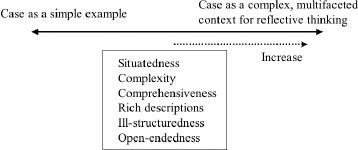
In traditional didactic instruction, cases frequently take the form of simple examples that allow students to check and confirm what they already know, typically using well-structured problems (Jonassen, 1997). However, in student-centered teaching and learning, cases are often used as tools to help students reflect on real-world problems and to foster critical thinking. Figure 1 represents the simplicity-complexity continuum of case applications. Simple cases, such as isolated examples, explicitly depict the basic information or concepts to be recognized or understood; as such, they provide a summative embodiment of the principles. As cases become more complex, ill-structured, and open-ended, however, they provide the means through which thinking is stimulated and learning is scaffolded. Rather than offering a “correct” single solution, authentic cases require that students think deeply about different variables, alternative theories, and a range of possible solutions.
Real-life cases portray “[a] piece of controllable reality, more vivid and contextual than a textbook discussion, yet more disciplined and manageable than observing and doing work in the world itself” (Shulman, 1992, p. xiv). In online learning contexts, which are often criticized for the lack of opportunities for authentic experience, case-based approaches featuring rich descriptions and situated problems may help to bridge the gap between the virtual and the real world (Jonassen & Hernandez-Serrano, 2002; Tippins, Koballa, & Payne, 2002). For example, problem-oriented math cases in the Jasper Series (e.g., What is the quickest way to rescue an eagle?1) are fundamentally different from the corresponding computational tasks posed in conventional math classrooms (e.g., If you divide 12 people into three groups, how many people are in a group?).
What are the Features of Online Case-based Learning?
Conventional case methods in education generally involve cases, study questions, case discussion, follow-up activities, and case analysis report (Wasserman, 1994; Williams, 1992); online case-based approaches share the same basic structures. In the following section, we elaborate other structures unique to case-based distance learning: case, case tools, case discussion, and learning resources.
Case
A case presents a narrative, story, and set of events (Shulman, 1992) that deliver critical and complex situations. As a narrative, a case has a plot—a beginning, middle, and end. A case is particular and specific, representing “the working of human hands, minds, motives, conceptions, needs, misconceptions, frustrations, jealousies, and faults” (Shul-man, 1992, p. 21). Finally, a case represents the social and cultural contexts of the events.
Cases vary in format, length, and purpose. Case formats vary from raw data to case study papers such as diaries, personal letters, students’ work samples, patient reports, white papers, and casebooks (Shulman, 1992; Tippins et al., 2002). Text-based cases, in the form of case study papers, have been used for a long time. For example, case books or case studies in journals have been used for business education and teacher education. Scenario-based video cases—acting as vignettes that capture important elements of situations—are often able to reflect the complexity of reality better than text form alone. Multimedia video cases, which have recently emerged, feature multiple data sources such as video, audio, graphics, and text allowing rich information of contexts.
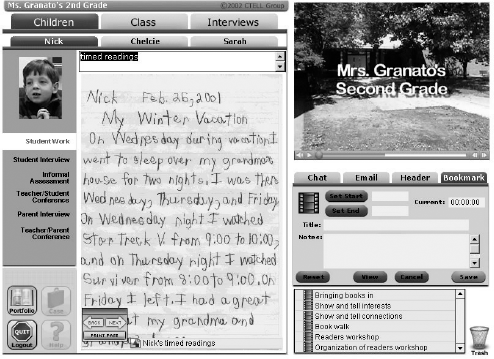
Multimedia cases: CTELL (retrieved from http://ctell.uconn.edu/screen_shots.cfm?PageNum_qScreen_shots=1).
Multimedia cases: CTELL (retrieved from http://ctell.uconn.edu/screen_shots.cfm?PageNum_qScreen_shots=1).
The Case Technologies Enhancing Literacy Learning (CTELL) project (Schrader et al., 2003), for example, delivers Web-based cases that include rich multimedia information in categories such as Children, Class, and Interview per case (See Figure 2). For example, the Children tab includes detailed information for three children, such as sample work, interviews with students and parents, informal assessments, and teacher/student and teacher/parent conferences so that users can deeply understand the children. The Class tab presents a large picture of the classroom activity beyond the three children, including submenus (Background, Lessons, Lesson Materials, and Student Work). The Interview tab provides teachers or experts’ commentaries on anchor videos, discussants’ comments on various reading principles, and interviews with school personnel. Using these resources, CTELL learners can explore multiple forms of information along with multiple perspectives on literacy instruction.
The role of a case depends on the learning goals. Problem cases have been widely used in case-based instruction focusing on decision-making skills, morals, and ethics (Lynn, 1999; Shulman, 1992). Cases
as experts’ stories provide advice to guide novice students’ practice. The length of case scenarios varies from a few minutes or single paragraph to a few hours or many pages; in some instances, business cases may exceed 30 pages in length (Blumenthal, 1991). Instructors decide the scope and length of cases based on the purpose of case-based instruction. Case development is not a simple task, as they contain critical concepts and incidents.
Case Tools
Cases can be represented and delivered in various ways. In the classroom, the instructor may hand out printed cases or show video cases in classrooms. In CTELL, tools are designed to effectively and efficiently collect, organize, and present cases. The Web and computer technology support a host of case tools that enable learners to readily access, use, and analyze cases. Web-based case tools generally include hypertext-enabled cases, search engines, supplementary information, and a communication tool. For example, InTime provides 60 online video vignettes featuring PreK-12 teachers integrating technology into their classrooms (See Figure 3). Using various case tools and category searches (e.g., subject, grade, or software), students can locate tailored video cases, as well as access a specific video event or segment within a case.
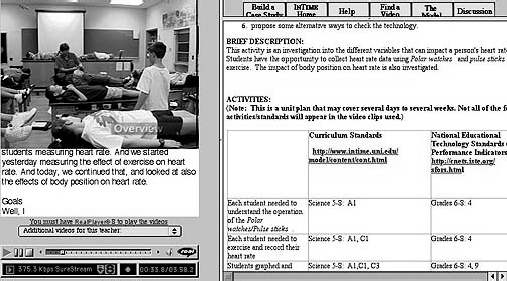
The Web-based video case tool, InTime (retrieved from http://ndwild.psych.und.nodak.edu/book/integ/summary/chap9.train.html).
The Web-based video case tool, InTime (retrieved from http://ndwild.psych.und.nodak.edu/book/integ/summary/chap9.train.html).
Case Discussion
Case discussion is critical (Barnes, Christensen, & Hansen, 1994) in case-based analysis. Whereas reading or watching a case allows learners to gain situational knowledge, case discussion allows learners to increase their general problem-solving skills, reasoning, oral communication, and affective
attitude (Masoner, 1988). Case discussion is perhaps the primary component application of cases in education. Several forms of discussion, such as Socratic dialog, small-group exchanges, and debriefing, can be used individually or in combination. Typically, study questions or discussion topics are used to stimulate analysis and processing after case presentation (Wasser-man, 1994). Based on the questions and topics, students work individually or collaboratively to analyze cases and, finally, take part in a whole-group discussion or debriefing session (Ertmer & Russell, 1995). Whole-group discussion often involves teacher-led Socratic discussion. Instructor-led Socratic discussion is generally used to stimulate and facilitate students’ thinking skills. The discussion facilitator “is planner, host, moderator, devil’s advocate, fellow-student, and judge—a potentially confusing set of roles” (Barnes et al., 1994, p. 23).
Learning Resources
Learning resources are used both as primary materials to stimulate problem solving in case-based learning as well as supplementary materials appropriate for case analysis. During problem-based learning (PBL) in medical education, learning resources play an especially critical role (Williams, 1992). After receiving a case or problem, students engage in small-group tutorial sessions to identify problems, generate hypotheses, and decide a reading list. During self-directed learning sessions, students spend considerable time studying the identified case-relevant library resources. Students use combinations of published reference materials and consultations with resource faculty (e.g., basic-science faculty), along with a variety of case-relevant resources such as cadavers, specimens, x-rays, computerized scans, films, and videotapes (Williams, 1992). Like PBL in medical education, learning resources are most effective in learning environments that require self-directed learning, such as in distance learning rather than classroom contexts.
Recently, a number of interesting Web-based resources to support case-analysis in teacher education have been developed. The Secondary Teacher Education Project (STEP) at the University of Wisconsin at Madison (Derry & the STEP Team, 2002), for example, is a Web-based, case-based learning environment designed to help preservice teachers to design and develop learning environments based on a deep understanding of different learning theories. As illustrated in Figure 4, the STEP Knowledge Web (KWeb) is an online hypertext system designed to link learning science theories with research (Theories) using a library of video cases on actual classroom practices (Cases) relevant to the theories. Students use the learning resources, learning science theories, and discussion after reviewing real classroom cases. Learning resources allow the students to achieve a deeper understanding of complex teaching-learning situations and to focus on critical concepts within ill-structured cases.
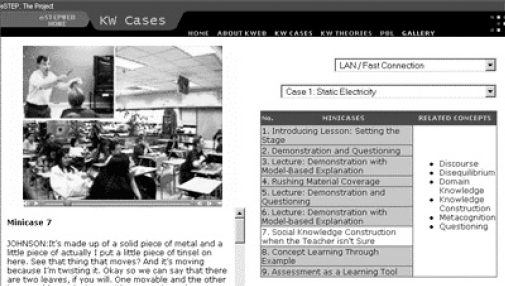
ESTEPWeb.org.cases (retreived from http://www.wcer.wisc.edu/estep/tour.asp?section=tour&page=cases).
ESTEPWeb.org.cases (retreived from http://www.wcer.wisc.edu/estep/tour.asp?section=tour&page=cases).
How are Cases Used?
Case applications in instruction vary from conventional case methods to constructivist-inspired, case-based learning. Cost, purpose, topic, and learner may influence which case method is used. The purposes defined for using cases guides the design and implementation of the pedagogical approach. For example, traditional methods mostly on case analysis and interpretation through discussion, and tend to be especially useful in learning complex concepts and principles within cases. Constructivist approaches, in contrast, stress active learning and “learning to learn”— critical analysis over the accumulation of specific knowledge. Consistent with situated cognition perspectives (i.e., authentic experience in authentic contexts, per Brown, Collins, & Duguid, 1989), some approaches have been used to facilitate active engagement of students in the actual settings of a case, though such approaches are relatively new.
Case-based Approaches in Instruction
| Case Study | Case-based Project | Thinking Engine | |
|---|---|---|---|
| What it is | Focuses on case analysis through case discussion and writing a report | Conducts relevant projects using ideas from cases | Solves ill-structured problems in designed situations |
| Main purpose |
|
|
|
| Role of cases |
|
|
|
| Example |
| • Web-enhanced case-based doing (CBD) (Kim, Hanna-fin, & Thomas, 2004) | Anchored instruction (The Cognitive and Technology Group at Vanderbilt, 1990) |
As summarized in Table 1, we highlight three pedagogical approaches for case-based learning—case studies, case-based projects, and thinking engines. The three approaches are consistent with and to some extent share common structures of case-based learning. However, they differ in their purpose of using cases. While case studies are similar to traditional case methods, thinking engines are consistent with constructivist perspectives emphasizing active learning highlighting the role of cases in solving ill-structured problems or contexts for metacognitive thinking rather than depicting real situations.
Case study: Situational Understanding of Complex Concepts and Principles
Case studies have a long-standing tradition in professional schools such as law, business, and medicine. A case study focuses on case analysis for a deeper understanding of complicated concepts and principles. The topic of a case is critical because it usually embodies the core concepts and knowledge of a particular community in complex and uniquely situated ways. The purpose of case-study approaches is to acquire both the content knowledge and thinking skills of professionals by pointing out critical concepts, events, and principles within cases. The focus of a case study varies in different disciplines. Medical and law schools, for example, share a similar approach to using cases, focusing on principles underlying expert analysis or actions in specific precedent-setting instances (cases). Case methods in business schools and teacher education programs, in contrast to expertise and precedents, focus more on open-ended problems and solutions to develop broader understanding and multiple perspectives in the real world (Tippins et al., 2002).
During a case study, students typically read or observe given cases, analyze the cases individually and in small groups, and participate in whole-group discussions during debrief sessions (Wasserman, 1994). For example, in law school applications, students prepare a brief before class by summarizing and analyzing law cases. During class, and based on the brief, professorled and large-group discussions are conducted using Socratic questioning method, and additional relevant cases are introduced (Tippins et al., 2002; Williams, 1992).
For online learning, organizing discussions is critical to effective case-based approaches. Conferencing on the Web (COW) (Bonk et al., 2000) was designed to promote asynchronous case discussion for preservice teachers in a case-based online learning environment. Each case, developed by students to document their field experience, consists of a case commentary, case questions, and case discussion board. Students posted their opinions on cases to foster discussion and debate; the archive of case discussions is stored as a knowledge repository. According to Bonk et al. (2000), COW fostered student learning and engagement and, moreover, strengthened the community of practice among preservice teachers, teacher educators, and teachers who supervise field experiences. The COW community has since expanded to include students and instructors from other countries.
The purpose of the case-study approaches is consistent with professional education: “A professional education curriculum both seeks to deliver a codified theoretically based knowledge base and intends to teach reasoning skills and strategies for analyzing and acting professionally” (Merseth, 1996, p. 724).
Thus, through case study, students gain both content knowledge and procedural knowledge. Content knowledge involves understanding broad repertoires of context and multiple perspectives; procedural knowledge focuses on reasoning processes including judicial, clinical, or pedagogical reasoning. In addition, students can achieve self-directed learning and reflection skills through analyzing and discussing cases.
Case-based Project: Experiencing and Practicing through Experts’ Cases
While case study approaches generally provide only vicarious experience (Putnam & Borko, 2000) and rely on Socratic discussion and case analysis, case-based projects combine a case study approach and project-based learning. From a situated cognition perspective, experience is provided through authentic activities (Brown, Collins, & Dug-uid, 1989); active learning beyond discussion may enhance students’ knowledge including the integration of concepts, culture, and situations. When students review and analyze experts’ cases, they observe critical thinking and know-how, the application of knowledge and principles in context, and the enactment of expert analysis and decision making in real-life settings. In case-based projects, therefore, students practice and apply critical concepts and ideas manifested in the cases. Students are assigned to project tasks, such as designing lessons, practicing teaching, or developing business plans. Novices, in effect, experience or re-enact real-world problems, applying critical thinking, conceptual knowledge, and decision making in the process.
The Web-enhanced case-based doing (CBD) environment was designed to enable preservice teachers to practice designing technology-enhanced lessons and implementing them prior to their student teaching experience (Kim, Hannafin, & Thomas, 2004). The case learning of preservice teachers involves scenario writing, observing and studying expert teachers’ cases, discussing and reporting case analyses, planning, and doing authentic activities, including developing technology-enhanced lesson plan and course materials, microteach-ing, and reflecting. As shown in Figure 5, the case-based doing tool (CBDT) consists of a case library and four templates that include guiding questions for each phase of the course project.
The four templates represent four procedures of case-based doing (CBD) activities. The first step, What’s the story, provides templates for case analysis, consisting of learning goal, instructional strategy, the benefits of technology, and lesson(s). After whole-group case discussion in class, preservice teachers write the case report in CBDT. The second step, Planning, helps preservice teachers plan their lessons including course material development using case ideas. Because the focus is on preservice teachers’ integration of technology into their lessons, guiding questions such as ideas from the case, knowledge of students, and benefits of technology directly support the format of the lesson plan used. In the next step, Doing, students develop their technology-enhanced lessons and course materials. This step aims to help students reflect in action through describing unexpected issues and identifying resources along with free-style journaling. The last step, Tell me your story, is related to reflection. Moreover, this step aims to help students build their own stories or cases as mental case libraries so that they can use them for relevant future tasks. Conclusions to individual scenarios, process briefs, lesson(s) learned, and technology notes are provided as guiding questions. Preservice teachers write their story after completing their course project. Through case-based doing (CBD) activities, preservice teachers learn from both expert teachers’ thinking and approaches in the cases provided and from application in their own course project.
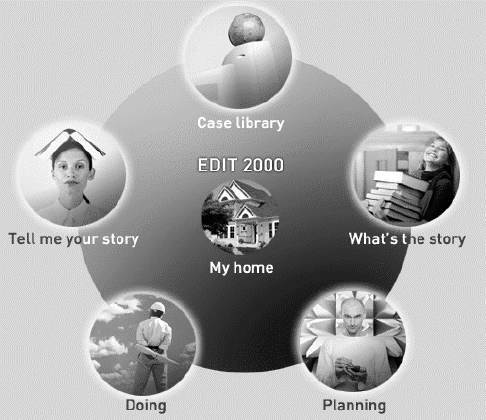
The screen shot of the Web-based case-based doing tool (CBDT) (Kim et al., 2004)
The screen shot of the Web-based case-based doing tool (CBDT) (Kim et al., 2004)
Learning by doing with cases allows students to experience “professional-like” projects represented through experts’ cases in order to integrate experts’ perception, knowledge, and skills with their own. Learning by doing with cases allows students to practice in safe environments before engaging in real experiences in high risk, high-stress, and high-cost situations.
Thinking Engine: Critical Thinking for Problem Solving
While cases in case studies represent real situations that epitomize central concepts and situations of a particular community, cases as thinking engines assume the role of a tool to facilitate thinking skills for problem solving. The topic of cases is designed to stimulate and scaffold the reasoning processes of students, but the content of a given case is thoughtfully designed or engineered rather than selected from real situations.
Anchored instruction (CTGV, 1990) typically uses case scenarios as a kind of thinking engine. The learning goal of anchored instruction is to help students detect as well as solve problems; in the process, students develop unique perceptions, understandings, and solutions rather than adopting those of an expert. The Jasper Woodbury Series is the best-known design example of anchored instruction. The Jasper series is primarily designed for mathematical problem formation and problem solving and also includes the development of applications of science, history, and literature concepts. Complex mathematical problems are embedded in the video story. A videodisc format also allows veridical representation, random access, and compression of time for representing a certain case or problem. While using videodisc, students generate (or find) problems and solve them by using embedded data in the videodisc.
While case study often focuses on Socratic discussion the instructor leads, the approach of using a case as a thinking engine empowers students’ ownership of problem solving. The students identify problems and solve them (CTGV, 1990). Facilitation focuses not on knowledge-driven processes but on metacognitive processes (Savery & Duffy, 1995)
Assessment I ssues: How do we Know when Case-based Approaches Work?
Like all online teaching and learning, assessment issues associated with online case-based approaches are important. The questions and issues are simple, but the answers are not; the need is compelling, but the means are elusive. There are no simple answers, only simple questions.
The focus of assessment varies according to the goals for use and the intent of the evaluation—logistical, technical, pedagogical, administrative, and so on. In the remainder of this section, we emphasize student-centered indicators and assessment methods associated with case-based approaches. While we cannot provide detailed guidelines, we identify student assessment issues of greatest relevance to online, case-based approaches.
Perhaps the most central of all assessment issues pertains to student goals—more specifically, to the focus of the case-based learning environment. Traditionally, assessment has tended to measure student content or domain achievement per course syllabi or instructional objectives. Case approaches tend to reinforce such objectives, often in the form of examples that reify the target learning outcomes or the provision of classic “landmark” cases. This type of knowledge has been described as “cognitive residue;” that is, the measurable impact of learning from technology. Likewise, a host of indicators are used to examine the influence of case-based approaches on students’ attitudes, beliefs, and motivation in a given domain of study. For the most part, the goals of the case-based learning environment mirror those of other approaches, so assessment needs are generally well-served by using traditionally aligned assessment items, questionnaires, and performance tasks.
As noted previously, however, the focus and purpose of online systems have changed considerably; likewise, the focus of case applications varies. Some goals emphasize reasoning processes over domain content, and “knowing why and knowing how” over “knowing that”; others aim to promote deep conceptual change in understanding. Such goals require different perspectives about, and approaches to, assessment. Several factors, often overlooked or undervalued, assume greater significance in both design and assessment. For example, greater focus is placed on the student’s ability to explain, predict, and warrant knowledge claims rather than simply state them (or obtain a score on a given test). Assessment, in such instances, might focus on the ability to analyze a position and rate the quality of warranting evidence and the ability to support positions to which one adheres (or perhaps, a position one does not share).
Evidence in online, constructiv-ist case approaches typically shift from student responses to supplied questions and test items to original, student-generated products. Portfolios, for example, can be used to both benchmark one’s reasoning in a given area as well as to provide baseline evidence needed to examine cognitive and metacognitive growth over time or to demonstrate conceptual understanding from multiple perspectives. The key consideration remains one of aligning assessment methods with the goals and objectives of instruction; shifts in the nature of the goals and objectives, however, require corresponding shifts in both the focus and methods of assessment.
Conclusion
A number of online tools and communication technologies have been developed; however, pedagogical ideas on how to use them are often overlooked (Bonk & Dennen, 2003).
Case-based approaches can be a promising pedagogy for online learning. Using cases for education can provide a variety of pedagogical ways, although currently most case-based instruction relies on Socratic case discussions. That is, case-based project and using cases as a thinking engine are still new. Specifically, these pedagogical ideas need to be more developed and refined for online case-based learning concerning integration of Web technology, communication at distance, and the characteristics of cases.
References
This problem and video vignette can be found at http://peabody.vanderbilt.edu/projects/funded/jasper/preview/RBMPreview.html
