What Is Globalization?
No one can deny that we live in a world that is, indeed, global. Yet, the term “globalization,” and other terms associated with this concept (i.e., glocalization), mean different things to different people. Still, it is important to become aware of and examine such concepts and their definitions, particularly as the need for global awareness, knowledge, and competency becomes increasingly important and prevalent, not only in higher education institutions as online programs proliferate and their desire to compete in the global marketplace grows, but also in any educational, corporate, or governmental unit.
Below are just a few examples of different definitions of globalization: These definitions can serve as a starting point for determining whether or not to incorporate this concept in the design and teaching of curricula, training, and professional development offered face-to-face, online, or in a hybrid learning environment.
International Monetary Fund: Economic “globalization” is a historical process, the result of human innovation and technological progress. It refers to the increasing integration of economies around the world, particularly through the movement of goods, services, and capital across borders. The term sometimes also refers to the movement of people (labor) and knowledge (technology) across international borders. There are also broader cultural, political, and environmental dimensions of globalization (“Globalization: A brief overview,” 2008).
Merriam-Webster's Dictionary: the act or process of globalizing : the state of being globalized; especially : the development of an increasingly integrated global economy marked especially by free trade, free flow of capital, and the tapping of cheaper foreign labor markets (“Globalization,” n.d.)
Stanford Encyclopedia of Philosophy: refers to fundamental changes in the spatial and temporal contours of social existence, according to which the significance of space or territory undergoes shifts in the face of a no less dramatic acceleration in the temporal structure of crucial forms of human activity. Geographical distance is typically measured in time (“Globalization,” 2010).
Wikipedia: is the process of extending social relations across world-space. Such extensions arise from the movements of people, things and ideas. It cannot be defined in terms of internationalization or integration as some theorists have suggested, though these developments might be an outcome of globalization. Globalization describes the interplay across cultures of macrosocial forces. (“Globalization,” n.d.)
What Is Global Awareness?
All major hiring companies need global citizens. Global sensitivities, global perspective, global insight; along with maturity and a capacity for risk-taking, are exactly the skills every major organization is looking for—in every industry. (Kevin Gill, global director of staffing for Honeywell)
In the financial world, cultural awareness and cultural adeptness are far more important than undergraduate major or existing skill sets… These needs touch all industries, from banking to healthcare to engineering. (Jonathan Jones, firmwide campus recruiting director for Goldman Sachs)
These quotes demonstrate a need for individuals from many different fields, to possess global awareness. Global awareness is:
using 21st century skills to understand and address global issues;
learning from and working collaboratively with individuals representing diverse cultures, religions, and lifestyles in a spirit of mutual respect and open dialogue in personal, work and community contexts; and
understanding other nations and cultures, including the use of non-English languages (“Global Awareness,” 2011).
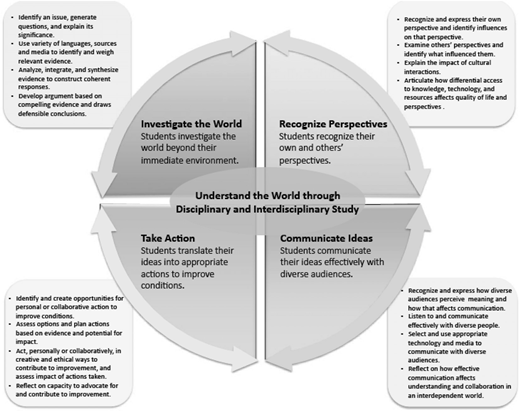
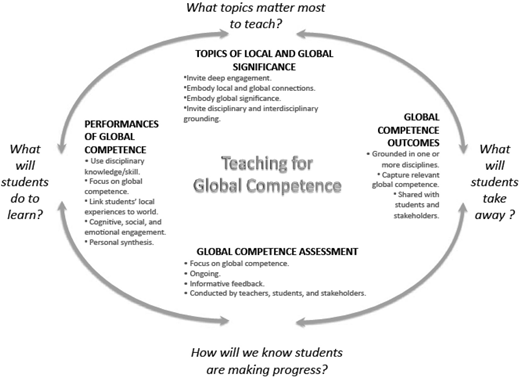
Yet, many recognize that global awareness is not enough—and that global competency is needed. Global competency refers to the knowledge, skills, and dispositions individuals possess, such as “the capacity and disposition to understand and act on issues of global significance” (Mansilla & Jackson, 2011, p. xiii). Figure 1 illustrates global competency and Figure 2 provides an idea of what global teaching entails. These might help offer concrete ideas for examining how this concept might be incorporated into the design and teaching of curricula, training, and professional development
What Is Glocalization?
With the emphasis on globalization, it is easy to forget the need for glocal understanding, or glocalization. Glocalization generally combines ideas associated with globalization with local issues and concerns (“Glocalization,” n.d.). The concept of glocalization, or having a glocal mindset, recognizes there are often many issues and concerns that should be considered and often addressed within one's “home” (wherever that might be) and not just abroad! Championing glocal awareness or even competency shows that one recognizes the importance of one's locality in light of the world around them.
About the author