

Introduction
Not having a high school diploma or its equivalent produces negative outcomes in individuals and society that are mostly related to economy. A person who does not complete high school loses approximately $260,000 in lifetime income compared to one with a high school diploma or general educational diploma (Rouse, 2007). This economic con-sequence may worsen if we consider that dropouts contribute about half as much in taxes as do high school graduates and draw larger government subsidies in the form of food stamps, housing assistance, and welfare (Dynarski et al., 2008). Comparing dropouts with those who complete high school, the average high school dropout costs the economy approximately $209,200 over an individual’s lifetime in terms of lower tax contributions, higher reliance on Medicaid and Medicare, higher rates of criminal activity, and higher reliance on welfare (Levin & Belfield, 2007). The National Center for Educational Statistics has projected 20,392,000 of ninth to 12th graders in the United States during 2013 and with an 8% dropout average (see Figure 1) (Chapman, Laird, Ifill, & Kewal-Ramani, 2011); more than one and a half million of students will leave school without a high school diploma. So if we consider that a cohort of 700,000 high school dropouts has a fiscal consequence of $148 billion in lost taxes revenues and additional public expenditures over the cohort’s lifetime (Levin & Belfield, 2007), the total lost in the Unites States will be more than $300 billion. Thus, something needs to be done to ensure high school graduation and avoid a fiscal crisis in the future.
Elber Alvis, Master’s Student, Nova Southeastern University, 2110 W. Norfolk Street, Tampa, FL 33604. Telephone: (813) 841-1971.
Elber Alvis, Master’s Student, Nova Southeastern University, 2110 W. Norfolk Street, Tampa, FL 33604. Telephone: (813) 841-1971.
A study developed by the Alliance for Excellent Education (2011), indicates that raising educational outcomes not only boosts incomes for individuals who earn degrees, but these individual gains also compound to improve local, state, and national economies. Indeed, improving high school graduation rates represents a great economic stimulus for any state.
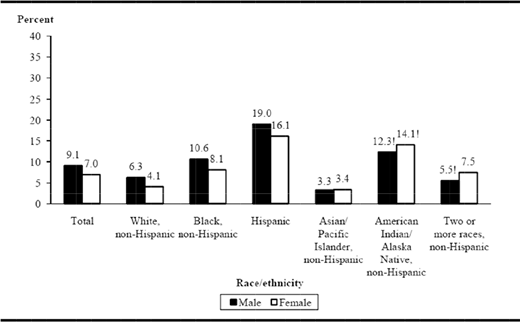
Status dropout rates of 16-through 24-year-olds, by race/ethnicity and sex: October 2009.
Status dropout rates of 16-through 24-year-olds, by race/ethnicity and sex: October 2009.
Consequently, the challenge for school districts and states is to implement interventions to raise high school graduation rates, which in effect is happening around the nation now. Five of those interventions whose effectiveness is supported by research studies are summarized by Levin and Belfield (2007) and shown in Table 1. Another important intervention is cur-rently in progress in the Hillsborough County Public Schools (HCPS), the eighth-largest school system in the country. HCPS is in the midst of a 7-year initiative focused in raising the rate of high school graduation from an initial 82.2% to 90% or more (Hillsborough County Public Schools, 2011). Although these interventions have increased the rate of their high school graduates, no one has reduced the percentage of dropouts to zero. It represents that there are still students who leave school before attaining high school gradu-ation. Therefore, additional effort must be done to reach those individuals without high school diploma that after all become in adults with fewer opportunities for success. Adult education provides educational opportunities and at the same time reduces the amount of dropouts.
Adult Education at HCPS
For more than 60 years, the Adult Education Program has been the major contributor to the educational opportunities to adults in the Hillsborough County. HCPS administers its Adult Education Program under the Division of Curriculum and Instruction and has for its mission to serve the academic, career, leisure, and special needs of students for the life roles they will assume and to enhance the economic development of the community. Each year, this program provides educational opportunities to more than 30,000 individual adult students 16 years or older in th eareas of adult basic education, general educational development (GED), adult high school credit, English for speakers of other languages, citizenship, vocational preparation instruction, workplace readiness skills, and technical career educational opportunities (http://ace.mysdhc.org).
Interventions that Demonstrably Raise the High School Graduation Rate
| Intervention | Details | Extra Graduates if Intervention Given to 100 Students |
|---|---|---|
| Perry Preschool Program (PPP) | 1.8 years of a center-based program for 2.5 hours per weekday, child-teacher ratio of 5:1; home visits; group meeting of parents. | 19 |
| First Things First (FTF) | Comprehensive school reform based on small learning communities with dedicated teachers, family advocates, and instructional improvement efforts. | 16 |
| Chicago Child-Parent Center Program (CPC) | Center-based preschool program: parental involvement, outreach and health/nutrition services. Based in public schools. | 11 |
| Project STAR: class Size reduction (CSR) | 4 years of schooling (Grades K-3) with class size reduced from 25 to 15. | 11 |
| Teacher salary increase (TSI) | 10% increase in teacher salaries for all years, K-12. | 5 |
In order to earn a Florida high school diploma through the general educational development program at HCPS, students, ages 16 to 17, may attend an approved underage GED program and adult students 18 years or older can enroll in a GED class. For placement, all students need to take the Test of Adult Basic Education (TABE). This test is used to evaluate reading, mathematics, and language skills. If students score 9.0 or more, they are placed in the GED program. If not, they are placed in the adult basic education program. After 60 hours of instruction, students are TABE posttested to measure educational gains. When adult basic education students reach the score of 9.0, they are promoted into the GED program. GED classes at HCPS are available in comfortable classroom settings or online. Whichever option students choose, they will receive professional help from certified teachers who assist them in attaining their goals. Once students reach scores 12.0 or more in all three TABE level D (Difficult) subtests, they are referred to one of the six GED testing sites to take the official GED test (http://ace.mysdhc.org).
About The GED Test
The GED, or general educational development, test had its beginnings in the military during World War II. In 1942, Ralph Tyler headed an advisory committee to the Army Institute that selected five tests from the Iowa Test of Educational Development to form the first GED test. In essence, the test was created to certify veterans who had left school to serve the country during WWII. The first GED tests were administered to returning veterans in 1943. In 1947, the state of New York allowed school dropouts who were not veterans to seek their GED credential. Soon after, other states allowed their nonveteran dropouts to take the GED test and, by 1949, 570 GED testing centers across the nation administered the test to 39,000 individuals (Tyler, 2005). In 2009, more than 470,000 individuals were awarded their high school credential (Turner, 2011). According to the American Council on Education nearly 800,000 adults sit for the GED test every year and, during its lifetime, more than 18 million adults have earned their high school credential through the GED. Since the original GED test was released in 1942, the five academic content areas in which candidates are assessed have not changed. They are math, science, social studies, reading, and writing. As secondary educa-tion has evolved, the GED test has too. Four generations of the GED test have circulated, with the current series released in 2002 and a new one coming up in 2014. Today the GED test is accepted by virtually all U.S. colleges and employers and is offered with the same content by the American Council on Education in every one of the 50 states of the United States and 11 provinces of Canada in several different formats and languages including: English, Canadian English, Spanish, Canadian French, Braille, Audio, and Large Print (GED Testing Service, 2012).
Online GED Preparation
Passing the GED tests may require some preparation. Some individuals study GED preparation books and other materials. Others are comfortable with simply brushing up on a few of the subject areas where they need practice. Some candidates prepare intensely by taking face-to-face or online classes at local adult education programs sponsored by school districts, colleges, and community organizations in their area.
Hillsborough County Public Schools offers online GED instruction to students who prefer distance education instead of face-to-face classes. In order to be accepted in one of the online GED classes, students must score 6.0 on the TABE Level D Reading Subtest and 9.0 in a minimum one of the three subtests (Math, reading, or language). Exceptions must be approved by the site administrator with the director’s permission. After registration, students attend an orientation to meet the online instructor and receive a password for login. Once students have logged in, they can work at their own pace in language arts writing, language arts reading, mathematics, science, and social studies. As they move along with the program, assessment is provided to monitor improvement. Two optional lab hours per week is provided to online students for testing and individualized tutoring and/or instruction. Online students must spend approximately 6 hours per week working on the course and submit at least three—preferably five— completed assignments per week. When students are ready to take the official GED test, they are allowed to take two GED practice tests. One is online and the other one is paper based. Students take the Online GED practice test as their schedules allow. For the paper-based test, students schedule a meeting with the instructor in a convenient date during the two lab hours provided by the program.
Characteristics of HCPS Online Learners
According to the Department of Adult Education Teacher Handbook 2012-2013, there are some characteristics of online learners that need to be considered at the time of the enrollment process:
Students should be self-disciplined and self-motivated. The online process takes a real commitment and discipline to keep up with the flow of the process. Students need to understand that with the freedom and flexibility of the online environment comes responsibility.
Students should be open-minded about sharing life, work, and educational experiences as part of the learning process. Students, extroverts and introverts, find that the online process requires them to utilize their experiences. This forum for communication eliminates the visual barriers that hinder some individuals in expressing themselves.
Students should be able to communicate through writing with their teachers. In this virtual classroom, nearly all communication is written through e-mails, so it is critical that learners feel comfortable in using e-mails and expressing themselves through writing.
Students should be willing to “speak up” if problems arise. If students experience difficulty on any level, either with technology or with the course content, they must communicate this immediately. Otherwise the instructor will never know what is wrong.
Students should accept critical thinking and decision making as a part of the learning process. This process requires learners to make decisions based on facts as well as experiences. Assimilating information and executing the right decision requires critical thought.
Students should be able to think ideas through before responding. Meaningful and quality input into the virtual classroom is an essential part of the learning process. Time is given in the process to allow for the careful consideration of responses. Learners will not always be right, but they need to be prepared to accept a challenge.
Students should be will and able to commit to 5 to 7 hours per week per course and do the minimum requirements for the course. Students need to understand that the online course is a convenient way to receive an education, not an easier way. In fact, many stu-dents say that it requires much more time and commitment.
Students should feel that high quality learning can take place without going to a traditional classroom and should plan to complete the course work successfully.
In addition, counselors use an online student survey with 14 questions is used during the registration process as a means to determine whether students are comfortable with using technology for learning.
About the GED Website
In order to get access to the GED online program, HCPS students must type in the address bar of their web browser the URL: http://fatdec.ucompass.com. The word FATDEC found in the URL stands for Florida Adult and Technical Distance Education Consortium. FATDEC is a group of public schools, community colleges, and school districts that are working together to deliver curriculum in an environment for adult education and career and technical pro-grams in Florida’s postsecondary public institutions. FATDEC was formed in March 2001 when six members got together to develop best practices for online instruction, create policies and procedures for distance education system, and design courses and development. The members chose the GED as the first course to place on line. Now FATDEC has 37 members and offers both credit and GED courses. FATDEC courses are delivered via the Internet through a learning management system product called “Educator” by Ucompass.com. Courses are hosted in a secure environ-ment, and each school or district remains autonomous in its admission and registration process (http://www.fatdec.com). Hillsborough County Adult Education uses it only for GED preparation. After new students are registered, the Division of Curriculum and Instruction office enters students into the required course along with assigning them a user name and password. The Online Student Registration List with the user name and password is e-mailed to the instructor, who contacts students with their sign-on information.
Conclusion
Future generations in the United States are in danger with the number of students who drop out of school every year, but great improvement of high school graduation rates is possible. Early educational interventions and adult education have been successful, but there are barriers that need to be defeated in order to fulfill expectations. Online GED gives dropouts the chance they need to improve their lives. Hillsborough County Public Schools has the commitment of equalizing opportunities for underage and adult dropouts by providing meaningful educational programs they can succeed. Online GED enhances the opportunities for those students that are not able to attend face-to-face classes. It provides the flexibility of learning from anywhere at their own pace and 24/7.
