Having a tool that objectively determines the most appropriate delivery method would be a powerful resource in designing learning. For your consideration, we offer the 12-Factor Test.

At one time learning events could take place only in the lecture hall. However, as technology took a permanent seat in the arena of instructional design, course designers began to enjoy an impressive selection of delivery method options that allow them to reach audiences far beyond the physical classroom.

Course designers, for want of both empirical research and universally implemented procedures, generally rely on their own experience, personal preference, and professional judgment when choosing the best delivery method for the particular teaching goals. The shortage of guidance on this subject necessitates a thorough, inter-disciplinary model that facilitates pedagogically sound delivery method decisions.

Our 12-Factor Test attempts to tackle this most pressing challenge–that of objectively weighing distance versus residential delivery. Our test focuses on how best to meet the desired learning objective. We also provide a tool, similarly focused on the learning objective, to hone in on distance options.

Learning objective-based design drives our analysis. Each learning objective is measured by the test. This ensures that the delivery method is tailored to meeting the objective. And, in the case of multiple objectives with different outcomes, the analysis will yield a blended design.

Using an analysis dependent on the learning objective ensures that the purpose of the learning event is fulfilled and the best delivery method is chosen. By allowing the learning objective to guide the analysis, our model produces a delivery method determination tailored to the learning objective.

The 12-Factor Test serves as an objective analysis for determining the ideal delivery method to achieve the learning objective. Our process is particularly helpful in maximizing residential training time by screening the learning objective(s) to distinguish those that require residential delivery from those that can effectively be delivered from a distance. The test evaluates the learning objective in light of 12 distinct factors. The 12 factors address fundamental components of the typical learning event and are divided into three design-related groups (presented in Table 1): content, participant, and facility.

The learning objective is measured against each factor. For each factor, the spectrum ranges from solely residential to solely distance. To quantify the placement of the learning objective within the range of options for a given factor, a 0–10 scale is used. The course designer then evaluates where on the spectrum the particular factor falls relative to the learning objective.

The scores for each factor are then aggregated to provide an overall analysis of the learning objective. The aggregate score recommends the appropriate method of delivery by identifying where the learning objective falls in the spectrum of delivery options. If the test yields a neutral score, then the designer can select the method or use a blended approach.

The ranges and their suggested delivery methods are presented in Table 2.

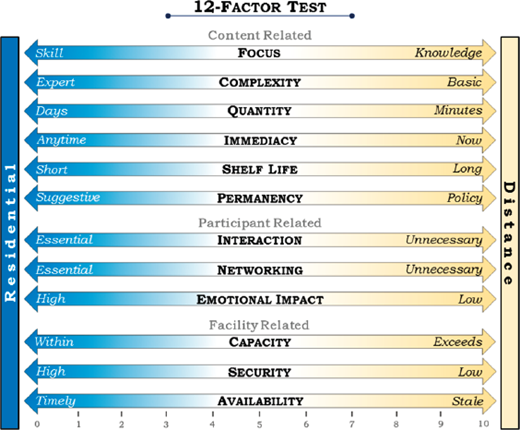
Often, a learning event is designed to meet more than a single learning objective. In that case, each objective is analyzed by the test to receive its own aggregate score. When the test yields different recommendations for delivery, a blended learning approach is called for. Figure 1 illustrates the 12-Factor Test.

Each factor is defined as follows:

  1. Focus. Is the learning more skill- or knowledge-based? The more knowledge-based, the more it favors distance. The more skill-based, the more it favors residential.

  2. Complexity. How advanced is the learning? The more the content is at the expert level, the more it gravitates to residential. The more basic, the more it gravitates to distance.

Table 1

The 12 Factors

ContentParticipantFacility
  • Focus

  • Complexity

  • Quantity

  • Immediacy

  • Shelf life

  • Permanency

  • Interaction

  • Networking

  • Emotional impact

  • Capacity

  • Security

  • Availability

Table 2
Aggregate Factor ScoreRecommendation
0–25Residential
26–49Learning residential
50–70Neutral
71–94Learning distance
95–120Distance
Figure 1

The 12-Factor Test.

Figure 1

The 12-Factor Test.

Close Figure 1
  1. Quantity. How much time must be dedicated to achieve the learning objective? Days suggest residential. Minutes suggest distance.

  2. Immediacy. When does the learning need to occur? If immediately, then distance. The less immediate, the more residential becomes practical.

  3. Shelf Life. How long is the instruction likely to stay accurate or relevant? Longer suggests distance, while shorter suggests residential.

  4. Permanency. Will the learning be perceived as a “best practice” or as a directive or policy? The more permanent the delivery format, the more likely it will be perceived as a directive or policy.

  5. Interaction. Is discussion between faculty and students or among students necessary to meet the learning objective? The more needed, the more residential delivery is suggested.

  6. Networking. Do the participants need to develop peer-to-peer or other professional relationships as part of the learning objective? The more needed, the more residential delivery is suggested.

  7. Emotional Impact. Is there a likely emotional response to the subject matter? The higher the impact, the more the learning should happen in a residential format.

  8. Capacity. Does fulfilling the learning need exceed the physical capacity of the facility that would be used? The more offerings it would take to meet the need, the more distance is favored.

  9. Security. Does the content involve information warranting protection from disclosure to unintended audiences? The greater the security needed, the more the learning leans toward residential.

  10. Availability. Under current training priorities, when can the event reasonably be scheduled? The longer the delay, the more distance is favored. This factor may include human capital limitation considerations as well.

In the event that the designer or others involved in the decision-making process take issue with the result of the test, at a minimum, the test narrows the focus to a specific factor (or subset of factors). Instead of a debate using nebulous terms like “my gut tells me” or “in my experience,” the test creates a foundation for discussion based on objective factors.

When the 12-Factor Test yields a distance delivery finding for the learning objective, the designer then needs to consider the various methods of distance delivery. We propose considering seven attributes for picking the type of distance method. This evaluation is an objective approach and evaluates the needs of the learning objective against the capacities of the four types of distance delivery methods. We divide distance delivery into four categories (see Figure 2).
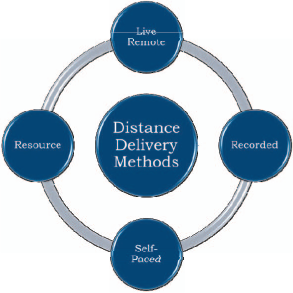
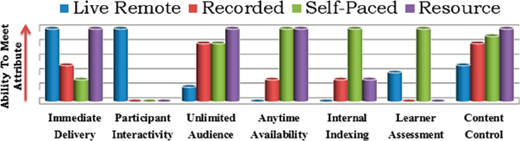
Figure 3

Delivery attribute considerations by method.

Figure 3

Delivery attribute considerations by method.

Close Figure 3

Live Remote delivery is real-time presentation with learners and instructors at more than one location. This method may include direct or indirect interaction between learners and instructors or between the learners themselves (e.g., watching a live webinar).

Recorded delivery is original content or recording of a previously live event delivered through a video file. Video can be analog, digital, optical, or encoded (e.g., watching a prerecorded webinar).

Self-paced delivery is content delivered with the pace controlled solely by the learner (e.g., performing a “click-and-go” learning experience).

Resource is printed content (both physical and electronic) (e.g., reading this article).

With these definitions in mind, the designer will then determine the best distance delivery method using the seven-attribute analysis. The attributes are: (1) Immediate Delivery, how soon the learning can be pushed out, (2) Participant Interactivity, the ability to interact among the participants, (3) Unlimited Audience, attendee capacity limitations, (4) Anytime Availability, attendance timing flexibility, (5) Internal Indexing, ability to bookmark content items, (6) Learner Assessment, ability to assess learning, and (7) Content Control, effective ability to prevet content. Figure 3 analyzes the ability of each form of distance delivery against each other over seven attributes:

When more than one learning objective is involved, each objective should be analyzed separately. When the results are different, blended distance learning is called for.

Determining the appropriate delivery method is paramount in developing learning events that fulfill learning objectives. Although the course designer is met with various elements to consider, the analysis does not have to be a treacherous one. We propose that you consider this model for making an objective analysis of delivery options.

A photograph of Scott Andrew Farrow
Chief Learning Officer, Executive Office for United States Trustees, United States Department of Justice, 1620 Pendleton Street, Columbia, SC 29201. Telephone: (803) 705-5131.

A photograph of Carmel Matin.
Attorney and freelance editor.

The authors’ views do not necessarily represent the views of the agency or the United States.

Abdous
,
M.
(
2013
).
Toward a taxonomy of distributed learning delivery modes
.
International Journal of Instructional Technology and Distance Learning
,
10
(
12
),
3
–
18
.
Anderson
,
M. D.
, &
Connell
,
M.
(
2009
).
Traditional versus online content delivery and assessment
.
International Journal of Instructional Technology and Distance Learning
,
6
(
2
).
Anderson
,
M.
(
2011
).
Crowdsourcing higher education: A design proposal for distributed learning
.
Journal of Online Learning and Teaching
,
7
(
4
),
576
–
590
.
Aworuwa
,
B.
, &
Owen
,
R.
(
2009
). Learning outcomes across instructional delivery modes. In
P.
Rogers
,
G.
Berg
,
J.
Boettcher
,
C.
Howard
,
L.
Justice
, &
K.
Schenk
(Eds.),
Encyclopedia of distance learning
( (2nd) ed., pp.
1363
–
1368
).
Hershey, PA
:
Information Science Reference
. doi:
Berk
,
R. A.
(
2010
).
How do you leverage the latest technologies, including Web 2.0 tools, in your classroom?
International Journal of Technology in Teaching and Learning
,
6
(
1
),
1
–
13
.
Brinthaupt
,
T. M.
,
Clayton
,
M. A.
,
Draude
,
B. J.
, &
Calahan
,
P. T.
(
2014
).
How should I offer this course? The course delivery decision model (CDDM)
.
Journal of Online Learning and Teaching
,
10
(
2
),
326
–
336
.
Chin
,
S. T.
, &
Williams
,
J. B.
(
2005
).
A theoretical framework for effective online course design
.
Retrieved from
http://jolt.merlot.org/05007.htm
De Gagne
,
J. C.
, &
Walters
,
K.
(
2009
).
Online teaching experience: A qualitative metasynthesis (QMS)
.
Journal of Online Learning and Teaching
,
5
(
4
),
577
–
589
.
DePaul University
.
(n.d.)
.
Teaching commons. Principles of course design
.
Retrieved from
http://teachingcommons.depaul.edu/Course_Design/developing_a_course/design.html
Dunn
,
J.
(
2013
).
Why teachers should use education technology
.
Edudemic
.
Retrieved from
http://www.edudemic.com/teachers-use-education-technology/
Fehr
,
D.
(
2014
,
March
).
Faculty financial incentives/disincentives in online education
.
Retrieved from
http://www.aabri.com/manuscripts/141947.pdf
Fink
,
L. D.
(
2003
).
A self-directed guide to designing courses for significant learning
.
Retrieved from
http://www.deefinkandassociates.com/GuidetoCourseDesignAug05.pdf
Frazier
,
L. C.
, &
Sadera
,
W. A.
(
2013
).
Distance education in teacher preparation programs: A national study
.
International Journal of Technology in Teaching and Learning
,
9
(
2
),
112
–
138
.
Gardner
,
J.
(
2009
).
A framework for understanding instructional design contexts
.
International Journal of Instructional Technology and Distance Learning
,
6
(
7
).
Greenhow
,
C.
,
Robelia
B.
, &
Hughes
J. E.
(
2009
).
Learning, teaching, and scholarship in a digital age: Web 2.0 and classroom research: What path should we take now?
Educational Researcher
,
38
(
4
),
246
–
259
.
Holbein
,
M. F.
(
2008
)
From traditional delivery to distance learning: Developing the model
.
International Journal of Instructional Technology and Distance Learning
,
5
(
8
).
Humphreys
,
A. H.
, &
Konomos
,
P.
(
2010
).
Student perspectives on campus-based versus online courses
.
International Journal of Instructional Technology and Distance Learning
,
7
(
8
).
Icard
,
B.
(
2013
).
Advantages and disadvantages of distance education
.
International Journal of Instructional Technology and Distance Learning
,
10
(
10
),
53
-
60
.
Keebler
,
D. W.
(
2009
).
Online teaching strategy: A position paper
.
Journal of Online Learning and Teaching
,
5
(
3
),
546
–
549
.
Keengwe
,
J.
, &
Kidd
,
T.
(
2010
).
Towards best practices in online learning and teaching in higher education
,
Journal of Online Learning and Teaching
,
6
(
2
),
534
–
535
.
Konetes
,
G. D.
(
2009
).
The organizational, governmental and external political forces shaping distance education
.
International Journal of Instructional Technology and Distance Learning
,
6
(
1
).
Lai
,
K.
(
2011
).
Digital technology and the culture of teaching and learning in higher education
.
Australasian Journal of Educational Technology
,
27
(
8
),
1263
–
1275
.
Levy
,
S.
(
2003
).
Six factors to consider when planning online distance learning programs in higher education
.
Online Journal of Distance Learning Administration
,
6
(
1
).
Lieb
,
S.
(
2010
).
Principles of adult learning
.
Retrieved from
http://www.life-slc.org/learningprinciples/Principles_of_Adult_Learning.pdf
Liu
,
L.
(
2011
).
Factors influencing students’ preference to online learning: Development of an initial propensity model
.
International Journal of Technology in Teaching and Learning
,
7
(
2
),
93
–
108
.
Meyer
,
K. A.
(
2005
).
Exploring the potential for unintended consequences in online learning
.
International Journal of Instructional Technology and Distance Learning
,
2
(
9
).
Mossavar-Rahmani
,
F.
, &
Larson-Daugherty
,
C.
(
2007
).
Supporting the hybrid learning model: A new proposition
.
Journal of Online Learning and Teaching
,
3
(
1
),
67
–
78
.
Mödritscher
,
F.
(
2006
).
The impact of e-learning strategy on pedagogical aspects
.
International Journal of Instructional Technology and Distance Learning
,
3
(
3
).
Nguyen
,
T. T.
(
2010
).
Online or not online: Into the 21st century education
.
International Journal of Instructional Technology and Distance Learning
,
7
(
11
).
Owen
,
R.
(
2004
).
Modeling cost trade-offs between traditional and technology-based course delivery
.
Center for Distance Learning Research
.
Poon
,
J.
(
2013
).
Blended learning: An institutional approach for enhancing students’ learning experiences
.
Journal of Online Learning and Teaching
,
9
(
2
),
271
–
288
.
Porto
,
S.
, &
Aje
,
J.
(
2004
).
A framework for operational decision-making in course development and delivery
.
Online Journal of Distance Learning Administration
,
7
(
2
).
Power
,
M.
(
2008
).
The emergence of a blended online learning environment
.
Journal of Online Learning and Teaching
,
4
(
4
),
503
–
514
.
Project Management Institute
.
(n.d.)
.
Learning outcomes and objectives
.
Retrieved from
http://www.pmi.org/~/media/PDF/Professional-Development/Learning_outcomes_and_objectives.ashx
Roehrs
,
C.
,
Wang
,
L.
, &
Kendrick
,
D.
(
2013
).
Preparing faculty to use the quality matters model for course improvement
.
Journal of Online Learning and Teaching
,
9
(
1
),
52
–
67
.
Saghafian
,
M.
A critical review of research on technology-based training in business organizations
.
Retrieved from
http://www.aabri.com/manuscripts/10632.pdf
Santally
,
M. I.
(
2009
).
Informing the design of personalized learning environments through iterative analysis of learner interaction and feedback
.
International Journal of Instructional Technology and Distance Learning
,
6
(
7
).
Schmieder
,
E. J.
(
2008
).
You can’t teach that online: A proposal for consistency
.
International Journal of Instructional Technology and Distance Learning
,
5
(
9
).
Sela
,
O.
(
2010
).
The power of the model: One step towards developing blended learning courses in higher education
.
Journal of Online Learning and Teaching
,
6
(
4
),
820
–
827
.
Slatinsky
,
D.
(
2013
).
Synchronous or asynchronous? How to pick your training delivery method
.
Learning Solutions Magazine
.
Retrieved from
http://www.learningsolutionsmag.com/articles/1197/synchronous-or-asynchronous-how-to-pick-your-training-delivery-method
Stanford University
.
(n.d.)
.
Why use technology in teaching?
Retrieved from
https://teachingcommons.stanford.edu/resources/teaching-resources/technology-teaching/why-use-technology-teaching
Steen
,
H. L.
(
2008
).
Effective eLearning design
.
Journal of Online Learning and Teaching
,
4
(
4
),
526
–
532
.
Taylor
,
A.
(
2014
).
A look at web-based instruction today: An interview with Badrul Khan, part 1
.
eLearn Magazine
.
Retrieved from
http://elearnmag.acm.org/archive.cfm?aid=2590180
Teo
,
C. B. T.
,
Chang
,
S. C. A.
, &
Leng
,
R. G. K.
(
2006
).
Pedagogy considerations for e-learning
.
International Journal of Instructional Technology and Distance Learning
,
3
(
3
).
The Learning Management Corporation
.
(n.d.)
.
Developing clear learning outcomes and objectives
.
Retrieved from
http://www.thelearningmanager.com/pubdownloads/developing_clear_learning_outcomes_and_objectives.pdf
The University of New Mexico School of Medicine
.
(n.d.)
.
Effective use of performance objectives for learning and assessment
.
Retrieved from
http://ccoe.rbhs.rutgers.edu/forms/EffectiveUseofLearningObjectives.pdf
The University of Wisconsin-Madison
.
(n.d.)
.
Asynchronous vs. synchronous
.
Retrieved from
https://tle.wisc.edu/blend/facilitate/communicate
Weerasinghe
,
T. A.
,
Ramberg
,
R.
, &
Hewagamage
,
K. P.
(
2009
).
Designing online learning environments for distance learning
.
International Journal of Instructional Technology and Distance Learning
,
6
(
3
).
Willis
,
J.
(
2005
).
Culture, context, and the diffusion of technology in education
.
International Journal of Technology in Teaching and Learning
,
1
(
1
),
9
–
18
.
Zhang
,
P.
, &
Goel
,
L.
(
2011
).
Is e-learning for everyone? An internal-external framework of e-learning initiatives
.
Journal of Online Learning and Teaching
,
7
(
2
),
193
–
205
.
Licensed re-use rights only

or Create an Account

Close subscription notice
Close access options