Introduction
The demand for online courses and programs continues to rise as more learners are looking for flexible learning options to meet their needs. Despite declining levels seen in overall enrollment, distance education enrollments are steadily growing (Seaman, Allen, & Seaman, 2018). Along with this demand and increase, however, comes a concern of quality among online courses. Quality is conceptually very subjective and there are many ways that quality can be assessed (McCroskey, Kovach, Ding-Miertschin, & O’Neil, 2011). Within higher education, instructors can determine how to assess and evaluate their courses for quality and for improvement. One of the most recognized standardized programs for quality assurance in online education is Quality Matters (McCroskey et al., 2011; Quality Matters, 2016a). The Virtual Campus at Indian River State College implemented the QM standards to assure quality in their online and blended courses. In addition, the Virtual Campus has integrated a master course model design, faculty development and training programs, and several support resources to not only ensure quality for their courses and programs, but also, to promote the overall success of Virtual Campus students.
Overview of Indian River State College
Indian River State College (IRSC) is a nonprofit, 4-year degree granting institution located on the Treasure Coast in Florida. IRSC has five campus sites in four counties; the Main Campus in St. Lucie County, the Pruitt Campus in St. Lucie County, the Mueller Campus in Indian River County, the Chastain Campus in Martin County, and the Dixon Hendry Campus in Okeechobee County. Governed by the District Board of Trustees, IRSC provides affordable educational programing to approximately 29,000 students annually. IRSC offers several degrees and programs including baccalaureate degrees, associate in arts, associate in science, associate in applied science, and a variety of technical certificate and adult education programs (Indian River State College, 2010a). Due to the increasing need for more flexible learning options, IRSC launched an advanced center to deliver web-based educational content and programs to its student population.
Accreditation
According to the IRSC (2010b) website, “Indian River State College is accredited by the Southern Association of Colleges and Schools Commission on Colleges” (para. 5). Additionally, IRSC has program specific accreditations including the commission on dental accreditation for the dental hygiene program, the commission on accreditation of allied health education programs for the emergency medical services program, the commission on accreditation for health informatics and information management education, the commission on accreditation of allied health education programs, the national accrediting agency for clinical laboratory sciences, the accreditation commission for education in nursing, the commission on accreditation in physical therapy education, the joint review committee on education in radiologic technology, and the commission on accreditation for respiratory care (IRSC, 2010b).
Mission and Goals
IRSC is committed to “creating a superior teaching and learning environment, cultivating student success, embracing diversity, stimulating economic growth, developing a highly skilled workforce, building partnerships to expand opportunities, and providing cultural enrichment and lifelong learning” (IRSC, 2010c, para. 1).
The mission of IRSC is fulfilled through the following goals:
student access and success.
fiscal resources.
student development and satisfaction.
physical resources.
educational programs.
workforce development.
cultural diversity.
economic development.
technology.
employee development (IRSC, 2010c, para. 1)
Indian River State College Virtual Campus
The IRSC Virtual Campus was created in 2013 and currently “serves as the central agent for online learning” at the institution (About IRSC, 2010a, para. 2). The virtual campus seeks to meet the needs of the ever-changing student population as well as overcoming the many challenges associated with rapidly advancing technologies. Their goal is “to be leaders in the application of new, leading-edge technologies for learning (Virtual Campus, 2010a, para. 3).
Leadership
According to Simonson, Smaldino, and Zvacek (2015), institutions that engage in distance education should have the proper administrative personnel who is qualified to lead and direct the distance education operations within the institution. The IRSC Virtual Campus falls under the direct leadership of the vice president of institutional technology and the assistant dean of the virtual campus (see Figure 1). Since its inception, the IRSC Virtual Campus has expanded its leadership professionals to include 19 key personnel: a dean, a director, five instructional designers, three course developers, two project coordinators, two e-Learning technologists, and five video production specialists (A. Moore, personal communication, April 5, 2018). The collaborative efforts of these stakeholders have allowed the virtual campus to expand, offering more distance education resources and opportunities to enrolled students.
 The organizational chart begins with a top box labeled Vice President of Institutional Technology comma CIO Paul O’Brien. Below are two connected boxes. The left box reads Information Security Committee. The right box reads Web Services D. Gibbons. A line extends across five lower boxes. From left to right the first box reads Assistant Dean of Enterprise Systems M. Coughlin. The second box reads Assistant Dean of Virtual Campus K. S. Hains. A connected box below this reads Director of E Learning Technology R. Latell. The third box reads Director of Network Technology M. Gibbons. The fourth box reads Director of Educational Media C. Purasch.
Indian River State College organizational chart, 2017–2018.
The organizational chart begins with a top box labeled Vice President of Institutional Technology comma CIO Paul O’Brien. Below are two connected boxes. The left box reads Information Security Committee. The right box reads Web Services D. Gibbons. A line extends across five lower boxes. From left to right the first box reads Assistant Dean of Enterprise Systems M. Coughlin. The second box reads Assistant Dean of Virtual Campus K. S. Hains. A connected box below this reads Director of E Learning Technology R. Latell. The third box reads Director of Network Technology M. Gibbons. The fourth box reads Director of Educational Media C. Purasch.Indian River State College organizational chart, 2017–2018.
Virtual Campus Courses and Degree Programs
Allen and Seaman (2017) reported that the pattern of growth for distance education has continued to rise and that the higher education sector has seen about a 4% increase from the previous year. Additionally, approximately 30% of learners enrolled in higher education courses are taking at least one online course. In order to respond to this increase, the Virtual Campus at IRSC offers several affordable and flexible options for learners. There is a total of 12-degree programs that learners can complete entirely online. These programs include:
associate in arts degree;
associate in science degree in business administration;
associate in science degree in computer information technology;
associate in science degree in health information technology;
bachelor’s degree in business administration;
bachelor’s degree in criminal justice;
bachelor’s degree in exceptional student education/esol endorsement;
bachelor’s degree in information technology management/cyber security;
bachelor’s degree in middle grades mathematics education;
bachelor’s degree in nursing;
bachelor’s degree in organizational management;
bachelor’s degree in public administration (with concentrations in emergency planning and management and public policy and leadership).
In addition to the 12 online degree programs, the IRSC Virtual Campus offers over 100 courses that can be completed entirely online (Virtual Campus, 2010d).
Technology Requirements for Online Learning
The computer requirements for virtual campus students include an Internet browser such as Microsoft Internet Explorer, Firefox, Chrome, or Safari, as well as plug in requirements including Java for file uploads and Adobe Flash for webcam recordings and video viewing. Many of the features and functionality of the BlackBoard Learning Management System (LMS) require additional plugins. Additionally, online learners are encouraged to download the BlackBoard mobile learn app so that course content can be accessed from anywhere at any time with a mobile device (Virtual Campus, 2010b).
Course Design Process
The virtual campus at Indian River State College uses two models to design and develop their online courses. The ADDIE model and the master course model. The ADDIE model is one of the traditional models for instructional design and is the foundation for many other instructional design models (Reiser & Dempsey, 2012). The ADDIE model is used as a systematic approach to instructional design. The five phases of the ADDIE model are analysis, design, development, implementation, and evaluation (Reiser & Dempsey, 2012). The virtual campus utilizes the ADDIE model in their course design process to ensure that the design of online courses is both systematic and effective.
The master course model is a concept in where instructional designers, course developers, and subject matter experts’s collaborate to design a master course. This course can be replicated into multiple sections and taught by multiple instructors, reliably and continually (Hill, 2012). The virtual campus utilizes a master course model and collaborates with members of the virtual campus team to create storyboards and instructional materials. A master course model allows the virtual campus to produce courses that are consistent, have an organized structure, and appearance (A. Moore, personal communication, April 5, 2018). The master course model serves as a template and design model for virtual campus courses therefore the layout for course components is always consistent.
Learning Management System
Virtual Campus courses and degree programs are delivered through the Blackboard learning management system (see Figure 2). Learning management systems are designed for the effective delivery of educational content, typically in the form of full courses. Using a learning management system allows the virtual campus to meet the needs of online students by creating a properly designed distance education environment.
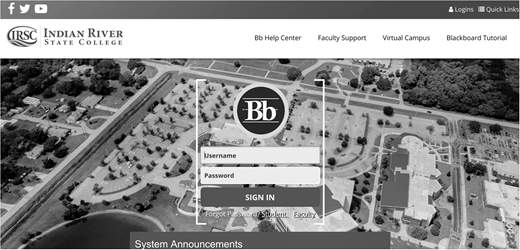
IRSC Blackboard Student Login Screen.
IRSC Blackboard Student Login Screen.
The Blackboard LMS allows virtual campus students to interact with each other and the system asynchronously from various geographic locations (Reiser & Dempsey, 2012). All courses at IRSC require either instructor or student interaction with the Blackboard LMS. Hence, IRSC’s online, blended, and face to face courses integrate the LMS within the design of the courses in order to support formal and cooperative learning as well as promote consistency, reliability, and quality among all courses, regardless of delivery method.
Quality Matters
In 2003, a consortium of professionals dedicated to online education, called MarylandOnline, Inc. sought to create a process in which online courses would be of the same quality regardless of educational content (Quality Matters, 2016a). From this the Quality Matters or QM Program was formed. With the help of the Fund for the Improvement of Postsecondary Education grant, a grant for the improvement of postsecondary education, Quality Matters was able to develop a standardized rubric and a peer review process that can be replicated among all institutions nationwide (Lowenthal & Hodges, 2015). Now a nationally recognized certifying organization, Quality Matters has over 60,000 subscribing members.
Quality Matters is a faculty-centered peer review process that is based on the Community of Inquiry Framework. The community of inquiry framework has been used to conceptualize community in the context of the online environment, specifically, online discussions (deNoyelles, Zydney & Chen, 2014). According to Garrison, Anderson, and Archer (2000), the community of inquiry framework has three elements that contribute to a successful educational experience; social presence, cognitive presence, and teaching presence. As a part of the course design process, the Virtual Campus at IRSC utilizes the QM rubric to ensure course quality, equivalency, and consistency.
The QM Rubric
The QM rubric is an evaluative tool used to assess online programs and courses. It can also be used as a model for effective course design (Simonson et al., 2015). In 2012, the virtual campus integrated the QM rubric as a part of the course design process (A. Moore, personal communication, April 5, 2018). The QM rubric consists of eight general standards and 43 specific review standards to be incorporated as a way to ensure course quality and consistency. The eight general standards are:
course overview and introduction;
learning objectives;
assessment and measurement;
instructional materials;
course activities and learner interaction;
course technology;
learner support; and
accessibility and usability (Lowenthal & Hodges, 2015, p. 86).
The QM rubric should be used by instructional designers and course developers to create courses based on the standards at the onset of the design process. The rubric is also used as a course assessment tool when evaluating if a course meets the standards and in what areas the course can be improved (Quality Matters, 2016b).
QM Courses
All courses that are a part of a virtual campus degree program are nationally certified through QM. By using a consistent design and format, virtual campus students are able to focus on course content and actively learning. The virtual campus has dedicated a significant amount of time and financial resources in order to properly integrate the QM standards into virtual campus courses (A. Moore, personal communications, April 5, 2018). The virtual campus hopes that the integration of the QM rubric will lead to better alignment between course objectives, activities, and assessments.
Best Practices for Online Teaching
The virtual campus has created best practices for online teaching and learning aligned with the QM standards. The best practices are stated as:
Etiquette expectations—also known as netiquette. These are expectations that guide instructors in explaining how learners are to communicate in the course.
Response time and feedback—faculty at IRSC are encouraged to keep learners engaged by providing substantial feedback in a timely manner. The instructor is responsible for providing the learner with information regarding feedback and response times in the course syllabus.
Minimum technology requirements— faculty should clearly list the technology requirements that learners will be required to obtain and utilize throughout the course.
Minimum technical skills—students need a variety of technical skills to be successful in online courses. Some of these skills include properly using the LMS, downloading and installing software, using spreadsheets, word processing, and presentation programs.
Course grading—assessments are a critical indicator of student success. Instructors are encouraged to clearly describe the grading policies and how grades are calculated (Virtual Campus, 2010).
Peer Review Process
All virtual campus courses that are QM certified must go through an internal and external peer review process (see Figure 3).
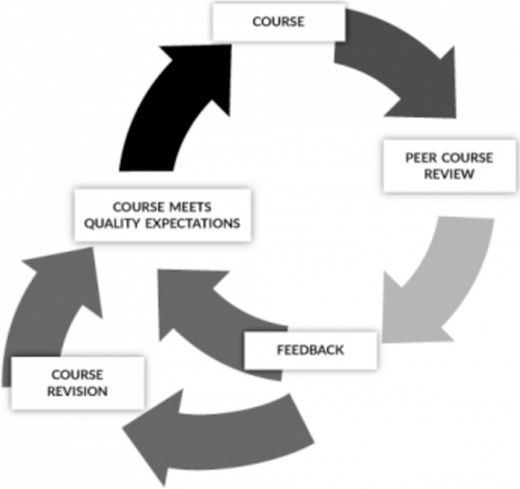
Virtual campus instructors are required to complete the QM training and peer review certification program. To become a certified peer reviewer, instructors must take the Applying the QM Rubric workshop and the Peer Reviewer Course. The virtual campus course at IRSC are reviewed internally by faculty members who are QM certified and approximately 20% of the virtual campus courses are sent to be externally reviewed and certified by QM (A. Moore, personal communication, April 5, 2018). After a course is submitted for external review, a team of peer reviewers will evaluate the course against the standards and provide feedback. The course has to meet the standards at 85% quality level or better to receive certification (Quality Matters, 2016c).
Faculty Development
The qualifications that the virtual campus faculty hold is critical to their success as online instructors. Institutions should have guidelines to direct the instructional practices of online instructors and they can aid faculty in improving online instructional practices by offering training and technological resources (Simonson et al., 2015). The IRSC Virtual Campus offers technology training as well as virtual campus instructor training courses to improve the success of online faculty members. Virtual Campus faculty, as well as other institutional faculty, are provided a variety of professional development opportunities throughout the academic year. Additional professional development opportunities are available for faculty members through the Institute for Academic Excellence. The Institute for Academic Excellence is a center for faculty exploration, inquiry, and reflection. The institute collaborates with the employee development program and the Virtual Campus to provide opportunities for faculty to pursue excellence in instructional pedagogy and learning (Institute for Academic Excellence, 2010). There are many challenges that exist for instructors who are developing courses and teaching in an online environment (Walters, Grover, Turner & Alexander, 2017). Designing meaningful professional development programs for virtual campus instructors allows for improvements in instructor satisfaction as they transition from traditional course delivery methods to distance education.
Virtual Campus Instructor Training (VCIT)
The virtual campus offers a training and professional development course for any faculty or staff member who is considering online instruction. The Virtual Campus Instructor Training (VCIT) course includes the following topics: online pedagogy, best practices, plagiarism, netiquette, online behavior, and LMS fundamentals (Virtual Campus, 2010c). The VCIT course provides an opportunity for online instructors to further their knowledge as online instructors and participate in a collaborative learning experience with other instructors who are transitioning into the online environment.
Technology Training
As technology continues to rapidly advance, the training needs of online faculty members at the virtual campus broaden. In order to address these needs, the virtual campus and the institute for academic excellence offers technology training opportunities for faculty. The trainers assist with one on one trainings, as well as, technology centered workshops and open labs. Faculty are provided resources and trainings in several areas including Echo360, BlackBoard Collaborate, BlackBoard instructional video series, grade center training, as well as assistance with Web 2.0 tools and presentation tools such as smart boards, Prezi, Camtasia, Weebly, Microsoft Office applications, and the green screen for video production (Virtual Campus, 2010c).
Student Retention and Success
The virtual campus at IRSC is committed to student retention and student success. The virtual campus provides numerous resources to support online students and reduce some of the barriers experienced by distance education learners. By providing these resources, online students are better equipped to meet the demands of online education. Some of the resources provided by the virtual campus to learners include a student success guide, virtual campus information sessions in each semester, BlackBoard LMS support guides, videos, and tutorials (Virtual Campus, 2010e). In addition, there are several virtual campus initiatives that are currently underway to help support students including a new online proctoring service for distance learners, the Complete Florida initiative, and an Open Educational Resource initiative. The OER initiative was started in 2016 as a response to the increasing cost of textbooks. The virtual campus, faculty members, and librarians are investing in this initiative in hopes that the cost savings and open access to course materials will show eventual improvements in success rates.
Conclusion
In order to address the needs of distance education students, the Virtual Campus at IRSC has taken steps to not only ensure that Virtual Campus courses are of good quality, but also that they are consistent and highly organized. By aligning online courses with the QM rubric and designing them using a Master Course Model, the Virtual Campus is able to deliver their online courses and degree programs to distance education students in a more structured and reliable way. The Virtual Campus at IRSC hopes that this rigorous course design combined with the skills and expertise of certified online faculty, will ultimately improve student success and retention at the institution.
The virtual campus hopes that its rigorous course design combined with the skills and expertise of certified online faculty will ultimately improve student success and retention.
About the author