Introduction
Online education is quite popular in postsecondary institutions and the increased use of the internet has changed how courses are being taught. Many working adults find it convenient to complete courses while they keep a fulltime job to support their family. Online education increases opportunities for additional certification to gain new or additional skills, training opportunities, and enhance current skills, which leads to increased production and/or job performance, which would eventually result in improvement of the economy. Buchanan (2012) claimed that having educated citizens means more productive work and improvement in the economy. There are a number of issues to address when planning for online instruction, but this paper will focus on the role of the learner, instructor/teacher, and the curriculum; discuss the status of online education mainly on Montserrat; and discuss its pros and cons.
Brief History of Montserrat
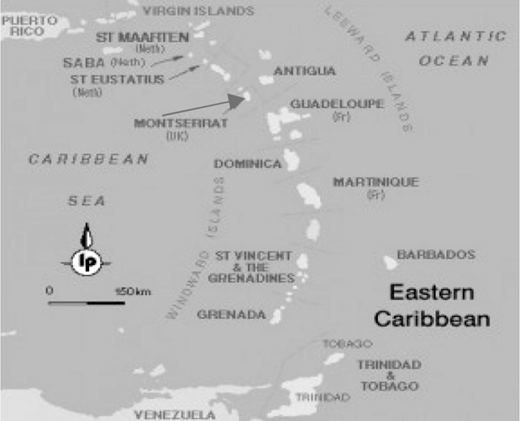
Montserrat, a United Kingdom territory, is known as the Emerald Isle of the Eastern Caribbean. It is 102 square kilometers (39 square miles) and has a population of approximately 5,000. Montserrat is also a member of the Organization of the Eastern Caribbean States and is located in the Leeward Islands between Antigua, Nevis, and Guadeloupe. The native people are of African and Irish descent and the main language spoken is English.
Education is of great importance to Montserratians, and it is free and compulsory for primary (5–11 year olds), and for secondary (11–16+) school children. Currently there are four elementary schools (two public and two private), one secondary school, and one community college on Montserrat. There is also a University Center, which is a branch of the University of the West Indies School of Continuing Studies, where students can pursue a bachelor’s degree or master’s degree at a distance.
Highest Education of Population 15 Years and Older
| Age Group | Preprimary | Junior Secondary | Preuniversity/ Postsecondary | University |
|---|---|---|---|---|
| 15–19 years | 5 | 263 | 43 | 2 |
| 20–29 | 15 | 330 | 143 | 71 |
| 30–39 | 38 | 313 | 160 | 136 |
| 40–49 | 117 | 365 | 123 | 164 |
| 50–59 | 309 | 110 | 98 | 98 |
| 60–69 | 290 | 49 | 64 | 64 |
| 70 and over | 278 | 20 | 35 | 37 |
| Total | 1,052 | 1,450 | 666 | 572 |
Source: Statistics Department of Montserrat (2012).
Overview of the Montserrat Community College
On July 18, 1995, volcanic activity began on Montserrat and disrupted the lives of the inhabitants and the education system, especially postsecondary education. In 1996, when volcanic activities increased, there was a massive exodus of people from the island and more than half of the population migrated to other Caribbean islands, United States, Canada, and the majority to the United Kingdom. Student enrollment dropped tremendously and the Montserrat Technical College (now the Montserrat Community College) closed until it resumed operation in September 2004.
Every college has a mission statement that gives the college’s purpose and primary goals. The Montserrat Community College’s mission is to “provide access to postsecondary and continuing education that will enhance personal, intellectual and professional growth and motivate students toward lifelong learning” (Montserrat Community College, n.d., Mission). The college also promised to provide creative programs that will incite the right attitudes, knowledge and skills required for response to the “social and economic development needs of Montserrat and the wider world” (Montserrat Community College, n.d., Mission).
When the Montserrat Community College reopened September 6, 2004, it offered advanced level program to 30 full-time students and a part time program in office administration and principles of business to 34 students. According to the college’s website the college currently prepares student for Caribbean Advanced Proficiency Exams in the following subjects: tourism studies, entrepreneurship, management studies, accounts, economics, sociology, literature, information technology, computer science, digital media, physics, chemistry, biology, pure mathematics, and applied mathematics. It also offers technical and vocational education courses in introduction to construction and introduction to cosmetology. All of these courses are still being offered in a traditional face-to-face setting full time during the day and part time in the evenings.
Pros and Cons of Distance Education at the Montserrat Community College
A few educators with connections to the Montserrat Community College were contacted for an interview concerning what they think are the pros and cons of having online programs at the Montserrat Community College. Of the two that consented one wished to be referred to as a former educator instead of using his name. The tourism officer of the Organization of Eastern Caribbean States (OECS) commission was also contacted via email for an update on the Eastern Caribbean Institute for Tourism (ECIT) program. Most of the information concerning the ECIT program was extracted from the YouTube video of OECS and Eastern Caribbean Institute of Tourism Partnership Agreement signing ceremony (OECSTV, 2016).
When asked about the pros and the cons of online education for the Montserrat Community College, a former educator on Montserrat claimed that it will allow those who are employed to study in their own time; that the stakeholders would need to look at the ability to engage instructors who are able to communicate effectively with students not only online but via telephone; and that the college will have to acquire the services of a consultant to determine the type of courses that can be effectively held online and who is going to teach them, and also decide if the courses will be available for just college age students or the entire working population. However, it should be more economically viable if everyone can access these courses because online in this case means unlimited access to any number of students, and there must be sufficient teachers to provide the necessary support for all the learners.
One major disadvantage the educator mentioned is finance for the initial set up of the program. However, he said that the hiring of teachers should not pose a problem because if the program is set up properly, the college can solicit the services of the qualified overseas diaspora. There will be a need for technicians to manage the WiFi and electricity system on Montserrat to ensure a smooth running of the program because stability and reliability of the Internet is important. The educator also noted that online education is not suited for every student, and that there are those who may prefer the classroom situation versus the online setting, and that it is really a choice. He also stated that the main issue would be having a reliable phone system for those who choose this mode of study, and that the direction in which academia is going now shows evidence of a major push toward self-study and that even in the traditional classroom students are steered toward more personal work and instructors are no longer lecturing but have more interactive sessions.
In an interview with Dr. Gregory Julius, director of education, he mentioned that some of the students that attend the Montserrat Community College full time complete their advanced level courses before applying to the University of the West Indies or other colleges while others work and attend classes in the evenings part time. However, in both cases all of the courses are taught face to face. Dr. Julius is quite optimistic that online education is feasible for the Montserrat Community College, and said in his interview that it will allow students who are unable to attend college full time the opportunity to complete their education online while they work and that online learning encourages interaction between lecturers and learners outside scheduled class time. He also speculated that the onsite set up, class schedules, and technical issues can be setbacks and should be taken into consideration.
Distance education is not new to the Montserrat Community College. In the interview with Dr. Gregory Julius, he said that in 2016 about eight secondary school teachers earned a diploma in education through the Montserrat Community College in collaboration with the University of the West Indies, Mona Campus in Jamaica, and that some of the instructors on Montserrat taught some of the courses. The director also added that his department is in the process of working with other community colleges in neighboring islands like Antigua/Barbuda and St. Kitts/Nevis for training of teachers on Montserrat. Because there are only a few teachers on Montserrat that need to be trained annually, it is not feasible to have a local teachertraining program because the numbers are too few. Dr. Julius also mentioned that the Montserrat Community College was chosen as the headquarters for the Eastern Caribbean Institute for Tourism Education, and recommended that I refer to the signing ceremony that was recorded live and posted on YouTube (OECSTV, 2016).
The ECIT apparently is not yet fully operational. However, Dr. Didacus Jules, director general of the OECS in the partner agreement signing ceremony with the principals of the nine community colleges, from each member states, stated that each community college is part of a network of excellence of tourism and hospitality training. This concept emerged from the Antigua and Barbuda Hospitality Training Institute to advance tourism and hospitality training in the region. He said the concept came about in April 2000 when the OECS council of tourism ministers agreed that there was a need to improve the human resource requirement of OECS tourism and hospitality sector to make it more globally competitive. Dr. Jules continued that ECIT is seen as a statutory intergovernmental tourism and Hospitality Virtual Training and Educational Institution serving all OECS member states. He mentioned that the administration and communication arm or hub is located at the Montserrat Community College and the tourism hospitality and training department in each country will serve as a node for the institution that concentrate on a particular area of specialization within the industry. According to Dr. Jules, ECIT should operate as a cohesive premier selfsustaining provider of tourism and hospitality education and training that serves the need of the industry and the tourism sector. He further stated that high quality bandwidth between the nodes will enable delivery of services and expand the reach of the institution if its focus is certificate, diploma and degree courses offered through blended learning (OECSTV, 2016).
When the tourism officer of the OECS Commission was contacted via email for an update on the ECIT program, she revealed that it is not yet fully operational because “some administrative matters are being worked out.” She noted the areas of specialization for each member country are as follows: The Anguilla Community College will specialize in oenology and mixology; Antigua and Barbuda Hospitality Training Centre in luxury accommodation services; H. Lavity Stoutt Community College, British Virgin Islands in marine management, boat repair and maintenance; The Dominica State College in nature and adventure tourism; The T. A. Marryshow Community College, Grenada in culinary tourism and gastronomy; The Montserrat Community College, in tour guiding; Clarence Fitzroy Bryant College, St. Kitts and Nevis in events and attractions management; Sir Arthur Lewis Community College, Saint Lucia in international pastry and Caribbean baking arts; and St. Vincent and the Grenadines Community College will specialize in spa services.
Specialized Areas of Tourism and Hospitality Education and Training in Nine OECS States
| OECS Member State | Name of College | Specialization |
|---|---|---|
| Anguilla | Anguilla Community College | Oenology and mixology |
| Antigua & Barbuda | Antigua & Barbuda Hospitality Training Institute | Luxury accommodation services |
| British Virgin Island | H. Lavity Stoutt Community College | Marine management boat repairs and maintenance |
| Commonwealth of Dominica | Dominica State College | Nature and adventure tourism |
| Grenada | T. A. Marryshow Community College | Culinary tourism and gastronomy |
| Montserrat (Headquarters) | Montserrat Community College | Specialized tour guiding |
| St. Kitts & Nevis | Clarence Fitzroy Bryant College | Tourism events and attractions management |
| Saint Lucia | Sir Arthur Lewis Community College | International pastry and Caribbean baking arts |
| St. Vincent & the Grenadines | St. Vincent & the Grenadines Community College | Spa services |
It would be quite interesting to see if this online partnership among the nine colleges within the OECS countries comes into fruition. Pina and Scheinbuks (2014) claimed that collaboration between faculty and universities in different countries have shown that distance education can break down barriers, races, and cultural differences between them. It is to be hoped that this partnership will ensure that large numbers of diverse students in the different islands are exposed to technology and to a wider variety of courses. Pina and Scheinbuks (2014) also stated that the implications of online teaching partnership for distance education are that the “challenges and complexities of development, management, support and participation in distance teaching and learning become even more acute when multiple institutions, disciplines, and a diversity of faculty and students are added” (p. 160).
Online Education
Distance education is institution-based, formal education where the learning group is separated, and where interactive telecommunications systems are used to connect learners, resources, and instructors” (Schlosser & Simonson, 2009, p. 1). Online learning will be used interchangeably with distance education in this paper. Although there are a number of issues to address when planning for online instruction, this paper will focus on the role of the learner, instructor/teacher, and the curriculum.
The Learner’s Role in Online Learning
Most of the learners who sign up for online classes are usually familiar with technology. However, they need to be organized and prepared; develop new work habits; get accustomed to a new learning environment, and the technology; and be willing to ask questions. The following are some general advantages and disadvantages for online learners.
Advantages of Online Learning for Learners
Should have a larger variety of courses to choose from.
Able to access courses at their convenience, from anywhere: work, home, library, or where there is Internet access.
Increase interactivity with other students and the instructor.
Able to work at their own pace, especially since different learners progress at different speeds
Access courses even if they are sick, or handicapped.
Gain new skills using different software.
Access courses using their laptops, tablets, and cell phones.
Share their thoughts online—less intimidating, especially for shy students.
Continue education, remain employed and manage their family, while completing their education.
Disadvantages of Online Learning
Set-up cost. Initial cost for purchasing computer and software.
Technology problems, Internet or power outage.
Technology may appear complicated because some learners may be intimidated by technology.
Lack of immediate or timely feedback from instructors.
Develop new study habits and keeping up with due dates for assignments, especially if they are not disciplined learners.
The Role of the Teacher in Online Education
Boettcher and Conrad (2016) stated that online instructors instead of lecturing, they coach, mentor, guide, and direct learning; prepare and monitor concept- focused discussions; and manage student interaction. Starting online teaching and learning can “create uncertainty and trepidation, and even a feeling of being overwhelmed” (Boettcher & Conrad, 2016, p. 8). In order to be well prepared, the teacher/instructor may need to devote some time and effort to learn the technology used in online learning, and may be required to participate in development and training programs to get acquainted with the instructional software and technology that will be used. In the case of online learning between other institutions, the instructors will have to build partnerships, learn how to trust, compromise and collaborate with other instructors in other in colleges. Instructors may also need to contact the help-desk staff when necessary. Huang, Hsiao, and Lunce (2014) stated that “successful faculty development and training programs require careful planning based on the institutions strategic plan” (p. 372).
It is quite necessary for the teacher/ instructor to prepare the syllabus lesson plans, and other materials in advance and make sure that students have access to the textbooks. Boettcher and Conrad (2016) advised that planning for online learners can take about 45 to 60 hours over two to three weeks or more if the teacher is new to online education. The syllabus, which is the main communication document with the learners, should include learning goals, learning outcome, course requirements, due dates of assignments, the assessment process, institutional policies, weekly teaching guides, discussions, and rubrics for each assignment.
Instructors must also plan to be online, that is be there for the students by sending them an email once a week to remind them of the upcoming assignments for that particular week or even schedule a conference call at least once in the semester or term. Also, schedule times when students can call and answer emails within a 48-hour period. Instructors may also post their biographies which include their hobbies, and maybe some of their research interests or the types of books they enjoy reading so students can know that they have a life also.
Understanding the characteristics of the learner is vital since it helps the instructor to understand the context of the learning experience. Knowledge of the learners’ age and technological, cultural, social, and economic backgrounds can be beneficial when developing courses and individualized instruction for online learners. It is also necessary to know how the students will apply the knowledge they gain from the course and how the course lines up with other courses. The instructor should also plan learning experiences that challenge the learners and keep them engaged and create and develop meaningful and engaging discussions that make learners eager to learn the content.
The Role of the Curriculum in Online Education
Changing from face-to-face to online education does not mean posting the course handouts and discussion topics to a learning management system, nor is it about completing correspondence courses electronically. When transitioning courses from a traditional to online learning one must ensure that the content is suitable and can be divided into smaller unit. Ulrich (2017) suggested that the course content and the choice of design model used will help determine if a course is suitable for online.
When developing a curriculum for an online course, do not just take the syllabus from a traditional, face-to-face course and post it online. Simonson, Smaldino, and Zvacek (2015) recommended that if traditional classroom materials are being revised one must “consider ways to illustrate key concepts, or topics, using tables, figures, and other visual presentations” (p. 130). Also, Anderson (2010) suggested that an online course “requires developing content, instructions, activities, multimedia learning objects, and assessment rubrics appropriate for a dynamic, interactive learning environment” (p. 21).
Interacting with technology and students is vital when creating a curriculum and it is very important that the instructor keep in mind that each learner is different and strive to match the curriculum to their need. In order to accomplish this, the instructor should know the students’ background and academic level. Boettcher and Conrad (2016) advised that instead of preparing 50-minute lectures, instructors should prepare “short and challenging concept-focused discussions; monitor discussions and manage student interactions, and support students’ creative work” (p. 8). The instructor should ensure there is sufficient time to cover the content of the lesson and that it includes the required knowledge and skills and has the correct sequence.
Special emphasis should be placed on engaging and motivating the learners since there is no direct student-teacher interaction. If the learners are not present when the course is being delivered one must use video and audio clips (which should be no longer than 10 minutes), include discussion boards and other ways students can collaborate with each other. Discussions should be meaningful to encourage socialization. A blog section can be included where learners can keep a journal, even a closed Facebook or GroupMe account or another social media account can also be used (for the group only) where the students can communicate and share their experiences. If one of the preceding is used, the instructor should be the only person with administrative rights to ensure that the members of the class are the only participants. Instructors must also keep in mind that each learner is different and address their needs accordingly by matching the curriculum to their needs, planning sufficient time to cover the lesson content, and making sure the resources used are accessible and or adaptable.
Conclusion
Distance education is a great venture, especially if it can make a difference to the learners, and the switch from traditional to online education will take some time, effort, money, patience, and openness to new teaching tools and strategies. Online education for the Montserrat Community College will make it possible for learners who have not completed their secondary education to do so whenever possible; earn a certificate, diploma, or a degree and eventually pursue a bachelor’s degree at the University of the West Indies or other online universities. Learners will be able to work full time, while they raise their families, and even seniors or retirees who have already raised their children may want to complete their postsecondary education or start a new career. Having access to online education will increase opportunities for working adults to learn new skills which will lead to increased production or work performance; gain promotion or advancement in careers; and lead to a change in career. Handicapped students will also have the opportunity to interact with others online without feeling isolated.
Online education for the Montserrat Community College is viable because apparently the infrastructure is already in place for the ECIT program. However, when planning for online instruction, the role of the learner, instructor/teacher, and the curriculum must be taken into consideration. Distance education among the nine community colleges within the OECS, will create a bond between the students; allow for good collaboration and networking among learners and instructors; allow each island to focus on their area of specialty and enrich the knowledge and skills of learners on each island. Eventually this can expand to other concentrations outside tourism which may lead to more Caribbean students remaining in the region instead of migrating to the developed countries. Pina and Scheinbuks (2014) agreed that if racially and culturally diverse students use online technologies properly, interact with each other, and create a bond between the different institutions, it could enhance the online courses.
About the author