

An investigation of collegiate recovery programs (CRPs) showcased CRPs as a vital student support service in traditional and online learning environments. Comparing standards for in-person versus online delivery showed equivalence in services consistent with the learner-centered approach to higher education. Despite COVID-19 restrictions, CRPs emerged as laudable examples of robust, creative problem-solving in distance learning by moving all facets of their programs online. Implications for the field of higher education include a replicable example for support services and justification for expansion and proliferation of CRP services for students attending college both in person and via distance learning.
In light of the COVID-19 pandemic, higher education institutions found it necessary to move student-centered services online, inclusive of educational and support activities. As a growing segment of institutional support services, the collegiate recovery community has approached the challenge of transitioning to online delivery through effective communication, networking, and agility. Using the principles of digital citizenship idealized in higher education, the collegiate recovery community serves as a working example of what can be accomplished despite adverse conditions. The role of collegiate recovery programs (CRPs) is summarized below, followed by a discussion of the changes implemented by CRPs to address the needs of students in recovery from substance use or process addictions during the COVID-19 crisis.

Research on the background of CRPs included a review of studies conducted by university researchers over the past decade, subscription to the ARHE listserv since 2019, data culled from webinars on the ARHE YouTube channel, university web pages describing their CRPs, YouTube videos featuring CRPs from various universities, and research participant interviews. Research on CRPs’ shift to virtual services since the onset of the COVID-19 pandemic included the testimony of CRP staff and students gathered from interviews posted on the ARHE YouTube channel and blog ARHE listserv, content recently added to university CRP web pages, and research participant interviews.
Four participants were interviewed about their experiences running CRPs: Patrice Salmeri, MA, LADC, ex officio and founding member of the Association of Recovery in Higher Education (ARHE), founding member of the Association of Recovery Schools (ARS), former executive director for recovery advancement at Augsburg University, and former StepUP tiered collegiate recovery program director at Augsburg University; Mackenzie Hogan, wellness coordinator for the Collegiate Recovery Community at The Ohio State University; Bruce Bettinger, student development specialist II, the Center for Students in Recovery at The University of Texas at Tyler, Student Services; and Stanton Corley, recovery support coordinator for the Beauchamp Addiction Recovery Center at Baylor University. All participants gave permission to use their names and interview content for this work.
The Relevance of Collegiate Recovery Programs in Academic Life
To understand the relevance of CRPs in academia, it is important to note that the term recovery encompasses so much more than substance use, even in the study and management of substance use disorders. A definition from the Substance Abuse and Mental Health Services Administration (SAMHSA, 2012) described recovery as “a process of change through which individuals improve their health and wellness, live a self-directed life, and strive to reach their full potential.” The SAMHSA definition of recovery is congruent with the ideals of higher education. Any discussion of the practices and values institutions of higher education aims to instill in students would include academic excellence, scholarship, responsibility, integrity, morality, professionalism, opportunity, innovation, diversity, citizenship, mentorship, leadership, and community (Kogan, 2000; Nova Southeastern University, n.d.; Orsini et al., 2019; Schlesinger et al., 2017). CRPs embody values and practices consistent with those considered essential to institutions of higher education.
The first CRPs were formed over 40 years ago (Pennelle, 2019). Since then, the CRP collective has grown to include 145 institutional members as of January 2020 (ARHE, n.d.-a). The National Center for Education Statistics reported 7,141 Title IV degree-granting 2- and 4-year higher education institutions in the 2017–2018 academic year (2019). Using those figures, less than three percent of higher education institutions offer a CRP for students coping with substance or process addictions; yet the benefits of a CRP are clear.
Watkins et al. (2013) tendered the notion that adding features to increase the value of distance education from the learner’s perspective would further the growth and success of distance learning as a delivery model. The quality of student support services directly contributes to the attraction and retention of distance learners (Simonson et al., 2015). CRPs constitute a small but significant support service that has grown steadily over the past several decades, with recent expansion into distance delivery.
The Relevance of Online Support Services
LaPadula defined student support services as “the assistance and guidance that students are offered above and beyond the learning materials” (2003, p. 119) and asserted that student support services are both sought and appreciated by students. Grant-Vallone et al. (2003) contended that support services acclimate students to college life, resulting in greater satisfaction with the college experience and improved retention rates. It makes good sense to provide distance students with the same support services available to traditional students. In fact, Kumtepe et al. (2018) argued that support services are indispensable for distance students who may struggle to feel a connection to the university, its staff, and their cohorts.
In tracing the history of support services in open distance learning, Tait (2014) recalled that distance learning eventually included academic and administrative, systemic, and social support services following a shift in perspective from that of cost to that of investment. In examining students’ wellness needs at several universities offering distance programs, researchers examined which online student support services are necessary to adequately serve students’ needs (Doyle, 2020; LaPadula, 2003; Thompson & Porto, 2014). Relevant virtual services parallel those offered in residential programs at institutions of higher education and include:
academic advising;
tutoring services;
peer mentoring;
academic technology assistance;
student employment and career advisement;
student government;
academic clubs;
honor societies;
athletics;
fitness and wellness classes;
campus media such as a newspaper or radio station;
cultural activities;
religious organizations;
addiction recovery support;
counseling center; and
coaching on such topics as how to connect to campus resources, how to connect to other students, how to manage finances, how to socialize, how to form healthy relationships, how to prioritize tasks, how to manage commitments, how to manage stress and anxiety, how to cope with isolation, how to stay physically healthy, and how to practice good self-care (Doyle, 2020; LaPadula, 2003; Thompson & Porto, 2014).
In their discussion of virtual universities, Aoki and Pogroszewski (1998) affirmed that a virtual university must possess an infrastructure that includes not only coursework but also support services. As universities moved classes and support services online during the most restrictive COVID-19 pandemic period, they temporarily became virtual universities. In their summary of the literature on wellness services for distance students, Thompson and Porto (2014) specifically identified a category of student wellness support that is especially germane to CRPs: addiction and recovery support. Thompson and Porto (2014) suggested that it may be a challenge for students to access wellness services virtually. However, by offering a full spread of equivalent online services, CRPs have managed to maintain the standards established by their umbrella organization, the Association for Recovery in Higher Education. These virtual services are detailed below after an overview of the ARHE standards.
Composition and Components of Collegiate Recovery Programs
Research on positive outcomes in student retention, graduation rates, and grade point average supports standardization of the collegiate recovery model (Bell et al., 2009; Harris et al., 2008; Laudet et al., 2014,Laudet et al., 2015; Laudet et al., 2016; Rabolt, 2017; Smock et al., 2011). Early research showed that CRP services attract students to college, bolster student performance, and improve graduation rates (ARHE, 2020a; Bell et al., 2009; Butler Center for Research, 2017; Harris et al., 2008; Relias Learning, 2017; Laudet et al., 2014; Laudet et al., 2016; Rabolt, 2017; Smock et al., 2011). The support services provided by a CRP help students in recovery become what one recovery fellowship calls “responsible and productive members of society” (Narcotics Anonymous World Services, 2008, p. 86). Students in CRPs report increased recovery capital (White & Cloud, 2008), enhanced career preparation, improved quality of life, and strong postgraduate recovery (Brown et al., 2019). Yet, the migration of campus support services to an online environment could have jeopardized the delivery of those services. An overview of the structure and features of CRPs provides context through which to appreciate the virtual solutions presented by CRPs in confronting the pandemic crisis.
Standards
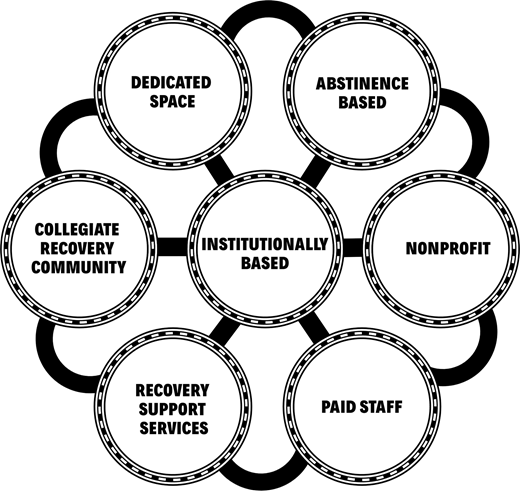
Since the 2011 formation of the Association of Recovery in Higher Education, ARHE has furnished CRPs with a central hub from which to network, learn from experienced CRP staff, and access resources (ARHE, 2020a, n.d.-b; Ashford et al., 2018; Butler Center for Research, 2017; Higher Education Center for Alcohol and Drug Misuse Prevention and Recovery, n.d.; Pennelle, 2019; Relias Learning, 2017). ARHE recommends seven standards of practice for CRPs: CRPs should be abstinence-based, institutionally based not-for-profit entities with paid staff, recovery support services, a recovery community, and a dedicated space (ARHE, n.d.-c; Relias Learning, 2017).
Abstinence Based
While relapse is commonplace in recovery populations, ARHE member institutions encourage abstinence in their collegiate recovery communities. All four interview participants mentioned accountability as a key factor in maintaining abstinence, as did the University of Colorado Bolder (Collegiate Recovery Center: Division of Student Affairs, n.d.), Relias Learning (2017), and student interns from ARHE (2020b).
Institutionally Based
CRPs are housed in degree-granting institutions of higher education. More than one CRP stresses that students should not have to choose between their recovery and their education (ARHE, n.d.-d; Division of Student Affairs, n.d.-a; Virginia Tech Recovery Community, n.d.-a). Membership in a CRP makes it possible to excel at both by offering a recovery-supportive environment (Collegiate Recovery Center: Division of Student Affairs, n.d., Student Affairs: Students Health Services, n.d.), providing hope (Jarpe, 2018; Virginia Tech Recovery Community, n.d.-a), and reducing stigma (ARHE, 2020c; Collegiate Recovery Community, n.d.; Virginia Tech Recovery Community, n.d.-b; Virginia Commonwealth, n.d.).
Nonprofit
To avoid conflicts of interest and facilitate access to resources, CRPs remain nonprofit entities. This enables some CRPs to provide scholarships to qualifying CRP members (Division of Student Affairs, n.d.-b; Student Wellness Center, n.d.-a). As nonprofit entities, CRPs are able to accept tax deductible donations. Many CRPs have donation buttons on their websites (Baylor University Wellness Department, n.d.; Collegiate Recovery Center: Division of Student Affairs, n.d.-; Division of Student Affairs, n.d.-a; Virginia Tech Recovery Community, n.d.-c).
Paid Staff
A professional staff trained in recovery protocols lends capability and credibility to the benefits a CRP offers in ways that a student-run CRP could not. CRP staff expedite referrals to other academic services such as mental health services, career services, health services, and sober campus housing (ARHE, 2020a; Harris et al., 2014; Laudet et al., 2016; Student Wellness Center, n.d.-a). Qualified staff provide treatment referrals when needed (Relias Learning, 2017). Paid student internships at ARHE provide a pathway to university CRP staff positions (ARHE, n.d.-e). Blake Schneider, CRP program coordinator at Mississippi State University and representative of the southeastern region for ARHE said it is helpful to have a point person on campus to oversee and coordinate administration of a CRP (Association of Recovery in Higher Education, 2020e).
Recovery Support Services
A CRP provides practical support for students academically, socially, spiritually, and emotionally (Student Affairs: Students Health Services, n.d.). Support services include one-on-one academic, nutritional, or wellness coaching; individualized recovery planning; group study sessions in a specified setting; and structured social activities (Relias Learning, 2017). Sober residence halls are provided on many campuses (Collegiate Recovery Center: Division of Student Affairs, n.d., Center for Collegiate Recovery Communities, n.d.-a; Center for Collegiate Recovery Communities, n.d.-b; Division of Student Affairs, n.d.-a; Office of Student Outreach & Support, n.d.-a; StepUP Program, n.d.).
Collegiate Recovery Community
A collegiate recovery community offers service opportunities such as speaking at or facilitating events or meetings or becoming a trained Recovery Ally (ARHE, 2020c; Virginia Commonwealth University, n.d.; Virginia Tech Recovery Community, n.d.-b). CRPs connect students to a variety of mutual aid meetings:
Twelve-step programs;
faith based;
secular recovery;
Buddhist based;
All recovery;
SMART Recovery; and
LGBTQ (ARHE, 2020d; Baylor University Wellness Department, n.d.; Collegiate Recovery Center: Division of Student Affairs, n.d.; Division of Student Affairs, n.d.-a; Health and Counseling Center., n.d.; Office of Student Outreach & Support., n.d.-b; StepUP Program, n.d.; Student Wellness Center, n.d.-b; University of Texas at Tyler, n.d.; Virginia Tech Recovery Community, n.d.-d).
CRPs support students’ choices to participate in recovery programs from multiple pathways. In addition to the options listed above, students’ recovery programs may involve mindfulness, the Wellbriety Movement, medication management, clinical support, and wellness-themed recovery (ARHE, 2020d; Virginia Tech Recovery Community, n.d.-d; Division of Student Affairs, n.d.-a; Student Wellness Center, n.d.-b). Social activities such as shared meals, bowling, dances, outings for sporting events, trips to the gym, and wildlife excursions further community bonding (Division of Student Affairs, n.d.-a; Student Wellness Center, n.d.-b; Collegiate Recovery Center: Division of Student Affairs, n.d.; Office of Student Outreach & Support: Alcohol & Drug Education, n.d.-b).
Dedicated Space
CRP students benefit from a dedicated space, ideally a physical space, in which to congregate without fear of exposure to alcohol and other drugs (ARHE, n.d.-c; Collegiate Recovery Center: Division of Student Affairs, n.d.-a; Center for Collegiate Recovery Communities, n.d.-b). Such spaces are known for person-first language (ARHE, 2020b); substance-free culture (Relias Learning, 2017; Division of Student Affairs, n.d.-a); a safe, recovery-friendly, judgment-free zone where students in recovery can connect with like-minded peers (Laudet et al., 2014; Laudet et al., 2015, Relias Learning, 2017; Virginia Commonwealth University, n.d.); a place to hold recovery meetings and social activities (Harris et al., 2014); a place to check in with staff or hang out with friends; and a place to study (Brown et al., 2019). A dedicated space helps students feel like they belong to a community (Relias Learning, 2017).
Interview participant Hogan pointed out that a dedicated space provided alumni with a place to visit and share their experiences with current students.
Services: Similarities and Differences
Although CRPs aspire to the ideals set forth in the ARHE standards discussed above, CRPs must also serve the needs of the institutions in which they are housed. This means that despite efforts at standardization, services vary among CRPs (ARHE, n.d.-c).
Department
CRPs may be housed under the auspices of student affairs, student life, health and wellness centers, or counseling centers (ARHE, n.d.-b; Brown et al., 2019; Harris et al., 2008; Harris et al., 2014; Health and Counseling Center, n.d.; Relias, 2017). Interview participant Corley noted that the CRP at Baylor University is “strategically not in the counseling center.” Corley explained that to protect confidentiality, counseling centers may require students to enter and exit through a private space to comply with privacy laws. Conversely, CRP students come and go freely in the CRP dedicated space because CRPs are not classified as covered entities under the Health Insurance Portability and Accountability Act (U.S. Department of Health & Human Services, n.d.). Corley further elaborated that although clinicians are discouraged from self-disclosure, sharing personal experiences and being available to students during off hours are assets for CRP staff.
Where and How They Start
CRPs may be initiated by students, faculty, or any of the institutional departments mentioned above. Often, students form an organization to establish the need for institutional support (ARHE, 2020c, n.d.-f; Student Wellness Center, n.d.-a; Laudet et al., 2016; StepUP Program, n.d.).
Membership Requirements
In some CRPs, all students have to do to participate is show up. Other CRPs may require an application, a minimum length of abstinence, or proof that a student is actively working a recovery program and is active in service (Center for Collegiate Recovery Communities, n.d.-c). The purpose of these requirements is to identify the level of interest and qualify students for fund-based services such as scholarships, individual coaching, event attendance, institution-sponsored off-campus excursions, and CRP-sponsored graduation ceremonies expressly for CRP students (ARHE, 2020c, n.d.-f; Laudet et al., 2016; StepUP Program, n.d.; Student Wellness Center, n.d.-a). Some schools require drug and alcohol education (Office of Student Outreach & Support: Alcohol & Drug Education, n.d.-a; Student Affairs: Students Health Services. n.d.).
Focus
CRPs differ in the emphasis they place on drug and alcohol education, relapse prevention, early intervention, and behavioral health integration (Student Wellness Center, n.d.-b); social and emotional support (Orsini et al., 2019); academic support and accountability, recovery planning, and building of recovery capital (White & Cloud, 2008). As mentioned earlier, CRPs may concentrate on a specific recovery program or encourage multiple pathways to recovery depending on their students’ needs and interests (ARHE, 2020d; Virginia Tech Recovery Community, n.d.-d; Division of Student Affairs, n.d.-a).
Funding
CRPs are funded by donations, endowments, and grants (ARHE, 2020a; Baylor University Wellness Department, n.d.; Collegiate Recovery Center: Division of Student Affairs, n.d.; Nunn, 2019). Funds may also come from students, alumni, students’ families, state institutional budgets, and such agencies as SAMHSA or the National Institute on Drug Abuse (ARHE, 2020a, 2020g).
As mentioned earlier, a physical space is recommended under the ARHE standards (ARHE, n.d.-c; Relias, 2017; Student Wellness Center, n.d.-a; Collegiate Recovery Center: Division of Student Affairs, n.d.). Ashford et al. (2018) observed that the presence of a dedicated space is a tangible indication of institutional support. However, Bettinger confirmed that some CRPs lack institutional funding or support for a dedicated physical space.
Curriculum
CRPs may or may not follow the recovery curriculum established by Texas Tech University (Center for Collegiate Recovery Communities, n.d.-d). The Texas Tech curriculum is freely available for CRPs to download and adapt to their needs (Center for Collegiate Recovery Communities, n.d.-d). According to Salmeri, the original Texas Tech recovery curriculum is a solid foundation but could benefit from an update that would include marginalized populations such as the LGBTQ community.
On-Campus Sober Housing
There are considerable liability issues associated with on-campus housing, so sober on-campus housing is best managed by CRPs with an established structure, experienced staff, and ample funding (ARHE, 2020e; Division of Student Affairs, n.d.-c; StepUP Program, n.d.).
Staff Background and Qualifications
Based on participant interviews and ARHE listserv emails, CRP professional staff hail from diverse backgrounds in business, student affairs, counseling, health and wellness, pastoral studies, addiction studies, and human services (Center for Collegiate Recovery Communities, n.d.-e). Staff may be asked to earn recovery coaching certification (S. Valentine, personal communication, May 20, 2019). According to interview participants, CRP staff may or may not have lived experience in recovery. Lived experience is a colloquial term used to describe an individual’s personal back story in addiction and recovery.
Purpose and Benefits
CRPs reduce risk of relapse or dropout and manage setbacks when students struggle to balance recovery and academic responsibilities by supplying the recovery support services discussed above, connecting students to ancillary services to ensure their basic needs are met, monitoring class attendance and grade point average, providing peer support, and engaging collegiate recovery students in an active recovery community. CRPs offer students an affirming and empowering academic experience supported by staff and peers (ARHE, 2020b; Brown et al., 2019; Condos, n.d.; Collegiate Recovery Community., n.d.; University of Texas at Tyler, n.d., University Health Service, University of Michigan, 2013).
There are academic, therapeutic, and social benefits to CRP membership. As previously noted, CRPs keep students in school and raise their grades. According to Hogan, members may qualify for scholarships, housing and study space privileges, and special graduation ceremonies.
Salmeri noted that professional staff provides therapeutic services that would not be possible in a student-run CRP. Hogan elaborated that staff excels at upfront planning, while students with little recovery experience tend to improvise. Without master’s level credentials, staff might lack the training to assess students for auxiliary services. All four interview participants asserted that students find staff helpful in defining and attaining goals for personal growth and academic achievement and for keeping students accountable. The four interview participants shared that CRP staff guide recovery students in maintaining a balance between school and recovery duties.
The value of supportive, nonjudgmental human contact cannot be underestimated. The acceptance found in a recovery community helps students adjust to college life, deters isolation, combats loneliness, and aids in relapse prevention (ARHE, 2020a, 2020b; Bean, 2017). When sponsored by the CRP, recreational activities keep recovery students safe from recovery-hostile situations where substances are present (Virginia Commonwealth University, n.d.).
Changes to Support Services Relative to the Pandemic
Some in-person activities became temporary casualties of circumstance as a result of the pandemic restrictions. According to the ARHE interns, the ARHE listserv, and the interview participants, in-person activities that required suspension include social activities like cooking and eating together, bowling, dances, sober tailgating, and attending sporting events; congregation in a dedicated physical space; trips off-campus; and the traditional graduation ceremony (ARHE, 2020b). These casualties necessitated a complete shift to online services, the most significant change in collegiate recovery programming since the shelter-at-home directives.
Challenges
The interview participants said that even at home, students face the same struggles with balance that are typical in a face-to-face college experience. Hogan et al. spoke of remotely helping students adjust to structuring their home time to include schoolwork, online recovery meetings, service, and self-care. The interview participants reported that some CRP students who were required to return home when the residence halls closed faced recovery-hostile environments if family members were substance users or lacked recovery education.
Hogan reported increased one-one-one coaching since she started offering that service online. Hogan said that students seem more likely to show up for individual sessions since the pandemic restrictions began. Corley reported that while some students check in regularly, others require what he called “professional pestering” to make contact. Even online, it is essential for CRP staff to know how to connect students to online services in other departments, to local services in case of a crisis, and to services that address basic needs such as SNAP benefits, economic impact payments, food banks, and shelters (ARHE, 2020b, 2020f).
CRP staff and ARHE interns reported helping students troubleshoot technical complications such as spotty Wi-Fi, picture or sound issues, and video conferencing login problems. Online security has become a concern, as ill-intentioned Zoom bombers hijack virtual meetings (Wikipedia, n.d.). To avoid hackers from accessing Zoom meetings, CRPs take precautions. Hogan’s university uses an institutional Zoom account that can only invite students who have an email address specific to that university. Corley addressed Zoombombing concerns by limiting the distribution of meeting IDs and passwords to student emails by refraining from posting social media links.
Solutions
ARHE interns have created a virtual schedule for students distributed to member institutions and students via the ARHE listserv. The schedule includes a virtual clubhouse that temporarily replaces the drop-in-friendly dedicated physical space; and eat-and-greets where students can keep each other company or share recipes while cooking and eating lunch (Pennelle, 2020). Online Naloxone trainings and Recovery Ally trainings are provided by several universities (ARHE, 2020c; Relias, 2017; Virginia Commonwealth University, n.d.; Virginia Tech Recovery Community, n.d.-b).
Other online activities set up by ARHE and member CRPs to maintain academic support, recovery accountability, and social connection include a GroupMe chat for CRP students and another for CRP staff, online morning coffee hour, virtual water cooler chats, virtual study hours, Zoom tutorials, online meetings for a variety of recovery programs in all time zones, virtual recovery yoga, virtual CrossFit, virtual meditation classes, a virtual music festival, virtual game nights, virtual trivia nights, Netflix movie nights, and a daily online wrap-up (T. Rabolt, personal communication, April 27, 2020). Student interns from ARHE advised students to be conscious of the language they use with others in online meetings and to be respectful, inclusive, empathic, and welcoming (ARHE, 2020b). Rams in recovery (n.d.) posted a guide for appropriate conduct in virtual meeting spaces. In an unprecedented move, ARHE’s 11th annual national conference will take place entirely online for the first time this June (ARHE, n.d.-f).
Institutional Perspective
Hogan et al. reported increased student anxiety due to isolation and boredom. Given the unique challenges of living under restrictions during the pandemic, the need for telehealth services is clear. ARHE Executive Director Tim Rabolt interviewed professionals from MAP Health management and asked them to offer direction to CRP staff in providing telehealth support for collegiate recovery students during the COVID-19 pandemic (ARHE, 2020g). MAP telehealth specialists Jody Sneed and TJ Howard stressed the safety, accessibility, and convenience of an online delivery model and outlined important points for institutions to consider when providing virtual services (ARHE, 2020g):
Posture: Alert posture indicates attention and active listening. Sit erect.
Appearance: Professional attire conveys that the staff member values the student’s time. Dress as you would for the office.
Intimacy: Staff should discard the limiting beliefs associated with lack of physical presence and use their clinical or coaching skills to establish rapport. Ask open-ended questions to engage students on a deeper level and lead to genuine interaction.
Energy: Students feed off of positive, motivated energy. Display enthusiasm and a desire to be there.
Affect: Though the pandemic has instilled fear and apprehension, staff need to remain calm and not react to challenges with fear. Stay nonjudgmental and solution focused.
Eye Contact: Pay attention to where the camera is located, or there is a risk of appearing as though eye contact is being avoided.
Delays: Slower speech and brief pauses are appropriate in video conferencing. Pause to prevent overlaps in conversation and give students a chance to think.
Distractions: Input from pets and family members should be minimized or eliminated. Turn off electronic notifications while in session, not just to avoid distracting the student but also to keep the staff member fully present.
Sound: Sessions will be awkward and unsettling if the parties cannot hear or understand each other. Test the microphone before a session and use an external microphone if the computer, tablet, or phone equipment produces poor quality sound.
Resources: Students in early recovery may not know where or how to access assistance with basic needs like food, clothing, shelter, and internet. Be prepared to help students find local and online resources. Calling 911 is not helpful if the student has returned home to another state. Contact information for local authorities will be needed, so it is critical to have an up-to-date address on file for each student.
Backups: Technology failures are commonplace. Arrange to contact students via phone or email in the event of an equipment malfunction or internet disruption.
Flexibility: This is the first time any of us are going through this. Be willing to adapt to unexpected circumstances or reactions.
Self-Care: Staff cannot be effective if they are exhausted. Schedule breaks to unplug, rest, and recharge physically, mentally, emotionally, and spiritually.
Sneed stated that the most important thing collegiate recovery staff can focus on is helping students build and maintain their sober support network, especially during a crisis that requires an almost total transition to virtual life (ARHE, 2020g).
Another concern for institutions is how to handle graduation ceremonies if the shelter-in-place is not lifted in time. Hogan reported that her CRP held a virtual send-off for students graduating in May, and she is confident that The Ohio State University will be able to deliver an online graduation ceremony in December if necessary. Virginia Commonwealth University demonstrated that it can be done; on May 1, they held a virtual graduation ceremony for CRP students.
Student Perspective
ARHE student interns cautioned CRP students not to compare prepandemic times with current conditions (ARHE, 2020b; Pennelle, 2020). They pointed out that virtual space has a different feeling to it, and daily life has a different structure when working from home (ARHE, 2020b). It may be prudent to measure productivity in context and praise oneself for simple achievements like getting out of bed, showering, going outdoors, keeping to a schedule, and completing one assignment goal a day (ARHE, 2020b). The interns recommended adjusting goals accordingly and leaving time for a change of scenery (ARHE, 2020b). The interns suggested having an accountability partner, a list of phone numbers of recovery supports, and knowledge of Wi-Fi hotspots (ARHE, 2020b).
The interns further emphasized the empowering action of reaching out to other CRP students in service and affirmation by showing up to online meetings to support CRPs across the country (ARHE, 2020b). They felt it important to recognize that not everyone has the same level of proficiency or comfort with technology and that the willingness to walk others through the process of using video conferencing software may be a life-changing service for the person being helped (ARHE, 2020b). The interns alerted students to the fact that professors might be feeling the effects of the restrictions as well and that students should communicate openly with their instructors about obstacles that could affect students’ productivity (ARHE, 2020b).
Conclusion
Collegiate recovery programs provide an essential support service for institutions of higher education. Collegiate recovery students are graduates of which any institution can be proud. Salmeri’s pitch expressed the value she sees in working with collegiate recovery students:
I would say if you want to recruit and retain some of the most brilliantly creative people, then collegiate recovery is your best referral. It’s the referral of a lifetime. You’ll not only have them as alumni, but you’ll have their families that will be very, very grateful for the things that you have done.
CRP staff, students, and community leadership have used the standards and skills ensconced in their programs to fill any gaps in service caused by the COVID-19 pandemic. CRP virtual services effectively embody the ARHE standards for implementation and demonstrate an exemplary paradigm for adaptation and accommodation in distance learning. Harris talked about the need for CRPs in every college and university and posited that higher education would consider CRPs just as relevant to the college experience as athletics programs if CRPs left a “legacy of success” (ARHE, 2020a). With their response to the pandemic, CRPs have secured such a legacy. CRPs spotlight the vision, imagination, and cooperation needed to serve students from a distance. Structures within higher education—collegiate, bureaucratic, administrative, or political—would do well to replicate the success of collegiate recovery programs in meeting the need for distance support services in a time of crisis. Harris dreams of a future where CRPs are the norm: “I think … if we could get some good research out there, that higher ed is going to have to see us as an integral part of their community” (ARHE, 2020a). Hopefully, this treatise contributes to that ongoing conversation.
