

Projections show that in the next 5 years, Brazil will have 9 million students in higher education courses (a 50% increase in the period). This growth is concentrated in the distance learning modality, which is expected to triple until it reaches 4.5 million students. This phenomenon may be explained by the development of technological tools, the eagerness to have a flexible schedule, and the expansion of distance learning units to remote areas (where the settlement of an onsite learning campus is not financially and logistically feasible). In this study, I provided an updated depiction of the Brazilian higher education scenario and analyzed the entry and permanency of the distance learning graduates in the job market. Additionally, I interviewed human resources executives and students and analyzed data from a survey conducted by a major Brazilian education company to understand students’ visions about their recruitment processes. The empirical investigation showed that students from both distance learning and onsite models have similar opportunities to get a job and receive similar salaries when employed. Despite that scenario, some potential prejudice against the distance model is still observed (especially among peers). My hypothesis, which needs to be investigated in further study, is that it may affect other career factors such as job satisfaction and motivation.
As the Brazilian population increases, so does the pursuit of higher education (HE) programs. Additionally, effects like rapid globalization and modernization enhance the competition in the labor market, creating a need for higher education courses capable of delivering updated content. If we analyze the higher education market among the BRICS countries (Brazil, Russia, India, China, and South Africa), we may see Brazil as the country with the second-lowest share of the adult population educated to higher education degree level (only ahead of China). However, despite having a percentage of the population with a higher education degree lower than the percentage of highly developed countries and lower than some developing countries, the demand for higher education in Brazil (as in other major countries) has never been so high. It tends to keep growing by 2050 (Roser & Ortiz-Ospina, 2013). This scenario stands as a huge challenge for the governmental public policies and private educational companies willing to fill this gap in the Brazilian market. Based on that, the distance learning (DL) model became a financially and logistically feasible alternative to reach communities where no HE institution would settle a traditional campus (offering onsite courses).

Moreover, even in cities where both onsite and distance courses are offered, we may notice an increase in the number of DL students because of the development of social networks and the willingness to have a flexible schedule. Despite the initial distrust over the DL model because of the lack of in-person activities, the new technologies and innovations in the business aligned to social changes have been closing the gap to the traditional onsite model and building reliability to the distance model (Morés, 2017).
Allied to that, the job market in the last decades has been looking for different professionals to deal with transformations in companies that try to follow technological progress to become more productive and competitive. In the next years, we will continue facing new trends, new workers’ generations, and new technologies that will affect our professional lives and demand people to adapt quickly. Although this is the ideal scenario for those who thrive in an environment of constant dynamics and change, those who prefer stable positions, the same location, and do not like changes, in general, will inevitably face hardship unless they learn how to adapt (Burns, 2019).
Objectives
This study intends to understand possible differences in employability and/or development levels between students enrolled in different higher education models (DL and onsite). We may consider two main objectives: (1) To comprehend if and how the companies distinguish in their recruiting processes candidates graduated in onsite courses from those who graduated in the DL model, and (2) To understand if and how companies perceive differences in performances and/or behaviors among employees who graduated from onsite and DL courses.
Restraints
I rely on empirical data obtained only from *company*’s students, as I work for that company and have access to its data. *Company* is a private company and has the highest number of enrolled students in higher education courses among Brazilian players. By choosing to focus on private HE students, we approach a fast-growing audience in Brazil (in opposition to the number of students in public institutions, which has grown at a much slower pace).
The so-called graduation offered by Brazilian higher education institutions is equivalent to undergraduate degrees, known in the United States as associate’s and bachelor’s). Some countries may refer to it also as postsecondary education, third-level, or tertiary education. In Brazil, it is mandatory to complete elementary school (at least 12 years) to be accepted into a HE course. The HE institutions (as a university) are supervised and regulated by the Brazilian Ministry of Education. They may be either public (usually managed by federal or state governments) or private (for-profit or nonprofit) funded. As stated by Oshima (2017), the profiles from enrolled students in Brazilian private and public Universities are quite different. Therefore, we should consider that future studies with public HE students may complement my conclusions and possibly get different results.
Theoretical Framework
The Distance Learning Evolution in Brazil
At the beginning of the 2000s, the predominant profile among the Brazilian DL students was of teachers already in the preretirement phase who needed a higher education course to keep working because of a change in the federal teaching normative. By that time, the majority of the students enrolled in DL courses were older than 40 years. In the middle of the last decade, between 2004 and 2007, the HE institutions started to include baccalaureate courses in the DL portfolio (as business administration, accounting, and social service), and in the next 5 years, they also developed technological courses (multimedia production, digital marketing, and so forth). In 2016 and 2017, within the economic crisis cycle that deepened in the country, high school graduates began to consider DL as a realistic option of continuity for their education, once the tuition fees were lower, and the remote study regime allowed them to maintain a fulltime job. These changes have caused the average age of the DL student to fall 9 years in the last 2 decades (from 42 years to 33 years; Vianney, 2017).
Reasonably, the scenario described above has boosted enrollment in DL courses and led to the emergence of large educational conglomerates. Figure 1 shows that the number of higher education students enrolled in DL courses increased by 254% in 10 years (from 449,000 to 1,591,000, CAGR 13.5%). While it represented 10.5% of the total HE students in 2008, it represented 25.5% in 2017.
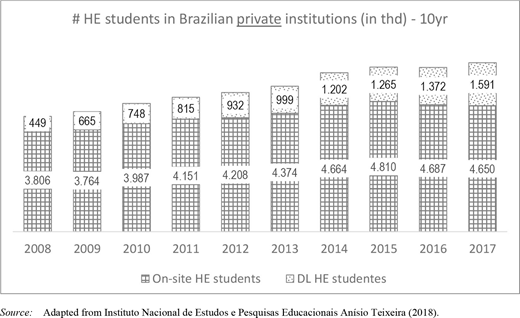
Number of HE students in Brazilian private institutions (last 10 years).
Number of HE students in Brazilian private institutions (last 10 years).
Employability and the Brazilian Reality
Among a broad set of definitions by innumerous authors, Yorke (2004) defines employability as “a set of achievements—skills, understandings, and personal attributes—that makes graduates more likely to gain employment and be successful in their chosen occupations, which benefits themselves, the workforce, the community, and the economy.” One of the core ideas on investing time and money in education is developing a set of skills that employers will be rewarded. For this investment to make sense, the delta between the upcoming earnings and the current earnings must surpass the amount invested in the study itself (tuition fee, related costs, opportunity cost, etc.). It is just like analyzing any other investment in terms of net present value and the internal return rate (Suleman, 2017). In this manner, it is reasonable to say that virtually every student who decides to attend a graduation course aims to raise or at least to secure his current gains. For those freshmen who already have a job, this goal may be achieved by progressing on the actual position or moving to a new company/role. Indeed, when compared to those who studied only until high school, the graduate professionals have higher wages, lower unemployment rates, and reduced chance to become unemployed (Lameiras et al., 2019).
Moreau and Leathwood (2006) stated that we could not ignore the effects of social and economic inequalities (gender, family income, age, etc.) that affect equal chances to access employment or obtain a matched job for some areas graduation (Silveira et al., 2018). However, due to a lack of information by the Brazilian Ministry of Education, it is impossible to depict the gap lived by an individual between the higher education conclusion and the job market entrance. We lack official information, for example, about graduates’ acceptance in the job market, their careers, salaries, and time needed to compensate for the investment in tuition (Castro, 2015).
In 2012, a study conducted in Brazil with 56 DL students analyzed their views about how the people around them saw the choice for online education. In the survey, 58% of the interviewees stated that they had already witnessed some biased commentary about the DL model. From this group, the most cited source of the critiques were the students from the onsite model, which leads us to deduce that there was a judgment of value among the public that seeks higher education and that the learning model was a factor that affected the choice of a HE course (Santos, 2012). There was an apparent prejudice against distance learning courses in Brazil because of its new pedagogical concepts and the massive use of technological tools as alternative options to the traditional model’s physical presence.
Despite the prejudice pieces of evidence described above, a more current view over this scenario shows that it seems to be changing. The labor market starts to receive more professionals from DL courses. Recent statements from company recruiting executives show that the course model is less important than other factors like the candidate’s professional experience and the HE institution he attended. According to Giordan (2018), DL students tend to develop soft skills recently required by the labor market, such as independence, organization, initiative, time management, and focus.
This study aims to answer if and how, after one decade, we can say things have changed in a practical manner.
Methodological Procedures
For this study, I gathered data obtained from *company* and listened to former students and companies linked (with partnership agreements or graduates hiring history) to it. As an employee of this company, I have facilitated access to students’ data. Because *company* is the HE Brazilian market leader, they can provide a valuable sample in both quantity and diversity.
This study’s methodological procedures were divided into three work fronts with specific goals that complement each other. In the first work front, I interviewed leaders from five different companies that act in Brazil and regularly hire DL graduates from *company.* By conducting these interviews, my objective was to understand how the labor market is nowadays dealing with former students from DL courses when compared to those from onsite courses.
The second work front consists of interviews with students who recently graduated from a DL course and are now inserted in a professional position. My goal was to analyze if these individuals noticed any additional challenge or biased reaction during their recruiting processes because they had taken DL courses (similar to Santos, 2012). In both the first and second work fronts, I worked on a qualitative approach using open-ended questions to collect data to arrive at a more complete understanding of the research phenomenon.
Finally, on the third work front, I used analytical data from a survey performed by *company* to understand if there are significant differences in the employability and the wages of DL onsite courses graduates.
First Work Front—Executives’ Interviews
To understand how the labor market is facing the duality between DL and onsite course students in 2019, I made two important decisions: what companies should I choose and what professionals in each company should I talk to. First, I tried to build a wide overview by choosing companies from different businesses, regions, and sizes. To get a complete interpretation of the scenario, I talked to executives of five companies with the following characteristics (data obtained from the interviewees):
Company 1 (represented by Executive 1): A multinational Spanish company with 150 thousand employees worldwide. In Brazil, Company 1 has offices in the main cities of the country and some dozens of thousands of employees. It is a provider of business-process outsourcing and customer relationship management services.
Company 2 (represented by Executive 2): A Brazilian company located in the northeast region with around 500 employees. It operates in the sale and service providing businesses.
Company 3 (represented by Executive 3): One of the biggest processed food companies in the world, based in Mexico with approximately 130,000 employees worldwide. In Brazil, it has six productive units in distinct regions and five thousand employees.
Company 4 (represented by Executive 4): A European company that develops and produces ingredients used in the animal nutrition industry. It has one single production unit in Brazil located in a small city in the interior of São Paulo state, with approximately 320 employees.
Company 5 (represented by Executive 5). An independent counselor who works directly with executives seeking professional relocation and/or coach services. Her office is based in one of the major cities in the south of the country and serves mostly people in that region.
After selecting the companies above, I had to choose the right person to interview. It should be someone able to provide a full perspective of the possible dissimilarities between DL and onsite courses employees from the recruiting process to the daily operations performance analysis. To cover this whole spectrum, I looked for human resources leaders with a business partner scope, who linked the corporative guidelines (sometimes from a foreign headquarter) with organizational needs and had both sides’ perceptions.
To avoid biased statements and ensure that the executives felt comfortable to share their impressions, their identity was kept confidential. Due to geographical issues, the five interviews were done by phone calls, which lasted, on average, 30 minutes each (totalizing 2.5 hours of recorded audio).
The topics that guided the interview may be found in Appendix A. I mentioned the scope of the research to the interviewees before the scheduled conversation if they wanted to prepare and/or gather opinions from other executives. Although I conducted the conversation considering the planned topics, the executives were advised to address any other topics they considered relevant.
Second Work Front—Students’ Interviews
Because employability is a relationship between employer and employee, it is crucial to understand how the second group sees the current frame of the Brazilian labor market. Unlike the research performed by Santos (2012), I interviewed DL former students and focused on comparing themselves to former students from onsite courses. I also asked how they feel that graduating from a DL course distinguishes them (positively or negatively) from other candidates in a professional recruiting process. All the interviewees graduated in DL courses at the end of 2018, making them able to provide an up-to-date impression of the current labor market.
Like in the first work front, I tried to cover a wide range of personal profiles when selecting the former students to interview. By doing that, I mitigate other factors than the HE course model that can also affect someone’s employability, such as age, gender, course, and race.
The *company*’s customer experience manager provided a list of students who recently took the company’s satisfaction questionnaire and signaled they were open to further contacts. In the net promoter score model (Reichheld, 2003), I considered individuals who were identified as neither detractors nor promoters to avoid biased statements. The five interviewees have the following aspects:
Student 1: 25 years old, male, and single. Currently employed as an IT manager in a small local company and partner in a car shop. He holds a technological degree and lives in a state capital in the north region.
Student 2: 38 years old, female, and married. She has a pedagogy graduation diploma and works as a teacher in a medium-sized city in the south region of Brazil.
Student 3: 34 years old, male, and married. He is graduated in history and geography and is currently enrolled in a pedagogy course, all of them through the DL model. He is currently a publicschool director and DL tutor in a small city in a southern Brazilian state.
Student 4: 33 years old, female, and married. She holds a technological degree with an emphasis in human resources. This student lives in a small city in the center-west region and currently works as an administrative staff in a small retail business.
Student 5: 47 years old, female, and married. She has recently finished her business administration course and lives in a Brazilian megalopolis. During her whole graduation, she worked for the same office as a human resources analyst.
As in the interviews with companies’ executives, the students’ identities remained confidential, and the five interviews were made by phone calls and averaged 20 minutes each (totalizing 1.7 hours of recorded conversation). The questions that guided the interviews may be found in Appendix B, but different from the first work front, the interviewees did not receive the questions in advance. Although the conversation was based on the listed topics, the students were advised to address other unlisted points that they considered relevant.
Third Work Front—Employability and Wages Analysis
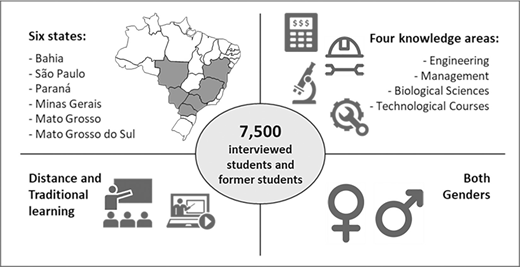
*Company* established an employability department some years ago, responsible for guaranteeing its students remain competitive in the job market and collecting the skills that the main employers expect to find in those graduates. At the end of 2018, this area hired a consulting firm to realize an extensive questionnaire over employability with 7,500 students and former students to understand their acceptance in the labor market. The fifty questions cannot be fully shared for reasons of confidentiality, but, broadly, they sought to understand how the student’s graduation period had been and how his professional situation was at that moment, regarding scope, salary, satisfaction, growth perspectives, et cetera.
The target audience was composed of people with the following characteristics (also shown in Figure 2) to provide a wide sample and enable comparative analysis: (a) from six distinct Brazilian states where *company*’s brands are more popular; (b) from the onsite learning model and distance learning model; (c) men and women, in a similar proportion, and; (d) from four knowledge areas.
Number of HE students in Brazilian private institutions (last 10 years).
Number of HE students in Brazilian private institutions (last 10 years).
Initially, these students received a link to an electronic survey by e-mail. After one month, the consulting company called the students who had not completed the questionnaire electronically and performed the survey by phone. In this phase, nearly 20% of the selected students could not be reached even by phone, and a new batch of interviewees was selected and sequentially contacted by phone. In the end, the number of surveyed students surpassed the initial planning and reached 8,688 people.
Data Procedures
The first and second work fronts used the inductive reasoning approach (in contrast to the deductive method). As described by Creswell (2007), the qualitative researcher’s logic is inductive, from the ground up, rather than handed down entirely from theory or perspectives of the inquirer. Sometimes the research questions change in the middle of the study to better reflect the questions needed to understand the research problem. In a dynamic environment that combines technological, social, and competitive changes, the qualitative method allows us to understand better what elements are essential for companies when hiring graduates and how these former students feel about looking for a job. To increase the quality of the analysis, reach a wider range of profiles, and minimize biased outcomes, I chose individuals with different characteristics to be interviewed.
The 10 interviews (five with human resources executives and five with DL graduates) were transcribed, translated (from Portuguese to English), and coded (Saldaña, 2011). The main ideas were grouped, and I tried to understand the extent of them among the interviewees. I also selected some direct quotes from the conversations that could synthesize these beliefs in the interviewees’ expressions.
About the third work front, I received the survey results organized as a table in a digital spreadsheet. As my focus is to understand the employability issue and the wage discrepancy between graduates from onsite and DL models, I selected from the survey, only the respondents who reported being employed in the private sector. By doing this, I excluded the interns, people who are still studying and not looking for a job, entrepreneurs (as they do not typify our concept of employability), and people employed in the public sector (because their jobs are assigned by public exam and their wages follow a public increment pattern). After receiving data, I noticed no surveyed individuals who fit our conditions and attended engineering or biological sciences courses in the DL model. By talking to *company*’s operations team, I understood that these courses started being offered in the DL model only in 2016 (as these courses last 5 years, they will have their first graduates only at the end of 2020). Each interviewee answered, among other questions, in which of 12 ranges, their wages were included, from “01. Until R$954” to “12. Above R$12.000” (several employees did not want to reveal their earnings or claimed not remembering their salaries). Table 1 shows the drill down in the sample from the initial number to the fragment analyzed in each test. Notice that the groups in each line of the table have intersections (for example, we cannot say that there were only 626 unemployed graduates in the sample, but that was the number after the previous deductions).
Sample Size Drill Down for Qualitative Analysis
| Initial sample | 8.688 |
| Entrepreneurs | –984 |
| Students not looking for a job | –1.109 |
| Interns | –653 |
| Employees in the public sector | –825 |
| Biological sciences students | –1.006 |
| Engineering students | –988 |
| z-test sample (employability proportion) | 3.123 |
| Unemployed | –626 |
| Did not inform current salary | –488 |
| Did not inform current position | –42 |
| t-test sample (salary analysis) | 1.967 |
My first study over this data was the analysis to understand if the proportion of employed graduates from DL courses differed from the proportion among onsite learning courses graduates. For that, I performed a one-proportion z test (Anderson et al., 2013) where the initial hypotheses (H0) was that EDL – ETrad = 0 (i.e., the proportion of employed graduates is mathematically equal between those from DL and onsite learning courses). I calculated z from the provided samples and compared it to z* from a confidence interval equal to 95% to understand if there was enough evidence to refuse H0.
Next, I examined the gathered data to determine if there is a difference in the wages received by professionals who attended DL courses and professionals from the onsite learning model. In these cases, our initial hypotheses (H0) were that WDL – WTrad = 0 (i.e., the average wage of DL graduates is mathematically equal to the average wage of onsite learning graduates). I used a two-sample t-test analysis (Anderson et al., 2013), and the confidence interval was set at 95%. As in the employability study reported above, I performed my statistical analysis using the Microsoft Excel software.
Because the list of respondents contained significantly different profiles, I performed additional analyzes (after t-test I) to eliminate external effects and increase the accuracy of the DL and onsite learning comparison. Once in Brazil, men earn, on average, more than women do when both have the same job (Villas Bôas, 2019). I performed t-test II and t-test III to isolate the gender effect from the analysis. As I interviewed employees from distinct hierarchical positions, I also ran t-test IV for technical positions (trainee, assistant, and analyst) and t-test V for management positions (supervisor/coordinator, manager, and director).
Findings and Discussion
The qualitative and quantitative data showed us that the DL model is becoming a competitive type of education pursued by young undergraduate students. I validated aspects of the DL model that are consensus advantages in relation to the onsite model, and I captured insights related to how disadvantages have been overcome.
Employability of DL Graduates
As Arkorful and Abaidoo (2015) predicted, discipline and autonomy are broadly cited in both executives’ and students’ interviews as a key behavior for the DL student to succeed in his studies. According to Student 3, “as in the DL model the learner must seek the knowledge more proactively than in the onsite model, it takes the student to develop a higher autonomy for doing things on his own since his graduation period.” Because of this independence, executives affirm that DL graduates are more likely to continue their studies autonomously afterward. Executive 3 states that these aspects developed during study may follow the student in his upcoming professional life:
The DL student is much more out of his comfort zone than the onsite model one. The latter has a very easygoing routine, where he arrives at the University, sits in the classroom, chooses to pay attention or not to the class, signs the attendance list, and goes home. The DL student, on the other hand, must seek knowledge mainly on his own. Thus, the DL student who really is dedicated to his study is more likely to develop these characteristics [autonomy, proactivity, and self-management]. (Executive 3)
About the entrance of students in the labor market, all interviewed executives affirmed that the job positions they announce do not include explicitly a preference for DL or onsite model graduates. Executives 1, 3, and 4, who work in multinational companies, cited a recruitment process that is competency-based and has a high degree of governance to avoid any biased decision.
Student 1 has lived the recruiting experience in both roles (as a DL graduate and as an entrepreneur executive) and presented a similar view:
Based on my personal experience, companies do not show a preference for students who graduated in DL or onsite learning courses. In the company where I am a partner, we also do not evaluate this point when hiring someone new…. What matters to me is that the candidate is able to perform his duties flawlessly. (Student 1)
Still, on the recruiting process, the students’ declarations unanimously said that the HE model is not a factor that they feel like an advantage or a disadvantage when applying for a job, but the reputation of the HE institution he attended may affect job opportunities (thus, we can say a school’s prestige seems to affect graduates employability).
Of course, the statements gathered from the interviews must be carefully considered in our conclusions. Although I warned the interviewed individuals that their identities would remain confidential and tried to make questions free of any bias, it is natural that an HR executive wants to promote the governance and impartiality with which his company treats his employees. In the same way, DL graduates will probably look for viewpoints that endorse the advantages and qualities of the model. The third work front analysis brings a quantitative view of these facts and minimizes the inclination and subjectivity factors inserted into the conversations.
Our z test for the employability of recent graduates (comparing the proportion of employed former students of the two HE models) showed there is no evidence to support that students who attended an onsite learning course are more likely to find a job than the ones who attended a DL course (or the opposite). The detailed analysis is in Appendix C.
Despite the results above, I could also notice that some people link the DL course as a product offered by low reputation institutions only:
Interviewer: Do you feel that the managers in your company show a predilection for candidates who graduated in onsite model courses?
Executive 3: Well, I cannot lie to you by stating there is no predilection. Even because there are some institutions that really are rated as high-level … and when we have a candidate with this background, that is something that catches our attention.
In the conversation above, notice that the interviewer’s question cites only the HE model when seeking to understand the manager’s viewpoint. Nevertheless, the interviewed executive immediately comments about the institutions with high prominence or popularity. This answer seems to show she made a mental link between onsite model courses and topnotch institutions. In the next topic, I talked about the reasons that lead to establishing precepts like this. For future research, I suggest extending the interviews to companies’ managers (i.e., the leaders who select new employees to their areas). In these cases, the researcher must be even more cautious when conducting the conversations to avoid biased opinions.
Once the professional is selected and hired, it seems it does not matter to his development and career progress whether he attended a DL or an onsite learning course. My t tests (I, II, III, IV, and V) show there is no quantitative evidence to refute the initial hypothesis that the average salary of a DL graduate is statistically equivalent to the salary of as onsite learning graduate. The full analysis (in Appendix D) also shows that gender and hierarchical position segmentation prevails.
Resistance to the DL Model
Despite the human resources executives’ notable efforts to maintain fairness standards in choosing the best applicant, they acknowledge that some leaders still mistrust the DL model. However, the executives affirm that the HE model does not affect the recruitment process. Executive 2 raises the hypothesis that this feeling is a social trend more than academic disbelief, as it represents the inherent discomfort of dealing with the unknown:
I think that people in this region distrust the DL because they attended daily during elementary school. When they get faced with a different reality in graduation … the idea of studying mostly alone, without someone to answer their questions in real time, inhibits and scares people…. Also, many candidates are afraid that they will not learn what is expected in the DL model. (Executive 2)
From the conversations with the human resources executives, I may understand that the potential bias raised against a DL graduate may be compared to other forms of discrimination found within the work environment, such as race, gender, or religion. Executive 3 compares this situation with the one faced by other groups by stating that “there is still prejudice and resistance against DL by some managers of the company … and then I have the same case as when we introduce, for example, a job candidate with a physical disability.”
About the historical construction of the prejudice against DL in Brazil, this model was not a target of public policies between its emergence (beginning of the 20th century, through vocational courses) and the 1970s. This absence of regulation and the abrupt stagnation of the DL customer base in the next 30 years (from the mid-1970s to mid-2000s) led to creating a culture where the model lacked confidence and reliability. According to Almeida Filho (2015), the battle against this factor occurs by making the information about the structuring and organization of DL courses more transparent and empowering students about their rights, duties, and attitudes of study. Indeed, the interviewed students do not hesitate to affirm that prejudice comes mostly from people who have limited knowledge of the DL model. The increasing popularity in the last years has led to a friendlier environment.
Additionally, a prejudice dimension was not initially mapped, and that showed itself relevant during the interviews was the prejudice among work peers. Because they see the DL as a “secondary” model, some professionals who attended onsite model courses feel discredited because they hold positions and salaries similar to DL graduates. Despite being more noticeable in private companies, this effect also happens in the public sector in which the admission open exams for government positions do not take into consideration the candidate’s HE course model. Student 3 commented on this issue:
Teachers, especially those more elderly who studied in onsite model courses, sometimes feel discredited because they attended classes every day while we [the DL students] did it once in the week. Of course, this is not fair because we studied a lot at home, far from everybody’s eyesight. However, this looks to me not as prejudice but as a kind of jealousy. (Student 3)
By the comment above, we can see how a culture built on unawareness leads to prejudice against the DL model (as people do not understand that the content and commitment of the DL student is virtually the same as in the onsite model). It is also interesting to note that the interviewee cites, in particular, the negative perception of older people. According to Almeida Filho (2015), it is perfectly understandable that people raised in an outdated technological environment have a more challenging time adapting to new communication tools such as those used in the DL, leading to a situation of discomfort later to prejudice against such technology. Along with some people’s technical difficulty, Almeida Filho (2015) also highlights the poor structuring and dissemination of technology in Brazilian society, both by governments and civil society.
Dealing With the Resistance
Despite the relative skepticism against the DL efficacy reported by interviewees and documented ahead, there is a solid consensus noted by all the students and by the majority of the executives: the level of prejudice against the DL model has been noticeably declining in recent years. Indeed, most of the students interviewed initially stated without hesitation that there is prejudice from society and the labor market against the distance learning model. However, none of them was able to give concrete reports of situations where this occurred. Even though it is a perceptionbased feeling, I explored the potential reasons that led to this decrease, and the result may be seen in the following paragraphs.
According to my conversations, one factor contributing to this improvement is the popularity enjoyed by postgraduation courses (or graduation, in North America) in the country. According to Executives 1 and 4, the enrollment in these courses in the DL model is more popular among company leaders, regardless of the modality in which they attended graduation. As many HE institutions offer both products (graduation and postgraduation) sharing the same technologies, this has led to greater awareness of the DL model as a whole. In research by Ribas et al. (2017) about using the DL model to offer health courses, from 208 interviewees, 11.8% affirmed that they would not accept to be attended by a professional with graduation in the DL model. When asked about students with an onsite learning graduation and a DL postgraduation, this index drops to 2.4%.
Executives 1 and 5 affirm that as more people begin to graduate in DL courses and enter the labor market, the greater the model awareness among the companies’ leaders. Executive 1 also adds that companies tend to use technological tools for the continuous training of its employees, which also may lead to a greater understanding of the DL model. In his words:
Part of this audience [company leaders] has already taken a DL course and thus knows how the model works…. Within the company, we also provide development courses through an online platform, which leads the manager and the teams to understand the concepts and the effectiveness of the model. (Executive 1)
Executives 1 and 4 cite that the quality of teaching materials, learning platforms (learning management systems), and DL centers infrastructure have increased significantly in the past years. Indeed, if we analyze Figure 1 once more, we may notice that the DL market increased by almost 400% in 10 years (from 2007 to 2016). This increment enhanced the competition among existing peers and brand-new players (as stated by Student 4, who noticed the entrance of many HE institutions in her small city in the last 2 years), demanding them to look for competitive differentiation through product enhancement. Furthermore, new technologies (as virtual reality, the internet of things, big data, and artificial intelligence) are being applied to the educational business to create more immersive experiences (Newman, 2018). This technological development helps to mitigate the difficulties pointed out by Arkorful and Abaidoo (2015) that the DL model may not be as efficient as the onsite one to transmit clarifications, explanations, and interpretations. Executive 1 stated that:
It is notorious that the DL education has evolved in terms of material, content, and even practical classes in those courses that have this requirement. A few years ago, in fact, there was a greater level of stigma and preconception on it, but nowadays, much for the accessibility and flexibility that made a greater number of people join and learn about the model …, the DL courses have presented the same potential of a face-to-face course. (Executive 1)
On the government side, we had a major milestone in 2005 with decree 5.622, which optimized the access to higher education and gave DL the prominence and regulation that would make it evolve in the years that followed (Corrêa & Santos, 2009). During the interviews, it also becomes clear the importance of the human resources team and the company leaders to assume the role of creating an atmosphere based on equality and respect:
If a person fulfills the requirements of the vacancy, the fact that he or she has a special condition or is graduated from a DL course should not make any difference. As human resources professionals, we have the role of overcoming this culture and raising consciousness among the company’s leaders. (Executive 3)
In terms of behavior/technical skills between DL and onsite learning graduates, executives stated they could see no difference during the recruitment process and that the HE model did not influence salaries.
Future Expectations
For the future, the increasing DL awareness, enhanced product quality, and new technologies may contribute to increasing the demand for DL courses further. As said by Student 2, “with more people knowing the DL model, I think there is a trend for it to grow even more in the future. And besides that, people need to get qualified, but they do not have the time and the predictability needed for the onsite learning model.”
Despite the decline in the average age of the DL student reported by Vianney (2017), it is not clear in his studies if this phenomenon is the result of an increasing interest in this model among young people or the limited number of onsite learning courses being offered to this public. Indeed, in many of the 5,570 Brazilian cities, the presence of an onsite learning unit will probably never be financially feasible, and the DL will be the only option for higher education candidates. However, changes in the technological tools and the candidates’ mentality lead the onsite model students to consider a DL higher education course. Although the DL is still more popular among working adults because of its schedule flexibility (as stated by all the interviewed executives), it is possible to see that young people are increasingly migrating to this model, as can be seen in the following commentary:
From the professionals I know, many have opted for a DL education because the course they wanted to attend was not offered in their city in the onsite model and because of their life moment. However, I have also noticed … there are many young people who could enroll in a face-to-face course, but instead preferred the DL. This is related to the new trends of modernity, the use of electronic resources, the possibility of studying at home, etc. (Executive 4)
Conclusions
First, the economic and social potentials of distance learning are undeniable. Although the modality has thrived in recent years, Brazil still has a considerable demand for higher education products that, due to geographical factors, onsite model courses will hardly meet.
Although a portion of the population still has some prejudice and apprehension against the DL model for higher education courses, factors such as the recent changes in societal habits, the increasing perception of DL course quality, and new tools contribute to better product acceptance. DL higher education courses, created initially to attend the working adult public, are increasingly becoming the first option of young people. As more students graduate, the faster the DL model reaches widespread awareness.
The labor market also recognizes the DL model as a proper equivalent to the onsite learning method. The statistical analyses showed no difference in the chance of getting a job when comparing DL graduate students to onsite learning graduates. My interviews showed that companies are increasingly treating students of both learning models equally, as well as DL graduates feel they are not penalized in the selection processes. Actually, depending on the job requirements, some distinguishing features are more likely to be developed in the distance model, such as autonomy, proactivity, and self-management. Once the employee is selected and hired, I could not identify (through either quantitative data or interviews) differences between a DL graduate’s average wages and the average wages of a traditional learning graduate.
Although there is a tendency for the prejudice against the DL to decrease organically, institutions may accelerate this phenomenon. One way of doing this would be to rely on the good reputation of postgraduation courses to reduce the disassociation that still exists between distance learning and low-reputation HE institutions. Other actions, such as the recognition of successful career alumni and the establishment of business partnerships with renowned enterprises and personalities, also have the potential to deconstruct the culture of mistrust against the DL model gradually.
Whereas the DL and onsite learning courses’ potential audiences were quite different in the past, the recent social, technological, and academic changes are bringing these audiences closer, which will gradually increase the cannibalization between these products. I propose further research to investigate how the HE institutions, aiming to maximize revenue, could conduct their advertising, product, and pricing strategies.
Finally, this research contributed to the scientific scenario by presenting the evolution of distance learning in the Brazilian scenario during the last years. Although my initial focus was on addressing the issue through students’ employability, my interviews led me to cover additional topics such as prejudice, perceived quality, and expectations related to the model. As we could see, the levels of employability and salaries attained by DL graduates are not a critical issue. Instead, considering the prejudice that still exists and the growing competition against the traditional model, it is important to promote actions able to leverage the reputation of the DL model and position it as the first option in higher education. Based on that, higher education institutions (especially those offering both onsite and distance learning) may be able to understand their customers’ aspirations better and use it to define short-term strategy.
My work focused extensively on an individual’s ability to enter the job market and the capability to maintain compatible financial gains. While these are the most prominent concerns in a higher education student’s mind, there are subtler factors that permeate working life and are important to evaluate. An upcoming valuable work would be dedicated to understanding if and how the HE model affects individual internal factors such as optimism, job satisfaction, and motivation.
References
Appendix A Business Executives Interviewing Guide
When your company has a job opportunity that requires higher education, do you specify if you, the candidate, must have attended either a DL or an onsite course? If so, what is the reason? If not, why not?
Do you think managers in your company prefer students from any of these HE models? Why? If yes, to what extent does this predilection goes (how does it compare to other drivers of choice, such as experience, recommendation, etc.)?
During the recruiting process, do you notice differences in preparation, skills, or behavior among students in each mode? If so, which ones?
Is there some type of role (casual, permanent, contractors, apprentices, etc.) or locality (not only region or city, but also dualities such as factory/office, field/city, production/management, etc.) where managers demand a professional from a specific HE model?
Have you seen cases of employees who decided to attend higher education courses while they were working? If so, what do you think is the purpose of these workers? In these cases, do they have a preference between DL and onsite learning courses?
In your company, are there differences in the hierarchical positions and/or salaries between professionals with the same profile but educated in different models?
In the regular work, do you think there is any difference in the technical and/or behavioral skills between DL and inperson learning graduates?
Regardless of the specific knowledge of each course, what technical and behavioral skills do you think should be further developed by HE institutions with both DL and onsite learning students?
How do you see the duality between onsite and DL in the upcoming coming years concerning the entrance of graduates in the labor market?
Any final comments about the contrast in the recruitment, selection, or work of onsite and DL graduates?
Appendix B DL Students Interviewing Guide
Could you tell me your age, marital status, city, graduation course, and current job status?
Why did you decide to attend a DL graduation course instead of an in-person one?
During the recruiting processes you have attended, have you ever suffered or noticed any kind of discrimination with a candidate for having graduated in a DL course? If yes, how was it?
Do you think that companies’ managers prefer graduates from some learning models? If yes, how does this predilection weigh compared to other factors such as work experience, recommendation, out-of-class activities, etc.)?
How do you think you compare to graduates from onsite learning courses regarding technical and behavioral skills developed during the graduation?
Have you studied in the onsite model recently? If yes, how do you compare the experiences between the traditional and the DL models?
Any final comments about the contrast in the recruitment, selection, or work of onsite and DL graduates?
Appendix C z Test for Proportion of Employed Graduates
| Employment Status | Distance Learning | Traditional Learning | Total |
|---|---|---|---|
| Employed (#) | 990 | 1.507 | 2.497 |
| Unemployed (#) | 239 | 387 | 626 |
| Total (#) | 1.229 | 1.894 | 3.123 |
| Employed (%) | 80,55% | 79,57% | 79,96% |
| Unemployed (%) | 19,45% | 20,43% | 20,04% |
| Total (%) | 100,00% | 100,00% | 100,00% |
| H0: EDL - ETrad = 0 (proportions are statistically equal) |
| Confidence interval: 95% (z* = 1,96) |
| Difference between variances |
| Variance (distance learning} = 0,00013 |
| Variance (traditional learning) = 0,00008 |
| Sum of variances = 0,00022 |
| Difference deviation = 0,01466 |
| z = 0,67257 |
| As (-z* < z < z*), we don’t have enough eeidenceto refuse H0 |
Appendix D—t Test for Wages Comparison
T-Testl-Full Sample
| Distance Learning Full Sample | Traditional Learning Full Sample | |
|---|---|---|
| Mean | 1.955 | 1.997 |
| Variance | 3.167.187 | 2.879.551 |
| Sample size | 771 | 1.196 |
| t Stat | -0,52210 | |
| P(T<=t) one-tail | 0,30084 | |
| t Critical one-tail | 1,64581 | |
| P(T<=t) two-tail | 0,60167 | |
| t Critical two-tail | 1,96146 |
Conclusion: as the t-stat value is between -1.96 and +1.96, there is no evidence to refute H0
T-Test II: men
| Distance Learning Men | Traditional Learning Men | |
|---|---|---|
| Mean | 2.390 | 2.263 |
| Variance | 4.877.665 | 3.334.444 |
| Observations | 318 | 584 |
| t Stat | -0,87535 | |
| P(T<=t) one-tail | 0,19088 | |
| t Critical one-tail | 1,64760 | |
| P(T<=t) two-tail | 0,38176 | |
| t Critical two-tail | 1,96425 |
Conclusion: as the t-stat value is between -1.96 and +1.96, there is no evidence to refute H0
T-Test II: women
| Distance Learning Women | Traditional Learning Women | |
|---|---|---|
| Mean | 1.650 | 1.744 |
| Variance | 1.747.988 | 2.318.172 |
| Observations | 453 | 612 |
| t Stat | 1,07275 | |
| P(T<=t) one-tail | 0,14182 | |
| t Critical one-tail | 1,64633 | |
| P(T<=t) two-tail | 0,28364 | |
| t Critical two-tail | 1,96226 |
Conclusion: as the t-stat value is between -1.96 and +1.96, there is no evidence to refute H0
T-Test IV: technical position professionals (trainee, assistant, and analyst)
| Distance Learning Technical positions | Traditional Learning Technical positions | |
|---|---|---|
| Mean | 1.740 | 1.740 |
| Variance | 2.221.912 | 1.767.147 |
| Observations | 597 | 969 |
| t Stat | -0,00162 | |
| P(T<=t) one-tail | 0,49935 | |
| t Critical one-tail | 1,64618 | |
| P(T<=t) two-tail | 0,99871 | |
| t Critical two-tail | 1,96202 |
Conclusion: as the t-stat value is between -1.96 and +1.96, there is no evidence to refute H0
T-Test IV: management position professionals (supervisor/coordinator, manager, and director)
| Distance Learning Mgmt. positions | Traditional Learning Mgmt. Positions | |
|---|---|---|
| Mean | 2.693 | 3.096 |
| Variance | 5.734.157 | 6.159.905 |
| Observations | 174 | 227 |
| t Stat | -1,64316 | |
| P(T<=t) one-tail | 0,05059 | |
| t Critical one-tail | 1,64888 | |
| P(T<=t) two-tail | 0,10118 | |
| t Critical two-tail | 1,96624 |
Conclusion: as the t-stat value is between -1.96 and +1.96, there is no evidence to refute H0
