The Epicenter
New York City became the epicenter of the coronavirus within the United States. Over the span of just a few weeks, we went from zero cases to one case, to having our intensive care units overrun with thousands of people in need of life support, to the military setting up makeshift hospitals in our main convention center, tents set up in the middle of Central Park, and a Naval hospital on the Hudson River.

Adjunct Assistant Professor, School of Education, Department of Curriculum and Instruction, St. John’s University, 8000 Utopia Parkway, Queens, NY 11437. Telephone: (718) 990-2000.
Adjunct Assistant Professor, School of Education, Department of Curriculum and Instruction, St. John’s University, 8000 Utopia Parkway, Queens, NY 11437. Telephone: (718) 990-2000.
It was early March 2020 when news of a novel coronavirus began to dominate news stories across the United States. We had heard about a virus spreading rapidly across China and Europe. In past years fears of other viruses such as SARS, swine flu, and Ebola had caused false alarm that led to my belief that the U.S. would have safeguards in place to ensure that the coronavirus would not reach our country. However, when news of the virus, causing extreme loss of life in Italy, began to surface, I became concerned.
I am an adjunct professor at a university in Queens, New York, and a group of my students from the semester prior had shared their planning and excitement anticipating their once in a lifetime opportunity to study abroad during the spring 2020 semester in Italy. Before class, we would discuss their hopes and fears and the financial burden placed on their families. Once I realized my former students might have been at risk of contracting the virus, I emailed the group to check in and confirm they were safe and well. The students responded immediately to inform me that the university had decided it was best that they return to the states, complete the rest of the semester online, and choose to quarantine in their homes for at least 14 days. I was relieved to learn that my students were at home reunited with their families until just before the end of our initial communication. They shared that although the media had been reporting a series of screening procedures at American airports, they were not screened to leave Italy or return to the United States. They explained that there was a very low risk any students could be infected because the region they were living in had no reported cases. Even though these students assured me that they were well, a feeling of panic began to set in.
A first report of a woman who had recently traveled outside the United States and resided in New York City emerged. Soon after, a lawyer working in Midtown Manhattan who had not left his hometown or the city was reported as infected with the possibility of having spread the virus to hundreds of others. At first, my understanding of this virus led me to believe that only the elderly or immune-compromised could be infected, but within 1 day, I learned that no one was safe. This vicious virus could be contracted by the young and old, as well as the sick or healthy.
A Trial Run?
On March 6, the university sent out an email to faculty notifying them of a “contingency plan,” which included a trial run of online classes on March 10th and 11th. Faculty were asked to test their ability to navigate online teaching resources and conduct either synchronous or asynchronous instruction. At this time, I was confident that the test run was strictly precautionary, and I believed face-to-face classes would resume the following week. Students and faculty were told to expect either short-term (14 days) or long-term disruption (14+ days). However, March 9 ended up being our last face-to-face class, even though that was not completely certain at the time. The entire class was present that day, and they appeared to be concerned. The conversations kept coming back to “do you really think this is going to happen?” I felt as if my role as a professor shifted to the role of a parent, trying to comfort them by saying “everything is going to be okay” and making all these promises while knowing inside that I had no experience with online teaching. I was trying to comfort them, but I had no idea what was really going to happen.
Once the news that my state could potentially be the epicenter of the pandemic began to spread, the panic of creating an emergency response plan for online instruction set in. The university sent emails saying they would support the faculty, but it was clear they shared the same uncertainty. Department heads asked all faculty to navigate online resources as a way to troubleshoot any issues that could arise while our information technology department was still available. I was confident that I would be able to provide instruction remotely after I had learned how to locate and utilize online teaching and feedback tools available on Blackboard and during a few over-the-phone coaching sessions with a member of our information technology department. The university made swift decisions to fully transition to online learning the week of March 16, 2020. To my surprise, within days, most U.S. universities, including my own, chose to transition to fully online instruction for the remainder of the semester.
In what follows, I share the story of teaching in the U.S. epicenter of the coronavirus pandemic. First, I share my initial plan to successfully provide online instruction and avoid anticipated barriers that may have occurred. Next, I detail student reactions to my intervention strategies and my observations related to student performance during extended online instruction. I also describe barriers to student success, such as developing feelings of anxiety and contracting the illness, as well as working through my own COVID-19 infection. Finally, I explain how I determined the end of term grades while staying true to my personal vow to maintain a fair stance toward grading during this unprecedented time. Within each of these sections, I describe my journey: my initial plan and what actually happened, including roadblocks, my internal struggles, and what the outcome was. I conclude by reflecting on key themes from this unexpected journey and offering questions for readers to ponder as we move forward in a year where higher education institutions will continue to grapple with COVID-19.
So This Is Really Happening
A Move Away From Business as Usual
The first day of our switch to online classes was the day student midterm presentations were scheduled. That meant that I was responsible for organizing the order of presentations, evaluating student work, and offering feedback. I was also responsible for ensuring that all students could participate remotely.
My response to transitioning to online learning was simple: I decided that scheduling a synchronized class would work best for all because it was the most similar to face-to-face instruction. I was confident that each student would be able to present their midterm projects and would be able to receive immediate verbal feedback from both myself and their peers. Prior to class, I created a secure Zoom account and scheduled a class meeting, which only allowed access to students enrolled in my course. I asked that students check their connections and the ability to sign in before class began. In order to prevent any issues with communication or Wi–Fi, I divided the class time into three 1-hour time slots and allowed students the opportunity to select the time slot that worked best for them. I hoped that including the option of choice and having the ability to coordinate their selection with friends would motivate students to participate and ease any anxiety they may have been experiencing. Fortunately, all agreed to participate, and I was instantly optimistic.
Roadblocks
A part of employing best practices as an educator is anticipating possible challenges that may interfere with instruction. Before the “test run” for online teaching, I planned to avoid foreseeable issues, and I believed that I would be able to ease students’ online learning anxiety by transitioning to synchronous class sessions. Unfortunately, several issues did arise during the first synchronous sessions.
Technical Issues
Even though the class was divided into small groups who were asked to sign in during a specified time slot and test their ability to access our online meeting before class began, several students encountered connectivity issues. Some students could not connect on their first few sign-in attempts, others were disconnected after signing on initially, and many experienced frozen screens and either lagging or total loss of audio. Overall, students appeared to have difficulty communicating with either present or respond to each other.
Virtual Communication Anxiety
During the initial online classes, students made remarks referring to how “weird” it was to learn online. Some students apologized for sounding “ridiculous” or appearing to be nervous or uncomfortable to actively engage in discussion. They explained that even though our class was synchronous, which most preferred, it did not offer the same comfort as face-to-face instruction, and technical issues led to virtual communication anxiety.
During our first synchronous class, students presented their midterm projects to a small group of their peers. Even the students that appeared to have rehearsed their presentations were thrown off track, flustered, or stumbled over their words when they encountered technical issues. For example, if a spotty Wi–Fi connection caused a student’s screen to freeze, the student would pause and wait for the connection to resume or ask the audience if everyone’s connection was clear before resuming their presentation. Many students seemed to lose their place or needed a minute to reread their notes and think about what they wanted to say. Others appeared to rush through the information they were presenting to get it over with.
Students who were not presenting turned off their microphones in order to limit any background noise. Although this effectively controlled unnecessary interruptions, it may have interfered with students’ motivation to actively engage in discussion. Whole class discussions where students offer feedback, ask questions, and make comments typically occur after each presentation during face-to-face instruction. During this synchronous online class, I was compelled to take the lead role to offer feedback and facilitate discussion after each presentation because there was silence. Students’ behavior led me to believe that there was an obvious shift in their perception of their role in an online forum. Instead of voluntarily engaging, most were waiting to be called on or questioned. I had devoted a great deal of effort to create a classroom that valued and afforded students opportunities to organically coconstruct meaning and take on shared responsibility for their learning. That was gone in a flash.
Internal Struggle
Prior to the online transition, I dedicated a significant amount of class time to teaching students how to design their midterm project. I shared exemplar projects, demonstrated my own design process, and offered opportunities for guided practice and collaboration with peers. On the day of our first online class, students electronically submitted a copy of the work they planned to present during our first synchronous session.
Before presentations began, I acknowledged that there could potentially be issues with technology and assured students that I remained confident that they could successfully present their projects. The criteria used to grade both the written project and the oral presentation had been reviewed during face-to-face class time, and I chose to remind students of the criteria they received at the start of the online class. I hoped that the criteria would serve as a guide to help them plan for their presentation. Each of the following five goals was initially valued as 1 point toward the midterm project grade:
demonstrates an understanding of the topic/purpose of the project;
capable of answering questions asked by the professor and/or peers;
holds the attention of the audience;
emphasizes key points; and
demonstrates enthusiasm.
As stated in the previous section, technical issues were anticipated and did arise. Students experienced issues with connectivity and appeared to look nervous or uncomfortable to communicate in an online forum. At times, students were thrown off track during presentations, and audience members were hesitant to ask questions or participate in a discussion. What I did not anticipate was the dilemma I faced when I tried to grade midterm projects fairly, knowing students may not have been able to perform to their full potential under the forced conditions of online learning.
I struggled with internal conflict and spent hours questioning myself and deliberating as I tried to make the right decisions. I asked:
Is it right to ignore the criteria for assignments because they were not initially designed for online instruction?
Should I award students full credit if they experience technical difficulty and are unable to meet criteria?
How should I grade students that did not experience technical difficulties and did not appear to prepare for their presentation?
What if students demonstrate that they were prepared but may have been uncomfortable with online presentation and excluded important information or were too nervous to answer questions adequately?
I joined online forums for educators working at institutions of higher learning and sought the advice of seasoned professors. Some suggested that it is only right to be lenient when grading, others insisted it was right to maintain the same expectations as if the pandemic did not occur. We were all living, learning, and working during unprecedented times; no one knew what the right answer was.
It was clear that my approach to grading this first assignment would influence my grading decisions moving forward. I needed to make a choice and stick with it. As long as I could manage to be fair, I knew that I could stand by my decision. However, during a pandemic, I believed that being fair, or making just decisions included having empathy for students who were forced to learn online when it was not what they signed up for.
In order to confidently grade the midterm fairly and with empathy, I decided to follow the original grading criteria for the written portion of the midterm and award full credit to each student for their online presentations. I believed that students would understand that there are still a set of expectations aligned with criteria presented within the syllabus. However, in cases where external factors may have influenced their performance, I chose to be fair and lenient.
Now It’s Real
Be Mindful of Challenges
Immediately following the first trial class, the university I work at, like many others in the country, decided it was in the best interest of all to transition to online learning fully. A series of emails from the leaders of the university and various departments began to flood my inbox. These messages were all intended to send a clear and aligned message to faculty: be mindful of our students’ challenges. Faculty were asked to consider challenges such as unreliable internet service and inequitable access to technology hardware and software. We were also advised to work with students that may be overwhelmed with personal matters related to COVID-19. Of course, I was aware that challenges may interfere with learning, but I was committed to supporting students to ensure they were successful in my courses.
I began to conduct independent research to locate articles that could identify best practices for adult-centered online learning. After reviewing the literature, I selected five strategies from Grant and Thornton’s (2007) recommendations of best practices associated with a good undergraduate education. I chose to immediately employ the following strategies to enhance the quality of my online instruction:
Encouraging Staff and Student Contact
I chose to use the first few minutes of synchronous class time to create a welcoming and comforting online community. I asked questions and encouraged students to engage in discussion. I also used this time as an opportunity to reassure students that I was committed to making myself available for student support during and after class. Students were encouraged to contact me at any time via email, phone, text, and our many class discussion forums.
Cooperation Among Students
During the second week of online instruction, I suggested that each student select a partner to provide additional support. I encouraged students to collaborate and utilize tools such as smartphones, Google Meets, and other popular communication applications to share resources, clarify misconceptions, and help them stay on track.
Giving Prompt Feedback
Grant and Thornton’s (2007) findings suggest that “feedback plays as [sic] important role in student retention in relaying different types of information needed by students to remain involved and connected in the online environment” (p. 351). Therefore, during synchronous class time, I vowed to provide students with prompt feedback after every assignment was submitted, which meant that my specific and/or corrective evaluation of their work would be sent within 2 days.
Increasing Time on Task
After the university suggested that faculty be mindful of challenges and “work” with students, I chose to speak with and email students to express my willingness to be flexible with submission deadlines and revised the syllabus to include the increased time between tasks.
I also dedicated a portion of my time each day to sending out messages to remind students of due dates, upcoming assignments, and my willingness to extend submission deadlines for those that need it.
Communicating High Expectations
In order to communicate high expectations, I continued to clearly communicate course goals by linking observable and measurable objectives to each class session. These goals and objectives were presented via a shared-screen PowerPoint presentation at the start of each session. The PowerPoint was also uploaded to my course portal, allowing students to access the document for reference or to download for future use.
Roadblocks
The strategies I chose to implement were seamlessly added to my course design. I began to receive emails, calls, and texts with questions or requests for one-to-one meetings to review projects or clarify content. Even though most of the students appeared to be adjusting to the online transition, a small group of students began to miss class or disengage during synchronous sessions.
Missed Class
At the start of each synchronous session, I would greet each student as they signed on and made a note of students that were not present. During one of the first online sessions, one student commented that they were told attendance was no longer mandatory and should not be taken for the remainder of the semester. After that class, I reread all of the university’s emails that were related to the pandemic or new policies. There was no message stating that I should discontinue taking attendance or keep track of the students not in class; there were only reminders to work with students and consider their challenges during this challenging and unprecedented time.
During the following class, I chose to begin the session with a discussion of my findings. I reminded students that I need to keep track of those who miss class to ensure everyone receives materials, important information, and updates. Student interpretations of university messages would continue to confuse the remainder of the semester.
After clarifying my reasoning for continued attendance tracking, a few students chose to contact me to explain that their part-time jobs were considered “essential” (e.g. supermarkets, takeout, and delivery food service). I offered my full support in these cases, including additional help sessions and extensions for submission deadlines.
Those Affected Directly by COVID-19
By the time the second week of online instruction began, two of my top-performing students contacted me to share that they were ill and had tested positive for COVID-19. My response was simple; rest, seek medical attention if needed, and know that we will work together when you recover to ensure you will be successful in the course.
Toward the end of that week, my own husband began to experience symptoms of the COVID-19 virus. He chose to self-quarantine in our basement: I was left to care for our home and children on my own. Within days I began to suffer from debilitating headaches, body aches, and exhaustion. At first, I chose to ignore these symptoms, thinking it must be the result of hours working on a computer or sitting in a stationary position. Before I knew it, I had a fever and could barely lift my head and arms.
I was scared, and within 2 days I developed a violent cough and periodically experienced shortness of breath. Fortunately, I was able to rest for an extended weekend because my illness occurred during a holiday break, and I was able to resume instruction without missing a class. My cough persisted for the duration of the semester; however, it did not impede my ability to continue synchronous instruction or support students. My greatest challenge was keeping my promise to provide immediate feedback on work submitted.
Internal Struggle
We were 4 weeks into online instruction when the second to last project was submitted. The students enrolled in my course were undergraduate elementary education majors, and their assignment required that they create a lesson plan aligned with edTPA certification requirements. A considerable amount of face-to-face and synchronous online instruction was dedicated to teaching students how to design a lesson and provide a rationale for their instructional decisions grounded in appropriate learning theories. In addition, a range of best practices to enhance my online instruction had been implemented to support student success. Students were encouraged to work cooperatively with peers and were offered several opportunities to join daily help sessions to receive coaching and immediate feedback on drafts. Further, students were reminded of my dedication to their success and my willingness to extend submission deadlines if needed.
Before I began to grade assignments, I chose to revisit the decisions I made when grading the midterms. I was determined to remain consistently fair. Therefore, I chose to use the criteria for this assignment as a guide for grading and was open to identifying and acknowledging unforeseen external factors that negatively influenced student performance.
Overall, most lesson plans were explicit, easy to follow, and included a rationale for instructional decisions aligned with certification requirements. However, there did appear to be a pattern of errors or misconceptions across papers within the same sections. I knew that the instruction on how to design these sections, as well as a wide range of resources, were presented during class time and available to those students unable to attend synchronous sessions via uploaded documents on the class portal.
Once again, I found myself struggling to make a fair or just decision in my approach to grading. I thought about the students who were not ill and did not attend synchronous classes or extra help sessions. I thought “If they completed sections of the assignment incorrectly, then it is their fault, right?” I then took a bit more time to examine students’ papers that did not miss class and chose to attend extra help sessions. A majority of these students submitted flawless work, but not all students. Some made the same errors that were aligned with the pattern I had identified earlier. I began to question what the fair or just decision should be for this situation.
To be fair, I knew I would need to apply my final decision to grading each student’s submission without favoritism for those who chose to actively participate in synchronous classes or extra help sessions. I reflected on my dilemma when grading midterms and remembered my goal of being fair and empathetic when grading student assignments during the pandemic. The decision was clear; I chose to use the criteria for this assignment to guide the grading of most sections but chose not to deduct points for student errors that I had identified as a pattern in certain sections. My rationale for this decision was that my instruction, including demonstrations and resources, must have been unclear. I chose to accept responsibility for student misconceptions and planned additional instructional sessions offered to students who appeared to struggle to understand these concepts. It is important to note that of the students offered additional help sessions to clear up confusion, all eagerly accepted and attended.
Triage
Emergency Intervention
After students submitted their second to last project and I analyzed and graded their work, it was clear that my first attempt to ensure all students learn and remain actively engaged was not completely successful. Although most students regularly attended class, correctly completed assignments, and contacted me when they needed additional support, a small group of students continued to struggle. I refused to feel defeated and set out to locate additional strategies or advice to immediately integrate to support my goals.
I contacted colleagues and stayed up late into the night reading articles and blogs, hoping to find ideas and strategies I had not read about up to this point. It was not long before I found a post written by Rick Reis (n.d), a Stanford University professor, related to best practices for teaching online. In his post, Reis credits Boettcher and Conrad’s (2016) text titled The Online Teaching Survival Guide: Simple and Practical Pedagogical Tips, 2nd Ed. for teaching him the 10 best practices for teaching online. Reis suggests that those instructors employ the following recommended practices to increase the likelihood of providing effective online instruction:
Be present at the course site;
Create a supportive online course community;
Develop a set of explicit expectations for your learners and yourself as to how you will communicate and how much time students should be working;
Use a variety of large group, small group, and individual work experiences;
Use synchronous and asynchronous activities;
Ask for informal feedback early in the term;
Prepare discussion posts that invite responses, questions, discussions, and reflections;
Search out and use content resources that are available in digital format if possible;
Combine core concept learning with customized personal learning; and
Plan a good closing and wrap activity for the course.
After careful review of Boettcher and Conrad’s (2016) teaching tips, I realized that I had already employed several of the strategies they suggested. I had created a supportive online community by encouraging open discussion, integrating cooperative learning, and offering to be available to support students outside of our scheduled class time. In addition, I set explicit expectations by developing and presenting learning objectives linked to course goals and allowed students to self-select large or small group instructional sessions or the option of working independently. Further, I ensured that each class session included synchronous instruction and asynchronous activities such as anticipation guides and opportunities to participate in discussion posts to share and reflect on ideas. Students were also able to access content resources in digital format uploaded and readily available on our course portal.
Strategies such as helping students determine how much time they should be working, asking for informal feedback, and planning a good closing or wrap activity for the course were ideas I had not considered. By this point, I was willing to try any and all strategies to ensure my students were successful. Below I describe how I chose to integrate these strategies.
Ask for Informal Feedback
Student feedback and course evaluations have always helped me reflect on and improve the quality of my instruction. Before the transition to online learning, I frequently used free digital tools such as SurveyMonkey to collect anonymous feedback from students. I have also used Exit Slips at the end of each face-to-face class to determine the level of students’ understanding and inform my instructional planning decisions. However, during the first weeks of online learning, I failed to utilize the tools to obtain feedback. I had chosen to use synchronous and open discussion forum instead. These sessions were often dominated by a small group of students and made it challenging to obtain any information from those with quieter voices.
I began to utilize tools such as surveys and Exit Slips to support student learning. I created a short, anonymous survey using a Likert scale to obtain student feedback. This feedback evaluated my ability to organize class time, clearly present content, answer questions, and maintain a reasonable rate when presenting material. I also used the open-ended survey questions to learn about students’ perceptions related to the value of certain assignments and to ask what they liked and did not like about our online class.
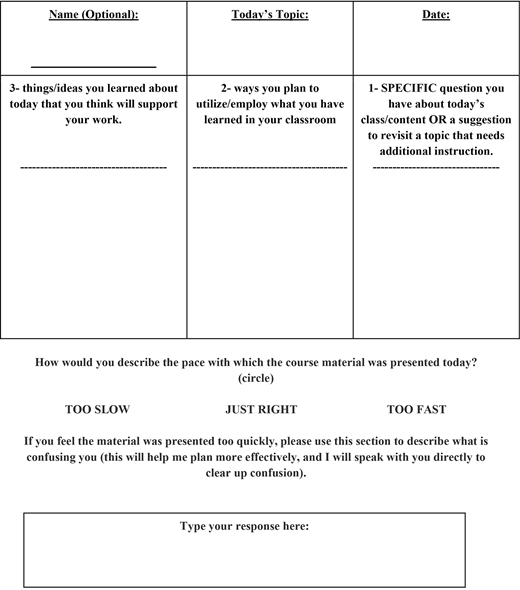
Exit slips were also reintroduced as a tool to obtain feedback related to the quality of my instruction and to help me identify students in need of additional instructional support. I created a general exit slip (see Appendix A) and asked students to complete and submit it after each class. As a way to motivate student participation and eliminate anxiety, I asked students to complete it during allotted class time. I assured students that this formative assessment would not be graded and would be used to plan future instruction. Overall, a majority of students enrolled in my courses chose to utilize these tools, and I found them helpful when designing instruction and activities.
Help Students Determine How Much Time They Should Spend Working
Students that fell far behind in submitting assignments expressed feeling overwhelmed and believed they were incapable of catching up. For these students, I felt it was my responsibility to remind them I was flexible in my approach to teaching and grading and chose to extend submission deadlines without penalty.
I offered to meet virtually with struggling students before or after class or during a time they could concentrate and complete their best work. During these virtual meetings I reviewed content, shared additional resources, and reviewed each student’s submissions to help them create a pacing calendar (see Appendix B) to complete past due assignments before the final. This strategy appeared to be the most successful in helping struggling students get back on track.
Plan a Good Closing or Wrap Activity
When I read Boettcher and Conrad’s (2016) suggestion to choose a good closing or wrap activity for the course, I immediately thought this referred to reflection. In terms of reflecting in an academic setting, I believe it is important to begin to reflect by returning to the purpose or objectives for individual tasks or the course as a whole. Instead of waiting until the final class to include a closing or wrap activity, I began to wrap up each class session by asking students to revisit the objectives presented at the start of class and reflect on their individual growth or performance. I guided each wrap activity by prompting students to ask themselves: “What do I know now that I didn’t know a few hours ago?” Or, “What am I capable of doing now that I couldn’t just as short time ago?” Overall, students responded favorably to this activity and were able to identify their success or need for additional support.
This strategy was also employed on the final day of the semester. I began class by presenting the course goals that were shared on the first day of the semester. I then facilitated a reflection discussion to help students determine whether they met the criteria for successful course completion. During this whole-class conversation, students were actively engaged and appeared to be pleased with their overall performance under unexpected and emotionally challenging circumstances.
Roadblocks
Although many strategies aligned with best practices for online instruction had been employed in my course, there were a few additional roadblocks or barriers that may have interfered with student success during the final week of class. During this time some students began to share feelings of mental distress and a small number of students missed class, did not submit final assignments, and did not respond to my many attempts to contact them.
Feelings of Mental Distress
During the final week of synchronous class sessions, students appeared to be worn down. They were signing in for class wearing pajamas, yawning, and engaging in side conversations with peers to share their overwhelming exhaustion and feelings of mental distress. They expressed feeling anxious and depressed due to viewing the news and being confined to their homes. They shared the issues they were facing in other classes, such as professors interpreting a transition to online instruction as a reason to add independent assignments and an unwillingness to respond to students’ questions and requests. It became clear that the students were fighting an uphill battle and were certainly not equipped to face challenges presented along the way.
AWOL Students
Although strategies had been employed to support students that periodically missed class, there was no advice I could locate in the literature to help with students that chose to miss class, not submit assignments, or failed to reply to the many attempts made to contact them. Two students that were present during face-to-face classes and many of the first synchronous sessions disappeared without explanation. These students were still enrolled in the course, and their names were included on my official roster, but I was unable to contact them via text, phone, or email until the last few days of the semester.
One student chose to reply to my email the day before the final to explain that her work schedule and her demanding course load left her without time to attend class and to complete the final project. In this case, I relied on my commitment to be fair, flexible, and empathetic in my approach to teaching. I assured the student that I was confident in her ability to complete the assignment and submit it before my final grades were turned in. Fortunately, she chose to accept my offer and was able to submit the work and pass the course.
The other student decided to send me a short message of thanks on the day after the final assignment was due. She expressed feelings of gratitude for the endless opportunities to support her success. However, she shared that under the circumstances, she chose to take advantage of the pass/fail option offered this semester by the university. Without the 20 points allotted for the final project, she was still able to pass the class. In this case, I reflected to determine whether or not there were additional strategies that I could have employed to help motivate this student to complete the final project. I did not find any resources that provided me with any further insights, but I will continue to seek guidance if this happens again.
Internal Struggle (Final Grading)
Final projects were submitted, and end of term grades were due in 72 hours. I completed reviewing and grading final projects and uploaded scores to each student’s online portal. Up until this point in time, determining final grades for students in my courses had not been complicated. Points for each assignment were added up and aligned with a corresponding letter grade. Once again, the process of grading had me self-questioning and deliberating how to make the best choices, the right choices, and the fair choices.
My goal in terms of grading fairly at the start of the pandemic included being mindful and empathetic. This decision meant I would be impartial and just when grading but would also consider the mandates and conditions students were forced to work through during this stressful time. Under the circumstances of living and working during a pandemic, I needed to choose an approach or procedure that could be utilized when trying to determine a student’s final grade.
As I viewed the total points accumulated by each student and tried to match it with the corresponding letter grade, I was conflicted. Although most grades appeared to perfectly align with a grade, I could have predicted based on student performance, there were four students that were 1 to 2 points below the grade they deserved. The only grading category left to factor in was participation.
I chose to revisit the grading requirements for the course. According to the syllabus created before the start of the semester, participation required consistent attendance in class as well as assuming an active role during class discussions. These four students never missed a class session either face-to-face or online, were actively engaged asking questions and participating in discussions during all class sessions and were willing to seek out additional support by attending small group instructional sessions. I asked myself, “If some students were not being penalized for missing online classes or failing to actively engage for any reason because of the circumstances, then shouldn’t students that exhibit an extraordinary amount of effort and push themselves to engage in any forum be rewarded? Do I just reward everyone?”
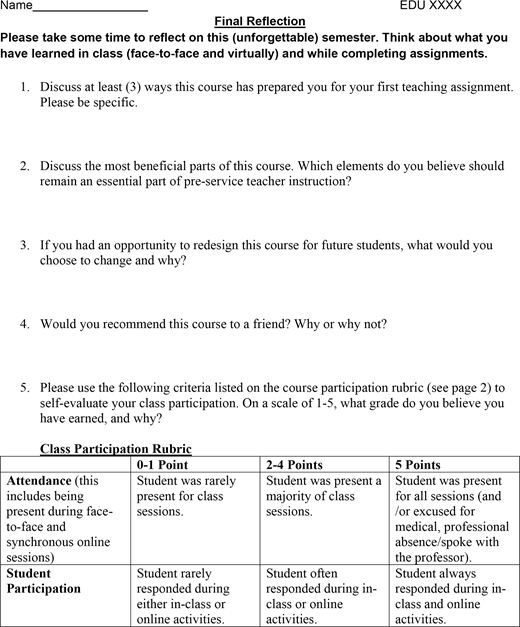
I took pride in my ability to openly engage in conversations with students and had always appreciated their willingness to offer honest feedback. I believed that in order to be fair and have empathy I should have a deep understanding of student perceptions of the grading process. The right choice, the fair decision, was to collaborate with students to determine final grades. Ultimately, I decided to ask students to reflect and grade themselves using the syllabus criteria as a guide (see Appendix C). I found that all students graded themselves fairly and accurately. Once the participation grades were factored into the overall points toward end of semester grades, I posted preliminary grades for students to review and suggested that they contact me if they had any questions, concerns, or believed the final grade was incorrect. In the end, no students were in disagreement, and I was confident that this approach, like the others I had employed during the pandemic, was the most fair.
Lessons Learned
The story of my journey teaching through a pandemic is powerful because it manages to highlight the experiences that were likely shared by thousands of students and educators living, learning, and working at universities all over the world. As I reflect on this challenging time both personally and professionally, I recognize that I have gained confidence in my ability to teach through my experiences and lessons learned. Despite minor setbacks, I was able to support my students and independently problem solve in order to overcome barriers that may have interfered with teaching and learning.
Providing Consistency for Students
Within a week of transitioning to online instruction, it was clear that providing and maintaining consistency for students would serve as the foundation of my own best practice during a pandemic. Consistency meant creating online learning experiences that closely mirrored the face-to-face instruction provided in class. I set high expectations, chose to teach synchronously, and created opportunities for students to engage in active learning by working in small groups, collaborating with peers, and participating in discussions.
Providing consistency for students was also achieved through my decision to remain available via email, phone, texting, and online office hours. Any student in need of additional instructional support was able to contact me to obtain resources, ask questions, and clarify misconceptions. Students frequently commented to share how comforting it was to know they could rely on their professor to be there when they needed help living and working through a pandemic.
Searching for Best Practices
I consider myself a lifelong, self-regulated learner, and teaching during a pandemic has certainly been a time when I have spent a considerable amount of time researching to learn about best practices. Prior to the outbreak of COVID-19, I had not considered teaching online and did not have any formal training in virtual instruction that may have helped me support students. When I began to identify issues that arose from rapidly transitioning to online classes, my response was familiar; I chose to engage in research to find solutions to overcome barriers that interfered with my ability to provide excellent instruction. Fortunately, resources to support teachers providing online instruction were available at my fingertips. I am confident that my decision to integrate many of the strategies I learned about can be credited for ensuring my students’ success.
Grading Fairly
The most valuable lesson learned through my experience teaching during a pandemic may be that grading students fairly means to grade with empathy. This means that teachers try to relate to their students’ feelings or understand the conditions they may be living or working under. I believe that when it comes to grading, whether it be kindergarteners or graduate students, teaching face-to-face or online, in New York City or any other location across the globe, it may be wise for all educators to consider what it means to grade fairly and should do their best to be empathetic when making decisions related to students’ learning.
Where Are We Going From Here?
Moving forward, there continues to be so much uncertainty about what professors can expect their classes to look like in the coming months. Rumors of what the “new normal” will entail may dictate whether or not face-to-face can continue. We have heard a hybrid model with limited face-to-face interaction and wearing mandatory PPE with partitions put up between students in classes may be in place. There is also the possibility of all online instruction. There are questions about how much enrollment will plunge—our students did not sign up for online education. With plummeting enrollment, which professors’ jobs are secure and whose are not? The only thing that is certain is uncertainty. All we can do is move forward with the lessons learned in these last few months and with a commitment to continue engaging our students with empathy.