

Introduction
Effective face-to-face (F2F) classroom discussions are those in which learners discover and explore dissonance or inconsistency among themselves. The learners are the ones asking and answering the questions with the instructors serving as guides on the side. Proposed new knowledge is being tested against existing cognitive schema, the learners’ personal experiences, or other sources as learners negotiate meaning. Laughter emanates from these noisy discussions and as the semester progresses, friendships are formed.
From the fast-paced spontaneity of F2F discussions, how can instructors make the shift to the written mode of an asynchronous discussion forum (ADF) in their online classes and be successful? Where is the noise, the laughter, and the socializing in an ADF? Can ADFs be structured in a way that learners will feel a sense of belonging to a learning community?
Although Garrison and Cleveland-Innes (2005) explain that there are three main components for meaningful learning to take place in computer mediated discussions—cognitive presence, teacher presence, and social presence—this paper focuses solely on the last. The purpose, then, of this action research study is to examine the role that social presence plays in asynchronous discussion forums in creating a sense of belonging in an online course. The authors suggest ways to increase social presence and interaction in online courses through the use of an informally structured discussion forum. In their case, the forum is titled the Anything Else Cafe. The structure of the Anything Else Cafe simulates, to an extent, what occurs in traditional F2F classrooms. The authors also discuss the limitations of this method. The following question guided the study: Can informally structured asynchronous discussion forums be helpful for students in creating a sense of belonging in a social learning community?
Social presence is defined as “the ability of participants in a community of inquiry to project their personal characteristics into the community, thereby presenting themselves to the other participants as ‘real people’“ (Garrison, Anderson, & Archer, 1999, p. 89). Creating a sense of community in which social interaction can occur is a major concern in the design and delivery of ADFs, not only with instructors but also with students. F2F classroom discussions seem to have the advantage of more personal interaction. In a F2F class, social interaction might take place through formal class discussions, before and after class, or in whispered asides to a nearby student. In an ADF, there are no pre-or postclass chats, nor are there any whispered asides to establish a social presence among the members of the group. Therefore, it is important that within the actual discussion forum similar such social interactions be permitted to take place. The incorporation of social presence in the ADF can promote greater understanding of course material and different points of view. Friendly exchanges of opinion can reflect a strong social presence (Peterson & Caverly, 2006). ADFs that are designed specifically for students to have these social exchanges may offer opportunities for students to feel they are part of a social community.
Online Communities and Social Constructivism
Social-constructivist pedagogies are defined by their social interaction. In distance learning, this interaction is always mediated. It is thought to be an integral component of quality distance learning (Garrison, 1997). Being a participant in a community is a vital component of the educational process. In that process of learning, meaning is negotiated in a collaborative and social environment (Barab & Duffy, 2000).
Anderson and Dron (2011) note that there has been much research on the value of creating social presence in both synchronous and asynchronous models of education. However, the more immersive technologies, such as Second Life, can provide the social enhancements that are not available in traditional synchronous and asynchronous forums. These social enhancements include forms of body language, like gestures, costumes, and voice intonation. In the traditional text-based ADF, these features are not available to the learner. The learner only has text and perhaps emoticons to show mood and emotion. The nonverbal signals present in F2F discussions are missing in the ADF format so ADF participants cannot read the body language, note the hesitation, nor hear the sarcasm in the writer’s voice.
The “here and now” quality of the F2F discussion is in sharp contrast to the “there and whenever” aspect of the asynchronous environment in which ADF participants operate. While F2F participants elaborate and repeat information, ADF participants try to increase communication efficiency by reducing unnecessary elaborative statements and repetition in their social interactions. Written communication is leaner so that ADF participants can reduce the typing requirements and express their thoughts clearly and concisely (Marra, Moore, & Klimczak, 2007).
MacDonald and Caverly (2001), on the other hand, do not see a big distinction between what occurs in F2F discussions and what takes place in asynchronous environments, particularly with the type of online discussions between students and instructors. In fact, they describe online discussions as “having a party in a dark living room. No one can see one another, but everyone hears what is being said” (para. 13). They identify three types of online discussions: (1) discussions where students ask the instructor or mentor questions; (2) discussions that encourage student-to-student interaction; and, (3) discussions that are student centered and led.
These three types of discussion formats are socially constructed. Social constructivism relies on two-way communication technologies that allow opportunities for interactions between and among students and teachers, like those offered in synchronous and asynchronous discussion forums. In a social-constructivist pedagogy, there is the acknowledgment of the social nature of knowledge and of its creation in the minds of individual learners. It is essential that distance education be a social activity rather than a one-way communication activity that is passively consumed by the learner (Anderson & Dron, 2011). The asynchronous discussion forum can be the venue for engaging in this twoway communication activity. Golding (2011) views an educational constructivist discussion as “a discourse between two or more people, at least one of whom is a student, that involves the student(s) actively constructing their own knowledge” (p. 469).
Method
The Setting and Participants
ENC 3250 Professional Writing is offered every semester through the Department of Language and Literature in the College of Arts and Sciences at Florida Gulf Coast University. All sections are offered online. This course is an upper division undergraduate course that fulfills a communication requirement set by the Florida State Board of Education. The data presented in this study are from one section of virtual ENC 3250 Professional Writing collected during the fall 2011 semester.
Procedure
Students are introduced to the Anything Else Café before the class begins when the syllabus is mailed to the course enrollees. The participation policy section of the syllabus states that 10% of the student’s grade is determined by the student’s participation in the course. Students are informed that ENC 3250 is not a selfstudy class and they will be expected to be accountable not only for their own learning but for the learning of others in the class. The instructors explain that participation in an online class is just as important, if not more important, than it is in a face-to-face class.
The Anything Else Café is one component of the participation grade. The minimum participation requirement is to post and/or reply twice a week. The other two components are study team participation and log-in activity.
At midterm, approximately 8 weeks into the course, students are asked to generate a participation report using the Report tab in Angel in which they document their login activity, their study team participation, and their participation in the Anything Else Café. This documentation is quantitatively based and not dependent on the quality of their posts or replies. They can meet the minimum requirement, exceed it, or significantly exceed the minimum requirement. At the end of the report, they provide justification for the scores they have given themselves. At the end of the course, they have another opportunity to generate a participation report using the same criteria. Each of the reports is worth 5% of their grade, or 10% total for the midterm and the final participation grade.
Data Collection and Data Analysis
The data collected for this study were generated by the “At a Glance” function in the Anything Else Café discussion forum over an 8-week period. This view provides information about activity trends, total post activity, and topical activity. In other words, this bird’s eye view gives a picture of when the students posted, how frequently they posted, the ratio of student communication to instructor communication, and the most popular and least popular topics that were discussed.
Other data were collected using the Threaded View feature in the discussion forum. Using this view, the researchers were able to examine the content of the posts and replies. Discussion forum transcripts were viewed in order to analyze the kinds of communication that were occurring in the forum. This communication was categorized into: course related queries, other queries, informational postings, and responses to posts that were information related.
The final set of data was collected in the form of a 10-question survey to students about their experience with the Anything Else Café and their use of these kinds of cafés for creating a social learning community. Vonderwell (2003) states, “Examining the communication experiences and perspectives of online students can help instructors design effective communication practices using asynchronous communication tools” (p. 78). The survey responses gave the researchers insights into how the Anything Else Café was being perceived by students.
Findings
Anything Else Café At a Glance
Figure 1 provides a bird’s eye view of the postactivity that took place in the Café during the semester.
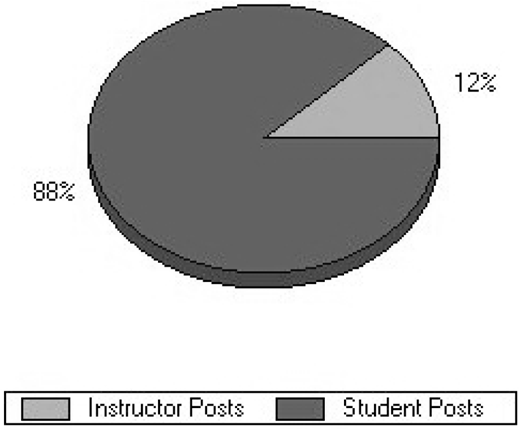
The data presented in Figure 2 indicate that the Anything Else Café served as a vehicle for creating a strong social presence in this online course. As shown in Figure 1 this two-way communication forum was a student-to-student generated one rather than primarily an instructor-to-student interaction. Student participation represented 88% of the communication, whereas the instructor’s participation was 12%. Even in the course-related inquiry posts, students worked out the answers to the questions and helped each to clarify assignment directions, due dates, questions on whether classmates could view their profile pictures, and questions about how to embed video and insert live links into a discussion forum. Overall, the posts were personal in nature, such as the very popular National Football League (NFL) talk. Other topics included talking about the weather, announcing events on and off campus, sharing stories about the everyday stress of being an undergraduate student at the university, sharing of resources about part time job opportunities, book and movie recommendations, service learning opportunities, internship opportunities, and talk of upcoming holidays.
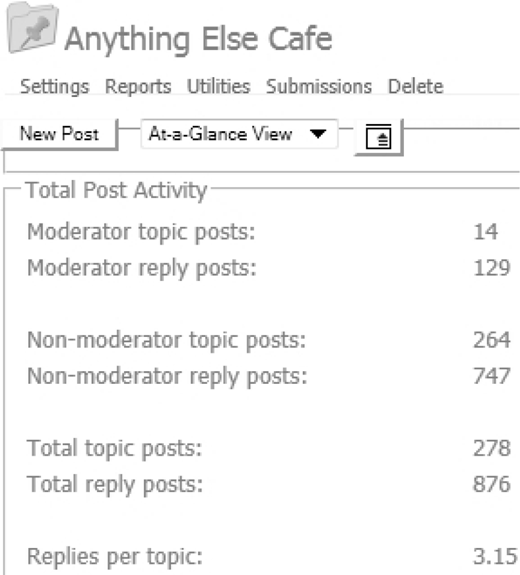
Comparison of moderator (instructor) post/reply activity to nonmoderator (student) post/ reply activity.
Comparison of moderator (instructor) post/reply activity to nonmoderator (student) post/ reply activity.
The Anything Else Café was an active place for students to meet in cyberspace as one can see in Figure 2. The student postreply activity compared to the instructor-to-instructor postreply activity indicates that students interacted with one another in a democratic space that was controlled by the students. Topics were initiated by the students in this informal learning environment. The 1,011 posts and replies by students far exceeded the 143 posts by the instructor. Over the course of the 8 weeks, these 1,011 posts and replies averaged 2.8 posts/replies per student per week, which significantly exceeded the requirement of two posts per week for this component of the participation grade.
Survey Results
Of the 44 students enrolled in this section of ENC 3250 Professional Writing, 34 responded to the survey, representing a 77% response rate. There were ten questions that were asked related to the use of ADFs in creating a social learning community in online classes.
Although the activity trends and posts provided the researchers with evidence of a strong social presence in the Anything Else Café, the survey results addressed whether the students themselves perceived this forum as an important way to establish a social learning community. Thirty of the 34 respondents of the survey, or 88.2% of the respondents, said it was important or somewhat important to have a social community in a professional writing online class; 70.6% of the respondents thought that the Anything Else Café was a good way to create a social community for online learners; 14.5%, or 5 respondents, thought that the Anything Else Café might be a good way to create a social community. One student wrote, “It absolutely is. I feel like I actually know some of my classmates, which is really rare for an online class.”
Questions 3 and 4 told a slightly different narrative about why students visited the café. The primary reason for 61.8% of the students was to satisfy the requirement for the Anything Else Café participation component of the course. The secondary reason was to socialize with fellow peers (32.4%) or respond to any of the other students who might be having problems with an assignment (32.4%). One might conclude from these data that participation in the Café might be low if the mandatory participation requirement were removed.
Question 10 on the survey provided some useful insights into the mandatory use of the Café to promote a social learning community. Respondents were asked, “If the Anything Else Café weren’t a component of your participation grade, would you use it?” Forty-four percent answered that they would use it, while 32.4% said that they would probably use it. Again, it can be concluded that even if the Café were not a component of the students’ participation grade, over three quarters of the students would use it or would probably use it. The Appendix includes the survey, results and sample student responses.
Discussion
An informal and unstructured forum, such as the Anything Else Café, whose primary function is to create a social environment, provides opportunities for students to create their own social space where they can interact with one another to form a social community. Although asynchronous in nature, it can simulate what happens in the face-to-face classroom.
The following are five strategies for the successful implementation of such a café:
Make it very transparent to the students at the start of the course that taking an online course is not an individual experience but a collaborative and social one.
Separate any structured ADFs that are part of the course from the more informal and structured forum whose main purpose is to create a social community.
Establish this informal and structured forum as a mandatory component of the participation grade.
Structure two participation grades: one at midterm and the other at the end of the course, which will provide opportunities for students to become more actively engaged after the midterm.
Allow students to control the forum by not rushing in to respond to posts and require that they generate their own participation reports of their activity.
These strategies are founded on theories of social constructivism. A comprehensive understanding of the role that asynchronous communication can play in forming communities of inquiry should provide researchers and practitioners with effective ways to implement a strong social presence in online communities.
Conclusion
This action research study explored the role that ADFs can play in establishing a social presence and a sense of belonging in online courses. Results indicate that an ADF that is informally structured can be helpful for students in creating a sense of belonging in a social learning community. Most students enrolled in this online course realized the benefits of using an ADF as a way to create a social learning community. This community of inquiry model values interactions of a social nature that support the discourse of online communities (Garrison & Anderson, 2003).
Although an ADF cannot replicate the natural and spontaneous social interaction that occurs in F2F classes, it can provide a space and a place for students to socially construct knowledge and connect with one another to form social networks that will help them survive, if not thrive, in their online courses.
Online instructors who wish to make connections to their students and have their students connect with one another in a social space will benefit from implementing this ADF design. This more informal yet unstructured ADF will encourage social presence and provide opportunities for students to interact with one another to build strong social learning communities.
About the author's

References
Appendix ENC 3250 Anything Else Café Survey
1. How important is it to you to have a social community in an online professional writing class?
2. In general, how often do you log into your ENC 3250 course in a week?
| a | Once a week | 5.9% | 1 |
| b | Twice a week | 5.9% | 2 |
| c | Three times a week | 26.5% | 9 |
| d | Four times a week | 26.5% | 9 |
| e | Five times a week | 17.6% | 6 |
| f | Every day | 17.6% | 6 |
3. What is your primary reason for going into the Anything Else Café?
| a | To post a query | 0% | 0 |
| b | To post my news | 8.8% | 3 |
| c | To socialize with my fellow peers and see what they are up to | 20.6% | 7 |
| d | To respond to any of my peers who may be having problems with an assignment | 26.5% | 9 |
| e | To satisfy the requirement for this participation component of the course | 8.8% | 3 |
| f | Other | 0% | 0 |
4. What is your second most important reason for going into the Anything Else Café?
| a | To post a query | 2.9% | 1 |
| b | To post my news | 11.8% | 4 |
| c | To socialize with my fellow peers and see what they are up to | 32.4% | 11 |
| d | To respond to any of my peers who may be having problems with an assignment | 32.4% | 11 |
| e | To satisfy the requirement for this participation component of the course | 19.6% | 7 |
| f | Other | 0% | 0 |
5. How many times in an average week do you go into the Anything Else Café?
| a | Zero times a week | 8.8% | 3 |
| b | Once a week | 20.6% | 7 |
| c | Twice a week | 17.6% | 6 |
| d | Three times a week | 23.5% | 8 |
| e | More than three times a week | 29.4% | 10 |
6. Do you think that the Anything Else Café is a good way to create a social community of learners? Explain your answer.
Sample Student Comments:
“There are many things that can be done in the Anything Else Café. What I have seen is that it serves as a hub for people to get answers to questions regarding the course. Students also usually announce activities and/or events that might be going around the area or college campus. There is also the habitual chit chat about everyday life as expected which is good and keeps things fresh outside the learning web.”
“Yes because it gives a location for students to converse that doesn’t have to be concerning a particular assignment. Gives students the ability to know others.”
“I can see where it can be a clever way to create a social community, but I don’t think it should be required because of the fact that I do not respond to someone’s posts that I do not know.”
7. How important is it to you to have a social community in an online class? Explain your answer.
Sample Student Comments:
“Without a social community on an online class, you have no means of interacting with other students.”
“It can keep people in touch with each other and help college students make friends/study partners, etc.”
“Any kind of social contact is important. Having the chance to socialize in an online class is great.”
“I believe the virtual classes lose the social aspect of going to school. The Anything Else Café is a step in the right direction.”
8. How important is it to you to have a learning community in an online class (e.g., discussion forums, peer editing groups, study teams)?
Sample Student Comments:
“A learning community in a class is very important because speaking to classmates about the assignments and trying to better understand them from peers makes it easier to swallow.”
“Working with others helps you learn the subjects better and without these things, there would be little to no interaction with other students.”
“I think a learning community is an important element and it must always be a part of an online class. Makes the online class be more than student-computer-professor relationship, which brings it closely to a regular class.”
“Getting advice from multiple people all in the same class is helpful because someone might find something you or someone else wouldn’t.”
9. Do you think that the Anything Else Café is a good place for online learners to establish a learning community? Explain your answer.
Sample Student Comments:
“The Anything Else Café allows for interaction and is a way for students to go to other students for help with assignments. Also, by using this as a way to grade participation, it pushes people to be more involved and learn actively.”
“It can be helpful for those that need assistance when a professor can’t respond immediately, but it is mostly full of chit-chat to fulfill a requirement.”
“One could establish a learning community, but I feel it establishes a place to create conversation which has potential to lead to a learning community.”
10. If the Anything Else Café weren’t a component of your participation grade, would you use it? Explain your answer.
Sample Student Comments:
“I would use it. Then again, would I use it as often? Probably not. I guess it would all depend on what goes around in the Anything Else Café. What the topics are, etc. There must be motivation and with all the things going on in a student’s life, there is little time to make a place for it. So, by making it mandatory, I think the Anything Else Café gets its ‘motivational boost’—which basically is 10% of your grade.”
“I’m not sure that I would. If I ran into a problem with an assignment, I might go post a question on the forum, but usually the assignments are pretty self explanatory.”
“I wouldn’t use it as much probably, but there are usually interesting topics being discussed so I’d definitely use it.
