

This article explains the importance of sharing perspectives in an educational context and on how e-learning course tools can facilitate shared perspectives. I discuss examples, from two courses (one an undergraduate and the other a graduate course), of sharing perspectives in four distinct ways: cross-culturally, over time, about texts, and to collaboratively create art.1
The sharing of perspectives is relevant in a world in which diverse people need to work together harmoniously and conscious of their responsibility to human respect and rights, and to the global environment. Francois Trochon, a teacher educator interested in the potentials of video study groups, describes “pedagogy of sharing” in which “knowledge comes from engaging in communication with a cultural community” (2001, p. 10).
Communication professor James Benjamin defines
five specific types of interactive classroom experience: 1) the evolution of traditional papers into hypertextual and hypermedia papers, 2) the progression from oral presentations to student created Web presentations, 3) the transformation of library assignments into structured Internet searches called WebQuests, 4) the development of journal assignments into online journals or “blogs,” and 5) the unique opportunities of online discussions as a new form of group discussion.” (Benjamin, 2003, p. 1)
This article extends instructional use of interactive media with an emphasis on the value of and strategies for shared perspectives in interactive communication.
While teachers and course designers can work toward teaching a shared vocabulary and may believe that “the notion of electronic communities can be best realized from within a particular application environment in which ‘community members’ share common values, objectives, and goals” (Reisman, 2003, p. xii), I believe that physical, psychological, and semiotic noise impacts interpretation and understanding, as well as the beliefs, values, and attitudes of all participants in the communication exchange. This article focuses on noise as important course content. E-learn-ing course tools helped me to facilitate investigation into such pervasive noise in communication in two courses (one an undergraduate and the other a graduate course) in four distinct ways. I present course participants’ learning from shared perspectives in cross-cultural exchanges, over time, about texts, and to collaboratively create art.
In the course “Visual Culture and Instructional Technology” (Fall 2003), I met twice a week in a computer lab with 19 students enrolled in the art education undergraduate degree programs at The Pennsylvania State University. Combined with the classroom interactions, we used ANGEL, which is an acronym for A New Global Environment for Learning? I used ANGEL for pedagogical goals that require Internet functionality, a Web editor, and server space. One goal is to develop a community concerning the course themes beyond the physical time and space of the classroom. Students post papers for self-critique in relation to the content of others’ responses, share and evaluate resources, and post ideas and plans for feedback from teacher and students.3
To initiate a sense of community I have students upload a photo or some other image to represent self. E-mail messages sent within ANGEL to others contain their self-representation. These often change over the course, and are a visual way to observe individual transformation. Additionally, students are required to send a message that includes something about themselves and that does one or more following:
ask a question about something that was mentioned or that occurred in the class;
react and reflect on what has occurred in class;
respond to a reading that relates to or is assigned to the class;
connect the course to a current social, educational, or personal issue;
describe a concern related to the course or to the degree program.
I encourage continued e-mail communication in the course to connect with me and other course participants, to collaborate on projects such as group-developed WebQuests, and to send and receive resources, to ask questions and give feedback, and to network with others outside the course. The first email is graded to help initiate communication and community. The first e-mail receives full credit if students fulfill the above, and if they ask the other class members for a response or respond to others’ email content, or offer future assistance or wisdom regarding something that might arise in the course projects. E-mail continues among some students. International exchanges continue in threaded discussions. In one assignment, I ask students, in groups of five, to read four others’ critical analysis essays in relation to their own paper and respond to questions in the threaded discussion board such as:
“What is something you learned or had not considered previously that another discovered in their interpretation of the same work?”
The visual culture undergraduate course involves an intertextual postmodern pedagogical approach to art education, in which students interlink images, text, video, and sound in explorations of visual culture. The student-created visual culture intertextual Webs have traces and associations, perpetually displaces (i.e., has no center or stagnate categories), interplays surface with depth, has no prescribed path, and presents a multifaceted reality like a woven fabric for viewers to come to their own perspectives. To realize these intertextual characteristics in Web design, students critique Web art and peer Web sites in formative stages of development to provide suggestions to extend, connect, and challenge homogeneous presentations of issues. I ask students to suggest visual metaphors that focus the issue or theme in their peers’ Web plans presented in message board postings that would not close down multiple perspectives concerning the issue.
Cross-Cultural Exchanges
The cross-cultural exchange in the visual culture course in Fall 2003 involved an online discussion in ANGEL between students and art educators in Korea and the United States in three multivocal art criticism activities. The “Interpretation,” “Representation,” and “Difference” sections asked for critical interpretations of visual culture. While there are different perspectives on what is meant by the term visual culture, I refer to a specific social theory inquiry into visual manifestations of cultural practices that shape knowledge, representation, ideology, and power. My visual culture pedagogy involves examining cultural narratives and interrogating subject positions that are offered to us through visual and/or visualized cultural practices in terms of compliance, negotiation, or opposition to lived experience and social justice (Keifer-Boyd, Amburgy, & Knight, 2003). Visual culture “transcends the limitations of the senses, to include visions of things that may not be possible in the real world. Mental images are the substance of cognition” (SmithShank, 2004, p. 10). Class and online discussions and Web accessible resources help the participants in the course explore various meanings of visual culture. While students are encouraged to develop their own definitions, a shared vocabulary commences as we begin to understand the values, attitudes, and beliefs that each brings to the cross-cultural exchange.
The “multivocal” approach, is a term and concept I adapted from Victor Turner’s (1967, 1975) anthropological work on multiple meanings assigned to a symbol within a culture and understood according to the contextual use of the symbol. My multivocal pedagogical approach is based on combining sets of questions, each set derived from theories in anthropology, sociology, feminism, art, and ecology. Each set of questions provides a lens to interpret visual culture. However, while a lens magnifies certain features and meanings, anything outside the focus is blurred or absent from the interpretation and judgment of the work’s purpose and/or significance. The combination of different theoretical stances including a formalist ideology, a sociocul-tural framework based on social theory, experimental reconstruction in anthropology, feminist theory, and ecology perspectives referred to as green criticism provide a range that provokes critical inquiry at its best, when interpretative ideas are juxtaposed and contested.
I ask students, in groups of five, to each apply a different lens to a work. The group then presents to each other and to the class how their interpretations and discussions evoked contractions, extensions, and new meanings from the combination of different perspectives. The multivocal approach integrates different ways of knowing and experiencing to gain insights into the artist’s thinking and making processes; and the social, political, economic, and cultural milieu from which the work is a part. It is a successful critique when the participants recognize that their interpretations are a reflection of themselves, and are aware of how their questioning strategy influenced their interpretation and judgment. The following are five sets of questions that people ages 12 years to adulthood have used to engage in a multivocal approach to interpreting visual culture. After seeing examples, the multivocal process stimulated shared perspectives in classroom and online discussions about specific works.
The formalist lens focuses on visual coherency and unique qualities of visible features (Greenberg, 1977).
How are the visual features— objects, people, colors, textures, lines, shapes—presented in a unique way?
What is emphasized by the style of representation?
How do the visual forms work together to express an emotion or idea, yet keep the focus on the work and not to its reference?
The socio-cultural lens focuses on the cultural stories, often expressed as metaphors, that the work conveys within a specific social context (Lakoff & Johnson, 1980/2003; McFee, 1998).
Who or what is powerful in this image?
What does the creator of the work believe and support?
Who might the image be made for and how are they positioned in relation to the work?
Who would or would not like the image, and why?
What social relationships are conveyed?
What cultural story is told through the work and its presentation in specific contexts?
What is the societal status of this work compared to other visual culture forms, and how has it changed over time?
The anthropological lens4 involves reconstructing the making experience in some way so that the viewer/researcher has insights into the material and conceptual processes. To do this, the viewer needs to engage in activities that are similar to the making and conceptual processes involved in the creation or use of a specific work. For example, in understanding Natalie Bookchin’s (2002) MetaPet,5 the student might re-create an existing game that changes the imagery and therefore its message. To understand the collaborative artwork, RadarWeb by Sawad Brooks and Beth Stryker (1996), you might ask for images and memories from others about a specific event and combine them within an artwork that can be broadcasted or disseminated on a large scale.
The feminist lens focuses on one’s personal experiences shaped by societal views of gender, ethnicity, age, and so forth in relation to the work (Fiore & Nelson, 2003; Garber, 1996).
What are the overt or covert messages in the work concerning gender, race, and social class?
How are you positioned in relation to these messages?
What does the subject matter mean to you?
How does this image impact you?
The ecology or green criticism lens focuses on the impact of the work on the environment (jagodzinski, 1991).
Where did the artist obtain the materials to produce the work?
Were any species exploited in the production or process?
How does the use of the materials in the work impact the environment?
Are the materials biodegradable?
Does the work inform us about a specific time and place?
What does this work contribute to an environmental awareness of a specific place?
This multivocal approach was the basis for the Interpretation, Representation, and Difference cross-cultural exchange activities.
Interpretation
The Interpretation assignment6 was described to students as follows:
Disney movies are created from folktales and stories that express long-held beliefs about heroes, villains, and overcoming difficulties. We learn cultural values from these stories. Specifically, we will consider race, gender, and conceptions of beauty in the Disney animated film Beauty and the Beast. First read Barretf s (1994) article, “Principles for Interpreting Art,” accessible through electronic reserve. Then go to examples of interpretations of Beauty and the Beast by selecting each of the five different lenses in the multivocal art criticism approach introduced in this activity. Next choose at least one lens and answer the questions with that lens and post your responses in the “INTERPRETATION” Message Board under the “Lesson” section of ANGEL.
PLEASE NOTE: You can view QuickTime® clips of Beauty and the Beast and see images of the characters by clicking here. Under movie at this site there is a synopsis and film trailer, etc. However, if you are unfamiliar with this Disney film, then select another that you have seen. And, if you have never seen a Disney film select any film to apply one of the lenses in the multivocal approach.
Evaluation: Full credit for responding to all questions in one or more multivocal lens with a persuasive and coherent argument supported by evidence with specific cultural references.
In the “Interpretation” activity in Fall 2003, in which participants critiqued a Disney animated film, one of the 22 participants who was a Korean art teacher, expressed her surprise concerning the difference in responses. She wrote, “I have read many responses to the Beauty and Beast. The diverse perspectives on the movie surprised me” (K1, October 4, 2003). Such a realization is a learning goal of my cross-cultural exchange pedagogy. Another in this same activity found similarities among those that he perceived as different. This Penn State art education student wrote, “I, too, find myself viewing the content of this movie through lens #4—mostly because of how disgusted I am by the gender roles portrayed in it” (P1, September 9, 2003).
Representation
The “Representation” assignment was presented as follows:
Have you seen Disney’s movie, Jungle Book? Baloo, the bear, sings “All you need are the bare necessities, the simple bare necessities of life” playing on bear/bare and affirming that nature provides all our needs. Read and critique Tavin and Anderson’s (2003) article on Disney accessible on electronic reserve. On ANGEL’s “REPRESENTATION” message board under “Lesson,” identify the authors’ position and discuss with reference to the reading and specific examples how different races and gender are represented in Disney movies.
Evaluation: Full credit for articulating how you learned the meaning of symbols, signs, and various visual conventions to understand how different races and gender are represented in visual culture; and that you critiqued Tavin and Anderson’s (2003) argument with specific references to the cross-cultural exchange.
Cross-cultural exchange can break down stereotypes and generalizations and bring about awareness of those perspectives held about you. In a dialogic setting, stereotypes are both revealed and challenged. For example, the statement by a Korean art teacher “But when I grew up more, I was wondering about why White people use force when they want to obtain something” (K2, October 8, 2004) presents a view concerning White people that is seldom heard within classrooms of predominately White students. Discussion continued concerning the strategies employed by people in general, and particularly White people in the United States, to obtain land, corporate control, money, goods, and social advan-tages—and the role of visual culture as consumption strategies.
Personal testimonies of real struggles remove the abstraction of racism and sexism, such as when a Korean student shares that her “parents think that boys are more special than girls no matter how good at study” (K3, September 28, 2003). Such issues are connected to lived experiences. When representations in widely popular media, such as Disney animated films, perpetuate oppression that is acknowledged in personal lived experiences, then critical interpretation is achieved. Furthermore, sharing the impact of such ideology with others of privileged status can begin to shift the criticality to social action for equality that is not premised on sameness or normalcy, but on difference.
Difference
The “Difference” assignment was presented as follows:
Rudyard Kipling authored the tales told in Disney’s (1991) Jungle Book animated film. Kipling (18651936), in his poem Ballad of East and West stated, “Oh, East is east, and West is west, and never the twain shall meet” (Kucich, 2003).
Korean American artist, Nam June Paik, who has lived most of his life in New York City believes that his life integrates East and West, and that his artwork helps people understand different cultures. Paik’s video “Bye-Bye Kipling” (1986) communicates the different cultures that are part of him (Mellencamp, 1995).
Consider the possibility of cross-cultural understanding. on ANGEL’s “DIFFERENCE” message board found in the “Lesson” area, write about cultural values, beliefs, and attitudes expressed in specific visual culture (i.e., in popular, everyday, pervasive, and/or society’s highly valued imagery) that is part of your life but that differ from your own cultural beliefs.
Evaluation: Full credit for contributing to the exchange of different viewpoints of cross-cultural experiences by discussing cultural values, beliefs, and attitudes expressed in specific visual culture that is part of your life but that differ from your own cultural beliefs.
Recognition of shared experiences brings people together as a supportive community. A Korean art teacher expressed support and shaped the community with her comment, “Suzanne! I read your reply and absolutely agree with your opinion. In Korea, like America, there are a lot of people who are not happy for many reasons” (K3, October 9, 2003). The conversation continued in a way that acknowledged similarities across cultures, and how each found ways to empower self amidst the cultural narratives to which they do not ascribe.
I carry over some comments from prior semesters in each of the forums on Interpretation, Representation, and Difference, especially those from backgrounds that differ from students in my courses. I also invite other art teachers or students to join each semester to continually expand on the cross-cultural exchange of perspectives on visual culture. Semiotic art educator Debbie Smith-Shank posits “we come to know all signs better through the process of community dialogue” ((2004, p. vii).
Perspectives Shared Over Time
Besides cross-cultural exchanges, I design my courses so that perspectives are shared over the duration of the course to encourage deeper reflectivity on one’s evolving views from the exchange with others about the readings. I elaborate in this section on how I do this by focusing on a graduate course I taught Spring 2004 at Penn State, titled “Artistic Creations & Theories of Knowing.” In this course, 12 graduate students posted on ANGEL by noon the day prior to the evening course—messages that included a critical response to the readings, a question raised by the reading they would like to discuss, and reflections on the relation of the ideas in the readings to their life and art. Since the first message by each was posted about 24 hours prior to class, not only did I have a chance to read the perspectives of all course participants, but also they dialogued with each other about the readings prior to class. At each class I brought the 30-page dialogue generated from that week’s reading highlighted by me for easy reference to facilitate discussion. After the class session, I wrote further questions and comments based on the in-class discussion and provided a synthesis of issues and ideas raised, which I posted on ANGEL. This served as the material for the end of the course reflection papers in which students were asked to synthesize their thoughts on art as a way of knowing. I provide two excerpts from student reflective papers as an example of the educational impact on students when they revisited the dialogue at the end of the 16 weeks of the course:
Critical inquiry by class members offered an amalgam of dialogs in the environment of the online discussions. Through varied topic explorations of knowledge in A ED 570, the cyberspace responses reveal an interface space. As these in/between interface spaces emerge, they negotiate the context of knowledge across public and private spaces extending world/views into a transformative circular narrative.
In concluding my reflection on this semester’s online postings I think that the importance of this learning experience was not just about the topics that were discussed and knowledge gained through those readings but in the format itself. Through the interaction of these postings true engagement of the topics and an attempt to counter ignorance of those topics has been documented.
Shared Perspectives About Texts
The 12 students in my Spring 2004 course, “Artistic Creations & Theories of Knowing,” also dialogued with 17 students in Professor Smith-Shank’s graduate Women’s Studies course at Northern Illinois University (NIU) about a film, The Handmaid’s Tale,7 that both classes watched in their separate locations. Both classes also read an article that the NIU professor and I co-authored, “Who’s in Bed with the Handmaiden?” (in press) concerning an interdisciplinary approach to art education in a counter-response to a view expressed by some art educators since the 1920s, which continues into the twenty-first century, that art should not be a handmaiden to social studies.
Adding others outside the group piqued interest in extended discussion beyond the time period of a class session and broadened the range of perspectives. I also noticed a tendency not to conform to a single “groupthink” perspective, but instead they comfortably espoused passionate and diverse perspectives. And, most importantly, they responded to what others wrote. The following excerpts for this dialogue are an example of active listening and responding to each other:
I agree with your ideas about color coding. Strange how we know instantly what it all means—the filmmaker is aware of how we have been programmed. I suppose another metaphorical idea was represented by the powerful “Commander” played by Robert Duval. Obviously a man so powerful could never be seen as impotent (infertile), so lefs not even bother testing the boys. (male PSU student)
I think that the colors in the movie do function more on the level of symbolism than that of metaphor, although they do, as Steve said, rely on an audience association with what they symbolize…. I was appalled to learn that Viagra is covered by all insurance, while my [birth control] pills are not! I find this similar to Robert Duval’s precious fertility/masculinity—an impotent male’s health condition is considered more medically valid (even though I would think that taking Viagra is in fact a choice) while a female’s serious condition that needs medicated [sic] is relegated to a supposed promiscuity. (female PSU student)
I was upset to hear that Viagra was covered but the pill still wasn’t. What century are we living in—sometimes I think we are still living in a man’s world. (female NIU student)
There are some critical writings by feminist lawyers who argue that if normalcy was understood as premised on women instead of men, the laws would be very different. Laws are based on what is within the range of what society has determined as normal, and baby-producing bodies are not in that range. The Handmaid’s Tale calls such bodies the chosen ones. Being “special” does not necessarily provide equality. Equality comes if you fit within the societal perception of “normalcy.” How we know ourselves, how we are informed and misinformed about who we are, has a lot to do with societal perceptions of normalcy. (PSU professor—me)
I decided to watch the film again, to get a second look at the color. The color of everything is so pronounced, kind of structural. (female PSU student)
I have to disagree about the existence of the handmaid as solely a vehicle for reproduction. That might be the party line, but I don’t think the Commander saw that as her sole purpose. (male PSU student)
I wonder how much people are actually controlled or deluded. Could it be more apathy than anything else.. I can’t help but think backward from current events to the movie. (male PSU student)
I wanted to bring up the point you made about the textbooks your friend’s daughter uses in school.. How does a person go about deciding when someone should think for themselves. Is it when that person thinks and acts exactly like the teacher? (male PSU student)
I think that would be similar to the power that is being shown in the film. I definitely do not think that the students should act and think like the teacher—that is still power and control but in an indirect way. The students need to have their own voice based on the knowledge they have acquired from the teachers. (female NIU student)
The idea of the handmaid in her silence and struggle to be within the confines of an oppressive dictatorship represents something for me. As an educator, I often find myself seeking desperately to find ways in which I may be true to my own beliefs about learning and my own creative self, while at the same time somehow being accepted within an institution that silently strikes out at anything or anyone who might be seen as not conforming. (female PSU student)
You touched on an idea I thought of throughout my viewing of the film. I kept thinking of how Kate exercised her agency through the (limiting and oppressive) role of the handmaid. Her “self” was not entirely crushed and she seemed to work with the agency and advantages that she could in the situation. I, too, felt that this was like teaching art. (female PSU student)
Shared Perspectives in the Creation of a Performed Visual Poem and Art Book Exhibition
Sharing perspectives to generate ideas for a collaborate art project began with a visualization I scripted and slowly read that asked students to look into a metaphorical mirror to see themselves as they are, followed by a series of questions concerning what they focused on, such as their physical self, actions, or emotions. They then looked again into the mirror to imagine what they would like others to know about them. From the visualizations that students shared in class we discussed metaphoric meanings. Students further developed a verbal or visual metaphorical self-image that they posted on ANGEL.
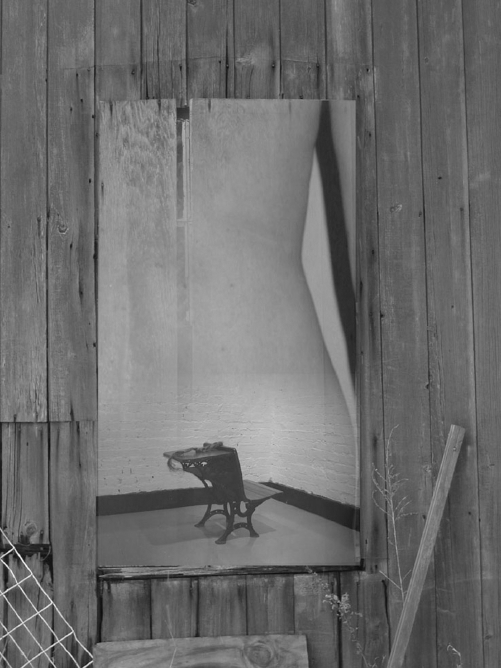
After the class read Margolis’ (1998) article, “A Theory of Culture and Emotions,” they analyzed each other’s self-metaphor images by looking for a “culture’s vocabulary of motives, emotions, and role relationships” in the combined grouping of self-images (Margolis, 1998, p. 135). We discussed the images according to how cultural residues were kept alive and/or thwarted by what was included in the image. We discussed how the conditions of others are part of the self-images. Figure 1 is an example of one of the self-metaphors.
Some interpretive ideas about the self-metaphor in Figure 1 included that a window is a medieval symbol of desire, which raised questions about whether this is a symbol of a desire for knowledge or a desire to recapture youth? The desk has abandoned the institution-alization of rows. The image seems to address the silencing that schools or educational institutions often create through standardization and expectations of conformity. A cutoff braid of hair might refer to youth, seduction, a prized possession, and a source of identity. The human back joined with the wooden schoolhouse frame could indicate the forces of education on every aspect of knowing who we are. Role relationships conveyed in the image suggest the tension between conformity and independence to societal norms and sanctioned knowledge. We noticed the visual culture vocabulary of openings and tensions between inside/ outside and strong/vulnerable. In the layering or merging of body and wood, the image itself could be a literal representation of metaphor since the “principle subject is ‘projected upon’ the field of the subsidiary subject” (Black quoted in Ferrari, 2002, p. 64). I encouraged all to continue visualizing their meta-phoric self as a means of self-reflection, which began the search for content for the collaborative art project. By producing a form to represent a metaphorical self each selected and disregarded features
that can be explored for how these choices inform and misinform, and create both knowledge and ignorance.
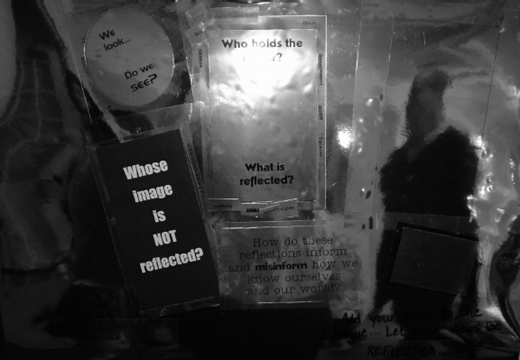
As a next step to brainstorm the contents of the collaborative artwork that the class intended to present at the Ethics and Epistemol-ogies of Ignorance conference held at Penn State, they listed three words or short phrases on note cards regarding that which “misinforms how you know yourself.” For example, one wrote she is misinformed through categorizations, societal views of normalcy, and comparisons. I compiled these into a chart that I referred to as “Self Texts” to suggest connections. I encouraged reading the chart vertically, horizontally, and diagonally to find larger encompassing ideas and divergences. I posted the chart in the course site and distributed it as a handout at the next class session. These initial ideas emerged more fully in the final poem and in the individual artworks as book pages.
I found from guiding other collaborative art projects that it is important to discuss beliefs about the nature of collaborations with the collaborators to share expectations and set group-formed guidelines. Each described what collaboration meant to him or her, its various forms, when it does not work, and successful collaborations. The group began by discussing readings and their content searches in the self-metaphors and how they are informed and misinformed. Following a teaching approach developed by artist Judy Chicago called Participatory Art Pedagogy Informed by Feminist Principles (see Keifer-Boyd, 2004) it is important to explore content prior to setting artmaking goals, which included discussing the format and media to meet those goals. Goals were modified in the process of recognizing limitations, such as time, resources, and space.
I posted process summaries of the discussion and decisions and asked all to do the same so that each expressed what they understood as the direction and contents of the project. I encouraged that we remain open to modifications. There was much online and offline discussion, ideas generated, and volunteers to take on specific responsibilities. Ellen Key, for example, a poet in the course, offered to create a poem from the individual statements about each book page created by the participants. We outlined tasks involved and each looked at their own strengths and those of their peers and work was distributed among the students. I formed students into groups of four and invited those in the course with a background in the visual arts to lead critiques of the artworks in the small groups by asking questions specifically derived from what artist Judy Chicago refers to as content-based critiques. To prepare for the content-based critiques I directed all to review a guide at http://www.judychicago.com/pedagogy/ that I had synthesized from research I conducted with Judy Chicago about her teaching methodology. The main questions to guide content-based critiques are:
What is your goal with this piece?
Start by telling me what you want to express.
Let’s talk about ways you could do this.
How will the viewer understand it?
Everything in the artwork should be part of the meaning of the work. The meaning should be accessible, yet not simplified, so that others understand the content. The artwork should attract the viewer to look more closely and to contemplate its meaning.
I visited each group, raised some questions, and made suggestions too. Mostly, I listened and photographed the work and the group interaction. We had early-on agreed to document the process, and different members took turns at this, although the photographer in the class did most of the documentation. I looked for each person’s strength and asked if they were interested in leading with that strength. Two performed the poem while the images projected large in an auditorium filled with philosopher professors from across the United States and beyond who were attending The Ethics and Epis-temologies of Ignorance Conference at Penn State. Students presented to others in class information concerning one of the conference keynote philosophers that they had selected to study prior to the conference.
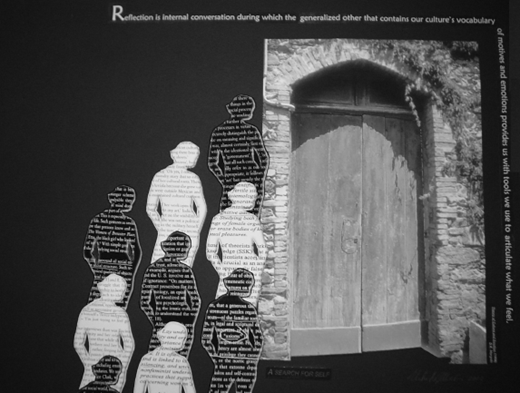
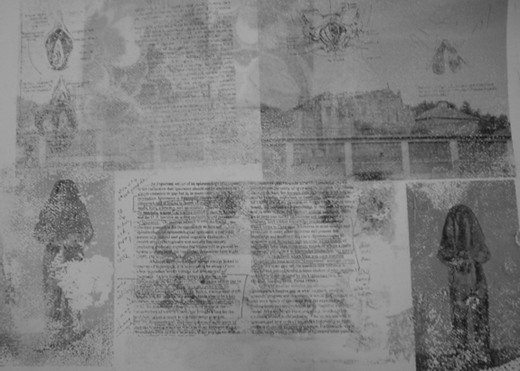
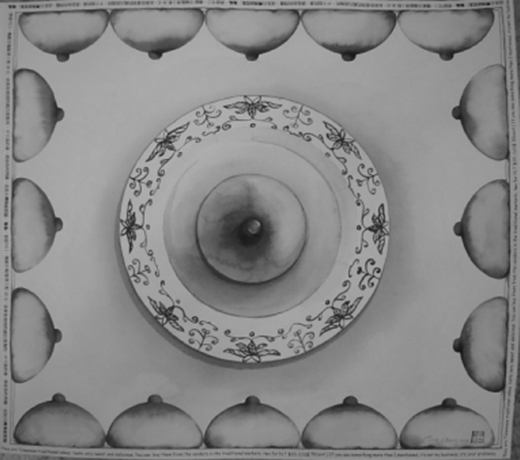
In January 2004, I introduced that the course project was to collabora-tively create a visual response to the following questions: How do we represent ourselves? How do we know ourselves? And, how is our knowledge of ourselves informed by ethics and epistemologies of ignorance? The result, in March 2004, was the project 4” Binding, an 18” x 24” book representing a multi-disciplinary dialogue exploring the ethics and epistemologies of igno-rance.8 Conference participants were invited to add to existing book pages and to create their own pages, which many did at the tables set-up with art supplies. After the exhibition and performance of a reading of the poem along with large projections of the book pages, we debriefed the collaborative art project in ANGEL and in class. Students decided to continue the collaboration beyond the course with a Website to enable paths of nonlinear exploration through the book and to build a flexible binding so that the book may travel to different sites and continue to grow. The students conceived that the pages of the book are the opening questions in a conversation that will encompass many views, many understandings, many voices. The book contains blank pages to represent absences of knowledge within culturally-shaped spaces and is offered as a traveling exhibition of ethics and epistemologies of ignorance. Below is the poem that they created along with some of the book page images.
Click Clack
Squeak
Ring
Mechanisms of the elite knowledge-making machine,
Whirring gears, cranks, and wheels,
Engage in an intentional process of manufacturing—
Standardization of both meaning and ignorance.
And I receive no invitation to participate.
Informed and misinformed at once by the turning of the machine
And my individual turning over of mind,
I step back to contend with my own shifting ideas,
Ideas and thoughts through which I come to know Self,
Defying those who craft definitions through sight and outer appearance.
The voices of Self circle through the pores of my existence:
Moments
People
Sights
Readings
All shaping how I see my Self and my world.
I search through entries from handmaid travel albums,
Noting the contrast between dark pages and colorful scenery,
And I realize that the trip to the Wonderland is never innocent.
The whirrings of the turning gears never cease.
Am I a part of a larger machine?
Examining reflections of Self in mirrors:
Of Society
Of Power
Of History
Of Media,
I am reminded that some Selves are not reflected, but stifled by ignorance.
This blur of ignorance:
Traditions of Shape and Size
Ethnicity and Sexuality
Wealth and Authority
Created by the turning wheels and gears
Obscures my vision of beauty.
Nevertheless I grasp for a clear vision of a truer reality:
A reality that refuses to erase aesthetics of the disturbed and grotesque,
A reality that repudiates selecting the contributions of only those in power,
A reality that resists the influence of the machine’s production.
I venture to rise from the hazy mist of assumptions,
To allow the world to leave its mark,
That my true Self may be freed from the captivity of sight.
Searching Self, I pass through the doorway,
The passage to alternative ways of understanding and knowing,
Silhouetted figures beckon to me, brushing past my skin,
Ghosts of the understandings and misunderstandings of the collective Self
Performing on and through me.
Where is my meaning?
Where is my truest Self and value?
The physical Self senses the world around me,
But in a moment, the experience has vanished into memory,
Captured eternally in the spiritual Self,
Reinterpreted in a thousand other meanings.
Fading images,
textural dissolves,
stains and imprints
Allow me to consciously and unconsciously engage in a process of knowing Self.
The interchange of my artistic work and play
Allow for exploration, communication,
Cutting and pasting of experience,
Re-presentation:
Relationships of cultural residues, memory, and identity.
Evidence which informs and misinforms my thoughts.
Whizz
Bang
Click
Whir
Mechanisms of the elite knowledge-making machine continue to turn,
But the ever-turning gears in Self give evidence
That the machine will not be the only one to leave its mark.
Concluding Comments
Without e-learning course tools, I could not have connected people from diverse cultures and distant locations in an exchange of perspectives that examined cultural knowledge and ignorances, and interrogated subject positions in terms of compliance, negotiation, or opposition to lived experience and social justice. I could not have students review the course dialogue to examine assumptions held at the beginning of the course and to reflect on their transformation of perspectives. E-learning course systems provided a space for a community to form and to develop a collaborative art project that continues beyond the time limits of a semester course, and a means for participants to share ideas and perspectives that I believe are necessary educational skills for most life endeavors.
About the author

This article is developed from a presentation about my teaching A ED 322: Visual Culture and Instructional Technology in Fall 2003 in which I blended computer lab and Internet environments. I presented the paper in May 2004 at A New Global Environment for Learning (ANGEL) Day II: A Symposium of Faculty Examples, The Pennsylvania State University, University Park, Pennsylvania.
ANGEL® is similar to Black-Board®, WebCT®, and other course tool packages universities have adopted for full and blended online courses. ANGEL provides a Web site for each course at The Pennsylvania State University that enables students to post work, look at others’ work, and communicate in threaded message boards, real-time chats, and/or emails.
For specific assignments and student work see the course site at http://explorations.sva.psu.edu/322/
The reenactment of cognitive, cultural, and physical processes to gain insight into visual culture has its origins in the branch of physical anthropology referred to as experimental archaeology, which is defined as the study of past behavioral processes through experimental reconstruction under carefully controlled scientific conditions. See http://www.anth.ucsb.edu/glossary/glossary.html
MetaPet, a simulation game that allow individuals to “maintain agency, or trick those in power … whether they have to do with getting through bureaucratic red tape or creating obstacles to divert authority” (Bookchin, 2002%, p. 66), is online at http://dian-network.com/con/intruder/
I worked with Jihyun Sohn (2004), a doctoral student who studied student response to the multivo-cal art criticism strategy that I developed in the early 1990s (KeiferBoyd, 1993, 1996), to construct a WebQuest: From Disney to Cyborgs in CyberSpace, for a course I initially developed at Texas Tech University in 1996 and continue to teach at Penn State. The course combines art making, critique, and pedagogy with digital and information technologies. I have guided students in creating WebQuests since 1998. WebQuests, originally conceived of by Bernie Dodge and Tom March are inquiry-oriented activities focused on “using [Web] information. to support learners’ thinking at the levels of analysis, synthesis, and evaluation” (Quoted from http://edweb.sdsu.edu/webquest/overview.htm in Dodge, 2001). I have guided the generative and evaluative dimensions of the student-created Visual Culture WebQuests to use metaphor and analogies to imagine, create meaning, and make connections; seek multiple perspectives; expose the worldviews in which specific beliefs are situated; engage in critical dialogue; involve reflective thinking; and transcend assumptions.
The Handmaid’s Tale is a film based on a book by the same title by Margaret Atwood (1986) that she refers to as speculative fiction of a future dystopia, that is, a dysfunctional utopia in which a militant religious power controls human behavior in an age of rapid sterilization due to environmental pollution.
Students in the Spring 2004 course A ED 570: Artistic Creations and Theories of Knowing who contributed to the collaborative 4” Binding project include: Wei-Chung Chang, Chiu-Jhin Chen, Ching-Yuan Hsiao, David Karmann, Maryellen Murphy, Ellen Key, Marissa McClure, Michelle Tillander, Wan-Hsiang Chou, Sarah MacKenzie, Emily Baxter, and Steve Williams.
