

Education is undergoing a theoretical shift from programmed learning and information processing approaches to knowledge building and transfer. Instead of focusing on how information is received, stored, and recalled, learning theorists are now turning their attention and concern to how knowledge is constructed within the mind of the learner and the interactions that the learner has within a cultural and social context. Traditional educational paradigms focused on instructional goals, such as recalling facts, generalizations, defining concepts, and performing procedures, whereas current learning theories, such as constructivism, emphasize reasoning, critical thinking, social negotiation, self-regulation, and mindful reflection. In this article, the author focuses on con-structivist learning theory and its applications to a quality e-learning environment.

Quality e-learning is a Web-based learning environment designed, developed, and delivered based on several dynamic principles, such as institutional support, course development, teaching/ learning, course structure, student support, faculty support and evaluation, and assessment (Phipps & Merisotis, 2000). Jonassen, Davidson, Collins, Campbell, and Haag (1995) relate the tenets of construc-tivist learning theory to technology and explain the role of this current theory in supporting quality e-learning. These scholars describe several technology systems that support individual and social interaction, and cognitive development, essential in helping e-learning students actively explore and construct knowledge. These constructivist-based technological systems include computer-mediated communication, computer-supported collaborative work, case-based learning environments, and computer-based cognitive tools.
These constructivist-based, technological systems and instructional applications are well suited for e-learning because they increase discourse, interactivity, and communication among peers and between students and faculty members. Applying Web features such as synchronous and asynchronous communication tools, hypertext- and hypermedia-based computer programs, like databases and artificial intelligence, e-learning students are able to work together via dialogue to solve and complete real-life problems and projects, settle conflicting ideas, and make meaningful experiences out of educational content and material (Jonassen et al., 1995).
Constructivism is a plausible theory for e-learning. As a viable distance learning option, e-learning requires that students be responsible for their education and collaborate and negotiate meaning with peers and guest experts, to broaden their understanding, to reconstruct individual knowledge, and solve real-life problems, as is described by constructivism. According to constructivism, students are also allowed to choose how they will accomplish their learning activities, as practiced in a quality e-learning environment. This theory encourages instructors to take on the role of a facilitator of student learning rather than a dispenser of information, as is practiced in a traditional learning course.
Definition of Constructivism
Constructivism is a philosophy based on the principle that knowledge is created from experience. One key characteristic that distinguishes constructivism from other learning theories, such as behaviorism and cognitivism, is the nature of reality. The constructivist learning paradigm emphasizes that there is no single or objective reality “out there,” which the instructor must transmit to the learner. Rather, reality is constructed by the learner during the course of the learning process.
Smith and Ragan (1999) define constructivism as “an educational philosophy within a larger category of philosophies that are described as ‘rationalism’“ (p. 14). These authors also explain that rationalism is “characterized by the belief that reason is the primary source of information and that reality is constructed rather than discovered” (p. 15). Furthermore, Driscoll (2000) suggests that “constructivist theory rests on the assumption that knowledge is constructed by learners as they attempt to make sense of their experiences” (p. 376).
Constructivists believe that learners are in control of constructing their own meaning in an active way. In a constructivist learning environment, “learners are active organisms seeking meaning” (Driscoll, 2000, p. 376). This meaning is acquired on the basis of experience. Hence, learners have existing beliefs, attitudes, and knowledge that impact their learning. The learning process in the constructivist environment is focused on enabling students to use knowledge in many different settings to make the learning itself as real-life as possible. Oliver (2000) explains how this process unfolds in e-learning:
In collaborative classrooms, students still collect data, but they also report and share their findings with other classes online. Students can then access a global database of information, discuss observations with peers and professionals, and seek more problem-based information [that] may help them develop a better understanding of real issues. (p. 13)
Tenets of Constructivism
The main tenets of the constructiv-ist learning paradigm suggest that constructivism would be considered a “postmodern” theory that reflects the intellectual and philosophical trends of the late 20th century. Driscoll (2000) summarizes the five major components of constructivism as being (1) a complex and relevant learning environment; (2) social negotiation; (3) multiple perspective and multiple modes of learning; (4) ownership in learning; and (5) self-awareness and knowledge construction. These tenets are useful for e-learning because they provide theoretical support for the learning activities conducted in a quality e-learning course. For instance, in a synchronous or asynchronous e-learning course, students use their prior knowledge and the knowledge of their peers and instructor to enrich the class discourse and negotiation process and, therefore, find the appropriate solutions to the problem at hand. This learning process is founded, acknowledged, and supported by the principles of social constructivism.
Conceptual F ramework
The conceptual framework illustrated in Figure 1 articulates a context for this article. This framework, which has been designed and assembled by the author based upon the literature review and personal experience, is formed as a triangle with each vertex aligning with each of the three constructs: instructional design, constructivism, and technology. Each construct has attributes and principles that, when integrated, lead to the design of a technology-supported learning environment such as e-learning. The conceptual framework suggests an interaction between learning theory, instructional design, and Web-based technologies.
This conceptual framework shows that effective instructional design is necessary to ensure quality e-learning. Based on the needs of the learners and the course content and objectives, the instructional designer selects the appropriate instructional strategies and Web fea-ture(s). The instructional designer then defines the development and the use of multimedia and hypermedia, the role of the instructor and learner, and the scope of interactions and communications in the e-learning process.
Instructional strategies included in the instructional design construct of the conceptual framework refer to the plan that is used by an e-learning instructor to accomplish a learning outcome. Supporting case-based reasoning, exploration, situated learning, collaboration and social negotiation, modeling and coaching, goal-based scenarios, multiple perspectives, and technology-based anchored instruction are examples of constructivist instructional strategies that could be implemented in a quality e-learning environment. For instance, applying coaching to Web-based learning could be implemented in either a synchronous or an asynchronous discussion format. A Web-based community of practice is an example of such an implementation. Knowing the e-learner helps in the development of appropriate and effective instructional strategies. Instructional strategies could be customized toward the needs of the e-learner. E-learning faculty, instructional designers, and Web developers need to design appropriate lessons and learning activities and use effective instructional strategies that address the different learning styles of the e-learner to provide quality e-learning experiences for each student.
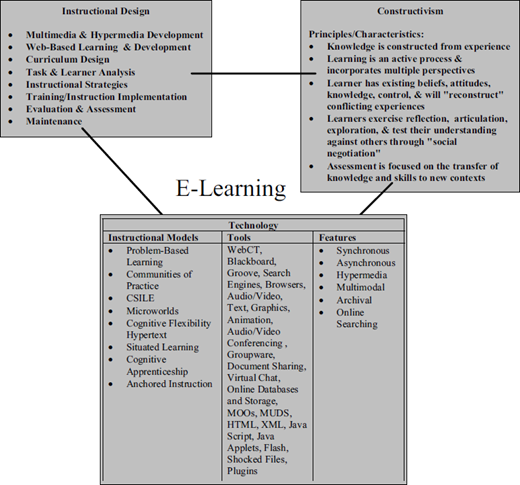
Based on constructivism, the evaluation and assessment components of the instructional design in the conceptual framework explain that e-learning instructors need to provide guidelines or rubrics for participating in meaningful class discussions that usually occur in synchronous or asynchronous technology tools such as chat rooms or bulletin boards. For instance, e-learning instructors may require their students to make a certain number of postings and paragraphs to earn the appropriate grade. During and at the end of an e-learning course, students should be encouraged to complete electronic evaluation forms to offer their constructive perspectives on different components of their electronic learning environment. According to the conceptual framework of Figure 1, these formative and summative evaluation processes would provide feedback on the effectiveness of the e-learning environment via various elements, such as the quality of instruction and level of institutional support. The ultimate goal of this continued evaluation method is to make the necessary enhancements to the Web-based synchronous and asynchronous e-learning processes and improve the quality of instruction, as well as channel the necessary support for e-learning students, faculty, and staff.
Based on this conceptual framework, students would be expected to attend and participate effectively in highly interactive class lectures and e-learning apprenticeship activities. A number of forms of e-learning technology, such as chat rooms, two-way audio and video, graphics, and document sharing would allow the e-learning instructor to monitor who is present and who is not. For instance, the synchronous software HorizonLive requires people to log on so the class instructor knows who was there by the log-on record. Asynchronous tools available on other software tools, such as Blackboard or eCollege, can keep track of those students who are present and participating in class.
To increase interaction among students and instructor in an e-learning class, the conceptual framework suggests that an extensive use of technology tools, for instance interactive video and audio, chat and PowerPoint capabilities, need to be used in e-learning classes. Picciano (2001) states that “one [of the] major benefit(s) of interactive video technology is that it enables teachers and students to interact synchronously and comparably to a traditional classroom environment” (p. 70).
E-learning resources need to be available to aid students in selfdirected discovery. E-learning students should be given ample time to explore and search for further information on those real-life class activities and problems using appropriate Internet search engines. The conceptual framework also emphasizes that electronic searching provides an effective vehicle for students to elaborate on their current knowledge by affording them the opportunity to seek additional knowledge or clarification of existing knowledge.
E-learning instructors work col-laboratively with their students to facilitate communication electronically in class, suggest different approaches and multiple perspectives to solve problems, and apply the subject content to real-life situations. Creating a medium for discourse and inter-connectedness would assist e-learning students to transfer knowledge from long-term memory into working memory through the use of an electronic community of practice. This virtual community fosters and enhances the institutionalization and socialization of the learning process in e-learning classes as depicted in the conceptual framework of Figure 1.
The conceptual framework also explains that every e-learning student is expected to participate effectively in class by reflecting on and articulating his or her own experience in solving real-life problems, and commenting on and answering questions for class discussion. Electronic class discussions would allow students to articulate their learning, and then elaborate based on the comments of others who are participating in a delayed or live electronic discussion forum. Students’ input, hints, and answers to class activities would then be shared with the class and assessed accordingly.
This conceptual framework suggests that notes and information exchanged and displayed via the video/audio system, Whiteboard, as well as Chat, in each class session, need to be archived for students to access and review at any time. The Web features, hypermedia and archival create and archive matrices, tables and outlines to support reflection and facilitate interaction, understanding and establish a context for content and instruction, as well as relate the new content to previous knowledge (Driscoll, 1998).
Conclusion
Constructivist learning theory meets the demands of the principles of quality e-learning. If instructional materials and course delivery systems are designed and developed well, this theory would provide the necessary theoretical support to implement quality e-learning courses and programs.
