This study uses educational technology tools to create a multimedia book to foster English learning skills as a second language for young Korean students based on the multimedia learning principle. According to multimedia learning theory (Clark & Mayer, 2011), students learn better with multimedia materials than text alone; multimedia resources contain text, sound, video, and visual images, facilitating interaction between learning content and students. This manuscript introduces multimedia components with examples from the book to the readers. In addition, implications and suggestions for future application of the books are discussed.
Introduction
This study uses educational technology tools to create a multimedia book to foster English learning skills as a second language for young Korean students based on the multimedia learning principle. Mainly, the multimedia learning principle suggests that students learn new concepts better when combined with multimedia learning materials consisting of text, audio, and visual images (Clark & Mayer, 2011; Mayer, 2002). During this study, major components of the multimedia principle were used to design a multimedia book printed to support students in learning the English language better than the traditional way. So far, two books which are titled for each Thanksliving Ch 1 and Thanksliving Ch 2 (Dean et al., 2022; Dean et al., 2023), are being used in online classes where young Korean students learn the English language with the support of native English-speaking teachers. Students have never learned English with native English speakers until participating in these classes with multimedia books. In online class sessions, the teachers help students read the book aloud as they use it to practice their speaking, listening, reading, writing, and vocabulary skills. Inside the multimedia books, educational technology tools, including QR codes, Word-Wall, and Padlet were embedded to assist students to engage with diverse practices such as a vocabulary game in learning English. This manuscript introduces multimedia components with examples from the book to the readers. In addition, implications and suggestions for future application of the books are discussed.
Multimedia Learning
According to Clark and Mayer (2011), students learn better with multimedia materials than with text alone. Multimedia resources contain text, sound, video, and visual images, which can facilitate interaction between learning content and students. Mayer (2002) explains that learning happens when a student creates a mental representation from both words and pictures that are presented to them. For example, when students learn about an apple in English as a second language, presenting a text and image of an apple together can help students learn better.
The signaling effect is another part of the multimedia principles. Signaling refers to highlighting key terms or specific content that does not add extra content or materials to the original learning material. In the experiment of Mayer’s study (2002), two students received the same content; one had signaled content, and the other had nonsignaled content. The results showed that students who received the signaled materials performed better than the nonsignaled group. Mayer (2001) also explains that humans have two separate channels for receiving and processing information while they learn with multimedia content. These channels are their eyes (the visual channel) and ears (the verbal channel; Chaivisit, 2021; Mayer, 2001). Research showed that multimedia materials could help learners process knowledge visually and verbally. Students memorized what they learned better since they saw pictures while listening. In addition, students actively learn by paying attention to the lesson. They better understood the content and enjoyed studying in the multimedia environment (Chaivisit, 2021).
Mayer (2001) suggests several principles of multimedia design that help develop and design multimedia presentations. One of the principles is the multimedia principle: students learn better from images and text than from text alone. The Temporal Contiguity Principle explains that students learn better when corresponding information is presented simultaneously rather than successively. The Individual Differences Principle explains that the design with all principles can work better for low-performing students than high-performing ones. Thus, the principles were used as design components in the multimedia books for low-level English-speaking students.
In this study, the multimedia principle was used by illustrating the audio of the reading and text next to each other. The temporal contiguity principle was used by presenting Korean words and their translations in English close to each other on the same page. The individual differences principle was used by considering how the design of multimedia books assists the performing English speaker students.
Problem Statement
Due to the complexity of designing and developing educational content (Jung et al., 2019), more research is needed to explore creative ways to utilize educational technologies in simple ways with practical examples. Thus, this study uses educational technology tools to create a multimedia book to foster English learning skills as a second language for young Korean students based on the multimedia learning principle.
Design Components
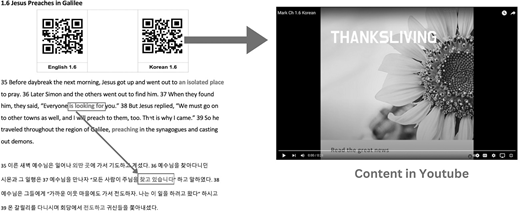
This study extensively used QR codes in designing and developing multimedia books, including a vocabulary game, audio files, and an online bulletin board. The following will provide specific examples of how the multimedia books used QR codes. First, when students scan the QR codes, they connect to multimedia resources, including the audio files on YouTube (Figure 1). With these videos, while students read the English passages, they can listen to the passages in the book simultaneously, either in English or in Korean, as much as they want at any time through their personal device, such as a smartphone (Figure 2). As Mayer (2021) suggested two channels, the books utilized the multimedia principles by encouraging students to utilize both “the visual channel (eyes) and the verbal channel (ears)” (Chaivisit, 2021, p. 25).
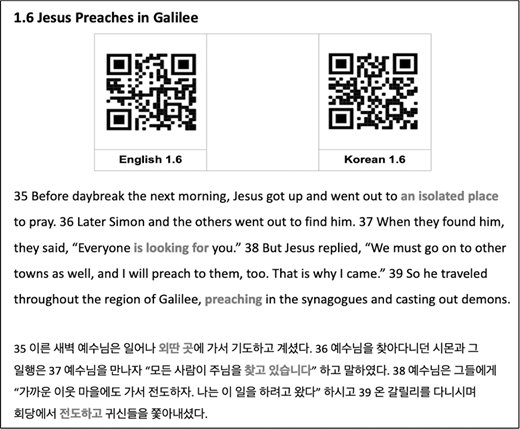
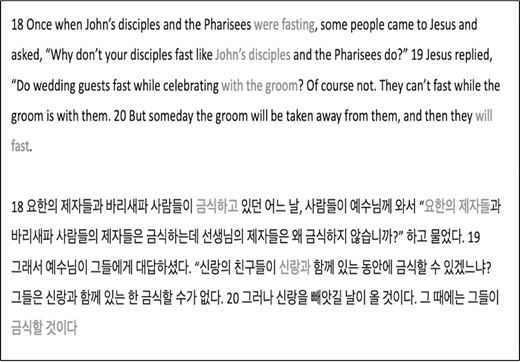
Another design component is that the books presented corresponding information on the same page rather than on a different page (Temporal Contiguity Principle). For example, in each section of the book, the Korean and English texts were added together on the same page, and three to five words in each passage were highlighted in red according to signaling strategies (Mayer, 2002). This is intended for students to recognize specific vocabulary words to focus on so they can remember after reading the corresponding passage. For example, in Figure 3, John’s disciples were highlighted in red in the English passage, and 요한의 제자들 were also highlighted in red in the Korean passage, and they indicate the same word in both English and Korean. This was supposed to be helpful, especially when students do not know most of the English words in the English passage. It can be daunting for students to read an English passage containing many unknown words. Therefore, highlighting three to five words per English passage could put less pressure on students to learn the new vocabulary by preventing them from closing the textbook and encouraging them to continue moving on to the next page.
In addition, the QR codes were used to connect students to play games and to communicate with their peers via online bulletin boards, which will be described more in one of the subsequent sections, Educational Technologies.
Educational Technologies
When designing the multimedia book, the authors used educational technologies to facilitate students’ learning English as a second language of instruction. This section introduces QR codes, Word-Wall, and Padlet, along with examples of how they were used in the multimedia book.
QR Codes
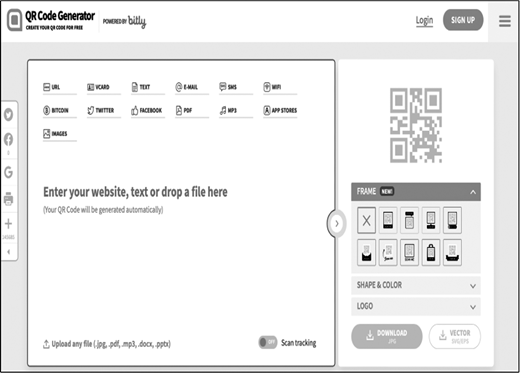
A QR (Quick Response) code is a twodimensional bar code that can be scanned by devices (i.e., phone’s camera and tablet’s camera) and connected to different forms of online environments in education (Ramsden, 2008). In this book, QR codes connect students to multimedia resources on YouTube, a virtual bulletin board called Padlet, and vocabulary games. QR codes can be generated for free on websites. The website https://www.qr-code-generator.com (Figure 4) is one of the examples where any user can generate free QR codes. Once a URL, image, sound, or video on the website is typed, a QR code that connects to each resource is generated within a minute.
Word-Wall
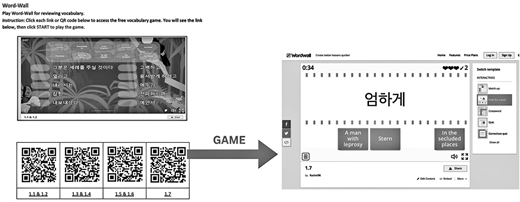
Word-Wall (https://wordwall.net/) is an online literacy tool where teachers can create teaching resources, such as quizzes and word games. In the last section of the multimedia book, several QR codes were added to guide students to engage in further activities (Figure 5). When students scan the QR codes, they can play vocabulary games unlimited times. This was intended for students to review the vocabulary that was highlighted in red in each section of the passages on the previous pages of the book. Different vocabulary games pop up once students scan one code with a phone. One form of the game is to select a correct English word among different words based on a given Korean vocabulary (Figure 5).
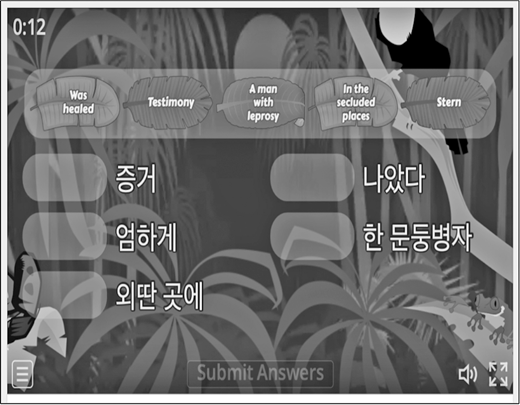
Another part of the vocabulary game is to match the correct words between English and Korean (Figure 6). When students play this game, fun music plays in the background, depending on the game’s themes. The theme of Figure 6 is a jungle, so the background scene and the music match a jungle theme. In addition, students can leave their nickname on the leaderboard if they finish within the top five, which can generate positive competition among students to complete the game fast. Once this game is set up, students can play it at their convenience, more than one student can access the same games at the same time, and students can have repeated access to the games if they want.
Padlet
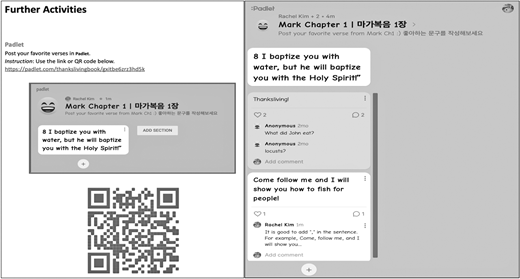
Padlet (https://padlet.com/) is an online Post-it note or a virtual bulletin board. Padlet has become a popular educational tool in online classrooms to enhance students’ engagement and collaboration (Fisher, 2017; Mehta et al., 2021). On the book’s last page, Padlet was added with a QR code as an extra activity (Figure 7). This tool encourages students to connect asynchronously or synchronously to communicate in English. While a paper bulletin board has only an option with a paper note, a virtual bulletin board can have diverse forms, including website links, videos, images, texts, and documents. Additionally, students can communicate by leaving comments on each other’s notes in English. One activity used in this book was that students choose and type their favorite sentence from the book in English (Figure 7).
Implementation
So far, multimedia books have been introduced to 3rd and up to 8th graders to learn the English language under the supervision of more than six teachers, mostly American teachers, through online classes. Students and teachers have met on Zoom to learn and teach English with the books, respectively. Students own their paperbased books by hand, and teachers use the same book as an online version and share it on the screen on Zoom.
By using these multimedia books, shadowing techniques are also used as students read and write about the content of the books. Since the book contains primarily Korean texts with corresponding English translations, it seems very beneficial to low-performing English reading students as they can understand the English passages with the aid of Korean texts. Through one of the online classes, eight students worked on writing English and Korean passages together each week during fall 2021. They expressed that their understanding of the books, including vocabulary words, increased compared to the beginning of the online classes.
Kim & Curry (2020) suggested that using new technology through hands-on activities helps build self-efficacy, especially “when working with novice learners” (p. 218). Offering diverse hands-on experiences through QR codes to students, such as playing a vocabulary game, was helpful as students could access through their phones, with the ability to play games either in or out of class. In addition, using QR codes facilitated accessibility as students can access learning content easily and quickly. After using the textbooks for more than 6 months, the students’ vocabulary, speaking, and listening skills improved tremendously.
Implications And Suggestions
The multimedia books were designed using simple educational technologies such as QR codes, Word-Wall, Padlet, and media content on YouTube. All of them are available for educators for free. So far, around 30 young Korean students and six teachers have used the books. Future studies will implement the design components into a different book to teach English to other language speakers than Korean. For example, the content of this book is from the Bible, which has the same content in different languages. Thus, the new book can be designed for students who use Japanese, Chinese, or Spanish as their first language to learn English in a similar format to the book and educational tools from the multimedia book.
In this paper, multimedia resources, including educational tools and their examples, were introduced. While developing online content can be complicated (Jung et al., 2019), by using these resources, teachers can easily create multimedia books; students can have fun interacting with educational tools. Additionally, using educational tools introduced in this book can benefit potential authors interested in creating a book with a small budget because different free and open educational tools are available.
This book was created to assist English learning, especially for young Korean students. English education has been a hot topic as educational issues in South Korea have been a problem for a long time. Scholars have been concerned with a social phenomenon called the “English Divide,” referring to the English gap between advantaged students and disadvantaged students (Jeon, 2012; Lee & Lee, 2016; Martinez-Garcia, 2020; Shin & Lee, 2019). Some students receive quality English education while others do not (Jeon, 2012; Lee & Lee, 2016; Martinez-Garcia, 2020; Shin & Lee, 2019). The multimedia books using different educational technologies were designed to offer good quality English education to any students with easy access. The target students of the book can be any English language learners, especially low-performing English speakers, and they can have repeated access to educational resources through a smartphone.
Language skills can be built by learning a new vocabulary, listening, reading, writing, and speaking. With games and highlighted words in the book, students were encouraged to learn new terms while reading this book. As students have access to audio files for the whole passages in English and their native language (in this case, the Korean language), they may increase their listening skills and understand the book’s content with a story. Reading skills may be facilitated with texts in English and Korean, along with audio versions. A virtual bulletin board may facilitate writing and speaking skills, allowing students to upload diverse files, including sound and typed text. All of the skill sets would contribute to building English language competence.
According to the self-determination theory by Ryan and Deci (2017), when students have autonomy, competence, and relatedness in learning, students can be motivated to gain knowledge. In this book, students can choose diverse activities based on the same content in different forms, such as listening, reading, or writing. In addition, with different activities, students can read the English passages; the book contains not artificial English texts that were artificially made to teach the language, but original English passages by using the English Bible, which English speakers usually use for reading, not for learning the language. This is a critical point, as using natural English passages could benefit learning English as a second language. One of the authors of this book was an English as a second language teacher for several years in South Korea; she observed many unclear and awkward sentences used in textbooks at public and private schools. Thus, the natural English passage, the Bible, was used as learning content in this multimedia book. The Bible is considered one of the steady sellers worldwide, so it is common sense that it contains natural or clear English sentences.
Self-determination theory (Ryan & Deci, 2017) also explains that when students feel they belong to a learning group or community, they can be motivated to learn. Through a virtual bulletin board, Padlet, and vocabulary game platform, Word-Wall, used in these multimedia books, students can connect with classmates and teachers. The educational tools work as an online community where students can gather outside the classroom for learning. Exploring bulletin boards and game boards could be future study topics.
Additionally, to explore the impact of multimedia books, future studies could ask the following questions. Interviews with teachers and students using some of the questions could be the ways to improve the current multimedia books.
What are the pros/cons of multimedia books, if any?
What are the potential challenges of using the book, if any?
What other features or tools would students and teachers like to learn and teach English better?
In order to use this book effectively, a smartphone is necessary as a smartphone connects students to access all the learning materials. In some districts and schools, using a phone in class is a controversial topic as it can be helpful or hinder students’ learning. The author of this book thinks a smartphone is considered the same as a knife. A knife can cook beautiful and delicious food at fancy restaurants. At the same time, a knife can be considered a weapon to hurt people. Phones can be the same way. In this multimedia book, using a smartphone is highly encouraged to students and teachers to facilitate students’ learning of English.
At the 2022 AECT International Convention, this project was presented to listen to diverse opinions from students, teachers, instructional designers, and professors worldwide. The audience, including educators and students, discovered the contents exceptionally captivating. Notably, most were thoroughly impressed by the games integrated into the books. Some educators even suggested expanding the books to cover more indigenous languages, which would benefit English as a second language students globally.
Finally, the presented multimedia books did not use Artificial Intelligence such as ChatGPT, one of the most promising educational technologies. ChatGPT has “humanlike interactive experiences through audio or text” (Barrot, 2023). Like other tools introduced in this manuscript, including Word-Wall, QR codes, and Padlet, ChatGPT can be used for free and even 24/7 repeatedly (Lee, 2023). Possibly, a QR code can connect students to ChatGPT for reading and writing in English as an interactive tool. Hong (2023) emphasized the benefits of the ChatGPT that it “excels in mimicking human interactions, learners can easily initiate authentic conversations with the chatbot” (p. 40). Hong (2023, p. 40) also added that ChatGPT could be a “personal language tutor” to students as “ChatGPT can generate topics for discussion and creative writing prompts for students to write creatively” (TESOL International Association, 2023). This can be a promising educational technology component that can be added to future multimedia books and in the language learning fields.
About the author's