

Introduction
In this digital era, the evolving landscapes of learning, teaching, living, working and more require adaptation to technological changes, preparations for disruptions, enhanced pedagogical practices, equity and access, and continuous, holistic development. A framework detailing cultivating digital education resilience offers insights, ideas, and inspirations to empower and navigate the ever-changing landscapes. Through the exploration, examination and execution of strategies, empowered educators can harness the potential of innovative technologies to improve educational outcomes, foster innovation and address the evolving needs of 21st century learners.

A framework for digital education resilience
Cultivating a framework for digital education resilience draws upon multi-faceted vital practices, processes and dispositions. Adopting the framework requires flexibility in how each component can be enhanced and tailored to personal style and preference.
Definition
A definition of resilience is “the ability to adapt and bounce back in the face of adversity, challenges or significant stress. It involves the capacity to recover, learn and grow from difficult experiences. Resilient individuals can effectively navigate setbacks, maintain a positive outlook and function well despite life’s challenges. In digital education, resilience specifically refers to “the ability of educational systems, programs and individuals to adapt and thrive in the ever-evolving digital learning environment, particularly when faced with Distance Learning unforeseen disruptions or changes” (ChapGPT, November 30, 2023).
Digital education resilience is more than just overcoming challenges; it is also about empowering individuals in various educational roles to adopt a growth mindset; advancing accessibility, equity and inclusion in curriculum, policies and more; modeling flexibility and open pedagogies; supporting holistic growth; reflecting on experiences, lessons learned and key takeaways and celebrating small and large achievements individually and collectively; and leveraging data-informed decisions to refine and improve the multi-faceted vital practices, processes and dispositions.
Framework components
Adaptive leadership, communication and cultivating collaboration
Adaptive leadership and communication must be balanced to strengthen digital education resilience. Leaders are much more than their titles; they model success strategies through intentional actions, interactions and thought processes to empower others. In digital education, resilience hinges on leaders who can adapt to new circumstances and create an environment that allows the talents of their team members to thrive. For example, by fostering a culture that focuses on growth, adaptive leaders respect team members’ and staff’s time and contributions (Chris Donnelly, 2023). Adaptive leaders balance achieving goals and promoting growth—a shared growth that permeates teams, communities or educational settings.
Adaptive leaders can cultivate communities of collaboration (Cherkowski, Hanson, & Walker, 2018). For example, adaptive leaders foster positive environments, openly discuss shared meaning in work and growth, and model strategies to build collaborative relationships. This leadership style can be developed and personalized at multiple levels or tiers within an educational system. Collaboration communities can forge through adversity, adapt to new challenges and establish the foundation for long-term success.
As we navigate the challenges and adapt to the changing digital education landscape, adaptive leadership involves recognizing effort, attributing credit where it is due, and communicating successes, challenges and actionable next steps. Lewis, 2018 describes this process of reconciling between the story-told and the story-lived. Adaptive leaders foster the reconciliation process and promote a growth mindset when they recognize or announce achievements and contributions from their team or staff. As we continue to navigate through the challenges and adapt to the changing digital education landscape, a commitment to mentoring or developing an adaptive leadership style might include, but is not limited to:
Establishing a continuous learning environment. Adaptive leaders actively promote a culture of learning and curiosity across an institution or organization. In digital education, this applies to faculty, staff and students. A primary strategy to achieve this is encouraging continuous professional development. Higher education institutions can stay ahead of the curve and keep up with the latest educational trends and strategies. This approach can lead to enhanced teaching methodologies and learning outcomes, fostering the overall academic growth of the institution.
Fostering collaboration and an inclusive culture. Adaptive leaders create collaborative environments where everyone’s ideas and contributions are valued. Encouraging teamwork and collective brainstorming sessions and fostering a space where innovative solutions can be born are paramount. These approaches can lead to a stronger sense of community and belongingness and elevate the overall productivity and morale of the institution. This adaptive leadership strategy extends to students, faculty and staff, as all play a significant role in their contributions to the institution’s overall success.
Being transparent and communicative. Transparency is key to adaptive leadership. Effectively communicating decisions and changes to key stakeholders and others helps build community trust and understanding. This can be done through regular updates, town hall meetings, newsletters and open forums for discussion.
Modeling an adaptive style to change. Higher education is always evolving, with technological changes, educational policies and student needs. Adaptive leaders must be willing to model a flexible yet consistently present adaptive style. Modeled leadership fosters a culture of adaptability and resilience, encouraging all institution members to embrace change and see it as an opportunity for growth.
Encouraging feedback. Creating channels for receiving feedback from students, faculty, peers, colleagues and staff is another crucial strategy for adaptive leadership. This feedback can provide valuable insights for improvement and innovation and make members of the institution feel heard and valued. Leaders can do this through regular surveys, feedback forms, suggestion boxes and open-door policies.
Flexible pathways
Higher education learners demand student choice in learning pathways, pedagogies (Camacho & Legare, 2016; Valtonen et al., 2021) and equitable access to education (Arum et al., 2021; LeBlanc, 2021). Universal design for learning, backward design and other current instructional design strategies have paved the way for flexible and open pedagogy approaches. This transformation in learning design can be connected to the evolving educational landscape and workforce (Meyer & Norman, 2020). Therefore, the current trend in digital education is a standard to consistently design curricula and programs that offer flexible pedagogical approaches that achieve student outcomes. Educators at all levels must become digitally resilient and responsive to student-centered, active learning environments. Furthermore, it is necessary to pivot an educator’s mindset to be open and willing to try these new pedagogical approaches. With successful strategies, digital resilience in meeting flexible, open pedagogical approaches for today’s students is achievable and soon to be a standard of transformative education.
This commitment to flexible pathways can be established through various strategies including, but not limited to:
Implementing universal design principles in course design and campus facilities
Implementing universal design principles can ensure that spaces and materials are accessible to all individuals, regardless of their physical abilities or learning styles. Accessibility could involve making sure that all campus buildings are wheelchair accessible, that there are adequate facilities for individuals with different needs, and that course materials are available in various formats to accommodate individuals with visual or hearing impairments. Implementing universal design principles in course design ensures that digital educational content is accessible to all learners, thereby improving the resilience of digital education by making it more broadly accessible and inclusive.
Developing a diverse and inclusive curriculum
Providing students with a well-rounded education requires a curriculum that represents a diverse range of perspectives. This means designing courses that include content reflecting various cultural, racial and social perspectives. It could also involve inviting guest speakers from diverse backgrounds or assigning readings from authors who represent a variety of experiences and viewpoints. Developing a diverse and inclusive curriculum that represents a range of perspectives enhances digital education resilience by offering inclusive and representative content. This change in curriculum encourages engagement from a broader student base, making the digital education system more robust.
Creating an office or department dedicated to accessibility and inclusivity
Establishing a dedicated department or office could ensure a team focused on implementing and promoting principles of accessibility and inclusivity throughout the university. This department could oversee creating and enforcing policies and practices that uphold these principles. Additionally, it could serve as a resource center, providing support and information for individuals on campus with specific accessibility needs. Creating an office or department dedicated to accessibility and inclusivity is essential for establishing digital education resilience. This department ensures that all students can access and benefit from digital educational resources regardless of their abilities or backgrounds.
Implementing mandatory training for faculty and staff
Mandatory training programs could be implemented to educate faculty and staff on important issues related to accessibility and inclusivity. These programs could cover various topics, including unconscious bias, cultural competency and strategies for creating an inclusive classroom environment. By equipping faculty and staff with this knowledge, they can better serve and support all students. Implementing mandatory training for faculty and staff on accessibility and inclusivity ensures that those running digital education platforms understand and cater to diverse needs. This enhances the resilience of digital education as it ensures that the platforms are inclusive and accessible to all.
Continuous and holistic development. Professional development and lifelong learning form the cornerstone of digital education resilience. Resilience in this context refers to the capacity of educational institutions and systems to adapt, withstand, and bounce back amidst changes and challenges, particularly those related to digital technologies. It forms the backbone of a robust digital education framework that can effectively cater to the diverse needs of learners, educators and administrators, and ensure the continuous and holistic development of the educational community.
As digital technologies progress at an unprecedented pace, educators and professionals must keep up with the latest trends and advancements to ensure their skills and knowledge remain relevant and up to date. This commitment to continuous learning can be facilitated through various strategies including, but not limited to:
Regular training workshops, courses and conferences. Workshops on new technologies and digital education trends can provide hands-on experience and practical knowledge that can be directly applied in educational settings. Workshops offer attendees opportunities to share experiences, insights and ideas related to trends, further supporting collaboration communities. These platforms offer opportunities to learn from experts and pioneers in the field, exchange ideas with peers and stay informed about the latest developments in digital education.
Keeping current with technology. The dynamic nature of technology necessitates staying current with the latest developments, which is essential not only for leveraging the benefits of new technologies but also for mitigating potential associated challenges and risks. One approach to staying technologically updated is regular quality assurance touchpoints and maintenance to ensure that the technology and platforms function optimally and offer the best possible teaching and learning features.
Feedback mechanisms. Encouraging feedback from students and educators on the technology and platforms used can shed light on their experiences, preferences and needs, guiding improvements and adaptations. A cyclic process to review feedback and continue holistic development is optimal for supporting a growth mindset and staying ahead of technological trends, pedagogy, and other related teaching and learning practices, processes and leads.
Provide onstructive feedback. Adaptive leaders regularly provide constructive feedback, which helps individuals understand their strengths and where they can improve, fostering a culture of continuous learning and growth.
Patience, reflection and celebration. In the ever-evolving digital education landscape, particularly within higher education, patience, reflection and celebration are paramount for fostering resilience. Patience is a virtue that may not be inherent in everyone, yet it is a characteristic that can be cultivated and ingrained through practice. Adaptive leaders foster a sense of belongingness in a digital world by intentionally creating spaces for reflection and celebration of growth and success. Belongingness can be particularly beneficial for individuals working remotely (in physical isolation), as it can boost their productivity, motivation and sense of value.
In the fast-paced digital age, patience allows for necessary pauses, allowing educators and learners to engage more deeply and develop an empathetic understanding of each other’s experiences, attitudes, behaviors and narratives. This approach fosters a more inclusive and understanding educational environment. It contributes to the resilience of digital education, enabling it to adapt and respond effectively to the diverse needs and challenges of different learners.
Reflection, another crucial component, helps us recognize our strengths, acknowledge our weaknesses, and strategize for improvement. It allows us to learn from our experiences and mistakes and to make necessary adjustments in our teaching and learning methods. In the rapidly changing world of digital education, where new technologies and pedagogies are constantly emerging, reflection becomes an invaluable tool for continuous learning and improvement. It helps build a resilient system capable of introspection and self-improvement.
Celebration in digital education resilience is not merely about acknowledging successes and achievements. It is about fostering a culture of recognition and appreciation that values every individual’s contribution, whether small or big. Celebrating milestones and achievements in the digital education environment can significantly enhance learners’ and educators’ sense of belonging and accomplishment. It can also boost motivation, engagement, and satisfaction, contributing to the overall resilience of the digital education system.
Grace is another vital aspect of patience, reflection, and celebration. As we navigate digital education’s complex and ever-changing landscape, we must remember that we are all human and prone to making mistakes. Expressing grace entails understanding and accepting this human fallibility and treating each other with respect and kindness even when mistakes are made. It signifies mutual respect and appreciation for the time and challenges faced by everyone, and it plays a critical role in motivating and empowering individuals to persist through various stages, phases or tasks, whether personal or professional.
A commitment to develop habits or characteristics related to patience, reflection and celebration include, but are not limited to:
Regular reflection. Schedule dedicated time for reflection. This could be a few minutes at the end of each day or a longer session at the end of the week. During this time, consider what went well, what could be improved, and what lessons have been learned.
Practice mindfulness. Mindfulness can cultivate patience by encouraging a focus on the present moment, which can be practiced through meditation, yoga, or simply taking moments to breathe and clear the mind.
Celebrate small wins and promote team celebrations. Recognize and celebrate small victories instead of constantly waiting for significant achievements. When working in a team, take the time to celebrate together, such as after the successful completion of a project or when a team member achieves something significant. This recognition not only acknowledges the achievement and gives credit to those who contributed to the success, but it also helps to strengthen team bonds, foster collaboration communities, heighten a sense of belongingness and an overall awareness of productivity within the organization. Celebrating achievements can create a positive environment and boost motivation.
Model patience. Leaders can model patience by demonstrating calmness and composure, particularly in challenging situations. Patience can help to set the tone for the rest of the team. Adapting communication styles to be calm and collective is helpful in times of stress and uncertainty.
Data-informed decision-making. Data-informed decision-making is vital to digital education resilience as both an outcome and catalyst in higher education. This process involves utilizing various data sources to guide decisions and strategies related to teaching methods, curriculum design, student services, and other facets of digital education. By leveraging data to inform decisions, educational institutions can adapt more readily to changes, cater to the needs of diverse learners more effectively and continually enhance their digital education offerings.
A commitment to developing data-informed decision-making as related to each of the framework components includes:
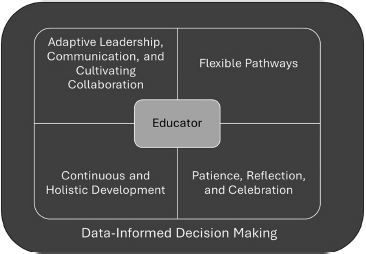
Adaptive leadership and communication. For leaders to make effective and adaptive decisions, they should be proactive and consistently review data on student outcomes, faculty performance and other critical metrics. These data can serve as a compass for decision-making, allowing leaders to adapt strategies based on what the data show and communicate changes effectively. For instance, if the data indicate that students are struggling with a particular online course, leaders might decide to provide additional training to the course instructor, revise the course content or even explore the possibility of introducing supplementary resources. These data-driven decisions can enhance the institution’s overall performance and ensure a more adaptive approach to leadership and communication.
Flexible pathways. Data can reveal insights about specific learning pathways’ effectiveness and the barriers students may face. By analyzing this data, educational institutions can develop more flexible and open learning pathways. For example, suppose data indicate high dropout rates in a specific degree program. In that case, the institution might consider offering alternative pathways to completion, such as online courses, competency-based assessments or even partnerships with other institutions. This flexibility can contribute significantly to enhancing digital education resilience, ensuring that the education system can adapt to the diverse needs of students.
Continuous and holistic development. Data can offer valuable insights into areas where students, faculty or staff may require additional support or development opportunities. For instance, if the data shows high-stress levels among students, the institution might invest in more comprehensive mental health services, create stress management workshops or even introduce new policies that promote a healthier work-life balance. Similarly, if the data reveal that faculty need help to use a new digital teaching tool, the institution could offer additional training, resources or even peer-mentorship programs where faculty can learn from their colleagues. These data-informed strategies can ensure continuous and holistic development, thereby enhancing the resilience of the digital education system.
Patience, reflection and celebration. Data can guide institutions in recognizing achievements and identifying areas for reflection and improvement. For instance, if data reveal improvements in student outcomes because of a new teaching strategy, this could cause celebration. The institution could acknowledge this success through various means, such as newsletters, recognition events or even incentive programs. Conversely, if data show that a particular initiative is not having the intended impact, this could be an opportunity for reflection and course correction. The institution could organize a session to discuss these findings, reflect on the reasons for the lack of impact, and brainstorm strategies for improvement. This practice of patience, reflection and celebration informed by data can contribute significantly to the resilience of digital education.
By incorporating these strategies, educational institutions can make data-driven decisions promoting digital education resilience, which ensures that their digital education offerings remain adaptable, effective, and inclusive, leading to a more equitable and robust digital education landscape.
Conclusion
Adaptive leadership emerges as a cornerstone, fostering collaborative environments where growth is nurtured and challenges are met with resilience. Leaders play a pivotal role in promoting a culture of continuous learning, inclusivity and transparent communication, laying the groundwork for sustainable growth and innovation.
Flexible curriculum design and pedagogy pathways offer learners diverse avenues for engagement and success, ensuring that educational experiences are accessible, equitable and responsive to individual needs. By embracing universal design principles and prioritizing inclusivity, educational institutions can enhance the resilience of digital education, empowering learners to thrive in dynamic learning environments.
Continuous and holistic development emerges as essential practices, fostering a culture of lifelong learning and growth among educators, administrators and learners alike. Through ongoing training, reflection, and collaboration, stakeholders can adapt to emerging technologies and pedagogical trends, ensuring that digital education remains relevant and impactful in an ever-changing world.
Patience, reflection and celebration are guiding principles, fostering empathy, resilience, and a sense of community within digital learning environments. Educators can cultivate environments where individuals feel valued, supported, and motivated to excel by creating spaces for introspection, recognition, and appreciation.
Data-informed decision-making emerges as a catalyst for digital education resilience, providing valuable insights that guide strategic initiatives and promote evidence-based practices. By leveraging data to inform leadership, curriculum design, and support services, educational institutions can readily adapt to challenges and foster continuous improvement.
In conclusion, cultivating a framework for digital education resilience and navigating the complexities of modern learning environments requires a comprehensive roadmap. By embracing adaptive leadership, flexible pathways, continuous development, patience, reflection, celebration and data-informed decision-making, educators can empower learners to thrive in an ever-changing digital landscape, ensuring equitable access to quality education for all. Through collective commitment and collaboration, we can cultivate resilient educational systems that prepare learners to succeed in the challenges of today and tomorrow.
