Introduction
Educators and trainers are increasingly challenged within their respective organizations to provide for the efficient distribution of instructional content using instructional media. The appropriate selection of instructional media to support distance learning is not intuitive and does not occur as a matter of personal preference. On the contrary, instructional media selection is a systematic sequence of qualitative processes based on sound instructional design principles. Although media selection is often mentioned when studying the discipline of instructional technology or instructional systems design (ISD), it is sometimes overlooked when applying the selection process in a distance learning environment. It is our intent, therefore, for this guide to highlight the essentials of good media selection. We hope to present an instruc-tionally sound and systematic approach to selecting the most appropriate media for the delivery of content at a distance.
Media selection is an integral part of the ISD process. In that role, media selection ensures that a specific distributed instructional medium can support the attainment of the desired learning objectives.
Distance learning has existed in the United States for more than 120 years. Not surprisingly though, many in the profession considered it a new phenomenon due largely to the emergence of the Internet. The resulting explosion in online learning was quickly embraced throughout the education and training communities encompassing K-12, higher education, and the corporate and government sectors.
Just as new technologies have given rise to new distance learning applications and new distance learning environments, so have they given rise to new terms that basically refer to the same thing. Some of the more popular terms are e-learning, online learning, and Web-based training. The mid-1990s saw the coining of the term advanced distributed learning, which was quickly adopted by many organizations. Even in the higher education community, where distance education was born, there have been revisions to the definition, to include the science of distance teaching and the resultant product, distance learning.
The definition of distance education in the academic community, however, has gained general consensus through its presence in leading course texts and peer-reviewed journals on the subject. As defined by the Quarterly Review of Distance Education, distance education is “institutionally based formal education where the learning group is separated and where interactive communications systems are used to connect instructors, learners, and resources.” Alternatively, America’s largest professional distance learning organization, the United States Distance Learning Association, has adopted the term distance learning, and defines it as “the acquisition of knowledge and skills through mediated information and instruction.”
After the birth of the USDLA in 1989, the Los Alamos National Laboratory organized and sponsored the First Annual Conference on Distance Learning. This conference brought together the leading distance learning professionals from throughout the United States. In attendance were representatives from higher education, K-12, state and local governments, and the federal government. One of the major objectives of the conference was to agree on a universally accepted definition of distance learning. The definition that emerged was elegant in its simplicity: distance learning was defined as “structured learning that takes place without the physical presence of the instructor.”
In the years that followed the Los Alamos conference, the distance learning landscape was changed dramatically with the development of the browser and the subsequent application of the Web to online learning. What emerged from this evolution of distance learning was a new set of terms born out of the online learning environment: Web-based instruction, Web-based learning, Web-based training, online learning, and the most prominent new term, e-learning.
Unlike distance learning or distance education, however, the term e-learning includes the use of instructional media technologies in its definition, hence the “e” for electronic. Not surprisingly, the term e-learning evolved not from an application, but from the emergence of the business terms “ecommerce” and “e-mail.”
Even though the term e-learning was defined by the American Society for Training & Development (ASTD) as the “delivery of content via the Internet, intranet-extranet, audio and videotape, satellite broadcast, interactive TV, and CD-ROM,” the marketplace has generally accepted it as applying only to the Internet. As a result, even this term has taken on different meanings, depending on the organization defining it, and has been variously defined as:
The educational content, learning services, and delivery solutions that support and enable network-based learning that is either asynchronous or synchronous (IDC).
Internet-enabled learning (Society for Applied Learning Technology, SALT).
Instructional content or learning experiences delivered or enabled by electronic technology (A Vision for e-Learning for America’s Workforce: Report of the Commission on Technology & Adult Learning, 2001).
Given the numerous definitions of what appears to be essentially the same construct, what are the necessary and sufficient elements of distance learning? On a practical level, for an activity to be considered to be distance learning it should include—at minimum—the following:
Physical distance between the student and the teacher—the most obvious element;
An organization that provides the content—in contrast to purely self-directed learning;
Part of a curriculum—learning must have an objective and therefore must have structure; and
Measurement of learning—without which no learning can be observed to have taken place.
We should note that our having left out interaction in our definition above is intentional. Whereas interaction is usually desirable for good distance learning, we are only considering the categorical—not the evaluative—sense of distance learning.
Generally speaking then, distance learning refers to all forms of learning at a distance, encompassing the full spectrum of instructional media—including nonelectronic media—whereas e-learning generally refers to those learning activities that employ “electronic” technologies, and distance education refers specifically to learning activities within a K-12, higher education, or professional continuing education environment where interaction is an integral component.
Instructional Media for Distance Learning
The selection of appropriate instructional media is an essential element of the instructional design process. Utilizing a systematic approach to media selection ensures that appropriate instructional media are employed to support desired learning objectives. Consequently, the process of media selection is one of identifying the most appropriate medium or set of media for a specific instructional endeavor. Media selection analysis must evaluate general and specific criteria, including instructional, student, and cost aspects for each delivery technology (or instructional medium) in order to ensure that the most appropriate media are selected for specific education or training objective.
Synchronous Versus Asynchronous Learning Environments
A synchronous learning environment supports live, two-way oral and visual communications between the instructor and the student. This exchange of information facilitates the transfer of knowledge from instructor to the student and can be achieved by (1) the use of audio response systems that support oral communications only; (2) the use of interactive keypad devices that support both the exchange of data and voice, or (3) the use of videoconferencing technologies. Synchronous learning also incorporates these elements:
Provides for dialectic learning environment with a high level of interactivity;
Encourages spontaneity of responses;
Allows for optimal pacing for best learning retention;
Allows for immediate reinforcement of ideas;
Controls length of instruction when completion time is a constraint; and
Is constrained by time but not place.
An asynchronous learning environment is when communication between the instructor and the student is not real-time. A typical example of asynchronous instruction in a distance learning environment is the use of text materials (print or electronic), discussion boards where students respond to questions from the instructor or other students. Asynchronous learning also incorporates these elements:
Provides for more opportunity for reflective thought;
Not constrained by time or place;
Delays reinforcement of ideas;
Provides for flexibility in delivery of content; and
May have higher attrition rate and may extend time for completion.
Enabling Technologies Supporting Synchronous and Asynchronous Learning Environments
For the purpose of this guide, the uses of discussion boards and chat rooms are not considered as instructional media delivery options, but instead are viewed as only enabling technologies used to support other instructional media in a blended learning solution.
Symmetrical Versus Asymmetrical Learning Environments
In distance learning, considering symmetry of the learning environment is almost as important as considering its synchrony. If not taken into account, it may lead the course designer to make less-than-optimal choices in media.
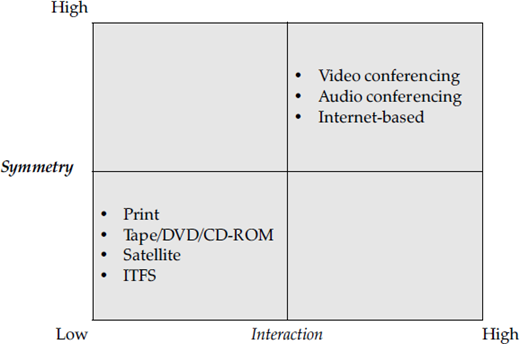
Asymmetrical learning or interaction is when the flow if information is predominantly in a single direction such as in a lecture, textbook, or computer-based instruction. Conversely, in a conferencing, collaboration, or brainstorming environment, the information flow is symmetrical; that is to say, the information flow is evenly distributed between learners and instructors. A close relationship exists between symmetry and interactivity. The more the interaction, the greater the need for a symmetrical delivery system, whether synchronous or asynchronous.
Taxonomy of Distance Learning Media
The Taxonomy of Distance Learning Instructional Media Table (Table 1) is designed to assist in determining the most appropriate media for a specific distance learning application. The taxonomy is focused primarily on a dichotomous learning environment—the initial selection criteria being either synchronous or asynchronous, and will aid the instructional designer or subject matter expert (SME) in determining the most appropriate media to be selected
The instructional designer may choose a combination of media to meet the desired learning objectives. For example, delivery of content can be accomplished using one asymmetrical medium (e.g., satellite or print), but the interactive aspect can be accomplished using a symmetrical medium (e.g., audio conferencing or email). Why is it important for the designer to consider symmetry? Using symmetrical delivery systems (normally involving lower bandwidth or shared bandwidth) for asymmetrical applications either reduces capacity for transmission outbound from the instructor or wastes capacity inbound from the student—inefficiency that under certain circumstances could be costly. The same is true for using an asymmetrical technology for a symmetrical application— the costly inefficiencies under these circumstances would be apparent (Figure 1).
Taxonomy of Distance Learning Instructional Media
| Synchronous | Asynchronous | |
|---|---|---|
Visual only (includes graphics) Aural only Visual and aural |
|
|
Instructional Media Delivery for Distance Learning
An analysis of available technologies must include a thorough examination of the advantages and limitations that each present within the learning environment. Considerations must be given to instructional objectives, development and deployment of instructional strategies, level and type of interaction between the instructor and the student, display of visual images, video and audio, responsiveness to changes in course content, efficiency of the delivery system, and total system cost.
Table 2 provides an explanation of the available media that can support the distribution of content for distance learning.
Strengths and Weaknesses of Instructional Delivery Media
The aforementioned instructional media can support the delivery of instructional content as stand-alone media, or integrated to create a blended learning solution. Also, any combination of the media could be used to compliment the traditional classroom environment for a blended learning solution.
Instructional Media Delivery Options for Distance Learning
| Delivery Technology | Description |
|---|---|
| Asynchronous Web-based instruction (WBI) | On-demand, online-based instruction stored on a server and accessed across a distributed electronic network. It can be delivered over the Internet or private local-area network (LANs) or wide-area networks (WANs) where the content is displayed utilizing a Web browser. Student access is asynchronous, self-paced, and does not provide for synchronous interaction between the instructor and the remote student. High-resolution images and video may be limited due to available bandwidth. |
| Audio conferencing | An audio-only environment in which students in different locations use telephones or audio conferencing equipment to communicate with each other in real time. Supports a synchronous interactive environment between the instructor, remote students, and multiple sites but does not support visual images and graphics, and often supplemented by electronic or printed handouts. Can be integrated with other delivery systems to provide synchronous audio capability. |
| Audiographics | Audiographics combines audio conferencing with personal computer text and graphics, allowing both voice and data to be transmitted to remote sites. Typically, a site consists of audio conference equipment, plus a large screen that serves as an electronic whiteboard. This system allows for two-way data exchange (limited to high-resolution still images only) and a synchronous interactive environment between the instructor and students at multiple sites. |
| Computer-based instruction (CBI) | Interactive instructional experience between a computer and the learner where the computer provides the majority of the stimulus and the student responds. The computer is the storage and delivery device with all content resident on the student’s computer. It provides the primary display and storage capability and can support high-resolution images and video. |
| Correspondence (print) | Entirely print-based, asynchronous, and self-paced. Can be augmented through the use of multimedia CD-ROM. Instructor feedback can be facilitated through the use of e-mail. Used extensively to support other media |
| Instructional television (ITV) | ITV is defined as a one-way, full motion video, and audio transmission of classroom instruction through a telecommunications channel such as satellite, cable TV, or Instructional TV Fixed Service (ITFS) (a dedicated 2.5GHz spectrum managed by the FCC and limited to educational programming only, which is usually transmitted via microwave towers). This medium, when combined with an audio response or keypad system supports the capability for students to spontaneously ask questions of the instructor and respond to other students at multiple remote sites (Note: The synchronous, two-way audio is normally provided by a telephone carrier utilizing an audio bridge and normal terrestrial phone service. This specific application would not be available to instructional programming received via commercial cable TV). Due to the bandwidth available via satellite or ITFS, this delivery medium can emulate the live, traditional classroom environment but at a distance. ITV is sometimes referred to as business television (BTV), interactive video teletraining, or interactive TV, and can be transmitted via analog or digital systems. |
| Recorded audio (tape and digital broadcast) | Recorded audio content—on tape or transmitted electronically—which can be used as a stand-alone delivery tool or part of a blended learning approach. Can be used as the sole means of content or as part of a blended approach. |
| Recorded video (tape and digital broadcast) | A method of capturing learning content on tape or as a digital file for viewing on-demand. Can be used as the sole means of content or as part of a blended approach. Often used to capture a real time event and is an effective distribution medium that supports high-resolution images and video but does not support a synchronous interactive environment between the instructor and the remote student. |
| Satellite e-learning | Satellite e-learning represents the next generation of distributed media. Utilizing IP (Internet protocol) as the network layer and distribution technology, it also incorporates the latest MPEG (Moving Picture Experts Group) video standard or latest version of Widows Media. Similar in application to ITV, it allows for the live traditional classroom to be transmitted to a remote site while synchronous oral interactivity is supported by audio teleconferencing or student response systems integrating audio and keypad technology (data interaction). Additionally, since satellite e-learning uses IP, video streaming can be utilized at extremely high bandwidths (~3.0Mbps). The IP-based video can be distributed directly to the user’s end-point and then distributed via the LAN to either a classroom or desktop computer, or both. Also, satellite e-learning can easily transmit large multimedia/web-based training modules (known as data casting) without being constrained by bandwidth, as is common with a terrestrial network. This capability allows the data to bypass the WAN by transmitting directly to the user’s end-point and then distributed locally via the LAN, thereby effectively bypassing the terrestrial infrastructure and the Internet. Satellite e-learning is also referred to as BTV/IP (Business Television/Internet Protocol). |
| Synchronous Web-based instruction (WBI) | Internet-based software and services delivered over the Web that enable synchronous audio or Web conferencing, text chat, audio, video, document and application sharing, whiteboards, presentations, etc. Can support synchronous oral interaction between the instructor and remote students at multiple locations as well as supporting a Multi-User Virtual Environment (MUVE) or Webinars. Due to bandwidth limitations, high-resolution images and video may be limited. |
| Video teleconferencing (VTC) | VTC systems are two-way communication systems that offer both audio and video from local and remote sites and provide for synchronous interaction between the instructor and remote students at multiple locations. It allows for the instructor to observe the students at the far end (remote location), allowing the student to demonstrate an event. These systems can be terrestrial, satellite-based, or microwave-based Instructional TV Fixed Service (ITFS). Generally VTCs transmit and receive between 384Kbps-1.5Mbps, with the next generation coders/decoders (codecs) IP enabled. |
Some instructional media, however, may be more appropriate than others depending upon their strengths in supporting either a synchronous or asynchronous learning environment. To that end, no single medium is inherently better or worse than other medium, just as a truck is not inherently better or worse than a sedan. They are all vehicles that simply deliver their contents. As discussed later in this article, the selection of the most appropriate media is not based solely on the attributes for that specific medium, but other considerations as well.
Instructional Strategies Supporting Distance Learning
The dissemination of content through the use of distance learning media is only as effective as the design of the instruction. Regardless of the learning environment, instruction is designed to transfer knowledge from the instructor to the learner to the real-world environment. And transfer of learning is facilitated by the development of instructional strategies.
Scholars have identified learning to be primarily a social, dialogical process. Social learning theory suggests that most human learning takes place in a social context where their behavior is modeled by others. This modeling can occur through lecture, guided discussions, role-playing, case studies, and other instructional strategies. Each distance learning medium, as depicted in the Taxonomy of Distance Learning Instructional Media, has its strengths and weaknesses when supporting various instructional strategies. No single medium can support all instructional strategies.
How does this reality influence media selection and choice of instructional strategies? Quite simply, certain synchronous instructional technologies such as satellite e-learning, video teleconferencing, and synchronous Web-based instruction, are best suited for instructional strategies that require a live and dialectic learning environment. And conversely, there are asynchronous instructional technologies that are best integrated with strategies that require asynchronous learning environment.
So how does this all come together? How do you ensure that the most appropriate distributed instructional media are selected based on specific learning objectives? By combining the Distance Learning Instructional Media Selection Matrix with the Table of Instructional Media Delivery Options for Distance Learning and the instructional strategies listed below, you can increase the probability of selecting the most appropriate set of media.
The instructional strategies depicted have proven to be effective in facilitating the transfer of learning, and because any given program of instruction has multiple learning objectives, it follows that finding the right medium-to-objective match will likely result in a blended media approach.
Integrating Distance Learning Media: A Blended Learning Approach
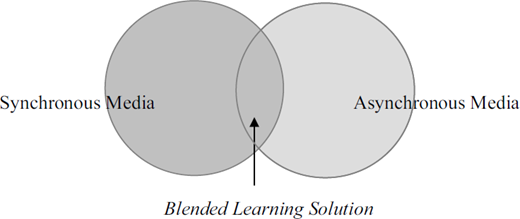
What is blended learning? Simply stated, blended learning is instruction using multiple media. Although appearing somewhat all-encompassing, this definition includes the integration of instructional media into a traditional classroom or into a distance learning environment. However, there is some discussion as to where technology insertion in the classroom ends and blended learning begins. Suffice it to say that blended learning can include any combination of media that supports instruction, regardless of the mix of synchronous or asynchronous media.
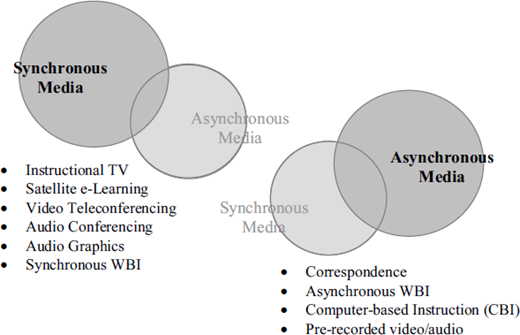
Figure 2 depicts the integration of synchronous and asynchronous media that can result in a blended learning solution. There are no prescribed solutions to integrating media, and in many instances, there are multiple blended learning approaches. The economy of scale and power of blended learning is derived from its “elasticity”: the ability to integrate a variety of synchronous and asynchronous media allowing the instructional designer to attain the most appropriate blended learning solution (Figure 3). Whereas the delivery technology does not alter the content, certain instructional media can affect the design of instruction, and as long as the “most appropriate” media are selected, learning outcomes will not be affected.
When developing a blended learning solution, maintaining instructional quality is paramount. To that end, learning objectives should never be sacrificed to achieve a blended learning solution. Also, when integrating instructional strategies (which are the products of learning objectives and serve to ensure the learning objectives are attained), some strategies may be more appropriate than others to achieve optimal learning.
Therefore, when selecting the most appropriate media one must consider the following:
Asynchronous media may be more appropriate for the lower cognitive levels where knowledge and comprehension and repetition or drill and practice are the primary focus.
Synchronous media may be more appropriate for the higher cognitive levels (synthesis, analysis, evaluation) where a synchronous learning environment is required to support a high level of interaction (dialogue).
Symmetry: To avoid inefficient (and perhaps costly) use of technology, symmetry of teaching strategy and technology should be matched. The key to efficient use of media is to use a judicious blend of symmetrical and asymmetrical systems. Delivery of extensive amounts of content (high-end graphics, large CBI files, etc.) to a dispersed audience, for example, should be (in most cases) accomplished over asymmetrical systems.
Distance Learning Instructional Media Selection
The instructional media selection process is a systematic approach based upon the instructional systems design (ISD) model. When selecting the most appropriate instructional media for distance learning, consideration must be given to a number of variables that may influence the selection of one medium over another.
Some instructional issues that must be considered are:
Identification of knowledge and skill gaps
Effective assessment and measurement tools
Level of interaction (didactic versus dialectic)
Instructional strategies
Complexity of content
Rate of content change
Delivery issues to consider are:
Audience size and distribution
Cost
In-house versus outsourcing
Availability of existing infrastructure
Delivery-hardware endpoints
Video teleconferencing equipment
Satellite receivers
WAN/LAN system/connectivity
TV/monitor, display devices, servers/ computers
Conclusion
Throughout this article, the focus of instructional media selection has been on the learning environment, and not the technology, as the primary determinant in selecting the most appropriate media. This sentiment has been echoed in other similar journal articles, and most notably by the U.S. Congress, Office of Technology Assessment, in their benchmark report: Power On! New Tools for Teaching and Learning (1988).
The authors concur, in that the most significant factors in student learning are quality and effectiveness of instruction, and the most important single factor in media selection is the instructional objective, with the end result of improving human performance. The level of cognitive objectives is a critical variable to consider when selecting the most appropriate media, whereas:
Asynchronous media may be more appropriate for the lower cognitive levels where knowledge and comprehension and repetition/drill and practice are the primary focus, and
Synchronous media may be more appropriate for the higher cognitive levels (synthesis/analysis/evaluation) where a synchronous learning environment is required to support a high level of interaction (dialog).
In conclusion, it is important to remember that instructional media are basically distribution systems, and that the most critical consideration in selecting a medium is the preservation of instructional effectiveness.
Authors’ Note: The full text version of An Instructional Media Selection Guide for Distance Learning contains additional information on specific instructional media and the use of instructional strategies. It is available online at http://www.usdla.org/html/resources/Guide.htm
“… the most significant factors in student learning are quality and effectiveness of instruction….”
In Upcoming Issues
| Twenty Guidelines for Successful Threaded Discussions | David A. Wade and Joanne P. H. Benfley |
| The Community College Leadership Perspectives of Quality E-learning: A Qualitative Case Study of a Two-Year Public Community College in Virginia | Abed H. Almala |
| One School’s Experience in Implementing E-Portfolios: Lessons Learned | Risa Blair and Lyndon Godsall |
| Upon Reflection: A Case Study of a Hybrid Classroom | Sandra Ratcliff Daffron |
| Online, Campus, or Blended Learning: What Do Consumers Prefer and Why? | Paul Epstein |
| Distance Education and the Well-Being of the Rural Poor: Case Study of the Kabongo Region in the Democratic Republic of Congo | Banza Nsomwe-a-nfunkwa |
| Best Practices in Distance Education | Lynn M. Smith |
About the authors