What is your school doing to improve technology skills of the teachers?” If you put 12 violins in a classroom, would you expect everyone to just walk over and start playing them? How can we expect teachers to sit down at a computer and do the same thing? Fittingly, Prensky (2001) said “Teachers are digital immigrants to technology, where students are the digital natives.” These are powerful observations that make technology implementation the key issue of the Digital Age.
As schools and colleges adopt sophisticated technology and ubiquitous portable computing, a thorough investigation of the effects of this technology is needed, which should include both the successes and problems that have occurred with implementation (Bartel, 2003). One of the key issues that keeps emerging is the need to adequately prepare teachers to implement technology successfully.
Dertouzos (1998) suggests that schools and colleges adopted computers like fashionable mantras and questioned why children in schools should be connected. After 35 years of experimenting with computers in various aspects of learning, Dertouzos believes there is still no evidence to suggest this has been effective. Others argue that schools have been adopting technology at a fast pace and there is little, if any evidence of the effects of this technology on teaching and learning because teachers have not been adequately prepared. According to Shotsberger and Vetter (2001), there is limited evidence to suggest that the inclusion of technology into an educational setting has improved student achievement.
Presenting a favorable argument on the positive side, Pierson (2001) reveals teachers are competent in using technology, and identifies exemplary uses of effective technology use in schools. Pierson also noted teachers maintain high levels of expectations for student learning, believe they can use computers to address individual learning needs, and are willing to shift focus toward activities that are student-centered. Additionally, teachers are three times more likely to encourage student use of the Internet if they adhere to a constructivist teaching style (guide on the side), rather than a traditional teaching style (sage on the stage). These same teachers focus on student interest rather than curriculum coverage, and promote critical thinking skills, real-world problem solving, and group projects (Becker, 2000).
Teachers who felt comfortable using technology also made conscious decisions to alter established curriculum, relying on their professional judgment to guide student choices in learning activities. How is it that some teachers can implement technology into their curriculum delivery better than others? Is this a personal decision on the part of the teacher who likes to tinker with technology or are there schools that have made a conscious decision to support the implementation of technology?
A report from the Partnership for 21st Century Skills (2003) reinforced that technology is, and will continue to be, a driving force in workplaces, communities, and personal lives in the twenty-first century. This report emphasizes the importance of incorporating information and communication technologies into education from elementary grades through the 12th grade.
What are the benefits to effectively implementing technology? Three specific outcomes of training were identified over 10 years ago and still are true today. The first outcome is due to the advances in technology; teachers have not only come to expect more from their students, but also have the ability to cover more complex material. The second outcome refers to teaching style. When teaching with effectively integrated technology, teachers are able to individualize learning. Additionally, students are more responsible for their learning (Hadley & Sheingold, 1993). The third outcome of technology integration is a direct shift from a traditional teacher role to a facilitator role in the classroom. Teachers move on the continuum from traditional assessment to authentic assessment, and students are engaged in active learning where they can independently move forward with their lessons. These specific findings indicate that teachers have changed their teaching styles to facilitate the learning process in their classrooms (Buck & Horton, 1996). Teachers shift from a more traditional teaching style to a more constructivist teaching style in which learners take on responsibility for creating, interpreting, and reorganizing knowledge in individual ways (Windschitl, 1999).
Gaining Administrators’ Support
What is the message for administrators at all levels to successfully implement technology across the curriculum? Administrators must be able to understand how effectively integrated technology can engage students in the learning process. Administrators must also serve as visionaries and clearly see how technology can fit into plans for school improvement (Johnston & Cooley, 2001). In addition, school leaders play pivotal roles in supporting teachers in their use of technology (Wil more & Betz, 2000), as well as guaranteeing access to a technology-rich educational environment for students (Boreen, 2000). Administrators need to be committed to the vision of providing technology-rich learning environments. It is this commitment to fully supporting teachers in their quest for technology, as well as providing ongoing training and development opportunities that will motivate those teachers to pick up their violins and start playing them!
At this K-12 independent school for gifted children in South Florida, the senior administrators made such a commitment. After running a successful capital campaign to lay the solid technology network infrastructure, they realized they needed something else to make the technology work. A director of technology implementation was hired who then formed a team of four instructional designers who acted as a technology support team. The team was named the Implementation Technology Team (ITT).
In its fourth year, ITT believes in a philosophy that it is every teacher’s and student’s right to be provided with the tools needed to succeed. Technology is now not only a necessity in life but also an exciting, innovative teaching and learning tool. Students, teachers, and parents must be well versed in the use of all technology tools and must be shown how to use these tools to create, disseminate, inform, and present information.
Successfully Implementing technology
To effectively implement technology, we first analyzed some of the specific barriers to teacher commitment to learning to use and implement technology, in order to deal with those concerns from the beginning. “Time constraints, insufficient access to classroom technology, limited knowledge and skills, and uncertainty regarding curricular integration are barriers to teachers’ technology use” (Shapley, Benner, Heikes, & Pieper, 2002, p. 32). With these key issues in mind, ITT created a successful all-encompassing implementation plan to address these teacher concerns. ITT developed and carried out numerous training sessions, supported teachers in groups and worked one-on-one with teachers to ensure this philosophy becomes a reality. As a result, the school is often visited by other schools, both public and independent, to find out how it has successfully implemented ubiquitous computing.
Implementing technology across a K-12 school is not an overnight achievement. In fact, the program that is in place at this school took almost 5 years to implement. Below are some suggestions and a model that could bring about success with regard to technology implementation:
Administrators need to make a strong commitment to technology implementation. This can be demonstrated in a number of ways, from a written document to the hiring of instructional design and technology support staff.
Once a person or team has been established, a system needs to be created that will benefit the institution. ISTE’s National Educational Technology Standards were used as a basis to establish department and grade level guidelines for technology use. ITT is able to survey and make personal contact with every member of the school to ensure that they have the needed support.
As the support system evolves, develop a technology evaluation tool to ensure that no one is falling through the cracks. Teachers complete online questionnaires and demonstrate through classroom observation how they are or are not implementing technology. ITT analyzes the questionnaires and plans either whole-school training or specialized workshops.
To further help faculty increase the use of the ubiquitous computing opportunities, adopt a course management system. This can be a major breakthrough, as it allows technology-challenged users to be supported with a system that makes technology easy-to-use.
To further involve the rest of the school, install a virtual customizable community environment to allow users to login and receive information based on their role in the school.
Finally, make every effort to provide technology training opportunities for faculty during and after the school day. ITT has offered teachers the opportunity to gain teacher recertifica-tion points for attending the sessions.
Using the UTĪM Model
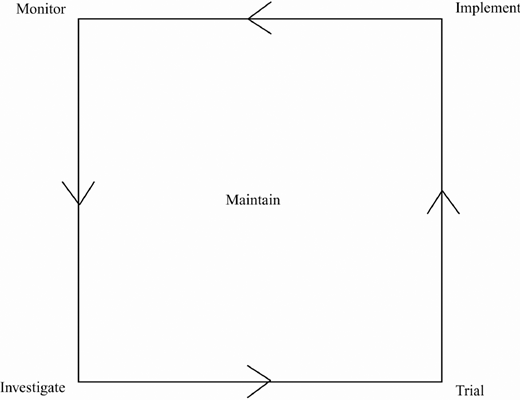
We developed the ITTIM Model for successful technology implementation. As we looked at other existing models in education, they were not a good fit with our particular needs. The ITTIM Model is inclusive because it involves the users, the teachers. It is not a bureaucratic model that adopts technology from a higher level and pushes it down to the users. This model, from conception, involves the end user.
The Implementation Technology Team Implementation Model (ITTIM) begins with the investigation of new products by the end-user. The ITT team recognizes that products endorsed and discovered by teachers are usually the most successful products to implement, because teachers have a vested interest in the success of the implementation. An example would be a teacher attending a technology conference or hearing about a product used in another school, and bringing it to the attention of the ITT. Together, the teacher and the team will investigate the product and its pricing, and then move to the next level. The key to all of this is to keep the end user involved in the process as much as possible. Teachers will promote use of a particular product to their peers.
To continually engage the end user (the teacher), ITT manages all of the logistics for implementation. The teacher needs only to be concerned with testing the product and offering feedback to the ITT team. Through various groups and independent teacher input, the team generates a report on the strengths and weakness of the product. One of the significant gauges for adoption is the suitability of this new technology related to how it will enhance our curriculum.
Based on feedback from the teachers and various user groups, and should we all choose to move forward, implementation will begin. Implementation takes place on various levels, depending on the technology. A common mistake is to bring technology on board and mandate use by all teachers. Through experience, ITT has found that a gradual adoption by interested groups is a much more effective way to introduce new technology into our school. Once the interested teachers have adopted and are working successfully with the technology, their peers pique an interest in actively adopting the technology themselves. An example would be the adoption of a course management system and learning portal. Originally, only a handful of teachers were involved with the CMS; however, only three years later, we have 100% support from teachers, parents, and the community. The benefits of using this technology became obvious to all those involved. This approach allows for a step-by-step implementation process that is usually successful.
We monitor and guide the users through the technology implementation process. By monitoring the process we are able to match training to end-users’ computer skill level and product sophistication. For example, for novice computer users, the team would develop a simple training program showing product basics, so that the novice user can feel comfortable with his or her level of competence and continue learning, endorsing, and implementing the product.
In contrast, for highly skilled computer users, the team would develop a more in-depth training program, so these users do not become bored with the product, and also continue to support product implementation goals and initiatives. In an ideal implementation, user groups are formed and those end-users come together and share techniques and ideas, so they may learn from each other.
The maintain phase of the model is ongoing to keep the product exciting for the end-user. Systematically, ITT will repurpose software by offering end-users workshops or one-on-one training to revisit the product and move the users to higher levels of usage. The process will start over again when the end-user brings forward an idea for implementation of a new product or technology.
Highlighting Teacher Endorsements
Perhaps the best indication of our success is teacher endorsement. In the past four years, ITT has reached 95% of our teachers with professional development activities that could be immediately used in the classroom. Trish Hawkins, a tenth grade English teacher, noted that “ITT has supplied us with the opportunity to attend the Florida Educational Technology Conference (FETC) every year and has designed professional development courses about such ideas as e-portfolios and other innovative ways to help us integrate technology into the curriculum.” Often educational researchers such as Cuban report that teachers are resistant to new technology. ITT, through an innovative technology program, can only praise the teachers at our K-12 school for their enthusiasm and willingness to try something new.
Joe Rega, a middle school math teacher, commented, “ITT is very instrumental in both maintaining our technology platform, and particularly in training both students and teachers in the proficient use of the technology. Training is provided one-on-one and in small groups; both informally, and in a formal classroom setting. Recently, ITT introduced a formal six-week training class on the use of various technologies both in and out of the classroom. This training and the support of our technology group is a valuable part of our daily routine at school.” As Kinnamon (1990) noted, “If teachers are to feel good about taking time from their schedules to acquire new computer skills, they must be provided incentives, remuneration, and recognition rather than roadblocks.” This six-week course provides the teachers recerti-fication points and occurs during the school day.
Lisa Garner, a fourth grade language arts teacher, commented, “ITT has established our K-12 school as one of the leaders in the field of technology implementation. Through ITT, we received a comprehensive training program on the use of the Content Management System (CMS).” As a result, teachers are able to log into tutorial programs, manage online grade books and student portfolios, input digital photography, design web pages, participate in discussion boards, and link to other outside resources. Our technology team also offers after school technology workshops and one- on-one training. One great incentive is that there is always something good to munch on!”
Teachers must first think of their curriculum and then how to integrate the technology (Guhlin, 1996; Persky, 1990). Our school provides ongoing faculty development workshops geared toward seamlessly integrating technology into the curriculum. The workshops focus on specific tasks with real application for the classroom, and are presented in a relaxed, non-threatening setting, for an hour at a time. Something for everyone is presented in the workshops, for the expert to novice users. Our technology team also provides one-on-one training and support to help with special technology requests. Bottom line, the technology team removes the anxiety related to learning and effectively implementing something new. Browne and Ritchie (1991) noted that coaching helps “teachers overcome the insecurity and fear of applying what they have learned in workshops.”
Brand (1997) concludes, “Technology is being integrated into school curriculums in many schools across North America as a result of effective staff development. If technology is to be used by students, then teachers must possess the confidence, understanding, and skills to effectively incorporate technology into their teaching practices. This will only occur by providing adequate training and development of teachers.” As with the violin, teachers must pick up their instruments and practice in the context of real time learning and teaching, with the support of an ITT. An Implementation Technology Team is the catalyst to provide the confidence and attitude that teachers need to be successful integrators of technology in their classrooms.
“An Implementation Technology Team is the catalyst to provide the confidence and attitude that teachers need to be successful integrators of technology in their classrooms.”
About the authors