OVERVIEW
The genesis of adaptive learning systems is from the artificial intelligence (AI) research. In the early 1980s there was significant development of systems to provide intelligent response to user interacting with the computers. The early AI research developed into three overlapping streams, namely, knowledge-based expert systems, neural networks, and genetic algorithms. These technologies were used primarily in adaptive control systems that managed the difficult task of controlling electromechanical actuators to adapt to the given situation and respond accordingly.
The artificial intelligence systems were based on strategies to learn users’ behavior and respond accordingly. The conceptual and philosophical differences of theses approaches led to the learning systems that were either influenced by the connectionists model that created supervised neural nets or unsupervised self-organizing maps or reduction of the knowledge domain into set-of symbolic representations leading to knowledge-based expert rules that can be fired to resolve a decision for the given situation.
Unfortunately, the learning management systems (LMS), learning content management systems (LCMS) or even the course management systems (CMS) completely have been completely void of any tool that allowed intelligent tutoring system to become part of the learning system to help individual learners to learn.
The learning systems developed by the author combine the elements of pedagogical learning framework with the intelligent systems to develop adaptive learning systems.
ADAPTIVE LEARNING SYSTEMS
Adaptive learning systems can be defined as the intelligent systems that are dynamically organized based on the observation of the learning preferences of an individual for the best learning performance.
The definition above illustrates following important characteristics of adaptive learning systems:
The adaptive systems needs to have a well defined pedagogical framework to identify and differentiate individual learning preferences
The systems needs to have a well defined quantification of learning performance and learning preference inference model and
The system needs to have a dynamic content sequencing engine to organize learning assets to match the individual learning
PEDAGOGICAL FRAMEWORK: THE LEARNING CUBE
The three-dimensional learning cube provides a logical framework to identify individual learning preferences based on the learning styles that define distinctive learning pathway. Three dimensions of the learning cube represent media, models and interactivity.
The proposed learning cube depicted in Figure 1 is composed of three dimensions—learning media, learning models/strategies and interactivities. The media elements are the modes of collecting information through text, graphics, audio, video, animations and simulations based on visual, auditory and kinesthetic preferences, the learning models refers to the process preferred by a learner to understand the information and turn it into useful knowledge, such as apprenticeship, incidental, inductive, deductive, and discovery, and the interactivity is used to provide feedback for confirmation, reinforcement and discussions. The learning cube is useful to map the individual learning preferences based on media, learning models and interaction.
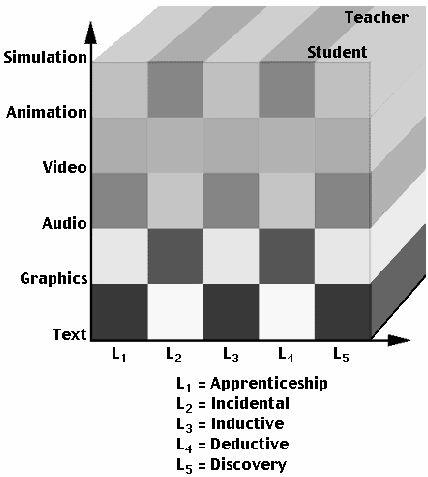
For adaptive learning we define the five functional leaning styles/strategies as:
Apprenticeship. A “building block” approach for presenting concepts in a step-by-step procedural learning style similar to mentor-student interaction.
Incidental. Based on “events” in a story or an educational trail that triggers the learning experience. Learners begin with an event that introduces a concept and provokes questions.
Inductive. Learners are first introduced to numerous examples that point to a central generalized principle.
Deductive. Learners are introduced to a principle by and learn by applying the principle in several situations and use principles to generate logical extensions.
Discovery. An inquiry method of learning in which students learn by doing, testing the boundaries of their own knowledge.
These models represent selected learning processes chosen from the numerous learning theories. These models and strategies are organized from simplest linear learning model to complex simulated environments.
QUANTIFICATION OF LEARNING PERFORMANCE CORRELATION
The learning performance correlation matrix is based on the statistical inference engine that collects information about the user behavior from each individual learning trajectory and creates a probability distribution for the entire set of learning content. These probability distributions are then updated based on the performance of individual user in a given diagnostic assessment.
The diagnostic assessments are as simple as a multiple choice questionnaire on the given concept or a complex exercise to demonstrate the level of mastery of an individual for a given concept.
DYNAMICS CONTENT SEQUENCING ENGINE
The diagnostic performance correlation leads to the identification of preferred learning model and concept deficiency. Based on the concepts that need remediation and the preferred learning style the content is sequenced dynamically to match the individual learning preference.
A remedial short presentation is dynamically generated following every diagnostic test to provide continuous intelligent feedback. The revision of the concept with the specific feedback leads to enhancement of the performance on each concept. This process of diagnostics and remediation leads to adaptive learning cycles that ensure that every individual learner reaches the necessary competency level.
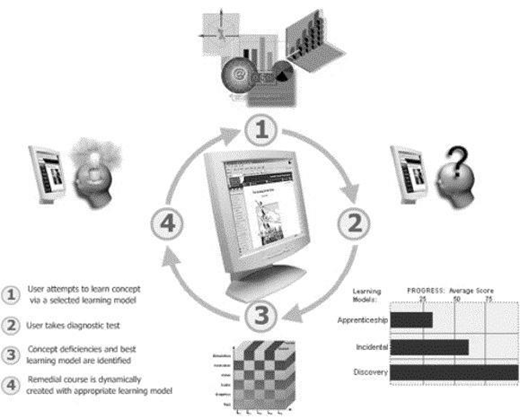
The four-step adaptive learning system.
The four-step adaptive learning system.
ADAPTIVE LEARNING CYCLE
The adaptive learning system as described earlier consists of a four-step learning process:
Learning of the concepts based on a given learning style/model
Diagnostic evaluation of the concept mastery
Concept deficiencies are identified and the learning preference correlation is generated.
Content is dynamically re-sequenced as a short remedial revision to ensure every learner master concepts, this cycle is repeated until every individual learner reaches the desired level of competency.
LEARNING WITH MASS CUSTOMIZATION
The future of e-learning is not in providing static content that just provide information, but lies in the power of customizing the content to match the learning needs of each individual learner. The learning process that is based on strong dynamic presentation and continuous adaptive feedback can overcome the deficiencies prevalent in the current on-line learning. Adaptive learning systems will provide the expected results that are long-awaited promise of educational revolution. It is time to build the next generation of adaptive learning systems.
About the authors