The University of Miami reinvented the process of professional development and training within the organization from static to dynamic by instituting the use of a learning management system to automate the registration process, give real-time access to the training course guide, give employees access to their training records, and create a portal to online computer-based learning modules (CBL). A learning management system, or LMS, as defined by most users in collaboration forums and in the industry, is a solution package that allows for the delivery and management of content and resources to all employees. The system is usually Web-based and provides continuous access to learning content and administration. At a minimum, the LMS allows for participant registration, the delivery and tracking of e-learning courses and content, and testing, and may also allow for the management of instructor-led training classes. In the most comprehensive LMSs, tools such as competency management, skills-gap analysis, succession planning, certifications, virtual live classes, and resource allocation are provided. The initial implementation of a LMS (NetLearning) at the University of Miami in June of 2004 under the leadership of Marcia Beckford, executive director of the Professional Development and Training Office (PDTO), met the minimum requirements for a system of that nature and at that time met a myriad of needs for the university community. Beckford’s vision was to tie professional development goals with performance evaluations and to create a reward system that would award those committed to professional development and working to narrow their skills gaps. She understood that NetLearning was not the right system to support that vision. NetLearning had been purchased to track and publish training at one of UM’s hospitals and was never meant to be used as an enterprisewide solution. Scalability would become a major concern. This was validated a year later, when increased usage slowed the backend of the system. It became apparent then that NetLearning could not offer the features needed to support the e-learning and professional development goals set for the effort. Data would need to be collected on the benefits of a LMS for the organization and why NetLearning would not be able to support those goals. Even though NetLearning did not have the needed functionality, it became part of a strategy for change.
UNDERSTANDING THE NEED
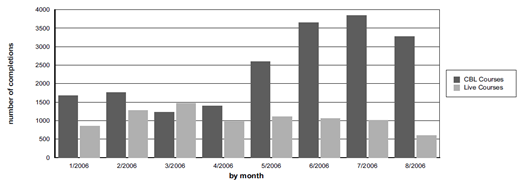
Despite all the successes and positive outcomes of the initial implementation, the goal for the LMS had changed significantly since its inception. In 2004, when it was launched, the goal was to track courses and provide 24/7 availability, which would decrease live course contact due to time constraints. This goal was accomplished as illustrated in Figure 1. The goal for the LMS morphed into providing a vehicle to assist in career enhancement through competency development, tightening learning plans, and using professional development as a vehicle to lead to reduction in turnover due to skill gaps in leadership. Based on user feedback, limitations of the initial system, NetLearning, and the direction of the strategic plan, a decision was made by Beckford to eventually migrate to a new environment that would provide a more comprehensive learner-centric experience to the learners and would meet organization goals. The need for this change was supported by exit interview data, performance issues, and the interviews conducted by the business and finance system design team at the University of Miami. The organization needed a system that could provide compliance reports and data on skill and competency gaps that could be translated into career mapping and then be used as tools for succession planning and promotion. To get the financial support and buy in for a new system, a plan was set in motion to establish the needed infrastructure and to guide training practitioners through a paradigm shift on how professional development was to be done at the university.
Before we can understand the steps taken to manage change during this period, it is important to understand the events and outcomes that transpired from this implementation and the successes that enabled the organization to accept the shift from instructor-led training to a blended format approach. Beckford’s strategy was to create the structure needed to support the vision for the organization’s learning, even without the adequate tools. As the projects were rolled out, the stakeholders were open to the possibilities and were coached on the acquisition of skills needed to implement such change. The changes to professional development in the 3 years under Beckford’s leadership have been remarkable. Employees have gained access to required modules 24/7 from any environment that allows them to learn. The CBL portion of the system allows employees the flexibility of learning at their own pace and at a time that is more practical for them and their departmental needs. Because training addresses knowledge, skills, behaviors, and attitudes, various levels of knowledge acquisition are equalized. This expedites the skill-building process by concentrating on practical experiences that increase transfer of learning back to the job. Trainers gain time for skill building by utilizing the content creation tool to impart knowledge; thus, more classroom time can be used to focus on proficiency, training reinforcement, feedback, and learners’ questions. Since NetLearning’s implementation and as of this writting, 250 CBLs have been designed and developed by various departments, utilizing both the learning management system and content creation tools. An additional 108 CBLs were purchased for use by one of the Medical Center’s specialty hospitals.
THE CREATION OF A SUCCESSFUL STRATEGY
PDTO e-learning and distance education strategy produced a paradigm shift at the university that created opportunities as well as challenges for the department. PDTO’s change management strategy was based on Rogers’ diffusion theory. It was implemented starting in early 2005, and included the following steps, (1) identification of a champion for change, (2) realignment of existing resources, (3) increasing number of course offerings and traffic to the system (4) set standards and model innovation behavior, (5) get lateral buy in as well as from leadership, and (6) partner with designers and SMEs. PDTO’s plan included (1) create excitement, and (2) show proof. PDTO created excitement by:
Identifying and getting the support of a champion;
Keeping the champion informed;
In the beginning, going for quantify, increase traffic in the system and number of online offerings available;
Collect data on system usage, participant feedback and manager’s comments;
Brand the system early so people feel they own it; and
Educate stakeholders on the possibilities and have them promote standards and best practices.
The first step in the process was to find a champion who would be supportive of the effort and who could promote the initiative at higher levels within the organization when needed. PDTO found champions in Thomas Roosevelt, vice president for human resources, and Paul Hudgins, associate vice president for the Miller School of Medicine Human Resources at the university. Theybelieved that this initiative would bring the employees professional development to the twenty-first century.
The second step was the realignment of existing resources. Different processes and tasks became automated after the implementation of NetLearning. PDTO’s employees had to be repurposed and different positions created to accommodate the new business requirements and goals. The staff needed to take on more of a consultant and coaching role. Beckford assessed her staff and identified skills gaps that needed to be closed before they were ready to take on the challenge. A staff professional development plan was created to allow staff members to gain the necessary skills and be ahead of the curb in promoting the standards and principles of distance education and adult learning; this allowed them to move from transactional to transformational work.
The third step was to promote e-learning, not the tools. This meant that the CBLs were initially created using tools that designers were most comfortable with—for example, PowerPoint. PDTO concentrated in promoting best practices for e-learning and to introduce different methodologies and techniques into its own CBLs. PDTO introduced new tools in their own CBLs, using different departments and initiatives as pilots for the new technologies. Beckford understood that, in many cases, training practitioners within the university did not have a training background and, because of that, they lack the skills needed to effectively design training. A forum was created to train training practitioners on instructor technology methodology, new tools, and techniques. PDTO started to act as consultants on best instructional design practices, guiding the stakeholders from outline presentations to interactive content and sound design. As practitioners became familiar with new methodology and tools, they demanded different functionality from the system. As those feelings became widespread, support for a new system grew stronger. Through collaboration efforts and training, the stakeholders were now able to make an educated decision on what they needed and why.
Participant Productivity and Cost Savings Going From ILT to Blended
| Begin Hours | End Hours | Hours Saved | $ Saved* |
|---|---|---|---|
| NEO Gables | 6 | 4 | 23,400.00 |
| NEO Medical | 14 | 6 | 180,000.00 |
| PIM | 21 | 12 | 27,000.00 |
| Total saved in 2006 | 230,400.00 |
*Annual savings assuming 415.00 per hour/person.
The fourth step was to set standards and model innovation behavior. PDTO promoted blended, adult learning, and distance education principles through different initiatives. Instructor-led training (ILT) offerings were redesigned and converted to modules, using learning objects with one or several online components. PDTO implemented these principles in high visibility projects like New Employee and Hospital Orientation. The collection of data and feedback from those projects were encouraging to other stakeholders, who started creating online modules to ease their training schedule and provide learners with 24/7 access to online tutorials and help. PDTO instituted standards and guidelines to direct the department and stakeholders on what needed to be done during and after the implementation. Migrating from a pure instructor-led environment required different skill sets and different processes. A road map was created that included the process for diffusion, communication, and engagement of those who were responsible for training functions within the University and would benefit and be impacted by the implementation of a LMS.
The fifth step was to get lateral buy in as well as from leadership. The support arose from data gathering and collection. Charts like Figure 1 showed leadership that employees wanted to participate in professional development activities and would do so if available to them when and how they needed it. The resulting savings as illustrated in Table 1 and change in performance help solidify the support. The Professional Development Council (PDC) was created in 2005 to promote adult learning principles, standards, benefits and best practices of eLearning among those with a training responsibility at the University of Miami. The PDC became a learning platform and a collaboration effort that helped identify business requirements and the need for a new system. Most PDC members were also NetLearning administrators that although using the system for online training, were nevertheless, refusing to offer the bulk of its instructor-led courses in the systems due to the effort needed to setup and complete those classes. Their input later became an integral part in identifying the requirements for a new LMS.
The sixth step was to partner with designers and subject matter experts (SMEs). PDTO partnered with different designers and SMEs to create CBLs that supported good instructional design methodology. These CBLs became beacons of what good e-learning could and should be like. These pilot programs helped gradually promote the desire among different stakeholders of acquiring the necessary skills to produce effective training and use different technologies. PDTO’s strategy included developing a competency-based program for training practitioners that provide opportunities for skill gap analysis and training in different areas of instructional design, adult learning, and distance education principles and methodologies.
BLENDING BUSINESS REQUIREMENTS AND BEST PRACTICES IN ONE LMS
As learners became more sophisticated, they started demanding different things from the system. The growth of the university demanded that training be delivered to employees who were not physically located on campus, and were located in satellite offices across Florida as well as worldwide. Learners started questioning the value of long instructor-led sessions. The support for a blended approach that promoted learning and maximized learners’ and the organization’s time grew. To address that need, PDTO introduced the university community to synchronous virtual training sessions. Elluminate (an application that provides a synchronous virtual environment) was used for feedback sessions and to allow those in remote locations to participate in training sessions that otherwise would not be available to them. As tools were added to increase interactivity and support distance learning, NetLearning’s inefficiencies and lack of scalability became more pronounced.
PDTO started collecting more data to promote the buy in of senior leadership for a new LMS. Focus groups and surveys conducted between the PDC, system users, and NetLearning administrators identified the features needed to accommodate the growing business and learning needs of the university community. These features were compiled into a requirement list used to research and select a new LMS. These groups participated in the final decision process and provided the necessary comments and feedback to support a change in system. They were part of PDTO’s strategy for change since NetLearning’s implementation and now became vital partners in the search for a viable solution. These groups understood the vision and the business requirements that the replacement system would need to meet in order for the initiative to be successful. It was paramount that these users thought not only of their unique requirements, but consider as well the enterprise requirements for the system. PDTO mediated interest groups and was responsible for bringing all requirements under one banner as well as to meet due diligence in researching and implementing a system that met the global needs of the enterprise.
Fifty-six systems were researched using three major areas: functionality, cost, and vendor’s responsiveness. From those systems, five were previewed by PDTO’s leadership team and two were then selected to be previewed by all major stakeholders. Data collected after the previews and information sessions revealed an overwhelming consensus among the stakeholders on which system to select. It is important to note that both systems were extremely similar and met 99% of the requirements. This consensus was a strong witness to the success of the change management process initiated by Beckford’s leadership in 2004. The group, composed of 50 people, branded the new system as ULearn and participated actively in the communication and diffusion projects implemented to pave the way for the system’s implementation on June 1, 2007. They were and still are an integral part of the strategy to manage and support the change management process at the University during the migration period.
THE ROAD AHEAD
Even though NetLearning provided each department in the university with the autonomy to access and maintain its own training records, and met the initials goal set for the effort, ULearn will expand on those achievements to bring professional development at the University to a new level and will provide the tools to support senior’s leadership goals for the organization. The eLearning and Professional Development strategy is built on the new system functionality and allows PDTO to create a learning structure that promotes a “learning as needed” environment. NetLearning ensured the accuracy and validity of professional development activities by giving control and oversight to the content experts. ULearn will identify and prioritize key positions for prescriptive learning. It will assess employees and provide them and their managers with a roadmap for skill and competency gaps that is then customized automatically in Individualized Learning Maps within the system. Those learning maps will address the employee’s performance gaps, compliance requirements by job role, and learning needs. The system will, furthermore, act as a needs assessment tool that will identify areas needed to be added to training curriculums and course offerings. It will allow training professionals at the university to work with senior teams to support, monitor and measure learning and performance. ULearn will enable managers to fast-track high-performing employees by placing them into the right training, supporting in this way succession planning and promotion tracks. It will create an immersion process for new employees with defined roles and clear expectations that will reduce attrition and place appropriate candidates in the right positions.
Currently, NetLearning allows employees to register for live sessions and access computer-based modules when it is most convenient for them. Employees also benefit by the ability to learn at their own pace and review course material as often as needed and to have access to compliance and regulatory training. ULearn will allow managers to register employees for training and to create development plans as part of their annual performance evaluation review. It will also track progress and correlate training to the job, while at the same time creating the ability to measure the impact and transfer of that same learning on the job. It will monitor compliance data by automatic reporting to supervisors of noncompliance with training requirements. Managers will be able to take accountability for the professional development of their staff, particularly for regulatory legal and safety compliance. It will also enhance the managers’ ability to access resources for their employees in order to improve their performance. The system will automatically define and map regulatory compliance training for all employee positions. ULearn will enable professional development activities to become individualized and to be tracked in one central location to support employee development and performance as it places one of the university’s greatest assets, the employees, in the forefront, to support the growth and strategic plan of the university.
SUMMARY
The success of the NetLearning implementation and the migration to ULearn were possible because of the strategic vision used to manage the change process. Both events were not the culmination or the final goal, but they were part of a strategic plan for a paradigm shift in professional development at the University of Miami. The lessons learned detail that best practices research, collection of data, and lateral buy in were critical elements in bringing about and maintaining change. This process showed that change can be initiated and supported at different levels without having to be initiated by senior leadership. The involvement of senior leadership in this process was planned and requested at strategic points during the process to minimize roadblocks. Change was maintained and managed through the involvement, acceptance, and participation of the stakeholders who would benefit and be the most affected by it.
YOUR ADVERTISEMENT OR ANNOUNCEMENT COULD BE HERE
USDLA 8 WINTER STREET, SUITE 508 BOSTON, MA 02108 800-275-5162
About the author