

A good plan is like a road map; it shows the final destination and usually the best way to get there.
—H. Stanley Judd
INTRODUCTION
Establishing an organization’s direction will help in selecting the right road and assist the organization in increasing its growth and effectiveness. Periodic evaluations by institutional leaders are required to determine if the needs and expectations of its members and constituents are being met. According to Wilbur, Kudla Finn, and Freeland (1994) “There should be a well-defined and understood strategic plan which the organization’s staff, as well as its board or governing body, uses to guide program activities, allocate resources, and assess the organization’s achievements (p. 1).
Strategic planning is not a laundry list of changes and programs that contributors desire. Instead, it is a realistic look at the changes that are taking place, both inside and outside the organization that are and will influence the ability of the institution to carry out its mission. A strategic plan does not provide the who, what, and when; these are the function of an operational plan. Instead, it broadly maps out the strategies the organization should pursue to maintain its desired character and identity within a prescribed timeframe (Wilbur et al., 1994, p. 2).
EDUCATION MASTER PLAN— BROWARD COMMUNITY COLLEGE
Broward Community College (BCC) has three main campuses and six educational centers. Each campus, in addition to offering a comprehensive curriculum of university transfer programs, offers career and technical programs that prepare students for careers in health science, aviation, automotive, and public safety, to name a few.
In August 2004, Broward Community College contracted with the Voorhees Group LLC to assist in the development of an educational master plan (EMP). The purpose of the plan was to address BCC’s ability to respond to the projected growth in Broward County and to make strategic choices about the future of the college. The process used by the Voorhees group to establish the EMP consisted of 11 countywide strategy sessions as well as interviews with college administrators, faculty leadership, and students. In addition, business leaders, economic development specialist, and personal from the public school system along with administrators from universities located in close proximity to BCC were interviewed. The final plan consists of 26 strategies to meet nine major goals.
The EMP called for the institution to “reach out in new ways to new and existing students thorough a range of new activities (Voorhees Group, 2006b, p. 3). Specifically, goal seven called for the re-examination of format and delivery options for all courses. Recognition of e-learning’s strategic importance by BCC leadership cumulated in a task force composed of 25 faculty, staff, and administrators that went on to develop a blueprint to guide the growth and impact of e-learning at Broward Community College. The EMP elevated e-learning as a means of addressing some of the challenges BCC is facing and as a result a 3-year e-learning plan was developed that defined the scope, goals, and outcomes for e-learning along with strategies and initiatives for implementation.
E-LEARNING AT BCC
BCC has a track record of successful elearning initiative over the past seven years. Driven by operational strategies such as "developing the 21st century professor," enrollments in fully online, blended e-learning and WebCT based course sections exceeded 47,000 in 2008. In the 2008-09 academic year, students will be able to earn an AA degree in the several programs as well as a number of AAS and AS degrees totally online.
According to Russ Adkins, associate vice president of instructional technology at Broward Community College, “What began as a faculty development initiative in the late 90s is now a strategic initiative impacting all campuses, nearly 50% of the full-time faculty, and thousands of students” (personal communication, December 13, 2006). Roundtable discussions produced the following working objectives:
- •
to increase strategic awareness of current flexible learning alternatives at BCC as well as how flexible learning growth is accelerating nationally and globally;
- •
to demonstrate how flexible learning can provide new choices for BCC especially as a tool to manage enrollment growth and classroom capacity.
- •
to provide twenty-first century learning options that provide flexibility for “digital natives” (students) who find commuting, employment, and family responsibilities inhibit their access to BCC;
- •
to use the education master plan as a tool to engage BCC’s administrative leadership and faculty in planning to position flexible learning as a key strategy for student access to course and degrees;
- •
to create a 3-year plan to strategically increase the use of flexible learning at BCC, and secure the internal resources through BCC’s budgeting cycle to effectively operate BCC’s plan;
- •
to evaluate contemporary content, course development, and delivery models that support increasing the scale of BCC’s e-learning activities while ensuring quality learning;
- •
to prepare BCC for a Southern Association of Colleges and Schools substantive change review of its e-learning initiatives (Voorhees Group, 2006a).
IMPETUS FOR CHANGE
Since more than 95% of courses offered at BCC are delivered face-to-face in a traditional classroom setting, what are the forces behind the increasing commitment to distance education? Several factors have been identified that address this question.
According to Oblinger, Barone, and Hawkins (2001), the force driving e-learning initiatives at most institutions falls into one of four categories. They either wish to expand access, generate new revenue, serve as a catalyst for institutional transformation or alleviate capacity constraints. Capacity constraint is one of the issues at BCC. The infrastructure cannot accommodate the growing college-aged population and enrollments, making more distance education programs necessary. It is hoped that by leveraging scalability of e-learning, existing place-bound capacity constraints can be avoided.
The timing for BCC to plan for expansion of e-learning is especially good, as e-learning throughout the United States is experiencing rapid growth. According to the Sloan Consortium (2006) “Nearly 3.2 million students were taking at least one online course during the fall 2005 term, a substantial increase over the 2.3 million reported the previous year“ (p. 1). Institutional transformation is also a motivating factor. Planning for e-learning can provide a powerful catalyst for transforming a wide range of current practices at BCC as it seeks ways to best to serve current and emerging learners.
A second reason for institutional support of e-learning is that students are shopping for courses that meet their schedules and circumstances. Adult learners need flexibility, choice, and convenience. Adult focus groups conducted at BCC in 2004 found that participants agreed that flexible class schedules and learning options were major motivators in persuading them to select a school. Many stated they would be drawn to a college that understood the need to maintain full-time jobs and responsibilities associated with families. Online courses were consistently mentioned as a desired alternative or supplement to traditional course hours. Learners, including adults who commute to work in ever more congested conditions, are increasingly cautious about how they allocate their time. Development of alternative formats (compressed, 5-week, 8-week, Saturday) for courses as well as accelerated alternative online delivery strategies (Internet, hybrid, technology-enabled) will help BCC meet learner needs (Broward Community College, 2006). This was affirmed by older students who view online as a reasonable alternative to battling traffic to attend traditional classes. Technology expectations are another driving force behind BCC’s commitment to e-learning. Students are increasingly savvy when it comes to technology. Today’s teenagers are unlike any previous generation in their exposure to multimedia and the Web. A recent survey by Lenhart, Madden, and Hitline (2005) found that 87%, or 21 million, teens use the Internet; 51% go online on a daily basis; 81% play games online; 76% get news online; 43% have made purchases online; 45% have cell phones, and 33% are texting; 75% use instant messaging to communicate but also share links, photos, music and video; 51% report broadband access.
Millennial students (born between 1982 and 2002) consider technology a natural part of their environment and want to learn collaboratively, online, in their time, and working on solving problems that matter (Apple Computer, 2003). The simultaneous use of multimedia (i.e., instant messaging while playing a computer game) adds up to 8½ hours of recreational media exposure daily (Kaiser Family Foundation, 2005). These traditional age students (18 to 24) are making up a large and growing segment of community college enrollments. As of 2001, students under the age of 22 constitute 42% of all credit-seeking students at community colleges (Adelman, 2005). In general, students expect faculty to incorporate technology into their teaching and be proficient at it. At the very least, communication via e-mail, access to online resources, PowerPoint presentations, Internet activities, discussion boards, and electronic classrooms are expected.
According to the Sloan Consortium (2005), online education has become part of the mainstream of American higher education. They report that the majority of academic leaders feel that online education “is critical to the long-term strategy” of their institutions (p. 7). BCC believes the development of e-learning programs and degrees is a service to their students and a marketing/positioning strategy for the college. The goal is to ensure that students in BCC’s service area can find the courses, programs, and degrees they need, in the delivery format most suitable for them, without having to look elsewhere.
BCC is, however, seeing competition not only from public community college in Florida, but also private institutions who offer online associate of arts degrees. Almost 5 million of the 20 million student enrolled in degree-granting institutions attend for-profit colleges (National Center for Education Statistics, 2005). Abolishment of the 1992 federal 50% rule which in the past had prevented any college that enrolls more than 50% of its students at a distance or provides more than half of its courses via distance education from participating in federal student-aid programs, will spur on a new wave of for-profit schools offering online education (Carnevale, n.d.). Public institutions are also a big part of the growth of e-learning. In Florida, 13 of the 28 community colleges offer complete online degrees (Florida Distance Learning Consortium, n.d.).
STRATEGIC E-LEARNING PLAN
The E-learning Task force adopted seven strategies to expand e-learning options at Broward Community College.
- •
Strategy 1: Select programs/certificates/degrees for priority e-learning development and delivery.
- •
Strategy 2: Improve and accelerate the course redesign/e-learning course development process.
- •
Strategy 3: Develop master e-learning courses that can be readily adopted for delivery by fulland part-time faculty, collegewide.
- •
Strategy 4: Seek approval from the Southern Association of Colleges and Schools to offer online degrees. Satisfy all qualitative criteria associated with this “substantive change.”
- •
Strategy 5: Align collegewide procedures, policies, and collective bargaining agreements procedures with e-learning initiatives.
- •
Strategy 6: Develop internal and external awareness of e-learning’s role at BCC.
- •
Strategy 7: Ensure that e-learning delivers return on investment and is sustainable (Voorhees Group, 2006b, p. 2).
A graphical representation (Figure 1) of the strategic plan denotes a linear process that progresses through a logical sequence of events. The first step is to identify those programs/certificates/degrees that should receive priority for e-learning development and delivery. These programs will be both new and those that are nearly complete but have gaps that can quickly and easily be completed. Alignment of these programs to the mission and goals of the college will need to occur on several levels. Approval from the Southern Association of College and Schools to offer online degrees is paramount to the success of online education at BCC. Preparation for a substantive change visit will require compliance with issues related to academic and student services, course quality, congruency with the college mission statement and student readiness and success. Collegewide policies/procedures, along with faculty collective bargaining, will also have to be considered. Current contractual requirements related to work load, student contact, and office hours are not congruent with actual roles and responsibilities of online faculty. Resolution of these types of issues must be part of the strategic plan if e-learning is to move forward and diffusion of technology is to occur.
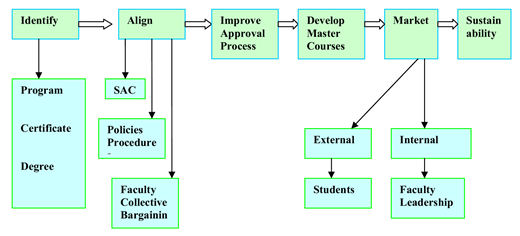
Graphical representation of e-learning strategic plan.
Graphical representation of e-learning strategic plan.
The third step will be to improve and accelerate the course development process. This will affect how courses are designed, developed, and updated. With the approval process smooth, timely, and efficient, the focus can shift to course design and development. Master course is a strategy for adding additional sections of an existing e-learning course. Full-time and part-time faculty can be utilized to teach courses they themselves have not developed. This allows flexibility and opportunities to meet scheduling needs that was not possible when a single faculty member was responsible for teaching a course.
The final two strategies are an integral part of the strategic plan. Marketing elearning to various stakeholders at BCC is tied directly into the sustainability of the programs and department. Positioning elearning among existing and potential students ensures that e-learning classes are full and student learning needs are being met. Consumer satisfaction goes a long way in retaining old and recruiting new students. Internal awareness by faculty and college leadership regarding the importance of e-learning is also important. The goal is to make e-learning a thread in the very fabric of BCC. Aligning strategic initiatives between the college and instructional technology is one way of doing this.
SUMMARY
There are many reasons why institutions of higher education do not develop strategic plans for e-learning. Broward Community College’s work in this area is unique and will pave the way for ongoing planning, implementation, and evaluation of future e-learning initiatives. This plan will need to be modified on the short-term and definitely will undergo revision over the long-term. It does, however, provide a venue for recognizing the progress made by BCC while detailing the steps needed to continue that progress. The ultimate outcome for this plan is to increase e-learning opportunities for students. According to the Voorhees Group LLC (2006b), the accomplishment of this has been initiated by incorporating the following elements of strategy into the e-learning strategic plan:
- •
the foundation, direction, and outcomes for expanding flexible learning opportunities for students;
- •
quality assurance for e-learning, relying on assessment of learning and student feedback;
- •
the development and use of learning objects as an efficient vehicle for promoting quality and access to courses;
- •
data collection, analysis, and synthesis to guide future choice in e-learning;
- •
seeking wide support of the college community including periodic reporting on progress in providing flexible learning opportunities for students, whether by e-learning techniques or otherwise throughout the college’s courses and programs;
- •
a collaborative model that ensure efficient scheduling of classes and other learning experiences for the benefit of current and future students;
- •
a stance that does not create dependencies on external vendors, rather a set of strategies that provides for BCC to control and refine its own curricular destiny;
- •
accountability for units and individuals to specific actions over specified time frames; and
- •
standards, criteria, and evaluation to ensure that accountability (p. 26).
