As more Americans than ever seek higher education, distance education has become a strategic initiative for the nation's colleges and universities. While traditional campuses reach their on-campus limits, academic institutions like Old Dominion University (ODU) in Norfolk, Virginia, are breaking new ground on the virtual campus of the future.
ODU has long been recognized as a pioneer in distance education, due to its early adoption of a satellite broadcast network.
Today, nearly 15% of the university's more than 20,000 students attend classes remotely, completing a wide range of undergraduate and graduate degree programs without ever coming to the main campus. ODU's virtual campus has grown to 50 remote sites and 200 classrooms spanning Virginia, Maryland, Arizona, Washington, and U.S. Navy ships deployed abroad.
As ODU's distance learning program has expanded, the university has endeavored to break down the barriers that separate distance classrooms from their main campus counterparts. The university has also sought to improve the efficiency and cost of delivering courses remotely.
In 2006, ODU made a strategic decision to invest in a satellite network supported by iDirect and X-Analog Communications, Inc., a satellite systems integrator. Through an ambitious three-phase rollout, ODU has been able to reduce its operating costs, increase and improve its video distribution to classrooms around the continent, and make available a wealth of digitally archived lectures to its entire student body.
SATELLITE VOICE CONNECTIVITY CUTS COSTS, IMPROVES CLASSROOM INTERACTION
To offer accredited university programs that connect students directly with the university's faculty, ODU originally extended standard telephone services to remote classrooms, allowing students to ask questions in real time during lectures. However, telephone toll charges incurred over hours of daily instruction across hundreds of classrooms were costly to the university. ODU was being charged long distance fees for the duration of every course at each classroom site, whether the remote student was interacting with the instructor or not. In addition, the costly phone bridges and phone line connections were often plagued by poor voice quality.
ODU partnered with X-Analog to find a cost-effective alternative solution to provide IP voice connectivity via satellite from remote classrooms to the main campus, integrate video distribution via the IP satellite system, and prepare remote facilities for other IP-via-satellite services such as file sharing, video conferencing, and so on. X-Analog proposed a two-way, IP-based satellite network from iDirect. Based on the iDirect platform, X-Analog and ODU engineered an innovative VoIP satellite intercom system.
The system works by establishing a VoIP session from each remote site to the main campus in Norfolk, Virginia. Students at the remote sites have a microphone at their desk and can interject at any time during the class to ask a question of the instructor. When no one is talking over the satellite link from that site, the system is idle and is not using satellite capacity. As a result, ODU is using less than one MHz of space segment to connect all its remote classrooms all the time on the voice return network.
Underlying the network is a complex call management system designed by X-Analog. The system converts analog voice signals to IP data and manages IP traffic from the remote sites, ensuring call prioritization and minimizing satellite latency.
“The VoIP network enables ODU to minimize the amount of traffic on the satellite network and keeps costs and usage of space segment low," says Mack Sanjak, director of engineering at X-Analog. “In addition, the iDirect platform minimizes latency. That's especially important because students have a minimal amount of time to get their questions in before the instructor has moved on to something else.”
“ODU can build virtual communication environments independent of geographical limitations,” says Timothy Ehrlich, director of the university's distance satellite network. "Our students can interact more easily with their instructors and with students across the country.”
EXPANDING VIDEO OUTPUT AND QUALITY
With the VoIP satellite intercom system in place, ODU turned to the second phase of its system transformation: integrating video onto the satellite network. By leveraging the flexibility of the H.264/MPEG-4 part 10 encoding protocol, ODU designed and deployed an encoding system capable of encoding video for distribution via the IP satellite network, terrestrial video streaming, podcasting, and digital asset management. The H.264 encoding system and video streaming infrastructure was developed through a partnership between ODU Distance Learning and the Office of Computing and Computational Services with support from investment funds awarded to the university from Governor Kaine's Productivity Investment Fund, a fund managed by Virginia's Secretary of Technology, Aneesh Chopra, established to promote cost savings in government agencies.
Leveraging the outbound satellite channel, ODU, iDirect, and X-Analog developed a system by which ODU can multicast up to eight live video channels simultaneously. iDirect's remote routers connect to set-top boxes integrated into the network and deliver quality live video to students with high reliability.
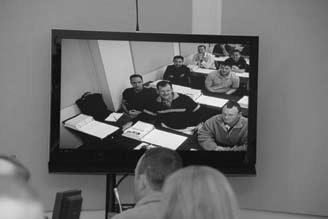
The enhanced capability enables ODU to increase its broadcasting capacity, while using the same amount of satellite bandwidth capacity. The network achieves this jump in efficiency by encoding the video content into H.264/MPEG-4 part 10 for broadcast, a highly efficient video encoding standard designed especially for IP networks. ODU has also been able to increase video quality and resolution to support large plasma and LCD displays. By leveraging the simulcast nature of the satellite network, new remote sites can be added without requiring additional satellite space.
A NEXT-GENERATION LEARNING ENVIRONMENT
With the satellite network multicasting H.264 encoded video, ODU can now digitally encode and archive lectures and make them available online. The MPEG-4 archives represent a valuable learning tool for students who have missed a class or who want to review the lecture, especially before an exam. Students can download the lectures for a variety of platforms, from desktop computers to mobile communications devices such as cell phones and iPods.
ODU views the new satellite network as a model for distance education. According to Ehrlich, "We are using our satellite capacity for new and exciting applications that were not possible before. This is an exciting time for our university, as we can affordably expand our reach and deliver an ODU education to more students in the U.S. and around the world.”
Ehrlich adds, “We are creating new learning environments to respond to main campus and remote learning demands to meet the changing needs of today's students.”
The Remote Classroom
15% of ODU's students attend classes remotely
Virtual Campus Includes
50 remote sites and 200 classrooms spanning nationwide
Navy ships deployed abroad
Technology Specs
Redundant iDirect satellite hubs
iDirect satellite modems
Satellite space on Galaxy 26
X-Analog designed
Call Setup Units
Quintum 24 port ATA
Envivio MPEG-4 encoder
Amino AmiNET 125 Set Top Box
“WE ARE CREATING NEW LEARNING ENVIRONMENTS TO RESPOND TO MAIN CAMPUS AND REMOTE LEARNING DEMANDS TO MEET THE CHANGING NEEDS OF TODAY'S STUDENTS.”


About the author