INTRODUCTION
Electronic portfolios (eFolios) are a relatively new teaching and learning strategy, with their roots in colleges and universities. They have gradually worked their way down to high schools and now into the lower grades. Through recent studies, ePortfolios have proven to be excellent documentation tools for a variety of purposes. Efolios can be used to measure academic achievement, growth over a period of time, or the accomplishment of state standards (Niguidula, 2005). The use of electronic portfolios in the Manatee County (Florida) School District (MCSD) is in its infancy stage, having been implemented for 2 years. The school district recently adopted a new mission statement; "The mission of Manatee County School District is to inspire our students with a passion for learning, empowered to pursue their dreams confidently and creatively while contributing to our community, nation, and world" (Manatee County School District, 2005). This new mission is one part of a new strategic plan titled EdVantage.
The word portfolio comes from the Latin words portare, meaning to carry, and foglio, meaning sheet of paper. A primary purpose of any type of portfolio assessment is to teach students how to evaluate their own work via application of quality standards and personal goals. Portfolios seem to mirror the comprehension and performance of a student (Gibbs, 2004). "Making an educational experience relevant and meaningful should include making the method of assessment relevant and meaningful" (Lambert, 2007, p. 78). Using portfolios provides for authentic and meaningful collection and assessment of student work that demonstrates achievement or improvement. Portfolios “create the opportunity to involve learners in directing, documenting, and evaluating their own learning" (Lambert, 2007, p. 78) Implicit in these meaningful collections is evidence of student self-reflection (Lambert, 2007).
Current state testing requirements have caused students to question that they are being taught "the test” and that there is no relevance to their learning. However, research indicates that if students connect their work to governmental standards they see value and relevance to their work (Ring & Foti, 2003). Yet, finding ways to show students the connection is not an easy task. Many researchers and educators feel that portfolio assessment is superior and a more accurate indicator of a student's progress than more conventional types of assessment. Assessing student learning using more authentic methods is a current favored topic among state and federal agencies and has made a significant impact on the literature in pedagogy since the early 1980s (Lambert, 2007). Additionally, portfolios provide opportunities for students to showcase their talents, creativity, and individuality, as well as technological capabilities. The "beauty of [the use of] e-portfolios is that it fosters active learning not only in the areas of subject contents but also in the use of technology" (Lambert, 2007, p. 76). Motivating students to be high achievers and to have a desire to attend school has always been a difficult task for educators. However, as students become active learners while constructing their eFolios, they assume ownership of their learning and a desire to attend class while submitting quality assignments.
The EdVantage plan is the result of over 6,000 hours of teamwork by more than 190 Manatee County community leaders and School District employees (Manatee County School District, 2005), with a core team of 18 community members and 18 school board employees. The strategic objectives of EdVantage are to have each student actively engaged in the following goals by the year 2010: (1) continually demonstrate enthusiasm for the self-directed pursuit of knowledge, (2) articulate personal goals, create plans to achieve those goals, and exhibit progress toward their attainment, (3) continually participate in democratic processes, and (4) actively engage in global outreach (Manatee County School District, 2005).
The district plan to achieve and measure these goals is to institute a student eFolios program. A pilot program was initiated during the 2005–2006 school year. Two volunteers from eight elementary, four middle, and five high schools were chosen to participate in the program. The result was 38 participants for the program: 18 elementary, 9 middle, and 11 high school teachers from a wide array of teaching fields, computer knowledge and experience. In the second year these numbers more than tripled, 112 teachers from 26 schools are currently participating in the program (Tschappat, personal communication, April 18, 2008). Superintendant of the Manatee School District, Roger Dearing, had hoped for 100 applications for the program and was pleasantly surprised by the nearly 200 applications the program received. “The project is a dynamic effort to bring the future of education into the classroom today. Students' records and reports, parent notification are paramount to the success of this program" (Dearing, personal communication, April 22, 2008).
The assistant superintendent for district support services stated that the “pioneers,” our group of first year eFolio teachers, learned so much working with the instructional technology staff (ITS), and creating, often by trial and error, the template for the future of eFolio in our district (Sismore, 2008). Upon acceptance into the program, teachers agreed to attend training several times a year and assist their students in developing individual eFolios. Aime Poole, a sixth grade teacher at a district middle school stated, “I really value the eFolio trainings where we were afforded the opportunity to work with our team and ask for guidance from the ITS in an informal way" (Sismore, 2008, p. 13)
The student eFolios are digital showcases of student work showing goals, knowledge, values, growth, achievement, and their connection to the strategic objectives. After attending several trainings facilitated by members of the ITS department, eFolio teachers began learning how to use SchoolPage, the district's Web design and publication application. "The eFolio training provided the foundation necessary for me to inspire my students to employ technology in the language arts classroom. We have had a blast!" stated Jenny Dobbs, a high school language arts teacher (Sismore, 2008, p. 13).
Some of the benefits of incorporating eFolios into the classroom include: improvement in teacher and student computer skills; storage of and access to student works such as artwork, photos, audio and video clips; the ability to integrate instruction by accessing portfolios in any subject from any classroom (Penta, 2002); students reflecting on the work they have completed in the classroom and tying them to the strategic objectives; and the ability of teachers, administrators, counselors and parents to easily access the students' work. Aside from the ease of accessibility, other advantages of ePortfolios are: having the capability to store multimedia; being easy to upgrade; and allowing cross-referencing of student work (Hewett, 2004).
EFolios take the focus off the teacher and make learning more student-driven. Two second grade and two fifth grade teachers teamed up to work on the eFolio projects. "Working with the second graders really reenforces the fifth graders knowledge and understanding of the district's strategic objectives. It also boosts their confidence in the use of technology software and hardware involved. The second graders love to learn from the 'big kids' and the fifth graders love showing off what they've learned. It's a great opportunity for sharing between grade levels," recalled Tomlin. (Sismore, 2008, p. 13)
This approach teaches students to work in teams, teach each other, learn leadership and negotiation skills, and appreciate diversity (Hanfland, 1999). Efolios give students ownership and responsibility for their own learning (Hewett, 2004); they become the authors of their own academic success. With the teacher in the role of "coach" rather than the provider of knowledge, self-directed learning is an attainable goal with technology integrated into the various content areas. Learning becomes interactive as students engage in problem solving rather than passively listening and memorizing (Hewett, 2004). Students are driven to produce quality work, while at the same time increasing their self-esteem by showcasing their best work (Hanfland, 1999).
Portfolios capitalize on students' natural tendency to save work, and they become an effective way to get them to take a second look and think about how they could improve future work (Hewett, 2004). With eFolios, the main idea is to keep students focused on learning rather than on individual projects or products (Garthwait & Verrill, 2003). Efolios are part of the learning process, not a result of it. This is accomplished greatly by student reflection, another key element of ePortfolios. Students are expected to collect, select, and reflect (Gibbs, 2004).
In Manatee County, students will collect artifacts, pieces of their best works, and either import, upload, or scan them into a district-owned Web page-making program, SchoolPage. Student will each have their own site to store and display their work. Once an artifact is linked to their site the students write a reflection. This reflection asks the students to think about their work and relate it back to one of the four strategic objectives. Many teachers devised creative ways to help their students learn the strategic objectives. A second grade teacher used the common game of four corners to assist students the objectives.
I placed the four strategic objectives around the room. Then I told the children a scenario, for example that I loved to watch birds and that one day I wanted to work in a national park so I could always watch birds and learn more about them. Then I told the children to stand in the corner of where they would put that in an eportfolio. After the children had all chosen a corner, I asked one child from all of the occupied corners to verbally explain why it would fit under the objective they had chosen. I used scenarios that would fit under multiple objectives and others that were more obvious, so the children could see that things can fit under more than one objective. (Sismore, 2008, p. 13)
For example, if a student wrote a report on water conservation, he might make a connection to the global outreach objective and how it is everyone on the earth's job to conserve water and offer suggestions of what can be done, or what their plans are to help their family conserve water. This reflection would then be linked to the students' work on their Web site. Once the students become familiar and comfortable with the process, they will become immersed in the strategic objectives and have greater insight as to their role in their school, family, community, and world. These eFolios will follow them throughout their schooling in Manatee County and serve as an excellent reminder of their accomplishments and growth.
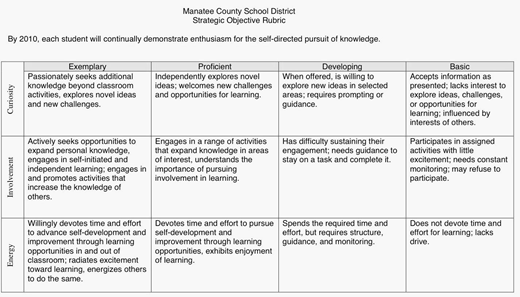
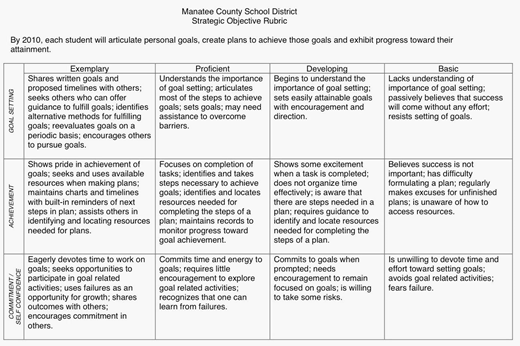
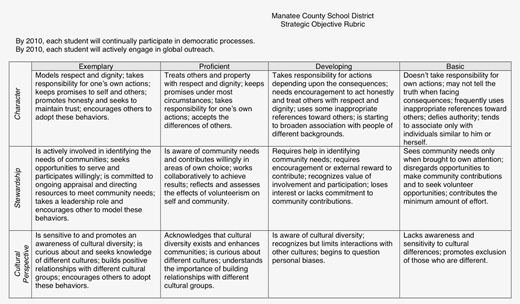
Like all initiatives, there needs to be a way to measure the success of the program. The district measurement team created three rubrics to measure students' understanding and ownership of the four strategic objectives. All three rubrics are measured on a scale from exemplary, proficient, developing, and basic.
These rubrics will be used at the end of each school year to evaluate student portfolios. A random sampling of eFolios will be viewed by a measurement team. The district goal is to have every student in Manatee County involved in the eFolio program and actively incorporating the four strategic objectives into their lives. The collection of student works is tied to the four strategic objectives, through reflection. These objectives are the pillars of EdVantage.
The teachers and students in the eFolio classrooms have improved their skills in technology, public speaking, leadership, and are immersed in the strategic objectives of our district's strategic plan, EdVantage. The best eFolio classrooms are truly the wave of the future in that technology is seamlessly integrated into the curriculum, taking students to levels that until recently, were only a dream,” stated Tschappat. (Sismore, 2008, p.)
As a member of the pioneer group of teachers in the eFolio program, I have been privileged to have had first-hand experience with the power of this program. The organization, thoroughness, passion, and dedication of the program members and creators is beyond reproach. I have personally observed the excitement of fellow educators and students who have not only benefited from but have also made important contributions to the current dynamics of EdVantage. Although there has not been enough time to collect conclusive data, I am sure that time will show that students involved in the EdVantage eFolio Program will have made the connection with the strategic objectives which will play an active role in their daily lives.
Manatee County School District Strategic Objective Rubric
By 2010, each student will continually demonstrate enthusiasm for the self-directed pursuit of knowledge.
“PORTFOLIOS CAPITALIZE ON STUDENTS' NATURAL TENDENCY TO SAVE WORK, AND THEY BECOME AN EFFECTIVE WAY TO GET THEM TO TAKE A SECOND LOOK AND THINK ABOUT HOW THEY COULD IMPROVE THEIR FUTURE WORK.”
REFERENCES
REFERENCES
About the author