Introduction
Ialifornia, the most populous state in the union, is a state of innovation and promise. The size, population, and geography of California present unique challenges to equitable delivery of quality instruction to K-12 students. As a solution to the problems of getting all of California’s K-12 students connected to learning and communication resources, the California K-12 High Speed Network (K12HSN, the network) was established under a grant provided by the California Department of Education. The K12HSN program connects to a statewide intranet supported by the Corporation for Education Network Initiatives in California (CENIC). The K12HSN provides support for California’s K-12 public schools with network connectivity, Internet services, distance education and classroom applications for teaching and learning, in addition to videoconferencing support and coordination. With classroom and distance education resources, the K12HSN provides a number of technical support applications and diagnostic tools for school sites, districts, and county offices of education (COEs).
Why the K12HSN?
When properly implemented and capitalized, online technologies possible only with high-speed Internet access enable students to become more independent learners at increasingly advanced levels (Nicholas & Ng, 2009). Access to online resources and learning opportunities is only truly equitable when students are able to universally access high-speed Internet connections (North American Council for Online Learning [NACOL], 2007).
Services provided by the K12HSN align with recommendations proposed by State Educational Technology Directors Association (SETDA, 2008). The goals of SETDA and the K12HSN include:
access to online assessments, data and administrative tools;
online and distance learning opportunities;
individualized special education learning;
Web 2.0 technology tools; and
online and hybrid professional development opportunities.
Online assessments make data more accessible to administrators and teachers. Not only do online assessments measure what students have learned, but offer administrators and teachers access to information directly related to improvement of teaching practices while individualizing instruction for learners. Online and distance learning opportunities permit students without on-ground opportunities to study in Advanced Placement or elective classes through high-speed Internet access, where otherwise no courses or access would be available. Likewise for special education—a variety of available online resources make learning with experts and specialists a practical possibility.
High-speed Internet access is essential in providing professional development opportunities. Strategies endorsed by SETDA are available through the K12HSN. Education Portals, such as the California Learning Resource Network (CLRN), the California Technology Assistance Program (CTAP) and EdTech Profile enable teachers to search for standards-based instructional material and professional development opportunities designed to meet the diverse needs of all California teachers.
Access and Equity
By providing high-speed educational access in California public K-12 schools, the K12HSN assures equity by offering online high-quality delivery of educational resources without resorting to a tiered system of Internet connectivity. Private, commercial Internet providers have no legal obligation to offer affordable high-speed Internet access and can block or give preference to Internet resources and applications with no involvement or consultation from subscribers. Unfettered and no-cost access to distance learning applications and resources serves educational goals to raise literacy and student achievement (Windhausen, 2008).
Broadband Connectivity
The K12HSN fulfills a critical need for broadband connectivity in schools. With a commitment to providing broadband connectivity, the K12HSN offers access to emerging distance education applications for student learning, as well as online resources for professional development, school administration, and content sharing. The high-quality videoconferencing capabilities of the network facilitate meaningful two-way, interactive, and real-time educational experiences. More accessible, faster, and more reliable Internet means more access to and from school communities. Parents can videoconference with teachers, administrators, and support personnel, and students and teachers can collaborate on projects with counterparts in remote locations and receive expert-led lessons from virtually any location.
CENIC is a partner in realizing the need for broadband connectivity for all K-12 education institutions and students. The California Research and Education Network (CalREN) is the result of CENIC resources dedicated to cost-effective, high bandwidth networking to support the missions and needs of school faculties, staffs, and students. The CalREN was designed by CENIC to connect the majority of K-12 and higher education institutions to facilitate collaboration in education and research. A fiber optic network backbone connects schools to county offices of education (COEs) in all 58 counties of California (CENIC, 2009).
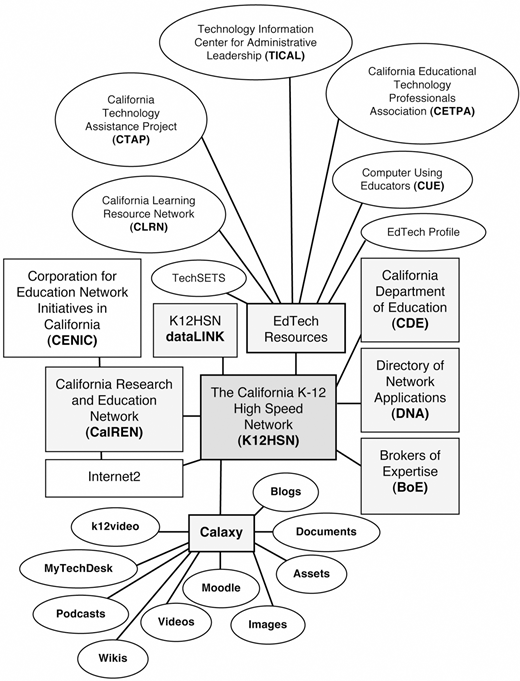
Applications and services of the California K-12 High Speed Network.
Applications and services of the California K-12 High Speed Network.
A high-speed network for K-12 schools lifts constraints of educational opportunities imposed by a lack of or poor Internet connectivity. The K12HSN complies with recommendations made in the Final Report of the California Broadband Task Force (2008). The Final Report emphasized expansion of educational opportunities through increased access and use of broadband connectivity. By expanding broadband connectivity, the State of California and the K12HSN can “leverage educational opportunities” with a “robust technology support system” to provide appropriate curricular resources for students in meeting academic standards and developing skills to compete in the global economy.
Partnerships, Associations, and Affiliations
The California Department of Education (CDE) initiated the K12HSN with a grant to the Imperial County Office of Education (ICOE) in 2004. Through ICOE, the California Department of Education (CDE) provides funding for the K12HSN in addition to facilitating collaboration between educational agencies and projects, financial and administrative services and technical oversight (CDE, 2008). As the lead state agency for K12HSN, ICOE received significant funding from the State of California. The K12HSN project shifted management from the University of California to the CDE to broaden the scope of services available to students at all public education institutions. The shift to the CDE, and ultimately to ICOE, was an effort to focus on technology and curriculum needs for the K-12 community. The CDE realizes that educators need to collaborate with one another to enable critical thinking about teaching practice, and provide effective tools to assist in closing the achievement gap and raising overall student achievement across the state (ICOE, 2009).
The Corporation for Education Network Initiatives in California, CENIC, and the California Research and Education Network (CalREN) are partners in combining resources to implement the K12HSN with high capacity, high-speed connectivity to schools and research institutions in California. The CalREN infrastructure for K-20 California research and education users operates at the third tier of a three-tiered network service. CENIC owns and manages 2,700 miles of fiber optic connection supported by cutting edge networking technology components. The upper two tiers of the CalREN network are reserved for the High-Performance Research Network and an experimental/developmental infrastructure for network researchers (CENIC, 2009a).
CENIC and CalREN acknowledge the increasing significance of high performance connectivity to California K-12 schools. After a recent annual CENIC conference, the president of the organization revealed that results from a post-confer-ence survey indicated that members and constituent organizations expressed increasing interest in online learning applications (CENIC, 2009). This unsurprising revelation bodes well for the ongoing development of increasingly sophisticated distance education applications accessible to K12HSN users. The CENIC organization has also made a commitment to use distance education applications to increase online participation for future conferences.
CalREN also links to the national Internet2 network as part of the Internet infrastructure dedicated to education. Internet2 is billed as one of the leading proponents of advanced networking, and is led by key members of the research and education communities. Internet2 supports the K12HSN with a split mission. As a partner in K12HSN, Internet2 “supports and enhances … educational and research missions” in and is committed to sustaining advances in the Internet infrastructure (Internet2, 2009). As a partner in providing high speed, high capacity Internet connectivity to California K-12 schools, Internet2 services are able to actively engage the education community in the development of new communication and information technologies that support online learning and teaching.
The DataLINK service of the K12HSN was designed and implemented to directly connect connectivity data with related information from California K-12 schools. DataLINK is a database of K12HSN schools and districts and the types of constituent connections to the state infrastructure. Connectivity information is aggregated and provided by DataLINK primarily to gauge and assess at school site, district, county, region, and state levels. Future implementations of DataLINK promise to expand and allow correlation of collected connectivity data between other databases that include student performance and demographic information. The goal of facilitating access to multiple databases will be to ensure that K12HSN resources and connectivity are having a positive impact on student achievement statewide, in addition to providing data for making sound decisions towards student and school success.
The Directory of Network Applications (DNA) is another service delivered by the K12HSN primarily to provide access to locally produced content resources. Focusing on the practitioner, the DNA assists in locating electronic instructional support materials developed by institutions, agencies, and individuals in California. Limited to electronic materials that reside on the K12HSN, DNA assures fast and reliable access to the instructional material. Efficient access to DNA materials allows for a comprehensive search solution as well. The DNA custom search capabilities let users search by resource type, curriculum area, grade level and California subject area content standards. Most content is provided free of charge to schools and COEs. There are several fee-based services available through contracts initiated by the state, COEs, and districts, usually at extremely low or reduced prices.
The California Learning Resource Network is a component of K12HSN that provides a clearinghouse of electronic learning resources (ELRs) aligned to California state curriculum frameworks and standards. Resources are approved for inclusion in the CLRN through a review process that coves legal compliance, standards alignment, and minimum requirements set forth by the California State Board of Education. Operating as an evaluator of instructional content for California public schools, CLRN objectives are geared to teachers, instructional coaches, and others responsible for instructional delivery. The CLRN’s stated objectives are to: (a) identify and review supplemental electronic learning resources such as software, video, and Internet resources; (b) identify learning units aligned to resources and the state academic content standards; and (c) maintain an interactive Web site to provide information about electronic learning resources through an online searchable database and links to state education technology projects and resources (California Learning Resource Network, 2009).
A third-party agency conducted an extensive evaluation study of the CLRN for the 2007-2008 school year. The evaluation process included surveys, self-assess-ments, interviews, and records of accomplishments to determine awareness and use of the CLRN, and whether the service “identifies electronic learning resources to meet instructional needs” (Cradler, Beuthel, Cradler, & Barline, 2008, p. 109). The CLRN evaluation results indicated that 91% of survey respondents from the population CLRN users agree strongly that CLRN is useful for identifying ELRs aligned to instructional needs.
The California Technology Assistance Program (CTAP) is another state funded initiative and K12HSN affiliate providing support to schools and districts to integrate technology into teaching and learning. California is divided into 11 CTAP regional offices that emphasize the integration of educational technology and provide support necessary to provide professional development opportunities in addition to sharing online educational resource information. CTAP support is focused into five areas: staff development, technical assistance, information learning resources, telecommunications infrastructure, and coordination and funding (CTAP, 2008).
EdTech Profile is a California Department of Education State Educational Technology Service (SETS) project, providing educational administrators with tools to guide their decisions about integrating technology into classroom instruction and how to create and evaluate effective teacher technology training programs. Information collected from the EdTech Profile is aggregated and used to plan professional development programs. Data are also used to monitor and evaluate state and federal technology grant programs (EdTech Profile, 2009).
TechSETS, an offshoot of the SETS project, operates an online interactive help desk for counties and districts to establish professional development programs and provide enhanced support for school site based instructional technology specialists. Technical support is contracted through the San Diego COE. The Technology Information Center for Administrative Leadership (TICAL) is another K12HSN partner providing professional development for district and site administrators focusing on digital school leadership with data-driven decision-making. TICAL programs are also offered to assist in integrating technology into all facets of school administration. These services are contracted through the Santa Cruz COE with funding provided by the CDE.
The K12HSN is also affiliated with two major professional organizations, the California Educational Technology Professionals Association (CETPA) and Computer Using Educators (CUE). Both of these organizations are concerned with improving student achievement through the use of instructional and communication technology. CETPA emphasizes the improvement of data access for administrative information processing in public education, with the goal of increasing “information sharing and communication among K-12 technologists on technology-related issues” (CETPA, 2009). The goal of CUE is to advance student achievement through technology in all disciplines, from preschool through college. CUE holds a widely anticipated annual conference that is among one of California’s most well attended educational technology events.
To tie all K12HSN affiliates, associations and partners together, the CDE has developed the California Brokers of Expertise (BOE) project to connect teachers, schools, and districts with best practices. The BOE project is intended to become a knowledge management system collecting educational research. The body of information gathered would be examined for trends that lead to strategies to implement research for reform and improvement of California schools. BOE goals formed in collaboration with K12HSN include: (a) to provide classroom tools and resources aligned to California Content Standards; (b) to provide easily accessible research-based, instructional resources searchable by grade level, content area and demographic information; (c) to provide opportunities for creating and publishing high-quality content that has been proven effective for teachers; (d) to facilitate communication and dialogue with educators across the state who have similar questions (California BOE, 2009).
Web 2.0 Applications of the K12HSN
The K12HSN offers tools for California K-12 distance education and classroom teachers as part of a comprehensive suite known as Calaxy. Applications provided by Calaxy are appropriate for classroom and distance education purposes, anticipating instructional, communication, and technical needs of teachers. Distance education and other Internet-based applications are hosted on the reliable and robust state network, ensuring consistency in instruction with a minimum of technical interventions required by teachers and other users. One of the primary intents of the Calaxy suite of applications is to give California public school teachers knowledge of and access to what are referred to as Web 2.0 tools. Available tools for designing, developing, and delivering instruction include blogs, document sharing, video and photo sharing, podcasting, wikis, course and learning management, technical support tools, and videoconferencing. Calaxy tools for communication and collaboration include social network and messaging within a trusted community of California educators. Significantly, these services are available at no cost to California public schools.
Tools provided by Calaxy have come about in response to a general call in education for K-12 teachers to prepare their students for collaboration and communication in an environment that should increasingly reflect the ways in which students live and learn outside of the classroom and other instructional spaces. Web 2.0 applications give teachers the means to engage their students through learner-centered activities. Teachers creating learning networks for personal and professional use can expand their network to include teachers and colleagues, with enhanced abilities to access and share information. In addition to the instructional advantages of managing content and learning with Web 2.0 tools, Calaxy services can take the technical load off of school sites and technical support personnel with cloud computing capabilities. Using a cloud computing model, files and other electronic information are not stored and retrieved on local, school site-based computers, but from locations elsewhere on the Internet. Teacher-created learning networks available from any Internet-enabled computer is one way the K12HSN and Calaxy tools meet the needs of evolving methods for engaging students and delivering instruction on student terms.
School principals, district support personnel, instructional coaches, and other school leaders can take advantage of Cal-axy-provided Web 2.0 tools to encourage reform at school sites. Interconnecting with instructional leaders across California can positively affect instruction by demonstrating higher expectations from students and teachers by using social networking, blogs, wikis, and other collaborative tools. Leading by example, administrators taking advantage of Calaxy tools can set the way for others who have not yet seen the implications of Web 2.0 in education. Calaxy provides practical applications that demonstrate the ability and variety of methods to facilitate communication, collaboration and, ultimately, leadership (Higgins, 2009).
Calaxy Tools
Of all the applications and resources provided by the K12HSN, Moodle, the open source course and learning management system, has the most significant implications for K-12 distance education in California public schools. The financial implications are obvious—commercially available equivalents to the Moodle platform are well out of financial reach for most schools, districts, and COEs. Calaxy Moodle courses are available free to all California teachers following a brief verification process. By creating online courses, teachers can offer virtual learning environments for students in blended or completely online programs.
Calaxy offers blogging and wiki services, again at no cost to California teachers. These collaborative online tools let any number of users create Web sites. Blogs and wikis are relatively simple and highly accessible Web 2.0 tools that teachers and students can use for cooperative projects in which all participants can equally create and add relevant content. The blogging and wiki features of Calaxy offer enhanced functionality with the ability to moderate content added by students and other nonadministrative blog and wiki owners. Alongside blogs and wikis, video and podcasting services are also part of the Calaxy suite of applications. These applications comprise a “new publishing revolution” (Hargadon, 2008). With the capability to let participants not just read the Web but meaningfully contribute to its content, Web 2.0 tools such as blogs, wikis, video, and podcasting turn students from passive participants to active contributors. Other Calaxy services intended for teacher and student use include image and document storage, retrieval, and sharing. These content sharing services are moderated by contributors and administrators for appropriate content.
The MyTechDesk and Assets features of the Calaxy suite are powerful, web-based systems for managing and tracking school work orders and inventory. These are yet additional K12HSN services provided to all California schools and districts at no cost. Either used as standalone applications or a joint solution, Assets and MyTechDesk have been implemented to allow local school and district sites to efficiently manage inventory from acquisition to obsolescence. These management tools let coordinators, administrators, and other school site personnel involved with instructional technology make informed decisions about services provided by the school to integrate and support instructional technology. Using MyTechDesk and Assets date in decision-making processes can lead to greater efficiency of support personnel and lower cost of ownership of instructional technology inventory (K12HSN Calaxy, 2009).
Summary
The K12HSN is poised to become an increasingly vital resource to California K-12 schools. The diverse nature of partners and collaborators ensure that the K12HSN will stay abreast of innovations and developments in information and communication technologies. Working in conjunction with several other state initiatives, the K12HSN has garnered sustained support for technology to improve teaching and learning. Increasing broadband access, online services, and content under the aegis of the California Department of Education virtually guarantees the availability of K12HSN resources to teachers, administrators, and students who will progressively be turning to online services.
The challenge that lies ahead for the K12HSN is to inform its constituent COEs of its services that many districts and schools may already be supporting financially. Redundancy is beneficial to the quality and integrity of network systems and hardware, especially for systems routinely backed up with a set of secondary and other auxiliary resources. However, redundancy can be anathema to schools and districts expending resources to maintain services that the State of California and the K12HSN is already providing at little to no cost. The K12HSN has professional development and data analysis resources built into almost every online service offered. Whether for administrators, teachers, or school support personnel, the K12HSN offers relevant and valuable services that help schools do what they have to do: manage resources and raise student achievement.
About the author