

There is no doubt that online education opens educational opportunities to learners from many walks of life such as those who are young or old, poor or rich, employed or unemployed, or from developed or developing countries. Online education has many benefits ranging from offering learners the ability to learn flexibly anytime, anywhere to minimizing (and often eliminating) commuting costs to learning from experts in the field, and much more. Today, learners from all over the world can earn degrees and certificates from accredited institutions in locations thousands of miles away from their homes, in countries they have never visited, and from institutions where they will never set foot—in a sense, creating a type of “flat classroom” (Friedman, 2007).

Director, Center for Distance Learning Studies, Uganda Martyrs University, P.O. Box 27450 Kampala, Uganda. Telephone: 256.77.460865. E-mail: grbasaza@yahoo.com Web: http://www.umu.ac.ug
Director, Center for Distance Learning Studies, Uganda Martyrs University, P.O. Box 27450 Kampala, Uganda. Telephone: 256.77.460865. E-mail: grbasaza@yahoo.com Web: http://www.umu.ac.ug

PhD, Associate Professor, Graduate School of Education and Human Development, The George Washington University, 2134 G ST, NW, Washington, DC 20052. Telephone: (202) 994-1884.
PhD, Associate Professor, Graduate School of Education and Human Development, The George Washington University, 2134 G ST, NW, Washington, DC 20052. Telephone: (202) 994-1884.
Yet, even though online education has grown exponentially in developed countries such as the United States, the reality is that developing countries are lagging behind significantly—statistics (see Figure 1 and Table 1) show the sobering reality of the “broadband gap,” the differences between access, speed, quality of service, and price for broadband service in various locations (United Nations Conference on Trade and Development, 2009). For instance, the International Telecommunication Union (2008b), a specialized agency of the United Nations focusing on communications, reported that
Contrary to what is happening in the mobile sectors, Internet use is not growing as quickly in the developing world as in the developed world. By the end of 2007, less than one out of five people living in the developing world were online, compared to over 60 percent of people in the developed world. (para. 2)
It is difficult to comprehend fully the consequences and implications of the broadband gap experienced in developing countries, especially for those who live in developed countries. But, it is important for online educators, instructional designers, and employers providing developing countries with online education and training or who wish to offer it to understand some of the challenges faced.
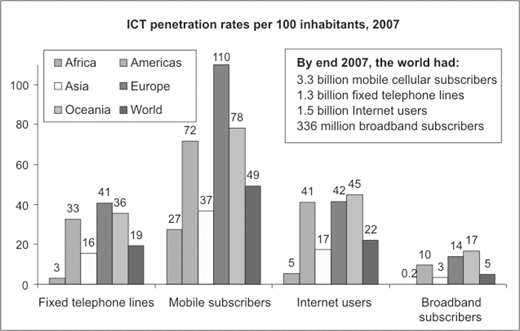
World information and communication technology (ICT) penetration rates (International Telecommunication Union, 2008a)
World information and communication technology (ICT) penetration rates (International Telecommunication Union, 2008a)
World Internet Usage and Population Statistics
| World Regions | Population (2009 Est.) | Internet Users Dec. 31, 2000 | Internet Users Latest Data | Penetration (% Population) | Growth 2000-2009 | Users % of Table |
|---|---|---|---|---|---|---|
| Africa | 991,002,342 | 4,514,400 | 67,371,700 | 6.8 | 1,392.4% | 3.9 |
| Asia | 3,808,070,503 | 114,304,000 | 738,257,230 | 19.4 | 545.9% | 42.6 |
| Europe | 803,850,858 | 105,096,093 | 418,029,796 | 52.0 | 297.8% | 24.1 |
| Middle East | 202,687,005 | 3,284,800 | 57,425,046 | 28.3 | 1,648.2% | 3.3 |
| North America | 340,831,831 | 108,096,800 | 252,908,000 | 74.2 | 134.0% | 14.6 |
| Latin America/Caribbean | 586,662,468 | 18,068,919 | 179,031,479 | 30.5 | 890.8% | 10.3 |
| Oceania/Australia | 34,700,201 | 7,620,480 | 20,970,490 | 60.4 | 175.2% | 1.2 |
| World Total | 6,767,805,208 | 360,985,492 | 1,733,993,741 | 25.6 | 380.3% | 100.0 |
Notes: (1) Internet usage and world population statistics are for September 30, 2009.
A first step for instructors and/or instructional designers to understand better their online learners residing in developing countries is to become acquainted with issues and concerns in the representative country or region in which they live. In many developing countries, for example, Internet connectivity is not reliable and will likely impede learners’ ability to participate in a course or training; therefore, measures will need to be taken to ensure adequate and equitable access to and dissemination of materials.
A second step is to conduct a learner needs assessment before or as soon as possible after an online course or training begins. Instructors and instructional designers typically conduct a needs analysis and assessment when designing instruction; however, most do not always know much information about their specific individual learners’ contexts, backgrounds, needs, and/or experiences until after the course or training begins (and in some cases, only if they request such information). Dupin-Bryant and DuCharme Hansen (2005) recommend that such a needs assessment should involve an assessment of learners’ “(1) computer skills, (2) learning styles, (3) available resources, (4) learner’s desired outcomes, and (5) prior learning experiences” (para. 4).
These steps will help to obtain essential information for instructors and instructional designers to design and develop instruction for learners in any context, but especially those in developing countries. It will also help them establish a common learning medium for all learners, use alternative means for delivering instruction, if necessary, and locate resources the learners might use to address the challenges they face. Learners, for instance, may not be able to watch a video of a live recording of a lecture, but they may be able to listen to it as a podcast on their smartphone or read it as a downloadable PDF document. Participation in synchronous online discussions may not be possible, but asynchronous e-mail or threaded discussions might be. Finally, although learners may not have direct access to a technology, there is the possibility that within their vicinity there might be inexpensive, reliable access at an Internet café, a friend’s or family member’s home, or a local institution that has the requisite resources (technology might be made available at a local institution at a subsidized fee).
